

Bluetooth audio glasses export considerations are settled by a short list of physical facts rather than by the length of a compliance pack. Every audio frame in this range carries one lithium cell inside the temples, and none of the eight audio models publishes a charging-case row, so the shipment you are planning carries one battery per unit rather than two. Everything downstream — the transport paperwork, the radio file, the label artwork, and the claims your listing is permitted to make — follows from those two sentences. This page is written for the procurement manager who already has a destination list, a quantity and a date, and who needs to know which documents to request before the purchase order rather than after the container has left the factory.
Bluetooth audio glasses export considerations start with the cell, not the certificate
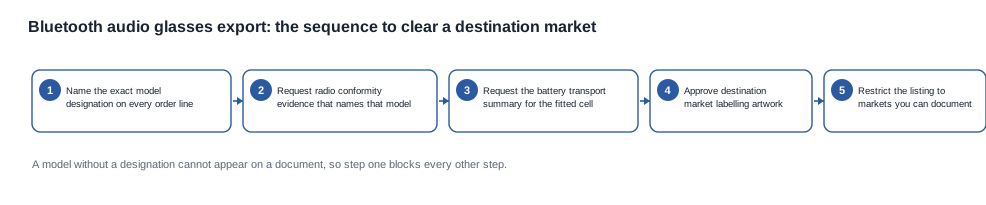
Most buyers in this category start an export conversation by asking for certificates, and it is the wrong first question. A certificate describes a product against a rule; a cell describes a physical object that has to survive a journey. The order in which the documents are collected matters because each one blocks the next.
The published physical facts that set the document set
The audio range in our catalogue contains eight models, and every one of them publishes the same five electrical rows: a Bluetooth version, a cell configuration, a charge time, a rated use figure, and a charging interface. The cell configurations fall into three groups. The K01 and the K02 publish two 90 mAh cells. The LC-105-2 and the LC-105-1, and the YK12 and the G07 publish two 55 mAh cells. The D11 and the D12 publish a single 100 mAh cell. Six of the eight charge magnetically; the D11 and the D12 charge over a Type-C port.
Two things follow immediately for an export programme. First, there is one cell per unit in every audio model. The camera models in the same catalogue publish charging-case rows in several places — the L1 Pro and the CY05, and the CY03 each publish a 1400 mAh case, the L2 Utral publishes 900 or 1400 mAh, and the MT6 publishes a 1200 mAh foldable case — but no audio model publishes a case row at all. A buyer assembling a mixed range therefore has to treat the freight class, the packed weight and the transport file as per-model variables, not as one variable for the whole shipment.
Second, the published charge time for all eight audio models is written as a ceiling of two hours or less, and for the two sport models it is written as about one hour. A ceiling is not a promise. It tells a transport planner that the unit will be off the charger within two hours under the manufacturer's stated conditions; it does not tell them what state the cell was in at the start of that window, and it is not a measure of how long the cell takes to recover between shifts.
Why the transport file comes before the radio file
Lithium cells in a consignment are the item that gets stopped at a border, and the testing requirement for them is UN38.3. What a buyer actually needs in hand is the test summary that covers the cell fitted in the exact model designation being ordered. A capacity published in a catalogue is a capacity; it is not a transport classification, and it does not tell you the cell's test reference, its mass, or its chemistry as declared for carriage. That is why the transport request should name the model designation and ask for the summary that covers it.
This is also where a supplier's answer tends to be vaguest. The most common reply to a request for the transport document is a general statement that the products are compliant with international transport standards. A general statement cannot be put in a file, cannot be checked by a broker, and cannot be relied on when a consignment is held. The three details worth pressing for are the test reference, the cell identification and the model designation coverage.
What the catalogue says about radio conformity, and what it does not
The honest position here has to be stated precisely, because it is easy to overstate in a way that creates a problem at customs.
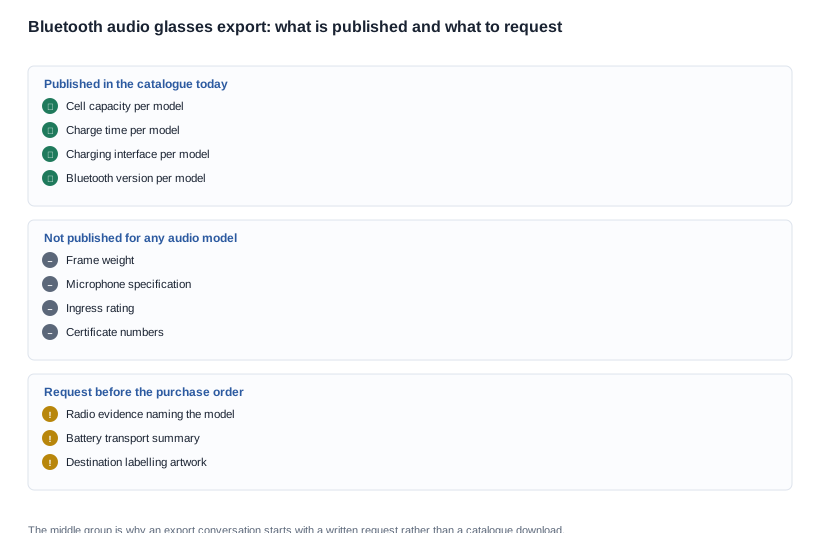
Our catalogue carries a company-level export certification page. The content of that page is images rather than text, and the catalogue text contains no reference to CE, FCC or RoHS. There is no per-model certification row anywhere in the range, and no per-model record of a certificate number marked as pending. That means a buyer cannot read a certificate number, an issuing body or a validity date out of our published data for any of the eight audio models. Radio conformity evidence is therefore a request you make and a document you receive, not a specification you can quote when you build a comparison table.
The regulatory routes themselves are not the problem. In the European Union the Bluetooth radio falls under the Radio Equipment Directive (EU) 2014/53/EU; in the United States the transmitter needs equipment authorisation under the FCC rules; in the United Kingdom it follows the country's own conformity route. What matters commercially is the form of the evidence you want: the certificate number, the issuing body, the validity dates, and the exact model designation or designations the document covers.
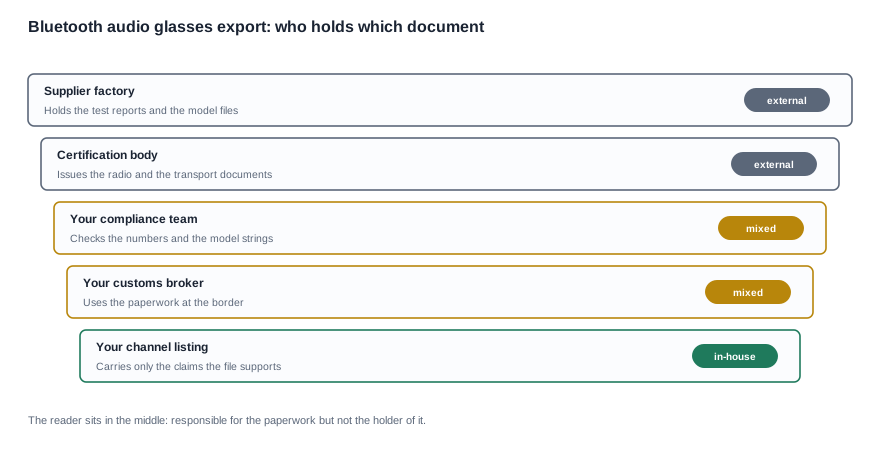
The layers diagram is worth pausing on, because it explains why export conversations in this category stall. The factory and the certification body hold the documents. The buyer holds the obligation to check them. The customs broker uses them at the border and the channel listing makes claims on the strength of them. The reader of this page sits in the middle: responsible for the paperwork, but not the holder of it, and that is why a request that says "send us your certificates" is a weak request. A request that says "send us the certificate number, the issuing body, the validity dates and every model designation the document covers" is a request that can be closed.
The four document families an audio-glasses shipment has to name
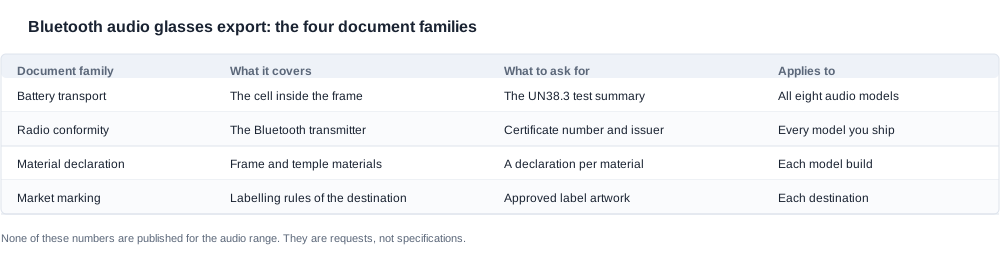
Working through the request in four families keeps the conversation with a supplier tractable, because each family has a different owner and a different failure mode.
The battery transport family
One cell per audio unit means one transport file per cell type in the range, not per unit. In practice a buyer will be looking at three cell configurations rather than eight model documents: two 90 mAh cells, two 55 mAh cells, and one 100 mAh cell. Ask for the summary that covers each configuration you are actually ordering, and ask what it covers when a model uses two cells rather than one.
The radio conformity family
This is where model designation coverage does the real work, and it is where the range is most likely to trip a buyer. Several models in this range publish identical electrical rows under different names. The D11 and the D12 share a cell, a radio version, a charge time and a charging interface. The K01 and the K02 share all five rows. The LC-105-1 and the LC-105-2 share all five rows, as do the G07 and the YK12. Electrically identical does not mean documented identically, and a document that names one model does not cover its sibling. If your order contains the D11 and the D12, plan for documentation that names both.
The material and marking family
This family is rarely the bottleneck and is regularly missed. It covers the material declarations for the frame and temples, the product marking that has to appear on the unit itself, the batch or serial traceability arrangement, the destination market's language requirements, and the identity of the party responsible for placing the goods on the market in that destination. None of these appear in the published catalogue, and none of them is negotiable by negotiation — they are set by the destination.
The accessory family
The accessory question is specific to this range and worth separating out, because the temptation is to assume a magnetic-charging model ships with a charging case. It does not, as far as the published data goes: the catalogue publishes no case row for any audio model, and magnetic charging in this range means a charging interface and dock rather than a case containing a second cell. What is in the box for each model is not published either. That is a short, cheap question to put in the request for quotation: for each model in the order, confirm the frame, the charging accessory, the cable where the interface requires one, and the documentation that travels with the unit.
How to verify a document when it arrives
Verification here is documentary and fast, but it only works if you check the four things that a document can be wrong about. Check the model designation first, character by character, against the order line — this is the check that catches a sibling substitution, and a mismatch is a stop condition rather than a query. Check the issuing body next, because a number issued by an unrecognised body is not a number your compliance team can rely on. Check the validity dates against the date you intend to ship, not the date you intend to sign. And check the scope, which is where most of the ambiguity lives: whether the document covers the radio function the unit actually performs, and whether it covers the model rather than the family.
The criteria to hold are simple enough to write into your own procurement checklist before the documents arrive, and writing them first is what stops a late-arriving document from being accepted by default. A buyer who has already defined what a valid document looks like is doing due diligence; a buyer who receives a document first is doing paperwork.
Where a buyer should spend negotiating capital
Some of the cost in an export programme is a factory's fixed cost that can move, and some of it follows the testing process and cannot. Knowing which is which saves an argument that cannot be won.
The lines worth spending negotiating capital on are the destination scope and the artwork rounds. A supplier who has already supported three markets will usually support a fourth at a lower incremental cost than a supplier supporting your first, and the artwork round count is negotiable in the same way a tooling revision count is. Delivery splitting is another one: agreeing to a split shipment against a staged payment schedule gives the buyer a holdback that a single bulk delivery does not. The payment nodes should follow inspection, not precede it, because an export programme has more moving parts than a domestic one and the risk sits upstream of the port.
The lines that should not be pressed are the certification cost and the certification time, which follow the testing body and the laboratory queue rather than the supplier's commercial appetite; and the per-configuration re-validation cost, which compounds every time a configuration changes and is therefore worth reducing by freezing the configuration list early. On the documentation side, what protects the buyer most is the retention held against the documentation package, because in this category the failure that costs most is a shipment whose paperwork does not cover the units inside it.

Where an audio-glasses export programme breaks: coverage, accessories and marking
These are the four failures that recur in this category, written as symptom, root cause and prevention, because a buyer who can name the failure has a chance of catching it early.
A family-level document was treated as coverage for a branded configuration. Symptom: a customs query, a marketplace rejection or a warranty claim that cannot be settled, arriving after the goods have cleared. Root cause: a document covering the product family was accepted as covering the specific model designation on the order. Prevention: make the exact model designation a condition of the purchase order, and read the designation on the document character by character against the designation on your order line.
An accessory shipped without coverage of its own. Symptom: a unit is returned by a distributor because the box contains something the distributor's own compliance process cannot accept. Root cause: the accessory list was agreed verbally and never written into the order, so nobody checked whether each accessory needed its own coverage. Prevention: write the contents list per model into the purchase order as an appendix, and treat any change to that list as a configuration change that requires notice.
The marking layer was designed for one market and shipped into another. Symptom: units are held at the point of sale in a second market, or rejected by a retailer's own labelling audit. Root cause: artwork was approved for the first destination and then reused, and the traceability and language elements were treated as decoration. Prevention: decide the regulatory and traceability layer from the destination list before artwork is approved, and freeze it per destination rather than per brand.
A claim was written before anyone asked whether a document supported it. Symptom: a listing is questioned by a retailer, a marketplace or a regulator, and the answer has to be withdrawn. Root cause: the copy was drafted from the retail language of the category rather than from the file. Prevention: write the listing from the claims that the documentation covers, and keep a list of the claims you have chosen not to make.

The claims that do not survive a destination market review
Ingress
Two frames in our catalogue carry an IP54 marking: the V06 and the S7. Both are camera models. No audio frame in this range carries an ingress marking, and a buyer who moves an IP54 claim from a camera listing onto an audio listing has created a problem that a retailer will find. Where a marking does exist, the second digit describes protection against water spray rather than immersion, and the test basis is not given in our documentation. The defensible position for an audio frame is that it is not published as ingress protected, and that the report is something to request if a channel needs it.
Runtime
The audio models publish approximate rated use figures of about eight hours, about seven hours and about six hours depending on the model, and they publish them without a stated test condition. A listing that turns a rated figure into a promise — "up to eight hours" attached to a specific model — is making an assertion the factory never made. The correct treatment is to publish the figure as a rated use figure, with the word "rated" in the sentence, and to leave the condition out rather than invent one.
Health and hearing
Do not attach any hearing, health or medical claim to an open-ear audio frame or to anything else in this range. In the United States, FDA 21 CFR 800.30 defines over-the-counter hearing aids as air-conduction devices, which places bone-conduction products outside that classification entirely; the point of the reference is not the product but the boundary, and the safe commercial position is that no product in our range is described with a hearing, health or medical benefit. A channel built on an eyesight concern is the wrong category for this product, and a buyer who discovers that at the copy stage has already lost the listing revision cycle.
The order of operations for a destination market
Take the destination list and work it in reverse. For each market, establish which of the four document families you hold, in which version, naming which model designation. Where a document is missing for a market you intend to sell into, there are three honest options: obtain it, restrict the listing to the markets you can document, or remove the claim that depends on it. The unacceptable option is shipping and discovering the gap after a customs hold, because the cost of a hold lands on the shipment rather than on the paperwork.
Our published position on export documents for the audio range
We publish the five electrical rows for every audio model, and we publish them per model designation. We do not publish certificate numbers, issuing bodies or validity dates, because we do not publish a per-model certification row; the export certification page in our catalogue is a company-level page whose content is images rather than text. We will not estimate a cell capacity, an ingress rating or a transport classification that the documentation does not contain, and we will not carry an ingress marking across from a camera model to give an audio frame an outdoor claim.
What we will do is tell you exactly which rows a document has to name, tell you which models in this range share their published electrical rows and therefore need to be named separately in a file, and tell you plainly when a document is a request rather than a published specification. That is a narrower answer than a certificate pack, and it is the answer we can stand behind.
A worked example: an accessories brand entering three markets
This is a worked case rather than a live order. What matters is the order of steps.
Assume a mid-size accessories brand that already sells wired audio into Germany, Poland and Spain, and that has decided to add a Bluetooth audio glasses line. The brand's existing operation carries no batteries, so its transport knowledge is thin, and its compliance manager has asked for one document pack rather than four conversations. The brand's constraint is not the radio, and it is not the cell; it is the labelling layer, because the three markets have different language requirements and the brand has historically used a single artwork master.
Step one, the physical inventory. The brand's first action is to write down what it is actually ordering: which models, in which quantity, with which charging accessory. Because the catalogue publishes no case row for any audio model, the brand notes that every unit carries a single cell and no second battery, and because the D11 and the D12 use a Type-C port while the rest of the range charges magnetically, the brand marks those two models as needing a cable in the contents list rather than a dock.
Step two, the transport request. The brand asks for the transport test summary covering the three cell configurations in its order — two 90 mAh cells, two 55 mAh cells, one 100 mAh cell — and asks for the model designations each summary covers. This single request replaces what would otherwise have been eight.
Step three, the radio evidence. The brand asks for the radio conformity evidence for each model designation, with the certificate number, the issuing body and the validity dates, and it states in the request that evidence naming only one of a pair is not sufficient where both are ordered. The brand's compliance manager notes that this is the point at which the request is most likely to come back partially answered, and it plans for that by asking early.
Step four, the artwork. The brand stops treating the marking layer as a single master. It identifies the language and traceability requirements per market and schedules three artwork variants rather than one, accepting the extra artwork rounds as the price of shipping the same units into three destinations without a hold.
Step five, the listing. The brand's copy uses the published rows, describes runtime as a rated figure, makes no ingress claim because no audio model has an ingress marking, and makes no health claim. It links the model designation into the listing so that the documentation and the listing can be reconciled later by anyone reading them side by side.
The outcome of that walk-through is a shipment with three document requests instead of eight, three artwork variants instead of one, and a listing that a retailer's compliance team can check without asking a question. None of the decisive decisions was about the radio, and none of them required a market forecast.
Five things to settle before the first export order
- The destination list, written down per market rather than as a single territory.
- The model designation on every order line, because a document cannot name a model that has no designation.
- The cell configuration behind each ordered model, so the transport request can be made per configuration instead of per unit.
- The contents list per model, including the charging accessory, so nothing ships outside its coverage.
- The claims your listing will make, checked against the file rather than against the category's retail language.
Send us the destination markets, the models you intend to ship and the quantities, and we will tell you which published rows each model carries and which documents each one needs. The range is on our Bluetooth audio glasses collection page, the same checklist for camera models is in AI camera glasses export considerations, and the order-volume mechanics are covered in bulk ordering Bluetooth audio glasses.
Related reading
- The same checklist for camera models — AI camera glasses export considerations
- Ordering at volume — bulk ordering Bluetooth audio glasses
- Claims discipline — bone conduction health claims and limits
Send us the destination markets and the models you intend to ship and we will tell you which documents each one needs.


