
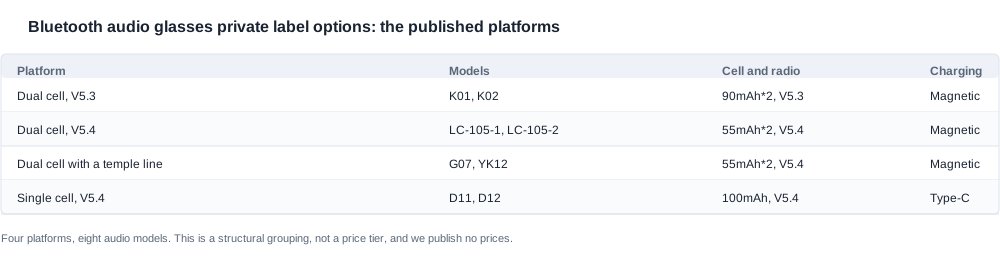
For a private-label buyer, the models in this category are not equal, and the ranking below is by how much published structure each one leaves you — not by how good they are, because nobody publishes the data that would let you say that, and not by price, because we do not publish prices at all. The range runs from dual-cell platforms with two 90 mAh cells through dual-cell platforms with two 55 mAh cells to a single 100 mAh platform, and each architecture leaves a different amount of room to build a brand around it. This is a structural grouping of published rows, not a price tier and not a recommendation, and the buyer who reads it that way will use it correctly.
Bluetooth audio glasses private label options start from the cell architecture
The first thing a private-label decision has to settle is not the model. It is the architecture, because the architecture determines the setup cost, the accessory chain, the documentation file and the artwork, and those four are what a brand actually pays for across a range.
What the eight audio models publish, and what it means for a brand
The audio range contains eight models on three platforms. The K01 and the K02 publish two 90 mAh cells with Bluetooth V5.3 and magnetic charging. The LC-105-1 and the G07, and the YK12 and the LC-105-2 publish two 55 mAh cells with V5.4 and magnetic charging. The D11 and the D12 publish a single 100 mAh cell with V5.4 and charging over a Type-C port.
Three things follow for a brand building a private-label range.
The platform is the setup decision. Models that share a platform share the firmware, the app, the accessory family, the documentation file and the artwork master. A range of four models on one platform pays the setup once; the same four models spread across three platforms pay it three times. Which platform to build on is therefore the first question, and it is a question about the buyer's operating capacity rather than about the product. The selection logic is set out in which model to pick.
The interface is the accessory decision. Six models charge magnetically and two charge over a Type-C port. Magnetic and Type-C are not cosmetic differences in a private-label programme: they are two accessory chains, two packaging specifications, two spare-parts plans and two sets of carton dimensions. A brand that supports one interface has one of each; a brand that supports both has two, and the second one is a cost the buyer usually discovers after the range has been approved.
The feature line is the differentiation decision, and it is much narrower than it looks. Three of the eight audio models publish a feature line. The D11 publishes one naming surround sound together with long battery life; the G07 publishes one naming a slim build together with a detachable temple; the YK12 publishes one naming surround sound together with a slim temple. The K02 and the D12, the LC-105-2 and the LC-105-1, and the K01 publish nothing beyond the five electrical rows.
The correction that matters most in this category
Two claims circulate about this range and both of them are wrong, and both of them are expensive because they change what a brand pays for.
There is no capacitive touch row published for any model in this range. The catalogue publishes no touch row for any model, and a quotation or a listing that describes a touch surface on one of these models should be supported by a document the supplier can produce. A brand that specifies a touch-controlled variant on the strength of a summary sheet is specifying a feature that may not exist.
There is no AI or translation row published for any model in this range either. The same test applies: if a feature is going into a branded listing, the written wording has to come from the supplier, and the branding has to be checked against it.
These are not pedantic points. In a category where five of eight models publish nothing beyond the electrical rows, the difference between the published data and a remembered or summarised version of it is the whole of a brand's differentiation, and a brand that builds its differentiation on a feature the catalogue does not carry has built it on a risk.
What the sport tier looks like to a private-label buyer
Two models sit outside the audio range and are worth knowing about because they are visible in most searches: the D17 publishes 115 mAh, roughly seven hours of rated use, a charge time of about one hour and charging over a Type-C port, together with a published feature line naming remote control photography and surround sound; the ZH12 publishes 100 mAh, roughly eight hours, about one hour of charging and Type-C, with a published feature line naming remote photography and stereo surround sound.
Both sit in the sport tier, not the audio tier, and that distinction is not cosmetic. They are the only two entries in the catalogue with a charge time of about one hour, which is a genuinely different turnaround, and they carry a different accessory chain and a different document position. A private-label buyer whose channel is sports-led should ask about them directly; a buyer whose channel is general should understand that importing a sport-positioned product into a general range brings a second set of costs that nobody has costed.

Four platforms and the models that sit on them
The grouping above is the structural map of the range, and a brand reads it in one of two ways. Either the brand builds a range on one platform and varies the frame or the colour, or it builds a portfolio across platforms and accepts that it is paying three setups. The trade-off is between the number of accessory chains and the number of distinct products on offer, and it is a decision about the brand's own operation rather than about the models.
What the grouping does not settle is the customisation, because that is where the actual headroom in a private-label programme lies.

What each platform leaves open for a brand
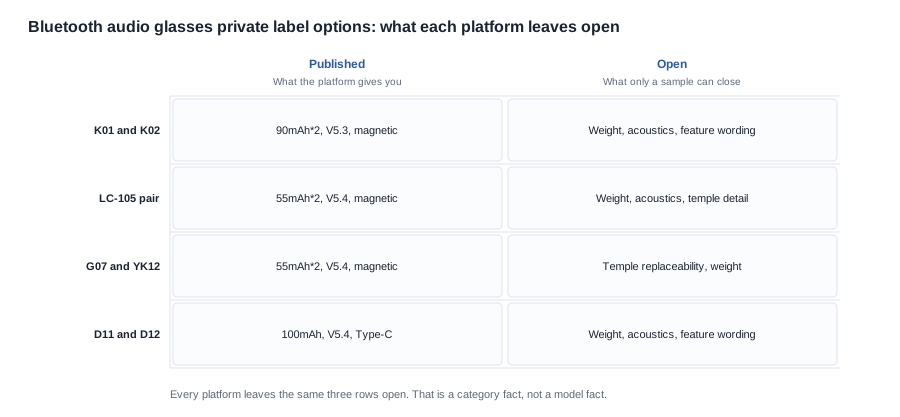
Every platform in this range leaves the same three rows open, and that is a category fact rather than a model fact. No audio model publishes a frame weight. No audio model publishes an acoustic figure or a microphone specification. No audio model publishes a charging-case row, and no audio model publishes a per-model certification row.
What the platforms do give is different, and it is worth being precise about it.
The two 90 mAh models publish the most generous energy configuration in the range — two 90 mAh cells, published as a cell and a count rather than as a total, so any total a brand quotes has to be labelled as derived. Their rated use figure is roughly eight hours, which the LC-105 pair also publishes on a smaller cell configuration, so the energy argument separates them and the endurance argument does not.
The two 55 mAh groups split along the temple line. The LC-105-1 and the LC-105-2 publish roughly eight hours and no temple description; the G07 and the YK12 publish roughly six hours and do publish one — the G07 a slim build with a detachable temple, the YK12 a slim temple. A brand that wants frame variants to carry its own identity has two published configurations to work with inside one platform, and a brand that wants the higher rated figure has the other two models.
The two 100 mAh models are the only Type-C entries in the audio range, which is the simplest customisation story in the category: one interface, one cable, one accessory chain, and a rated use figure of roughly seven hours. For a brand whose customers already own a USB-C cable, that is the argument, and it is checkable without a sample.
What no platform gives you
The three open rows are open everywhere, and a brand has to treat them as a risk it either accepts or closes with a written request before it commits.
Frame weight is the row that decides the sizing story and the parcel weight, and it is not published for any audio model. The only published weight in the catalogue is 158 g for the MT6, a camera model with a different cell and a foldable case, and it cannot be used as a proxy. Weighing a sample of each model is the cheapest way to close this gap.
Acoustic and microphone figures are the rows that decide whether the product can be listed with any sound or call claim at all, and neither is published. A brand that wants to say anything about sound has to measure samples and describe its own method.
Certification is per model and per market, and the catalogue's export certification page is a company-level page whose content is images rather than text, with no per-model certification row anywhere. The document position has to be requested in writing, with the model designation named, and the compliance cost and lead time are real costs in the programme rather than paperwork. The certification coverage notes explain why a certificate that does not name the model is close to worthless.
The customisation questions to put in the request for quotation
In a private-label programme, the customisation routes are the differentiation. Because the specification is thin, what a brand can change is the product. Every item below is a question to put in the request for quotation, and none of them is a promise any supplier can make before the configuration is agreed.
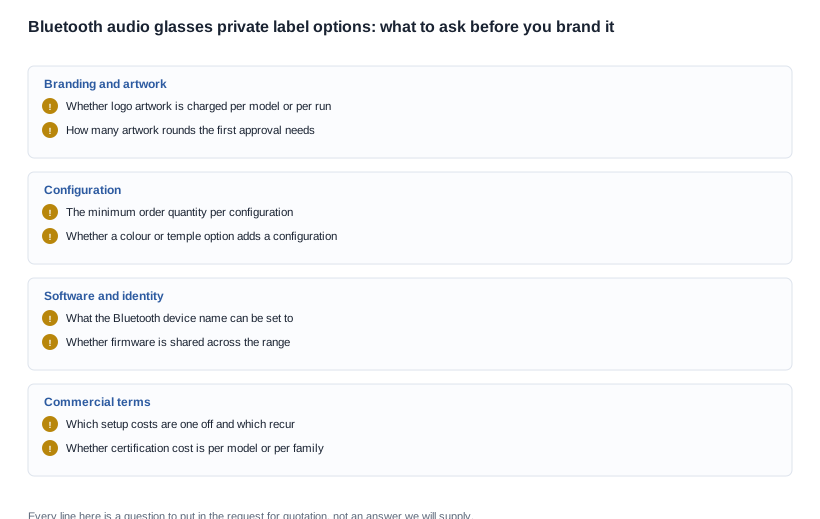
On branding and artwork. Is the logo artwork charged per model or per artwork run, and does the artwork minimum apply per model or per run? How many artwork rounds does the first approval need, and what is the turnaround on each? Is a printed insert a cheaper way to vary a model than a printed box?
On configuration. What is the minimum order quantity for each configuration, and does a colour option or a temple option create a new configuration with its own minimum? How many configurations does the brand's launch plan have, and is that number the same as the number the supplier will quote? How to choose the configuration count is a question about the artwork and the documentation rather than about the product.
On software and identity. Can the Bluetooth device name be set to the brand's name, and is there a cost or a minimum attached? Is firmware shared across the range, and what happens to the range if the supplier changes it? Is there an application in the product, and if so who hosts it and who maintains it?
On compliance. Is the compliance cost per model or per product family, and what is the lead time per destination market? What documentation will name the brand's model designation rather than the supplier's? Which documents exist before the first order and which have to be requested?
On commercial terms. Which setup costs are one-off and which recur per configuration or per model? What is the delivery schedule, and can it be split against a staged payment? What are the warranty period and the response time, and what are the return terms for a business channel? The commercial structure around a range is in OEM ready platforms, and the inventory consequences of a configuration decision are in inventory planning.
How to choose a platform without a price list
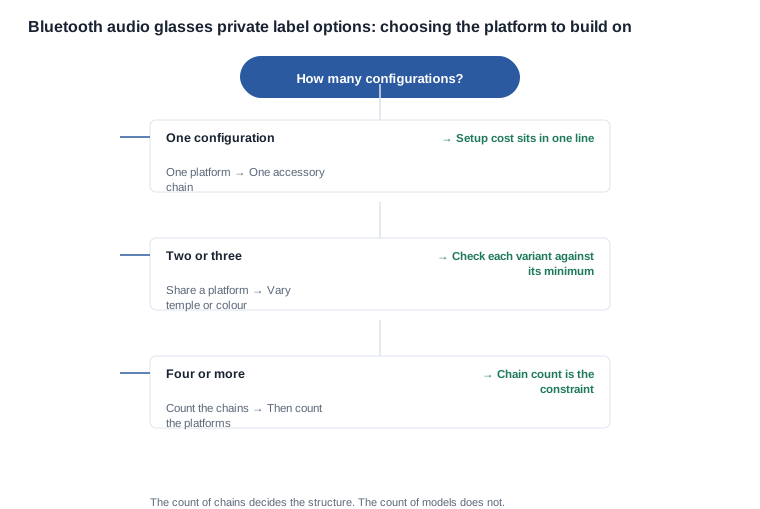
The method is a four-step sequence that a buyer can complete with the published data and a request for quotation, without ever needing a published price.
Step one, count the configurations the launch plan actually has. Not the models — the configurations. A range of three models on one platform with two colour options each is six configurations, and six is a different cost structure from three.
Step two, map the configurations onto the platforms and count the chains. Each platform adds an accessory chain and, usually, a documentation file. A buyer who cannot reduce the chain count is accepting a cost structure, and should at least know its size before the order.
Step three, check the device fleet the brand's customers run, because the radio version is a platform-level fact and a compatibility problem returns to the supplier as a quality complaint.
Step four, put the three open rows into the request for quotation as numbered questions, with a sample programme budgeted for the weight and the acoustic measurement. A brand that closes the open rows itself owns the evidence and can use it in its own listing.
A worked example: a house brand with a two-market launch
This is a worked case rather than a client project. It is here to set out the order.
Assume a house-brand accessories company launching into two markets with a limited operations team. It has no imaging capability and no plan to enter the camera band. Its commercial director has asked for a comparison of the range and a recommendation.
Step one, the configuration count. The company counts what it actually plans: two models and one colour on each, because its production run is small enough that more configurations would strand inventory. That is two configurations on one platform, which is a manageable structure, and it fixes the brief before any supplier conversation starts.
Step two, the platform. The company maps its two models onto the platforms and finds that the LC-105-1 and the LC-105-2 share one platform with the G07 and the YK12. Because the LC-105 pair publishes roughly eight hours of rated use and no temple description, and because the company does not need frame variants at this volume, it decides to build on that pair. It notes the D11 and the D12 as the alternative if the device fleet turns out to be Type-C-centric.
Step three, the customisation questions. The company issues a request for quotation with the customisation items as numbered questions — artwork charging basis, artwork rounds, minimum per configuration, device name, firmware sharing, documentation per model and per market, setup cost split between one-off and recurring, delivery schedule, warranty and return terms. It issues it before it has asked for any price, so the answers come back inside the programme rather than after it.
Step four, the open rows. The company buys one sample of each model on production terms, weighs them, and runs a leakage test with an acceptance criterion fixed in advance, because a quiet-room channel cannot absorb a product whose sound escapes into a shared office. It records the method, so that its own listing can say what it measured.
Step five, the position. The company's launch rests on two configurations on one platform, one accessory chain, one artwork master and its own measurements for the three rows the catalogue leaves open. It is not the widest range available and it is not the cheapest to start with; it is the structure whose cost the company can see before it commits.
The three questions a private-label buyer should not skip
Three requests sit at the end of every request for quotation in this category, and they are the ones that get dropped when a buyer is in a hurry.
Which rows in the published data are per model and which are per platform? The radio version, the cell configuration and the charging interface are platform facts. The rated use figure and the feature line are per model. A brand that treats them all as per model will build a range that looks more differentiated than it is and will find that the feature line is the only per-model argument available.
What happens to the documentation file when the platform changes? If a brand later moves a model to a different platform, the file has to be reissued for that model. That is a cost, a lead time and a change-control obligation, and it is worth establishing before the first order rather than discovering it during a range revision.
Which of the three open rows does the brand intend to close with its own measurement, and which does it intend to leave open? A brand that measures the frame weight and the acoustic behaviour has evidence it can use in its own listing. A brand that leaves them open has to write a listing that says nothing about them, and that listing is narrower but defensible. Which rows to close and which to leave open is a decision about the launch date and the evidence budget, and it is better made deliberately than by default.
Why we rank platforms by published rows rather than by preference
We will rank platforms by what is published rather than by what we estimate they can become, and we will not present a model as having customisation headroom we have not confirmed for a specific configuration and quantity.
We do not publish prices, price tiers or a value ranking for this category, and the grouping at the top of this page is a structural grouping of published rows rather than a recommendation of one model over another. A buyer who needs to know which platform is cheapest for their configuration will get a better answer from a request for quotation than from any ranking we could publish, because the answer depends on the quantity, the configuration count and the destination markets — three inputs that are the buyer's, not ours.
What we will do is tell you which models share a platform, which published rows each platform carries, what each platform leaves open, and which questions have to be answered before a platform is committed. The Bluetooth audio glasses collection page carries the range reference, and the packaging consequences of a configuration decision are in packaging design.
Six things to establish before a private-label platform is committed
- The configuration count of the launch plan, not the model count.
- The platform each configuration sits on, and the number of accessory chains that follows.
- The customisation questions answered in writing: artwork, device name, firmware, minimum per configuration.
- The documentation position per model and per destination market, with the model designations named.
- The frame weight and the acoustic results from your own samples, with the method recorded.
- The commercial structure: setup costs split between one-off and recurring, delivery schedule, payment nodes, warranty and return terms.
Send the model shortlist, the market and the launch configuration and we will tell you which of these platforms can actually carry your brand.
Related reading
- How launch configurations affect inventory — inventory planning
- Packaging and carton decisions for a private label — packaging design
- Bluetooth audio glasses range overview — Bluetooth audio glasses
Send the model shortlist, the market and the launch configuration and we will come back with what can be confirmed.


