

Every audio frame in our range is open-ear, and that single fact is what makes the category confusing: "open ear" is the format, not the option. A buyer choosing between the frames in this range is choosing between four things that sit on top of the format, and confusing them is how a range ends up with two products that differ on a word rather than on a feature. The four are the platform, the charging interface, the feature line and the temple. This page sets out what each one is worth, where they combine, and how to specify them without inventing a difference that is not there.
Bluetooth audio glasses open ear options come down to four axes
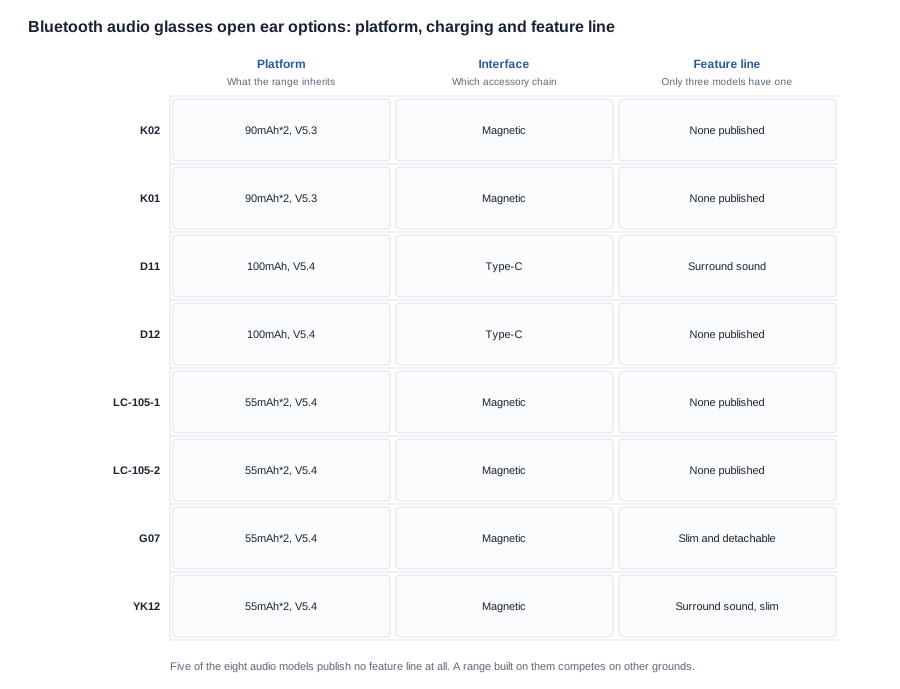
The range holds eight audio models, and a buyer looking at it sees eight products. A buyer looking at the four axes sees three platforms, two accessory chains and three published feature lines, which is a far more useful number to plan a range around. Eight models and eight products is not a range. Eight models on three platforms is a range with a structure.
Who is choosing, and what they are building
A brand owner building a range needs to know how many genuinely distinct products the family can carry and which combinations are defensible. Four axes over eight models sounds like breadth; it is much narrower once you know that five of the eight models publish nothing beyond the electrical rows.
A procurement manager placing a single order needs to know which model to write on the purchase order, because "an open-ear frame" is not a specification and a model designation is. The order has to name the cell, the interface and the feature line, because those three are what a supplier quotes against and what a documentation file has to cover.
A channel buyer deciding between a feature-led listing and a clean, plain one needs to know which of the two the range can actually support. On the published data, a feature-led listing has three candidate models and a plain listing has five, and that ratio is the single most consequential fact in this page.
The rule that makes the selection work
Choose the platform and the interface first, treat the feature line as the third question, and pick the temple last. The platform and the interface are what a later model in the range inherits — its firmware, its app, its accessory family, its documentation file and its artwork. The feature line and the temple are per-model decisions, and they are the two that have to be revisited every time the product changes.
The platform axis: what a range inherits from a cell and a radio
Three platforms sit behind the eight audio models, and they are defined by a cell configuration and a radio version together.
The dual-cell V5.3 platform carries the K01 and the K02. Both publish two 90 mAh cells and roughly eight hours of rated use, and both charge magnetically. Two 90 mAh cells is the most generous published energy configuration in the audio range, and it is also the configuration whose total is most often quoted as a single figure — which it should not be, because the catalogue publishes the cell and the count, not the sum. If a buyer uses the total, it has to be labelled as a derived number, or a reader will take it for a published row.
The dual-cell V5.4 platform carries the LC-105-1 and the LC-105-2, and the YK12 and the G07. All four publish two 55 mAh cells and magnetic charging. Their rated use figures differ within the platform, which is worth understanding rather than treating as an inconsistency: the LC-105-1 and the LC-105-2 publish roughly eight hours, while the G07 and the YK12 publish roughly six. The two six-hour models are the two that publish a temple line, so within one platform the published endurance follows the mechanical configuration.
The single-cell V5.4 platform carries the D11 and the D12. Both publish a single 100 mAh cell, roughly seven hours of rated use and charging over a Type-C port. This is the only audio platform on the Type-C side, and it is the platform a buyer chooses when the customer's existing cable set is the priority.
Why the platform decision is the first one and not the third
The platform decision carries three costs that are invisible in a unit price and that compound across a range.
The setup cost. Tooling, artwork and the platform's own development are amortised across the models that share it. A range of four models on one platform pays the setup once; the same four models spread across three platforms pay it three times. The buyer's shortlist should be scored on platform count before it is scored on anything else.
The accessory chain. The interface determines the dock or cable, the packaging specification and the spare-parts plan. Two interfaces across a range means two chains, and the second chain is a stock line, a packaging change and a supplier dependency that the buyer has to manage for the life of the range.
The documentation file. Models that share a platform can often share a file, and models that do not cannot. That matters for a buyer who has to answer a compliance request, because the cost of a document is per model rather than per unit, and it is the cost most likely to be underestimated by a buyer planning a first range.

The feature axis: three models carry a published line and five carry nothing
This is the axis where a buyer is most likely to be misled, and it needs stating in plain terms. Three of the eight audio models publish a feature line. The K02 and the D12, the K01 and the LC-105-1, and the LC-105-2 publish nothing beyond the five electrical rows. There is no capacitive touch row published for any model in this range, and there is no AI or translation row published for any model in this range. If a listing or a supplier quotation describes either of those on one of these models, the buyer should ask for the document behind it.
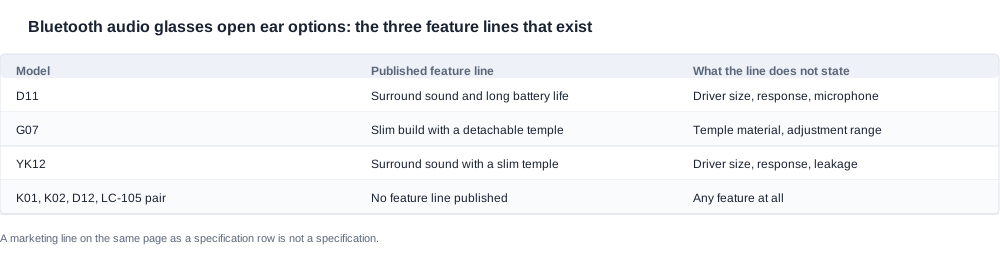
The three published feature lines are worth reading closely, because a marketing phrase sitting on the same catalogue page as a specification row is not a specification.
The D11 publishes a feature line naming surround sound together with long battery life. The surround sound part is a listening attribute and the long battery life part sits next to a published rated use figure of roughly seven hours — which is not the highest figure in the range. A buyer should therefore treat the phrase as a marketing line and use the rated use row for the endurance argument.
The G07 publishes a feature line naming a slim build together with a detachable temple. This is the only line in the audio range that describes a physical configuration, and it carries a service implication: a detachable temple is a spare-parts question, and whether it is user-replaceable or factory-only changes whether it is a channel asset or a channel cost.
The YK12 publishes a feature line naming surround sound together with a slim temple. Like the D11's line, the surround sound part is a listening attribute and says nothing about transmission, and the slim temple is a physical configuration that changes how the frame sits.
The temple axis and the question nobody asks
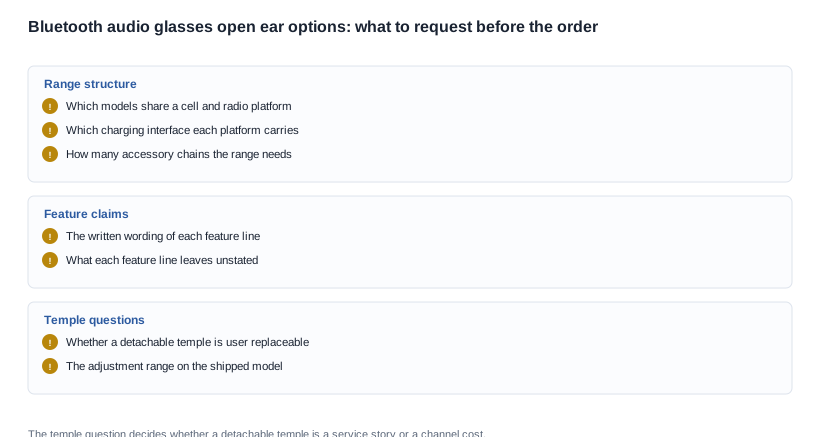
Six of the eight audio models publish no temple description at all, which means the buyer's only published proxy for stability is available on two models. That is not a reason to avoid them; it is a reason to ask. The two temple questions worth asking are whether the G07's detachable temple is user-replaceable or factory-only, and what the adjustment range is on the shipped model. A detachable temple with an established replacement path is a serviceable product; a detachable temple without one is a warranty claim waiting for a customer who breaks it.
The open-ear format itself makes the temple question more consequential than it looks. Because an open-ear speaker works by position, the frame's placement relative to the ear changes what the user hears. The positioning instruction and the sound instruction are the same instruction, and that belongs in the manual rather than in a discovery. The format itself is covered in open-ear audio.
Building a range without four accessory chains
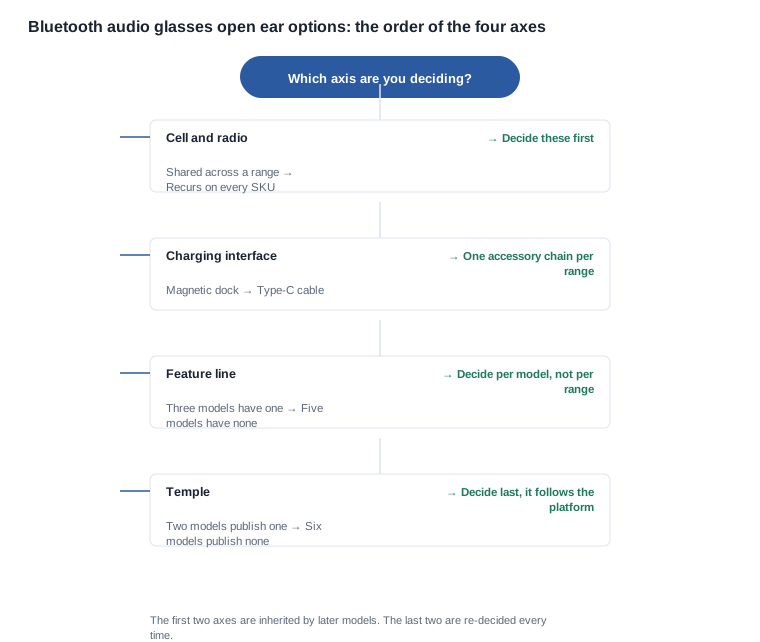
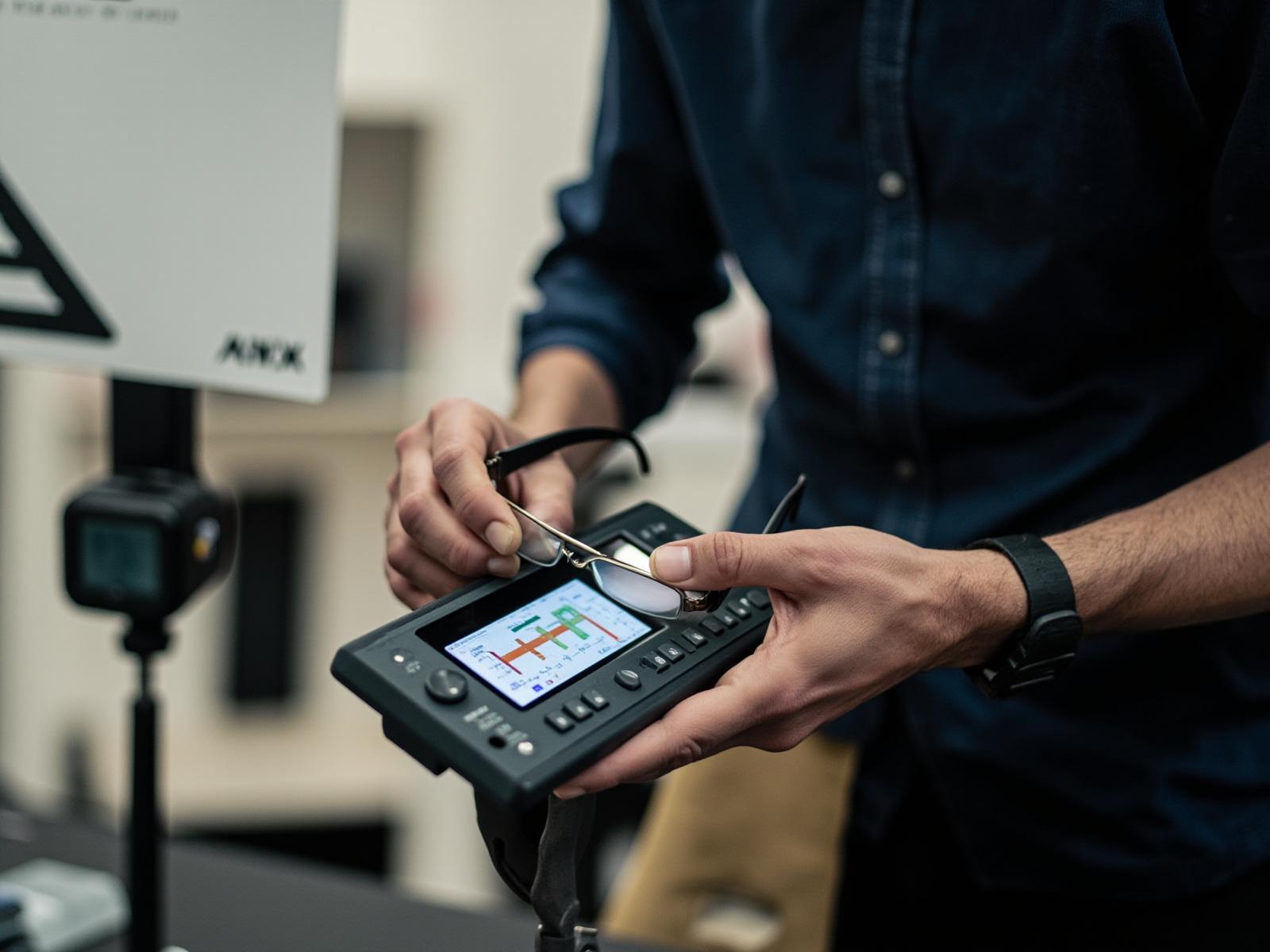
The decision chart above is about order of work, not about which model wins. A range of four models built on two platforms with two interfaces is a manageable range. A range of four models on four accessory chains is not, and the trade-off here is almost entirely about the number of chains rather than about unit price.
What a range of this family actually costs to carry
The customisation routes are the differentiation in a specification-thin category. In a range where five models publish nothing beyond five electrical rows, the things a brand can change — the logo and its artwork, the colour, the packaging structure, the temple or frame finish, the charging interface, the Bluetooth device name, the firmware behaviour — are the whole of the differentiation available. That makes the customisation question list the commercially important one, and it is a list of questions to put in the request for quotation, not a list of things a supplier promises: whether logo artwork is charged per model or per run, how many artwork rounds the first approval needs, what the minimum order quantity is per configuration, whether a colour option creates a new configuration, what the Bluetooth device name can be set to, and whether firmware is shared across the range.
The variant strategy follows the platform, not the model. Two models that publish a temple line can carry frame variants without a second product development. A model that publishes no temple line can still carry a colour variant, but a colour variant that crosses an artwork boundary is a new configuration with a new minimum, and the buyer should treat it as one from the start.
The cost of the range is decided before the first unit. The number of platforms, the number of accessory chains, the number of artwork rounds and the number of configurations are all decisions that are cheap to make and expensive to reverse. A buyer who makes them at the request-for-quotation stage has a negotiation; a buyer who makes them after the artwork is approved has a change request and a schedule.
What the format gives up, and what it buys
The format's real advantage is that the ear stays open. The user hears traffic, a colleague and a warning, which is why it suits outdoor and workplace channels. That is the argument a listing can make without any measurement behind it.
The cost is leakage. Sound played at speaking volume in a quiet room is audible to the people around it, and no leakage figure is published for any model in this range. A buyer building a quiet-office channel has to state the format's limit in the listing and test for leakage before the shortlist is scored, because a format cost that is not stated becomes a return.
The second cost is the low-frequency end. Open-ear designs trade bass for the physical size of the speaker and for the leakage limit, and no frequency response and no driver size is published for any model. The third cost is the environment itself: an open-ear frame on a loud street is hard to hear, and that is a product decision rather than a defect — but it belongs in the listing.
The format's own commercial value is that it needs no fitting and no consumables, which makes it a natural second pair: a travel pair, a work pair, or a pair for a customer who already wears prescription glasses. For a brand that is a range-extension argument, and in most channels it is worth more than a feature line.
A worked example: a house brand building a two-model range
This is a worked case rather than a live order. Its purpose is to show the order.
Assume a house-brand consumer electronics company that already sells a wired headset and wants to add an open-ear audio frame as a second product. The company has no camera development capability, no plan to enter the camera band, and a small but committed channel of its own retail partners. Its constraint is that it can support one accessory chain and one artwork master without adding a second operations head, and its commercial team has been pressing for a market estimate to justify the programme.
Step one, the band. The company settles the band question before it looks at any model, and the answer is the audio band, because that is the band its existing capability and its existing channel can address. The commercial team's estimate is set aside rather than argued about, because it does not change the answer and because it would have pointed at a band the company cannot serve.
Step two, the platform. The company reads the published rows and groups the range into three platforms: the dual-cell V5.3 pair, the dual-cell V5.4 group of four, and the single-cell V5.4 pair. It then reads that grouping as a range design constraint rather than as a list, and decides that its range will sit on one platform. The specific platform is decided on the accessory chain, because the company has decided it can support one interface, and it notes that the LC-105 group and the G07 and YK12 share the dual-cell V5.4 platform and therefore share the interface.
Step three, the feature line. Within that platform, the company notes that two of the four models publish a feature line and two publish nothing. It decides that a plain listing with one feature-led model is a better range shape than two feature-led models, because the feature line on the D11 sits next to a published rated use figure that is not the highest in the range, and a listing that leads on a marketing phrase is a listing that a retailer's compliance team will query.
Step four, the request. The company's request for quotation lists what it wants to know rather than what it wants to be told: which models the supplier considers to be on the same platform, whether the configuration is shared, what the artwork charging and the minimum order quantity per configuration are, what the device name can be set to, and whether firmware is shared. It also asks for the acoustic and microphone specification, because the company knows that the only published rows will not carry a listing on their own.
Step five, the sample. The company buys one sample per shortlisted model on production terms and runs a leakage test, because the format's cost is the one thing that would disqualify the product in a channel where people sit next to each other, and because that test is the one it cannot get from a datasheet.
The result is a two-model range on one platform, one accessory chain, one artwork master and a feature-led model chosen on the strength of a published line rather than on a forecast. The commercial team's estimate never entered the business case, and the case was stronger for it.
The limits of the open-ear format and what it cannot be sold as
A buyer should choose the platform and the interface first, treat the feature line as the third question, and pick the temple last, because the platform and the interface are what a later model in the range inherits while the feature line and the temple are per-model decisions.
We will not publish a leakage figure, a frequency response, a driver size, a microphone count or a pickup distance, because none of them is published for any model in this range, and we will not present a rated use figure as a working day without the test condition behind it. Where a row is not published we will mark it as not published rather than fill it, and we will not carry a figure across from one model to another.
There is a commercial reason for that narrowness that is specific to this category. When the specification is this thin, a listing has only three places to stand: the published rows, the feature line and the presentation. A buyer who fills the second and third and reaches for a figure that does not exist has taken the only honest ground out of the listing and left the claim standing alone. A range that sells on its published rows is dull. A range that sells on a figure it cannot defend is a liability, and the difference between them is not visible until the first customer measures it.
Six things to request before an open-ear range is committed
- Which models share a cell and radio platform, written out as a grouping.
- Which charging interface each platform carries, and how many accessory chains the range needs.
- The exact wording of each feature line, and an explicit statement of what each one leaves unstated.
- Whether the detachable temple on the G07 is user-replaceable, and what the adjustment range is on the model you will ship.
- The customisation questions in writing: artwork charging, minimum order quantity per configuration, device name, firmware sharing.
- A leakage test on the shortlisted models, with the acceptance criterion fixed before the samples arrive.
Tell us the channel, the volume, the target market and how many models you plan, and we will come back with which combinations the range supports. The family is on our Bluetooth audio glasses collection page, and which model to pick sets out the selection logic in full.
Related reading
- How the format actually behaves — open-ear audio
- The selection logic across the family — which model to pick
- Building the range structure — Bluetooth audio glasses private label options
Tell us the channel, the volume and how many models you plan, and we will come back with which combinations the range supports.


