

AI camera glasses packaging options are usually discussed as a finish decision, and they are not one. The carton, the insert and the accessory set inside the box decide four commercial facts at once: which model designation travels with the unit, how many units fit into a master carton, what the customer has to hand in order to charge the device, and which regulatory markings the packaging is allowed to assert. We do not publish packaging minimums, packaging charges or packaging lead times, because our documentation does not contain them. What we do publish is the specification content every packaging conversation has to reconcile, and this article turns that content into the questions to ask and the lines a quotation has to state.
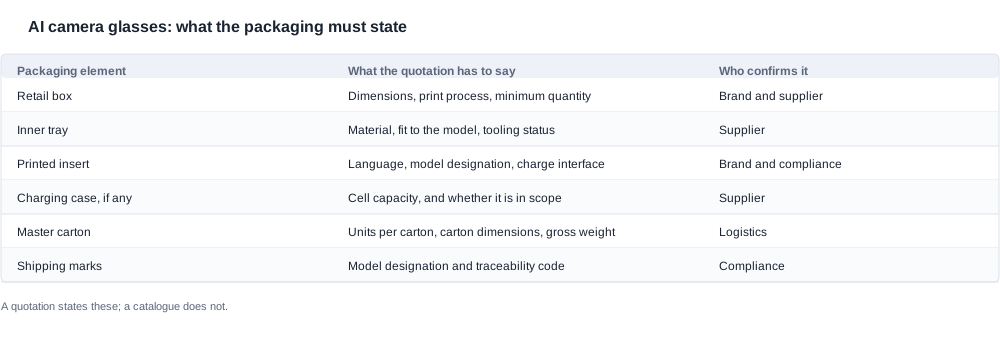
AI camera glasses packaging options: what the box has to settle
A packaging conversation is really four conversations wearing one label, and they fail in different ways. Splitting them apart is the fastest route to a quotation you can act on.
The identity question. What model designation is printed on the carton, on the insert and on the unit, and does that string match the designation that appears on the documents that ship with the product? This is the one that decides whether the paperwork you paid for actually covers the goods in the box. A brand on the carton changes nothing about the model, and a certificate names a model. If the two strings differ, the import file, the compliance file and the returns file are all describing different objects.
The content question. What is physically in the box, and which of those items are optional? For camera-equipped glasses the content set has at least two variables. The first is the charging case: five of the eleven camera models publish a charging-case capacity, and the remaining six publish no charging-case row at all. The second is the charging interface, because magnetic charging and a Type-C port are different accessories, and a range that mixes them needs a different accessory policy from a range that does not. Only two camera models publish a Type-C port; the other nine publish either magnetic charging or no published interface.
The logistics question. How many units fit into a master carton, what are the carton dimensions, and what is the gross weight on a packed sample? None of these figures appear in our catalogue for any model. They come from a physical sample, and they are the inputs to a freight rate. A packaging decision taken without them is a packaging decision taken blind on the cost line that a channel partner will care about most.
The compliance question. What does the packaging assert, and on what evidence? The catalogue holds a company-level export certification page, the content on it being images rather than text, and the catalogue text makes no mention of CE, FCC or RoHS. There is no per-model certification row anywhere in it. So a certification mark printed on a carton is a claim the buyer is making, and the buyer needs the certificate number, the issuing body and the validity dates behind it before approving the artwork.
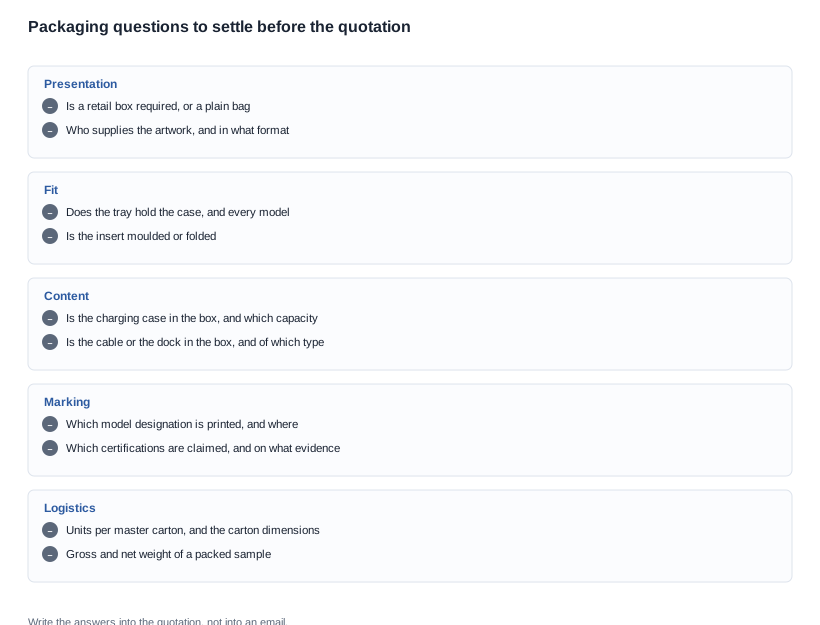
None of these four is a packaging decision in the decorative sense. Each one is a piece of information that ends up in a contract, a customs file or a freight quote, and each one has to be requested rather than assumed. That is why the useful output of a packaging negotiation is a written list of what the box contains and what is printed on it, not a photograph of a mock-up.

The questions to put to a supplier before artwork is approved
The order of these questions is not arbitrary. Ask them in this sequence and each answer makes the next one easier to frame; ask them in a different order and you will get an artwork file before you know what it is allowed to say.
First, enumerate the contents. Ask for a list of everything inside the retail box, with a yes or no against each item and the model designation it ships with. The list should separate the hardware from the accessories from the printed material. A supplier that answers "standard package" has not answered, and an answer that does not distinguish a case from a cable from a dock is not usable for a freight calculation.
Second, ask which of the contents are optional and what changes if they are removed. The charging case is the obvious candidate. A configuration without a case is a different packed weight, a different accessory requirement and a different battery transport profile from the same model with one. If a minimum order quantity applies per configuration, that is exactly the kind of line that belongs on the quotation, in writing, with the number on it.
Third, ask for the charge interface per model. Not in general — per model. Ask whether the magnetic models ship with a dock and whether the Type-C models ship with a cable, and ask what the accessory specification is. The buyer's total cost of ownership on this line includes the customer's second purchase, and a customer who receives a device they cannot charge will contact your support line rather than your supplier.
Fourth, ask for the packed measurements. Ask for the gross weight of one packed retail unit, the dimensions of that unit, the number of units per master carton, and the gross weight and dimensions of the master carton. Ask for the method at the same time: the same scale, the same packing state, the same point in the process. A weight figure without a method is not a number you can plan a freight rate around, because the next supplier's figure will be measured differently.
Fifth, ask what the artwork is allowed to assert. Ask which marks appear on the carton, whether a certification mark is among them, and which certificate number supports it. Ask whether any water-resistance or durability wording appears and which published row supports it. Only two camera models publish an ingress rating, so any wording on the other nine has to come from somewhere other than our catalogue.
Sixth, ask about the printed material. The insert carries the language, the model designation, the charge instructions and usually a safety summary. For a European Union sale, the insert is also where the general product safety regulation (EU) 2023/988 obligations are usually discharged, alongside the economic operator and product identification details that regulation requires. Who supplies that content, and who approves it, is a question to settle before the plate is cut rather than after it is printed.
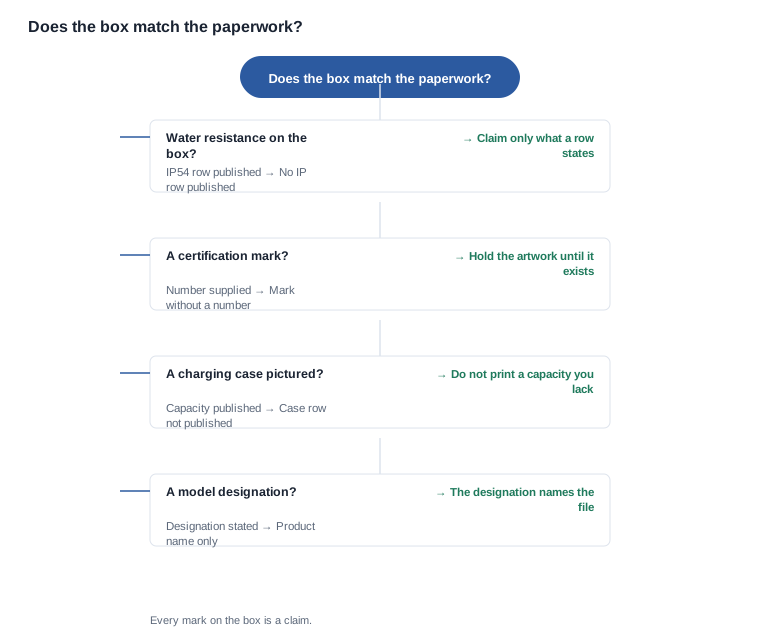
That sixth question is the one most often deferred and most expensive to defer. Printing a run of cartons with a missing operator detail means the material is scrap, and in a regulated market the units in that run may already be non-conforming before they leave the factory.
Turning packed measurements into a freight line
Every packaging conversation eventually reaches the same arithmetic, and it is worth separating the part that is known from the part that has to be measured.
The part that is known is narrow. The catalogue publishes the weight of exactly one camera model: the MT6 glasses body at 158 g, which includes the cell and the camera and excludes the folding charging case, whose capacity is published separately at 1200 mAh and whose mass is not published at all. For the other ten camera models no mass appears anywhere in our documentation, and no case mass, insert mass, retail box mass or master carton mass is published either. So the honest position is that the packaged weight of an AI camera glasses unit cannot be derived from the catalogue at all, in either direction. It has to come from a scale.
The part that has to be measured is the part the freight rate is calculated on, and this is where the packaging decision and the logistics decision are the same decision. A carrier charges on the greater of the actual mass of the consignment and the volumetric mass derived from its dimensions, and the divisor that converts a volume into a mass is set by the carrier or the forwarder rather than by the factory. That has a consequence buyers miss: a light product in an inefficient carton can be charged as a heavy one, and a packaging change that reduces the carton dimensions can change the freight rate more than a sourcing change that reduces the unit mass. The packaging brief is therefore a freight brief, which is why it belongs in the same conversation rather than in a separate one.
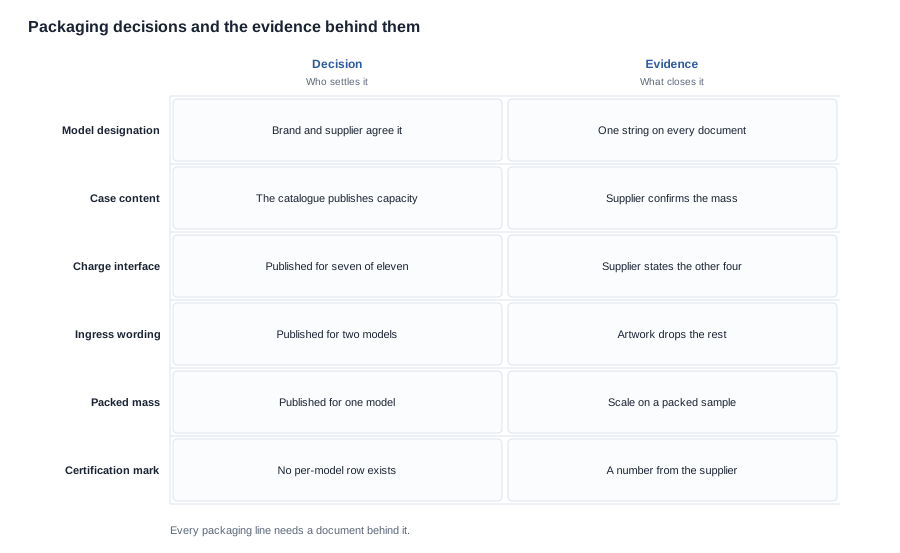
The measurement request itself is short, and the method is what makes it usable. Ask for the gross mass of one packed retail unit on a stated scale in a stated packing state; the dimensions of that unit at its widest points; the number of units per master carton; and the gross mass and external dimensions of a filled master carton. Then ask the method question explicitly: the same scale, the same packing state, the same point in the production sequence, and whether the figure is a single packed sample or an average across a run. A figure produced on a sample and quoted as a production average is a different claim, and a buyer who does not ask will sometimes receive one and sometimes the other.
Two further lines are worth requesting at the same time. The first is the packed weight per configuration, because a configuration with a charging case and one without do not weigh the same, and quoting a single figure across both is how a freight estimate goes wrong at the first shipment. The second is the revision rule: what changes to the packed weight when the insert language, the printed material or the accessory set changes, and who re-measures it. A brand that changes the insert for a new territory has changed its freight profile, and if the rule for re-measuring is not written down, that change arrives as an invoice rather than as a line on the quotation.
The practical checklist, then, is a shortlist of four numbers per configuration — packed unit mass, unit dimensions, carton quantity and carton dimensions — each with a stated method, each re-taken whenever the contents change. The AI camera glasses shipping weight article covers the same gap from the logistics side, and the OEM ready platforms logistics planning piece covers where that data set belongs in a wider plan.

Where packaging and the documentation meet
Two interfaces matter more than the rest, and both are worth writing into the purchase order.
The model designation interface. The designation printed on the unit, the designation on the carton, the designation on the insert and the designation in every conformity document have to be the same string, character by character. Our catalogue names eleven camera models — the V03 and the CY05, the MT5 and the V03 Pro, the S7 and the MT6, the L2 Utral and the KY06, the V06 and the CY03, and the L1 Pro — and each of those strings is what a supplier's documentation, a customs declaration and a retail listing should carry. A branded retail box does not change the designation, because the designation is what identifies the technical object the paperwork describes.
The accessory interface. A charging case is a second cell in the unit. That has consequences well beyond the box. It changes the packed weight, it changes the freight class, it changes the battery transport documentation, it changes the warehouse volume per unit and it changes the customer's charging routine. Our catalogue publishes the case capacity for five camera models — 1400 mAh for the CY03 and the CY05, and the L1 Pro, 900 mAh or 1400 mAh for the L2 Utral, and 1200 mAh in a folding case for the MT6 — and it publishes no case row for the other six. It does not publish a case weight for any of them, and it does not publish the transport test summary for any cell in the range. So the case is simultaneously a published fact and an open question: the buyer knows the capacity and must still ask for the mass and the transport documentation.

On radio and battery compliance, the buyer should hold the line on numbers rather than marks. The Radio Equipment Directive is (EU) 2014/53/EU and the EMC Directive is (EU) 2014/32/EU; EN 301 489 and EN 300 328 are the harmonised standards that sit under them, not directive numbers in their own right. None of these strings appears in our catalogue text, and none of them appears on the packaging page. That is not a contradiction — the catalogue is a product document, not a conformity file — but it does mean the buyer collects the numbers from the supplier and matches them against the exact model designation being packed. The same applies to the UN 38.3 transport test summary for the fitted cell, which we do not publish.
The practical rule that falls out of this is simple and worth stating in the contract: the artwork may not assert anything the file does not support, and the file may not cover anything the artwork does not mention. Both directions matter. An overstated carton creates a claim the supplier will not stand behind; an understated carton creates a compliance gap in the destination market.

A packaging walkthrough for a retail launch
The following is a hypothetical walkthrough, written to show the decision sequence rather than to report a result from a client project.
Assume a consumer electronics brand with four retail channels, two in the European Union and two in the United Kingdom, opening a camera-glasses line with two model designations from our range. The brand has no packaging team, so the supplier proposes a standard retail box and a supplier-printed insert. The brand's constraint is that it cannot re-run artwork once the launch is live, and that it wants a single packaging design across both territories rather than two.
The first decision is the content set. The brand asks for the contents list per model and learns that its two chosen designations differ on the accessory: one publishes a charging-case capacity, the other publishes no charging-case row. It asks what changes if the case is removed from the first model and is told that the packed configuration, the accessory supply and the transport documentation all move with it. The brand therefore decides to run two configurations rather than one, and puts the minimum per configuration into the written quotation instead of leaving it to a phone call.
The second decision is the charge interface. The brand learns that its two designations do not share an interface position, and that one of them does not publish an interface at all. It asks each supplier to state the interface in writing per variant, and adds a clause requiring notice before any variant changes its interface, because a dock swapped for a cable changes the accessory set, the insert wording and the customer instructions simultaneously.
The third decision is the artwork scope. The brand asks what marks are on the box. It discovers that the draft artwork carries a generic durability line and that no ingress row supports it for either designation, so that line is removed. It also asks for the certification numbers covering both designations and receives, for one of them, a number that names a model the brand does not order. That variant is dropped before artwork approval rather than after the first shipment.
The fourth decision is the logistics pack. The brand asks for the packed unit weight, the unit dimensions, the carton quantity and the carton dimensions, all measured on a packed sample with the method stated. It asks for the master carton gross weight as a separate line rather than accepting an estimate, and it asks for the figures again at the second order, because packaging revisions change them.
The fifth decision is the language plan. The brand asks who supplies the insert text for each territory, what regulatory content it carries, and who approves it. It settles that the brand approves the content and the supplier prints it, which means a proofing step in the schedule with a named reviewer.
The result is a packaging specification rather than a packaging preference: two configurations, a fixed accessory set per configuration, artwork limited to claims the file supports, and a logistics data set that can be re-measured at each order.
What our catalogue publishes about packaging, and what it does not
On AI camera glasses packaging options, our position is that the packaging decisions worth making early are the ones that tie the box to the paperwork and to the freight arithmetic, and that the decorative decisions can wait for a supplier who can quote them accurately. We publish the specification content a package has to reflect: the eleven camera model designations, the charge-interface position per model, the charging-case capacity where it is published, the ingress rating for the two models that carry one, and the published weight for the single model that carries one. We do not publish packaging minimums, packaging charges, packaging lead times, carton dimensions or packed weights, because our documentation does not contain them.
The second half of our position is about what a buyer should demand from any supplier in this category, ourselves included. The minimum quantity per configuration, the artwork and plate charges, the sample and tooling charges, the freight terms, the warranty on the printed material and the delivery schedule are all lines that belong on the quotation and in the purchase order, stated rather than implied. A buyer who is told "standard package" has been given no information at all, and a buyer who is told a figure without the method behind it has been given a number they cannot audit. The OEM ready platforms packaging design piece covers the design decisions on the other side of that conversation, the AI camera glasses charging case options piece covers the accessory economics model by model, and the AI camera glasses bulk ordering piece covers where the packaging review sits in a production sequence.
Send us the model designations you are considering, the territories you are shipping into and the configuration per designation, and we will tell you which published rows apply to each configuration and which ones you will have to get in writing from a supplier.
Related reading
- The models in this range — AI camera glasses
- The accessory that decides the cost — AI camera glasses charging case options
- The packaging design conversation — OEM ready platforms packaging design
- Where the review sits in production — AI camera glasses bulk ordering
- Why a case changes the product — smart glasses battery life
- Answering the certification question first — certification checklist


