

A buying guide for this category that begins with the battery would be misleading, and there is a reason for that. The published specification for our bone conduction product includes an amplification gain of 35 dB — a figure that sits squarely in the range hearing-assist products occupy — and the certification position for it has not been provided to us at all. The product also has no model number allocated.
That combination decides the buying guide. Everything else in this category is a specification conversation; this category is a compliance conversation first.
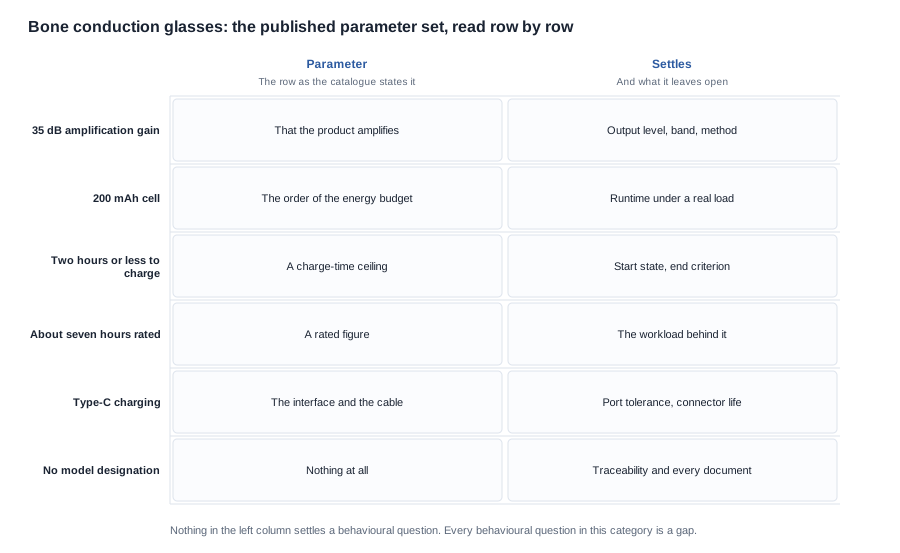
Bone conduction glasses buying guide: read the parameters in the order they constrain each other
Why the risk comes first, and what it changes
The risk in this product is not a legal opinion that sits beside the specification. It is the reason the specification has to be read in a particular order, and a buyer who reads the rows in the order they appear on the page will draw the wrong conclusions.
Read in catalogue order, the product looks like a generous battery and a long runtime: 200 mAh, charged in two hours or less, rated at about seven hours. Read in the order that matters, the product is a 35 dB amplifier with a small cell, a ceiling on the charge time, a rated runtime with no published condition, and no model designation at all. Same rows, completely different buying decision.
The published rows of this product, taken in full: a 35 dB amplification gain, a 200 mAh cell, a charge time of two hours or less, a rated runtime of about seven hours, and Type-C charging. No Bluetooth version row. No model designation. No frame weight, no temple length, no lens dimension, no transducer position, no frequency response, no output level, no leakage figure, no certificate numbers and no clinical data.
The bone conduction certification and medical device boundary notes set out the regulatory frame, and the bone conduction common questions cover the documentation gaps in more detail.
The buyer, and the decision in front of them
Three buyers come to this product, and each one is making a different decision.
A procurement manager is comparing this product against an alternative source and needs to know what they will actually be buying. The answer is a short specification and a long list of gaps, and the value of the list depends entirely on whether the supplier will close them.
A compliance lead is deciding whether the programme can proceed, and for them the first two blockers are the model designation and the certification position, because nothing downstream can be filed without them.
A channel buyer is deciding whether the product can be listed in a channel that will test it. For them the question is whether the claim can be written narrow enough to be supportable, and that question is answered by the acoustic gaps rather than by the electrical rows.
All three are reading the same five published rows, and all three need them in a different order.
What 35 dB tells you, and the four things it cannot tell you

It does not tell you the output level
Gain is the ratio between the electrical signal going into the amplifier and the signal coming out. It is not a sound pressure level, and it is not comparable to a volume setting. Two products with identical gain can sound completely different, because what follows the amplifier matters as much as the amplifier itself.
This is the single most common misreading in this category. A gain figure gets compared against a volume setting, or against another product's gain, and the comparison is made without any of the three being on a common basis.
It does not tell you the frequency range
A gain figure across a wide band and a gain figure concentrated in speech frequencies produce completely different results for a listener in noise. Frequency response is not published for this product, and it is the parameter that decides whether the product is useful in the environment a buyer will actually sell it into.
It does not tell you about noise
A gain figure says nothing about how the product handles background sound, whether there is any noise processing, and whether it amplifies a noisy environment as faithfully as it amplifies speech. For a product sold on a hearing-support use case, that is the parameter a competitor with a more developed audio chain will win on, and it is the one this product cannot be compared on.
It does not tell you the acoustic coupling
Bone conduction works by contact through the temple. The delivered output depends on where the transducer sits against the skull and on how firmly it is held there, and neither the temple dimensions nor the contact geometry is published. A gain figure measured on a coupler and a gain figure experienced on a head are different quantities.
The net position: the figure is real, it is unusually high for a wearable product, and on its own it is not sufficient to evaluate the product. That is not a criticism of the specification; it is what a single number is.
The electrical rows, and what a seven-hour rating is worth
The cell and the charge time read together
The 200 mAh cell and the charge time of two hours or less have to be read as a pair, and both need their caveats stated in the same sentence.
The charge time is a ceiling, not a typical figure. It comes with no starting state — charged, half-charged or flat — no termination criterion — charged to what percentage counts as complete — and no temperature condition. A buyer who quotes "two hours or less" as a working figure is quoting a ceiling and calling it a typical, which is exactly the error the battery specification guidance is written to prevent.
The cell is small, and small cells set the envelope for the whole product: the runtime, the case or cable decision, the thermal behaviour, and the number of complete charge cycles a channel can expect before the cell degrades. None of those is published, and all of them are questions worth putting in the same message.
The runtime figure, and why it is the weakest row in the set
About seven hours of rated runtime is the row a listing will quote and the row a buyer should quote least confidently. It is a rated figure, produced under conditions nobody publishes, on a product whose workload is not defined.
This product's workload is unusually hard to pin down, because a bone conduction amplifier running at the level that makes the 35 dB figure meaningful draws a different amount of power from the same amplifier running at a lower level. The runtime and the gain figure describe the same product under two different assumptions, and neither assumption is published.
That is why the runtime figure is the weakest row in the set, and it is the reason the acceptance criteria for a first order have to set a workload rather than accept a number.
The interface as a design fact, not a preference
Type-C charging is a published row, and it is worth reading as a design fact about where the product puts its weight and how it is serviced. A Type-C port means a cable in the box or a deliberate absence of one, a port in the temple that can collect debris, and a charging routine that depends on the customer's own cable rather than on a supplied one. For a product in a category where the charge path is the most common early fault, that is a specification consequence rather than a preference.
The absence of a Bluetooth version row is also worth noticing for what it is. The rest of our catalogue publishes a radio version on every model that has one. This product publishes none, and the buyer should not assume a radio version from the presence of Type-C charging or from the family's other products.

The gaps that decide the purchase
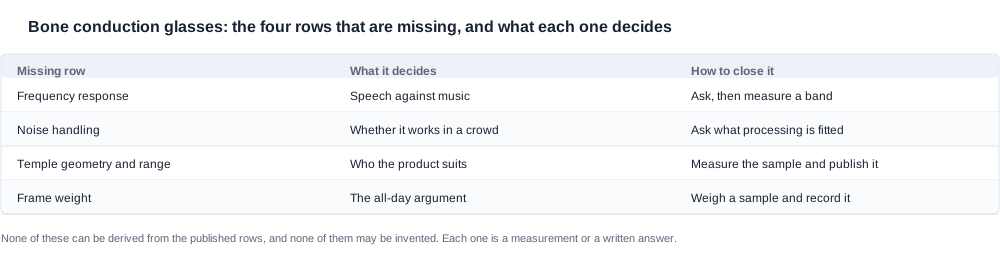
The four behavioural gaps
The four rows below decide the purchase, and each one is a behavioural question rather than a configuration question.
Frequency response decides whether the product is a speech product or a music product, and the difference is the difference between a product sold into a working environment and a product sold as a personal audio accessory.
Noise handling decides whether the product is usable in the environment the claim implies. A product with a 35 dB gain and no described noise processing amplifies a noisy environment exactly as faithfully as it amplifies speech, which is a performance characteristic a user will discover rather than a claim a brand can make.
Temple geometry and adjustment range decide who the product suits, and they decide the return rate. The seating of the transducer is a function of the frame geometry, and a frame that is not dimensioned cannot be sized, cannot be listed with a sizing note, and cannot be separated in the returns data from a genuine hardware fault.
Frame weight decides the argument for a product used through a whole working day. The weight is not published, and it is the parameter a competitor with a published figure will use, because it is the one that a customer feels without a specification.
How to close each one, and what closing it is worth
Frequency response and noise handling are written answers. They may be available from the supplier, in which case they go into the file and into the copy with their conditions attached. If they are not available, the honest response is a narrow listing that describes the product as an audio device with an amplification specification and says nothing about speech intelligibility in noise. That is a weaker listing, and it is a defensible one.
Temple geometry and the adjustment range are measurements. A buyer with a sample can record the dimensions, and the range can be established by trying the adjustment. The measurement is worth more than a supplier's description because it can be published and defended.
Frame weight is a measurement, taken on a sample with the same scope the buyer intends to use, and recorded against the model designation once one exists. A weight figure without a model designation cannot be attached to anything.
The ordering in that last sentence is not pedantry. Every published number in this catalogue is attached to a model designation, and this product does not have one.
The order the gaps should be closed in
The four gaps do not close in parallel, and the order is not arbitrary.
The model designation closes first, because a measurement or a written answer that is not attached to a model designation cannot be published, cannot be warranted, and cannot be referenced in a second quotation. The gain figure with its conditions closes second, because it is the parameter the claim rests on, and the conditions determine whether the claim can be made at all. The frequency response and the noise handling close third, because they decide the width of the copy. The temple geometry and the weight close last, because they are measurements, and a measurement on a sample is only worth taking once the sample can be identified.
There is a practical reason for that order as well. A written answer takes one email, and it can be requested in parallel with the designation request, because it does not need the designation to be requested — only to be attached. A measurement needs the physical sample and the ability to name it, so it comes last in practice even when it appears early on the list.

The documentation gap that is unusual even for this category
No model number
There is no model number allocated to this product. Everything else in our range has one. A product without a SKU cannot be listed cleanly, cannot be certified against a specific model, and cannot be warranted.
That single fact has a long tail. It is the key that the artwork uses, that the documentation file names, that the customs declaration carries, that the warranty record is written against, and that a second quotation has to match. A buyer who orders without one will acquire it later, and it will arrive after the artwork has been approved, which means the artwork has to be reissued.
The certification position, and the document set
The certification position for this product has not been provided. Certification at company level appears in the catalogue as a page of images rather than text, and the catalogue text contains no reference to CE, FCC or RoHS. There is no per-model certification row anywhere in it.
That means the correct question is not "is it certified" but "what exists, for which model, with which issuing body and which validity dates". The certification checklist sets out the form that answer should take, and the market compliance routes page is where the destination-market side is worked through. In this category, the answer may legitimately be that the classification has to be settled first, and that is a result rather than a failure — but it has to be a written result, because an assumed coverage is the most expensive kind of gap.
What the model designation unblocks
It unblocks the documentation file, the artwork, the customs declaration, the warranty record, the certification request and the returns record. It also unblocks the weights and measurements, because a measurement without a name cannot be quoted.
This is why the model designation is the first item on any list for this product, and why the order in which the other items are requested matters: a request for a frequency response sent before the designation is settled will come back attached to nothing.
What a first order should contain, and what we will mark as unknown
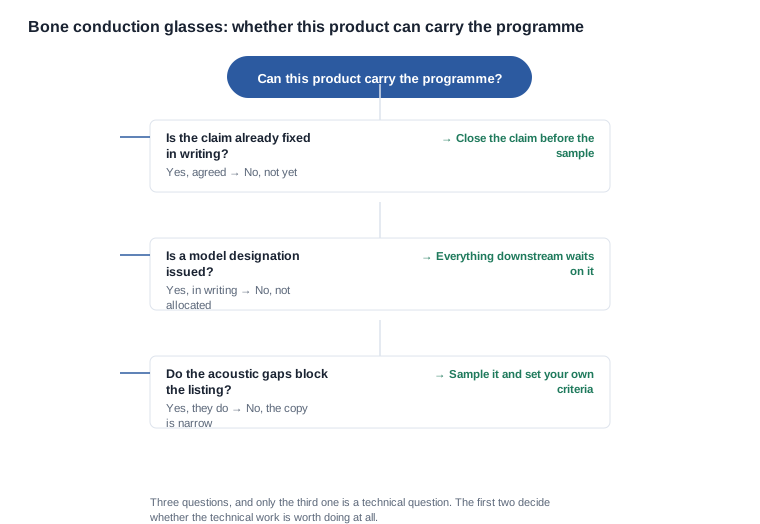
The written acceptance criteria
The published rows of a category with no published performance baseline are not a specification, and a buyer who has only the catalogue rows has no standard to inspect against. The standard has to be written, and it belongs in the purchase order.
A workable set for this product has four parts. The configuration: the model designation, the cell, the charging interface, and the rated runtime with the workload that produced it. The claim: the agreed wording, which constrains the copy and the packaging. The measurements to be taken on the first article: the dimensions, the weight, the gain figure with its conditions, and a defined intelligibility check, each with a pass condition written before the sample arrives rather than after it. The documentation set: the certificate position per market, and the file that travels with the goods.
Each of the four is a document rather than a promise, and each of them is cheap to write before the order and expensive to reconstruct afterwards.
The sample order, and what it has to establish
The sample in this category has to establish more than a first article, because the first article in a category with no published baseline has to become the reference for everything that follows.
Four things, and they are the same four that the acceptance criteria name. The designated unit: the sample that is kept as the reference, signed, versioned and sealed, with its configuration recorded. The gain figure: measured on the sample under conditions the buyer writes down before measuring, because a figure taken afterwards is a description rather than a protocol. The geometry: the temple dimensions, the adjustment range and the weight, recorded on that same designated unit. And the intelligibility check: a defined test — a source, a distance, an environment and a scorer — run with the audio running and the unit in place, because the behaviour of this product depends on seating and cannot be observed on a table.
The last of these is the one most often skipped and the one that determines the return rate. A unit that performs well on a desk and poorly on a head is not a defect; it is a product whose seating requirement has not been established, and the difference between those two descriptions decides whether the channel absorbs the cost.
What we will answer, and what we will mark as unknown
We can tell you the published rows for this product and we can tell you, precisely, what is missing and why each missing row matters. We will not fill in a frequency response, a noise figure, an adjustment range or a weight, and we will not help you build a marketing claim around an amplification figure whose compliance status we have never been shown.
We will also not characterise what the product does for a person's hearing. We hold no clinical data, no test protocol and no regulatory assessment for it, and we would be wrong to draw a conclusion from a single gain figure.
If you send us your target market, the wording you intend to use, and the environment it will be used in, we will tell you which parts of this list we can answer and which parts we will mark as unknown.
Four things to ask before the sample order
- The model designation, issued and confirmed in writing, with the date it will be fixed.
- The gain figure with its reference level, input signal, frequency band and measurement method.
- The frequency response and any adjustment range, or a written statement that neither is published.
- The certification position for the model in each destination market, or a written statement that none exists.
Related reading
- Where this category sits in our range — bone conduction glasses
- Verifying a supplier's claims — certification checks
- Market-by-market compliance routes — market compliance
Send the market, the claim you intend to make and the environment, and we will be direct about what we can support.


