
Bone conduction glasses technology: the case study is evidence
In this category there is no third-party acoustic measurement available for any model in the range. That absence changes what evidence is, and it is worth being explicit about the consequence: in bone conduction, a case study is not marketing collateral. It is the only measurement of the product's behaviour that exists, and if nobody runs one, the behaviour is simply unknown to everybody.
That framing produces two different jobs, and conflating them is the most common error in the category. A study you run yourself is evidence, because you control the protocol and you hold the record. A study a supplier sends you is an assertion until it can be checked field by field against a template. The template below is the admissibility test for the second case, and it doubles as the recording sheet for the first.
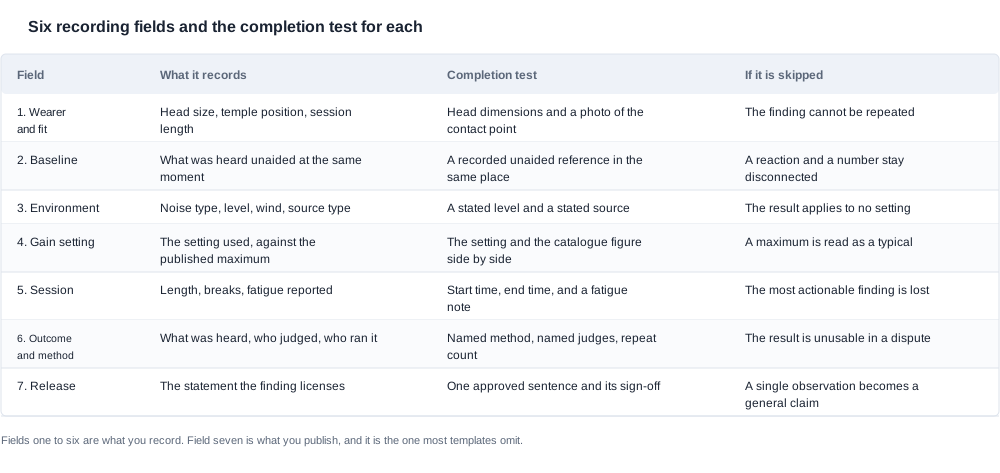
The template has six recording fields and one licensing field. The six recording fields are what you observe. The seventh field is the sentence you are allowed to publish afterwards, and its absence is what allows a single observation to escape into a general claim.
Who commissions the study, and what they are buying
The reader is a brand product lead or a channel buyer who has been shown a demonstration unit, and who now has to decide whether the behaviour survives a purchase order, a production lot and a listing. What they are buying is not reassurance. They are buying the ability to describe the product accurately to a channel reviewer, to answer a customer who asks whether it works, and to refuse a lot that does not behave like the sample.
Three situations recur, and each one changes what the study has to cover. The first is a brand about to publish a listing for a product it has never tested, where the study is being run to decide whether to publish at all. The second is a channel buyer who has already decided to stock the model and needs a record that survives a dispute with a supplier, where the study has to be reproducible rather than merely persuasive. The third is a product team comparing this entry against the open-ear models in the same range, where the study has to run on both so that the comparison is like for like.
What the buyer is afraid of is a finding that is true and still unusable — because it was recorded without a baseline, or at a gain setting nobody will ship at, or by a person whose judgement cannot be attributed. Those findings do more damage than no finding, because they get quoted.
The supply chain angle is worth stating plainly, because it is unusual. Because the published rows for this entry stop at five — a 35 dB amplification gain, a 200 mAh cell, charging in two hours or less, roughly seven hours of rated runtime and Type-C charging — a study is the mechanism by which the remaining rows get evidenced. The transducer type, the frequency response, the leakage, the microphone function, the contact geometry, the weight and the ingress rating are all Not published for this entry. A buyer who runs no study is buying a product whose central physical behaviour has never been recorded by anyone, including the factory.
The six fields, and the completion test for each
Field one: the wearer and the fit. Record head size, temple position, how long the session ran, and where on the skull the transducer actually sits. Because the transfer path runs through the skull, the fit changes the result more than it does for a conventional speaker, and two people wearing the same product can produce materially different outcomes. The completion test is head dimensions plus a photograph of the contact point. Skipping it means the finding cannot be repeated by anyone else, including you.
Field two: the baseline. Record what was heard unaided, in the same place, at the same moment, with the same source running. This is the field that separates a measurement from an impression, and it is the one most often left out because it feels redundant — the person running the test already knows what they heard without the product. The completion test is a recorded unaided reference. Without it, a gain figure and a reaction are two disconnected observations and neither one supports the other.
Field three: the environment. Record the noise type and level, whether there was wind, and whether the source was speech or a machine. A device that helps in a quiet room and fails on a road is doing what it was designed to do, and a study that does not say so invites a customer to test it in the wrong place. The completion test is a stated level and a stated source type. Skipping it means the result applies to no setting a customer will actually be in.
Field four: the gain setting. Record the setting used during the test, and write it next to the catalogue's 35 dB figure every time. That figure is a published maximum, and the gap between the maximum and the setting used is the difference between a defensible statement and an indefensible one. The completion test is the two numbers side by side. Skipping it means a maximum gets quoted as a typical, which is how the category's most aggressive number becomes indefensible.
Field five: the session. Record the length, the breaks taken, and any fatigue reported. The fatigue point is frequently the most actionable finding in the entire study, because it is the first thing that predicts a returns pattern. The completion test is a start time, an end time and a note. Skipping it throws away the most commercially useful observation the study produces.
Field six: the outcome and the method. Record what was heard, who judged it, who ran the test, and whether it was repeated. An unattributed result cannot be defended in a support dispute, and a result from one wearer cannot be generalised to a population. The completion test is a named method, a named judge, and a repeat count.
Field seven: the release. Write the single sentence the finding licenses, and have it approved before anything is published. This is the field that turns a study into a bounded statement rather than an open-ended one, and it is where most category templates stop one step too early. A study of one wearer in one setting, honestly recorded, licenses a sentence about that wearer in that setting — and it licenses nothing else. The completion test is one approved sentence with a sign-off and a date.
Designing the protocol before you open the notebook
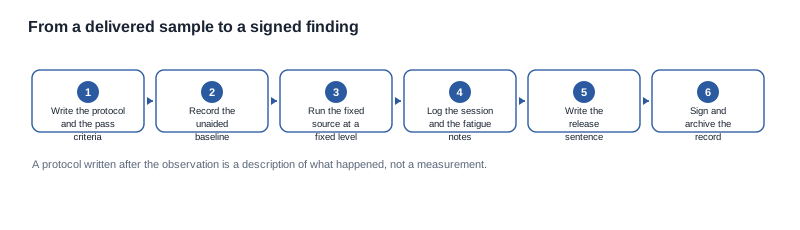
The protocol is written before the sample arrives, and that single rule is what separates a measurement from an impression. The protocol for this category is short, and it should specify: the source and its level, the distance and position, the gain setting and which published figure it corresponds to, the unaided baseline procedure, the session length, the number of wearers and the head shapes to be covered, the pass criteria, and who records what.
Three design decisions matter more than the rest. Use a repeatable source rather than a live environment for the fixed runs — a calibrated playback at a stated level — and reserve the live environment for the field observation, because a live source changes between runs and a protocol that depends on it cannot be repeated. Vary the wearers deliberately, at minimum across different head sizes, because in this technology the coupling is personal and a single wearer is an anecdote with equipment. State the pass criteria before the run, in the same terms as the purchase order, so that the study and the acceptance standard are the same document and a failing result cannot be reinterpreted afterwards.
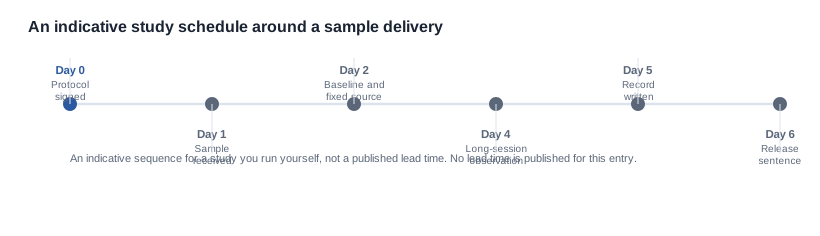
The study is cheap relative to what it replaces. It costs the sample, a sound meter, a pair of calibrated speakers if you do not have them, and the time of two or three people across a few days. What it replaces is considerably more expensive: an unsupported listing claim, a returns pattern that takes a season to diagnose, and a compliance question that arrives from someone who is not on your side.
How a study you did not run is checked field by field
When the study arrives from a supplier rather than from your own bench, the check is mechanical and fast, and it is done against the same six fields plus the release.
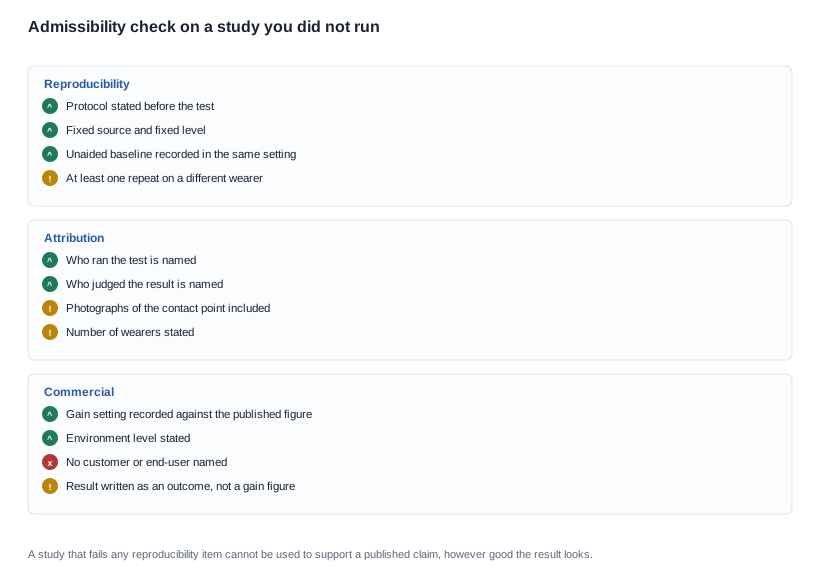
The protocol is missing, so the result cannot be repeated. The symptom is a study with a strong result and no stated conditions. The root cause is that the study was written as a narrative for a channel rather than as a measurement record. The prevention is to send the template to the supplier before the study is commissioned, so that the deliverable is specified in advance, and to treat a narrative as a missing protocol.
The baseline is missing, so the finding is an impression with a number attached. The symptom is a comparison between the product and normal hearing that nobody can reproduce, because the "before" was never recorded. The root cause is that the study was designed to demonstrate rather than to measure. The prevention is to require the unaided reference in the same setting at the same moment, and to refuse a study that presents only the amplified condition.
The gain setting is missing, so a maximum is presented as a typical. The symptom is a published claim quoting 35 dB when the setting used was lower. The root cause is that the setting was assumed to be the maximum because the maximum is the number in the catalogue. The prevention is to require the setting next to the published figure, and to check the two.
The number of wearers is missing. The symptom is a general statement built on one observation. The root cause is that the study was designed to answer a marketing question rather than a procurement one. The prevention is to require the repeat count, and to set a minimum in the request.
The judge is not named. The symptom is a result that cannot be attributed when a channel asks how it was obtained. The root cause is that the study was written for publication rather than for the file. The prevention is to require the method and the judges to be named, and to accept that an unattributed result is not usable in a dispute even when the result is good.
A named customer or end user appears. The symptom is a study that cannot be published because it identifies someone, or one that creates a privacy exposure. The root cause is that the supplier's version of a case study and the buyer's version of a measurement were treated as the same document. The prevention is to write the privacy condition into the request, and to ask for the study to be recorded with roles rather than names.
What a study is worth commercially, and what we will sign
A study is commercially worth the risk it removes, and the risk it removes is larger than most buyers expect. Three numbers frame it. The first is the rework cost of a listing that has to be pulled: one artwork round per affected asset, across the product page, the packaging, the instructions and the marketplace metadata, and a schedule that moves by the length of that round. The second is the inventory exposure if the description is challenged after the goods have landed, which is a function of the order value and the time the goods sit. The third is the cost of a returns season, which is paid in freight, handling, refunds and a support load that lands on the team that has the least capacity to absorb it.
What can be negotiated around a study is the support for it. Whether the supplier provides the sample at no charge, or sells it at cost, or includes it against the first order. Whether the supplier supplies the protocol conditions in writing so that your measurement matches the demonstration. Whether the supplier reviews the completed record against its own published rows before it is filed, which is a service worth having even where it is not a contractual obligation. Whether the pilot quantity can be sized so that a first finding arrives before the production commitment. And whether the acceptance clause can reference the study's pass criteria directly, so that the study and the purchase order are one instrument rather than two.
What cannot be negotiated is the study's independence and its cost. The measurement has to be run against a written protocol, and it has to be run by someone whose name is on the record; a study whose conclusion was fixed before the protocol was written is not worth the paper. The supplier cannot author a finding and then present it as an independent measurement of your own unit, and no commercial term should be offered in exchange for a conclusion you have already reached.
The clauses to write into the purchase order are specific. That the study protocol is attached and that the pass criteria in it are the acceptance criteria for the first lot. That the record is delivered with the first shipment. That the release sentence is the only statement approved for customer-facing use, and that any change to it re-enters approval. And that the study does not name an end user, because the buyer will be asked about that in a due diligence review and will not have an answer.
A worked scenario: a channel buyer who needs a record, not a demonstration
What follows is a constructed example, not a client project, and it sets out the order of the steps rather than what they produced.
Assume a channel buyer who has been shown a demonstration unit by a supplier and wants to stock it for a specialist retailer. The buyer's real question is not whether the product works; it is whether the product works in the retailer's environment, and whether they can say so in a way the retailer's buyer will accept. The supplier has offered a case study. The buyer has a week.
The decision on the offer. The buyer applies the admissibility check rather than reading the narrative. The study has no protocol, no baseline and no stated number of wearers, so it is inadmissible as evidence and is filed as an assertion. That decision costs ten minutes and it prevents a narrative from entering the buyer's own documentation.
The protocol. The buyer writes a protocol with a fixed source at a stated level, the unaided baseline in the same setting, the gain setting recorded next to the published 35 dB figure, a session across three head sizes, and pass criteria written in the same terms as the purchase order. It is sent to the supplier, which means the supplier knows in advance what will be measured — and it is also sent to the retailer, who agrees the environment and the setting.
The run. The baseline is recorded first, then the fixed source at the stated level, then the long session. The fatigue note from the four-hour mark is the most useful line in the record, because it is the one that predicts behaviour in a retail environment where the product is worn through a shift.
The release. The buyer writes one sentence that the finding licenses, and it names the setting: amplified listening in a noisy retail environment, at a stated gain setting, across the tested wearers. The sentence is approved by the compliance contact, because a sentence about a hearing benefit would need a different route than a sentence about a mechanism. It becomes the only statement the buyer may publish, and it is the only one the support script quotes.
The commercial step. The buyer negotiates the pilot quantity down so that the first delivery is the study units plus a small run, and attaches the protocol to the purchase order as the acceptance criteria for the first lot. The result is a first order that carries its own evidence, a support script with one sentence in it, and a defensible answer ready for the retailer's own due diligence.
What we will sign, and what we will not
We will support a study, and we will review a completed record against the published rows and say which observations are consistent with them and which are not. We publish the 35 dB gain, the 200 mAh cell, the charge time of two hours or less, roughly seven hours of rated runtime and Type-C charging, and we publish the absence of a model designation, of any customisation capability, and of any measured performance data for this entry with the same prominence. We will not estimate a figure we do not hold, and we will not supply a case study with results that nobody measured.
We will not write a hearing-improvement claim, and we will not present an amplification figure as an outcome. We will not publish a finding that names an end user, and we will not sign a release sentence that the record does not support — including a sentence that is more favourable than the evidence, which is the request we decline most often. The technical background is under bone conduction audio technology, the regulatory boundary is set out under medical device boundary, and the specification behind the published rows is under bone conduction key specifications.
Three things to send with a completed template
Send the protocol before the study, not the study after it. We will tell you which of the conditions in it we can confirm from the published rows and which we cannot, and we will say where a field has no published value behind it.
Send the completed template from a sample. We will mark the fields that are consistent with the published figures, the fields that describe a condition rather than a product, and the sentence the finding licenses.
Send the release sentence you intend to publish. We will tell you whether it describes a mechanism or asserts a benefit, because those two sentences travel through entirely different approval routes. The range is under bone conduction glasses range, and the sample route is under sample evaluation.
Related reading
- The claims this category can carry — bone conduction manufacturer claims
- Where the numbers come from — bone conduction key specifications
- The same discipline applied to a spec sheet — how to read a bone conduction datasheet
Send us a completed template from a sample and we will tell you which findings are consistent with our published figures.


