

A bone conduction datasheet is short, and almost every row on it is a rated figure with its conditions removed. Bone conduction glasses technology smart glasses how to read a datasheet is therefore less about decoding what is written than about noticing what is absent: the acoustic rows that would let you compare two products are the ones a supplier sheet omits, and the electrical rows that are present are the ones that cannot decide the purchase. Read the sheet in seven rows, mark three things while reading, and you will have an output you can put in a comparison table — plus a short list of questions that a sample test will have to answer.
Our range publishes one bone conduction specification: 35 dB of amplification gain, a 200 mAh battery, a charge time of two hours or less, a rated runtime of about seven hours, and Type-C charging. The model designation is not published, and neither are the acoustic details behind the gain figure.
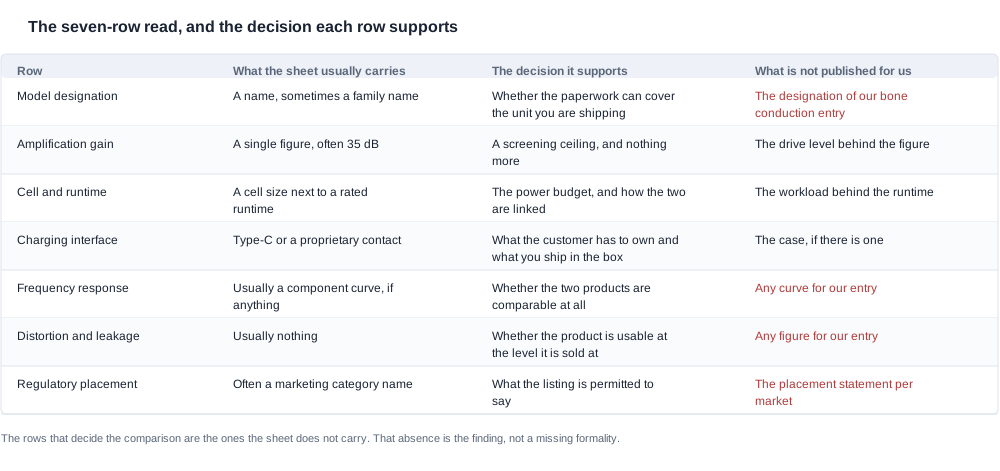
Bone conduction glasses technology: a short sheet omits the deciding rows
Reading the sheet in one paragraph
Read the sheet in seven rows: model designation, gain figure, runtime and cell, charging path, the acoustic rows, the regulatory position, and what is not in the sheet at all. The gain figure decides the least of the seven and is the row a buyer reads first, because it is the only number that looks like a quality measure. Read the sheet for what it does not say, because in this category the missing rows are the ones that decide the comparison, and the absence of a row is itself a procurement finding.
Who is reading this, and what they are holding
A buyer reading a bone conduction datasheet is usually deciding between a bone conduction product and an open-ear one, or between two bone conduction suppliers, and holds a unit price, a channel and a target customer. What they do not have is a picture of the acoustic behaviour, and the reason is structural: the acoustic rows are generated by the transducer supplier, and the assembly factory receives them as a component specification, if it receives them at all.
The practical consequence is that a datasheet comparison in this category produces a near-tie on the published rows, and the tie has to be broken by a sample test rather than by more reading. Reading the sheet properly is therefore about knowing which questions to put to a supplier and which to put to a test.
There is a second audience, and it is the one that decides whether the product can be sold at all: whoever writes the listing. For them the practical question is what sentence the evidence supports, and the answer in this category is almost always narrower than the sentence they want to write.
What a bone conduction buyer is trying to avoid
Treating the gain figure as a quality measure. Decibels are logarithmic, so six decibels is roughly a doubling of sound pressure. A gain figure asserts an electronic gain applied to a signal and nothing more, and two products carrying identical gain figures can differ by an enormous margin in usefulness.
Reading a rated runtime as a result. Our catalogue publishes about seven hours alongside a 200 mAh cell, exactly like every runtime in the range, and the bone conduction entry is no exception: no test condition is published for it.
Copying a category name into a listing. In the United States, the FDA regulation at 21 CFR 800.30 defines an over-the-counter hearing aid as an air-conduction device intended for a person aged eighteen or older. A bone conduction product is neither air-conduction nor a hearing aid, and it cannot be sold in that category. The legitimate positioning is a personal sound amplification product. We make no health claim for any of our products, in any market.
Assuming the acoustic behaviour transfers between suppliers. It does not, and it is the single most expensive assumption available in this category.
The thresholds that turn a gain figure into a comparable product
This table is the second half of the datasheet read: the rows to request when the sheet does not carry them.
| Row to request | The pass line | What a soft answer sounds like |
|---|---|---|
| Model designation, exactly as it appears on the document | One string, matching the certificate | A family name |
| Amplification gain, with the drive level | A figure plus the input level that produced it | "35 dB" with no condition |
| Frequency response, measured on the product | A curve or a stated band on the assembled frame | A component datasheet |
| Distortion at the working level | A percentage at a stated gain and signal | "Low distortion" |
| Pressure required to deliver sound | The force the frame must apply against the head | Not offered |
| Leakage to a nearby listener | Measured at a stated distance and working level | Not offered |
| Runtime, with the workload | A figure plus the load it was measured under | "About 7 hours" |
| Regulatory positioning, per market | The category the product is placed in, per market | "Classified as a hearing device" |
| Certificate numbers | Numbers naming the exact model designation | A family-level document |
Read the designation character by character
A datasheet is the document a compliance file is built from, and a designation that does not match across documents is a traceability failure that surfaces at customs or at a warranty claim — long after the point at which it could have been corrected with one line in an email. Our own catalogue is a working example of how the problem starts: the entry appears as "L2 Utral", the catalogue notes that "Utral" appears to be a typographical rendering of "Ultra", and it carries two parallel variant names, "Utral" and "Pro Max", without publishing which configuration either of them belongs to.
Read the gain figure as a maximum capability rather than a condition
A result achieved at a lower setting is a different result from one achieved at the maximum, so the sheet's gain figure tells you the ceiling and not the working point. Two suppliers quoting the same number at different input levels are quoting different products, and the only question that separates them is the drive level — which is why that question has to be asked before the comparison table is built rather than after.
Read the cell against the runtime, and ask what sits between them
A 200 mAh cell published alongside a roughly seven-hour runtime is a rated figure with no test condition, exactly like every runtime in our catalogue. It also tells you something useful: the product's load is light, because the ratio is generous for a cell of that size. A buyer who asks what the workload is discovers whether the seven hours describes continuous audio or continuous audio plus something else, and the answer changes how the figure may be used.
Read the charging row for what it commits you to
Type-C is a path with a defined cable ecosystem. A proprietary contact is a path where the charger becomes a consumable that has to be in the box and in the instructions, and that is a packaging decision as much as an electronics one.
Read the acoustic rows that are not there as the finding
Frequency response, distortion at working level, pressure requirement and leakage are the four rows that decide the comparison, and a sheet that carries none of them is a sheet that cannot answer your question. Treat the absence as a finding to record, not as a formality to skip.
Reading the sheet and closing the gaps on a sample
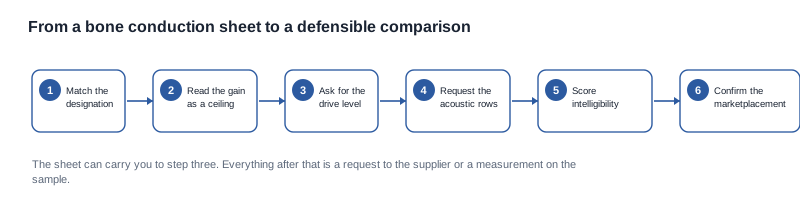
1. Match every row on the sheet against the certificate numbers and the model designation. If the designation on the datasheet does not appear on the certificate, stop there. A document that cannot name the product cannot cover it.
2. Check the certificate numbers in the issuing body's public register. Confirm the model designation, the covered functions and the validity date. It takes minutes and it is the highest-yield check in the category.
3. Ask for the gain figure with its drive level. Two suppliers quoting the same number at different input levels are quoting different products, and neither of them is wrong.
4. Ask for a product-level frequency response and treat a component curve as a soft answer. A component curve excludes the frame, the transducer seating and the fit, which are exactly the parts that differ between two finished products.
5. Ask what happens to the product when the cell is empty, and get the answer in writing. It goes in the instructions, in the manual and in the customer service script. A device whose behaviour at the end of its charge has never been described is a device whose behaviour at the end of its charge will be described by a customer.
6. Run the sample test, because the sheet cannot close the comparison. Same script, same distance, same presenter, in a quiet room and a noisy one, at a matched output level rather than a matched volume setting. Have the far end score intelligibility, because intelligibility is what the customer experiences and volume is not.
7. Confirm the regulatory placement for each market before the copy is written. The decision chart below sets out the three positions and what each one permits you to say.
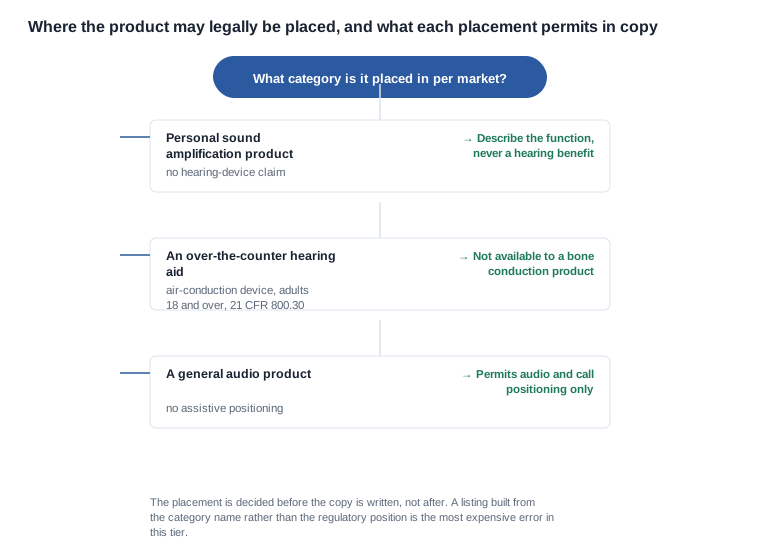
The regulatory placement is a procurement decision, not a copy decision
The category a product is placed in determines what the listing may say, and the placement is decided by the product's construction and by the market, not by the copywriter's choice of words. A bone conduction device is not an air-conduction device, and the over-the-counter hearing aid definition in the United States at 21 CFR 800.30 turns on exactly that distinction.
The commercial consequence is straightforward. A product that is positioned as a personal sound amplification product can describe what it does. A product positioned as a hearing device invites a regulatory framework the supplier has not entered, and the framework does not care what the copy says. In the European Union, Bluetooth-enabled products in this category sit inside the radio equipment framework, and the category placement determines the declaration and labelling obligations that follow.
The rule we hold ourselves to is simple: describe the function, name the technology, and make no claim about anyone's hearing, eyesight or health, in any market. A buyer who wants to go further needs advice from someone qualified for the target market, and that advice is not something a factory catalogue can substitute for.

Where a bone conduction datasheet is misread
Two products are shortlisted on the gain figure and the wrong one is chosen. The symptom is a product that performs well on a bench and disappoints in a call. The root cause is that the gain figure was read as a quality measure rather than as a capability ceiling. The prevention is to shortlist on the four acoustic rows, and to break the tie on the sample test.
A datasheet designation and a certificate designation do not match. The symptom is a customs query or a warranty claim that cannot be settled. The root cause is that the sheet was read without cross-checking the paperwork. The prevention is to make the cross-check a step in the read, and to treat a mismatch as a stop condition rather than a query.
A runtime figure is copied into a listing and the customer complains. The symptom is a complaint that the product runs out earlier than the page says. The root cause is that a rated figure with no condition was published as a result. The prevention is to state the workload next to the figure, or to publish the figure you measured on your own units.
The product is loud but the customer cannot follow the call. The symptom is a complaint about sound quality rather than volume. The root cause is that distortion at the working level was never measured, because the sheet carried a gain figure and a buyer read that as sufficient. The prevention is to test the sample for artefacts and score intelligibility at the far end.
A listing describes the product as a hearing device. The symptom is a regulatory query, a marketplace takedown or a withdrawal request. The root cause is that the copy was written from the category name rather than from the regulatory position. The prevention is to run the copy past someone qualified for the target market, and to keep the positioning to personal sound amplification.
A transducer is substituted and the acoustic behaviour moves. The symptom is a sound character change between two deliveries of the same product. The root cause is that the transducer was never a named line item. The prevention is to make the transducer part of the change-control list with a notice obligation attached.
What the acoustic evidence is worth commercially
Negotiable, and this is where the effort belongs. The willingness to supply the product-level frequency response and the drive level behind the published gain is a documentation request, and a supplier who answers it has a measurement habit. The willingness to run the intelligibility protocol against production units rather than engineering samples is negotiable and is worth more than a unit price concession, because a bone conduction product's behaviour is unusually sensitive to assembly consistency — the transducer has to seat correctly against the head, and seating is an assembly variable. Whether the protocol applies to the first shipment only or to every shipment is a negotiation. Volume tiers, the packaging and insert artwork, the market labels and the payment node structure are the standard positions to work through, and the regulatory placement statement per market is the document worth having in writing before any of them is settled. The regulatory placement statement per market is a document you should get in writing, because it is the document that supports the copy.
The acoustic engineering and the gain test bench are settled before the order is negotiated. A bone conduction product is bought on the promise of an acoustic result, so the transducer seating and the gain test bench are the two lines that decide whether the published figure means anything. Ask what the bench measures — a bench that reads a driven signal rather than a radiated one produces a number that looks like a gain and is not one. Tooling for the acoustic path is a one-off setup carried by the first order. Also not negotiable is the acoustic engineering itself: a supplier who will not change the transducer, the frame geometry or the firmware tuning is telling you the product is fixed, and the programme should be built around that fact rather than against it.
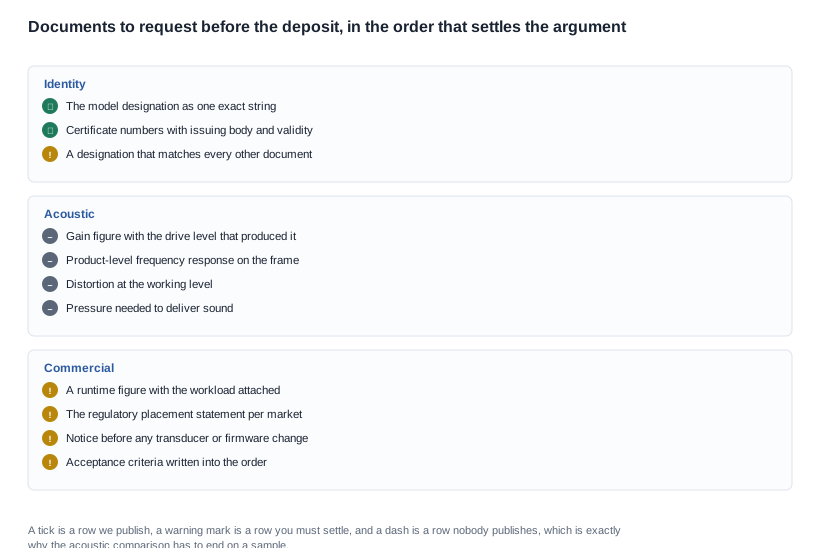
Documents to request before the deposit. The model designation written on the quotation. The certificate numbers with the issuing body and the validity dates. The gain figure with its drive level. The runtime measurement condition. The regulatory positioning statement for each target market.
Clauses to write into the contract. The model designation as a line item, with the certificate numbers attached. The acceptance criteria for the sample, referencing the intelligibility protocol and the conditions attached to it. A clause on the regulatory positioning per market, with the buyer holding the right to require the copy be amended. A clause requiring notice before any change of transducer, firmware or frame geometry. And a clause that puts the cost of a transducer seated badly enough to change the sound character back on the supplier.
A worked scenario: two candidates for a working channel
A buyer comparing two bone conduction sheets that both carry the same gain figure has to test rather than compare, and the six steps below are the order in which that test gets written.
Assume a brand product manager evaluating a bone conduction candidate against an open-ear candidate for a working channel where people need to hear colleagues and their own devices at the same time. The binding constraint is not price and not the gain figure; it is that the channel's previous audio product generated complaints about not being able to hear a colleague at the same time as the device.
Step one is the sheet read. The bone conduction candidate's sheet carries a gain figure, a cell, a runtime and a charging interface. The open-ear candidate's sheet carries a driver description and the same class of electrical rows. On the published rows the two are effectively tied, and the manager now knows that the published rows cannot decide this.
Step two is the acoustic request. The manager asks both suppliers for the same four rows: the product-level frequency response, the distortion at the working level, the pressure required to deliver sound, and the leakage to a nearby listener. The bone conduction supplier answers with the drive level behind the gain and offers a product-level curve; the open-ear supplier answers with a component curve and a feature name. The manager notes the difference in evidence quality rather than in performance, and does not draw a performance conclusion from it.
Step three is the sample test. Same script, same distance, same presenter, quiet room and noisy room, at matched output level rather than matched volume setting, with the far end scoring intelligibility. The bone conduction candidate wins intelligibility in the noisy room and the open-ear candidate wins it in the quiet one, and the leakage measurement then separates them on a row the manager had not originally weighted.
Step four is the placement. Before any copy is written, the manager confirms the regulatory position for each target market and keeps the positioning to personal sound amplification, with the copy describing the function and making no hearing claim.
Step five is the commercial response. The manager negotiates the transducer and the acoustic configuration into the purchase order as line items with a notice obligation, which means the acoustic behaviour cannot move silently between deliveries.
The decisive rows were the two the sheet did not carry, and the gain figure played no part in the decision at all.
What our bone conduction rows publish and where the boundary sits
The specification we hold is published and the rest is marked as open, and a buyer who establishes the acoustic rows by measurement is in a better position than one who accepts a gain figure as a proxy for them. We publish the 35 dB gain, the 200 mAh cell, the charge time of two hours or less, the roughly seven-hour rated runtime and the Type-C interface. We publish no frequency response, no distortion figure, no leakage figure, no microphone pickup distance, no model designation and no customisation capability for this category, and we will not estimate any of them from typical values, because the whole point of this read is that a typical value is a number no test in your programme produced.
We also make no health claim for any of our products, in any market, and we would advise anyone building a listing in this category to run the copy past someone qualified before it goes live. The 35 dB figure is a gain figure and we will not describe it as a hearing, medical or assistive benefit, in any wording.
What we will do is supply units and a written test script, and tell you plainly which of the seven rows our documentation can answer today and which have to come from a measurement. The category background is under bone conduction audio, the specification row by row is in bone conduction spec sheet explained, the test side is in how to test before ordering, and the alternative form factor is under open-ear audio.
Three requests for the bone conduction sheet
Mark the sheet in two colours. One colour for the rated figures with no condition attached. One colour for the rows the sheet does not carry at all. The second colour is the list of questions you take to the supplier.
Send the four acoustic rows in one request, plus the drive level behind the published gain. Five questions, and each one either exists or does not.
Send us the two products and the environment, and we will write the comparison script with you. We will say which rows our documentation answers, which have to be measured, and where the copy boundary sits.
Related reading
- The category and its published specification — bone conduction audio
- The alternative form factor — open-ear audio
Tell us the two products and the environment, and we will write the comparison script with you.


