

Bone conduction glasses technology: claims are compliance documents
Bone conduction is the category where a manufacturer's language travels furthest from the engineering, and the reason is structural rather than dishonest. A gain figure of 35 dB sounds like a hearing specification, and the regulatory question in this category is decided by how the product is described rather than by what it does. The claim and the compliance position are the same thing, which makes reading a claim sheet a compliance exercise before it is a technical one.
Three questions settle most of it. Does the phrase name a device class, such as a hearing aid or an assistive device? Is there a number with no condition attached to it? Does it describe a result the wearer experiences rather than a mechanism the device performs? If all three answers are no, the sentence can go onto a product page and be defended. If any answer is yes, the sentence needs work before the artwork is approved, and the work is cheaper now than after the packaging is printed.
What our own documentation holds for this platform is one line: a 35 dB amplification gain; a bone conduction transducer; a 200 mAh cell; a charge time of up to two hours; a rated runtime of approximately seven hours; and Type-C charging No model number, no certification status, no disclosed customisation capability, no acoustic figures, no weight and no ingress rating. That is the entire evidence base behind the sentences we are willing to sign.

Who signs off on the wording, and when
The buyer in this category is usually a brand-side product manager or a sourcing lead who has been handed a supplier PDF, a sample and a target market, and who has to turn three things into a purchase order: a product, a set of claims and a file. The category makes the third of those unusually hard, because the specification that normally anchors a comparison does not exist here in comparable form. A camera programme can be compared against sensor datasheets; a gain figure in decibels, stated without a method, can only be replicated or ignored.
Three fears drive the timing, and each one has a deadline that is not the supplier's deadline. The first is a claim that cannot be defended: a listing that says a product is hearing-aid level, or that it eliminates ear fatigue, and a customer or a marketplace reviewer who asks for the basis. The second is a certification gap discovered after the artwork is locked, when the certificate turns out to name a different model, or to cover a different route entirely. The third is the opposite failure, where the copy is so cautious that the product sounds worse than it is, and the channel refuses to carry it.
There is a fourth buyer in this category, and she is the one who usually decides the launch date: the person who writes the listing. For her, the practical question is which sentence the evidence supports, and the answer is nearly always narrower than the sentence she wants to write. A claim sheet review that happens before the product page is drafted removes that person from the negotiation entirely.
So the sign-off order matters more than the sign-off list. The compliance position should be settled before the claims are written, and the claims should be written before the artwork goes out. Reversing that order is the standard way a programme ends up re-printing its own packaging.

Why two suppliers can quote the same gain and land in different regimes
The economics of this category explain why confident claims are cheap to make and expensive to inherit. A bone conduction platform is a small bill of materials built around one unusual component: the transducer that converts an electrical signal into the mechanical vibration the frame carries to the temple. That single component sets the acoustic behaviour of the whole product, and it is the part with the fewest qualified sources. Everything else in the bill — the cell, the charge circuit, the radio, the frame, the hinge — is a commodity sourced from the same pool as every other wearable in the catalogue.
That asymmetry is the commercial root of the problem. A factory competing on a commodity electronics platform can reach parity with a competitor on cost, so the differentiator has to be somewhere else: the claim. When two suppliers quote the same 35 dB figure, they are not quoting the same product, and neither is quoting an auditable measurement. The figure describes an electronic gain applied to a signal upstream of the coupling, and the part that actually reaches the wearer — the coupling through the frame into the skull — is the part nobody publishes. A supplier who states the figure without a condition is not hiding anything; they are quoting the one number that is easy to quote and impossible to compare.
The second driver is regulatory arbitrage. A product described as a hearing aid or an assistive device is pulled into a framework with clinical evaluation and conformity assessment obligations. The same hardware described by its mechanism is not. Two suppliers with equivalent factories can therefore reach two different markets with the same unit, and the description is what decides which one they have entered. This is why a buyer should treat the wording on the supplier's own material as part of the technical due diligence rather than as decoration: it is the first place a supplier's intended route becomes visible.
The third driver is simply the thinness of the published category. When a buyer compares audio platforms; there is a chip version; a cell capacity; a runtime; and a charging method and an interface for each model When a buyer compares bone conduction platforms, there is one entry with six rows and no model designation. With nothing to compare, the copy does the comparing. A buyer's negotiating position is strongest when it is anchored on measurement and weakest when it is anchored on adjectives, which is the opposite of how most supplier conversations in this category actually run.

The wording ladder, from mechanism to outcome
This is the part of the review that gets skipped, and it is the part that decides the outcome. The four steps below are ordered by how much of your legal position they consume. A sentence that sits on the first rung can be repeated verbatim; a sentence on the fourth cannot be used without evidence the category does not have.
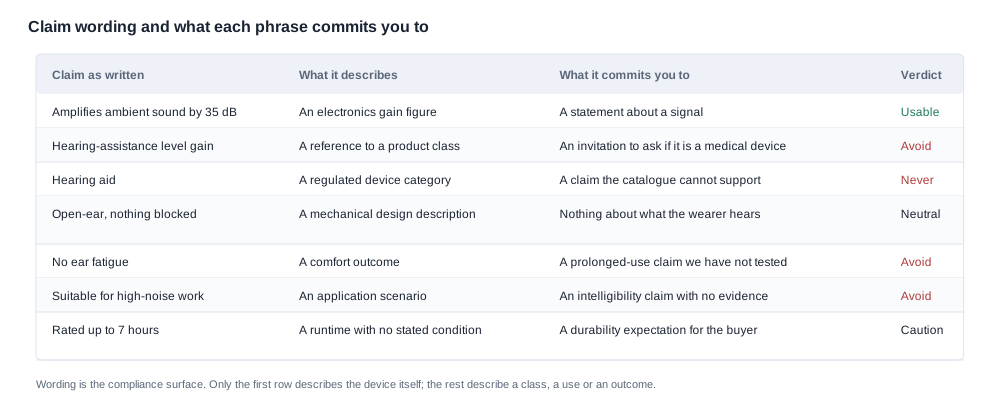
Rung one: the mechanism, with a figure. "Amplifies ambient sound by a published 35 dB." It states what the device does to a signal, it is the figure our documentation records, and it makes no claim about hearing, impairment or an outcome. The condition to keep in mind is that the figure is an electronics measurement and the sentence should be written so that it stays one.
Rung two: the design description. "Open-ear, so nothing is blocked" describes a mechanical arrangement and nothing more. It is defensible, and it is also nearly empty: what actually determines whether a wearer hears their surroundings is leakage, how much transmitted sound escapes into the environment and how much ambient sound reaches the ear. We publish no leakage figure for this entry, and neither does most of the category. Use the sentence for what it is.
Rung three: the class reference. "Hearing-assistance level gain" is a step closer to the boundary, and the step is small but real. It describes the product by reference to a medical category rather than by its function. In the United States, the over-the-counter hearing aid framework at 21 CFR 800.30 defines a hearing aid as an air-conduction device for adults with mild or moderate hearing impairment, with personal sound amplification products outside that definition. A bone conduction product is not an air-conduction device, and describing it by reference to that class creates a claim our documentation cannot support. In Europe, the medical device framework under Regulation (EU) 2017/745 is the equivalent test, and a product that describes itself as a medical device enters a route with clinical evaluation requirements. The sentence is the one to replace.
Rung four: the outcome. "No ear fatigue." "Suitable for high-noise work." "Helps you hear conversations." These describe a result for the wearer, and results in this category are governed by two variables that nobody publishes: the coupling through the frame, and the individual wearing it. A supplier who asserts an outcome without data is not necessarily wrong, but the assertion cannot be transferred to your listing, because you will not be able to defend it to a customer or to a regulator.
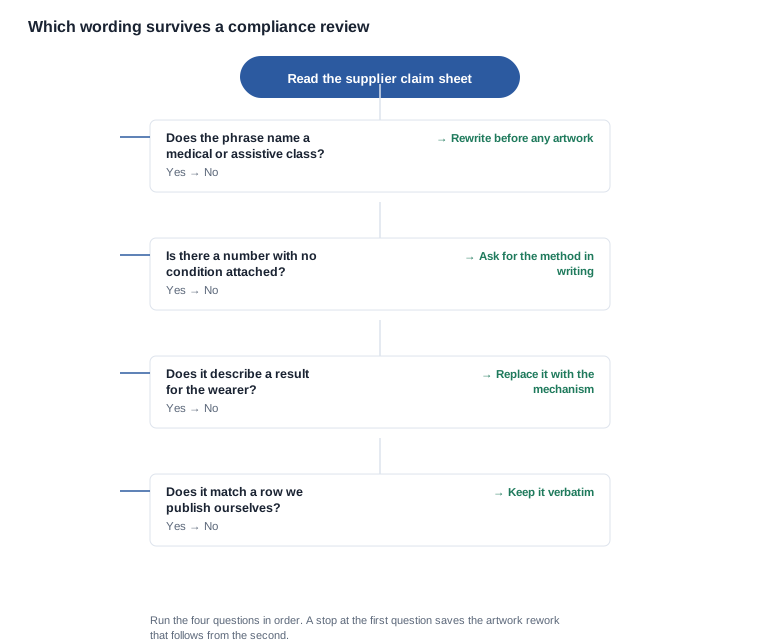
Two thresholds make this ladder operational rather than academic. The first is the rewrite rule: any sentence that names a device class is replaced, not qualified. "Hearing-assist level" does not become "hearing-assist level for situational awareness", because the class reference survives the qualifier and the qualifier is what makes it indefensible. The second is the attribution rule: a sentence that states an outcome is only usable if it can be attributed to a specific, named, dated test with a stated condition. Until then it is a design hypothesis, and it belongs in an internal document rather than in a product page.
Turning a claim sheet into a signable file
The review is short, and each step assumes the one before it passed. A failure at any step tells you what the next step would have told you, which is exactly why the order matters and why a claim sheet should not be read end to end in one pass.
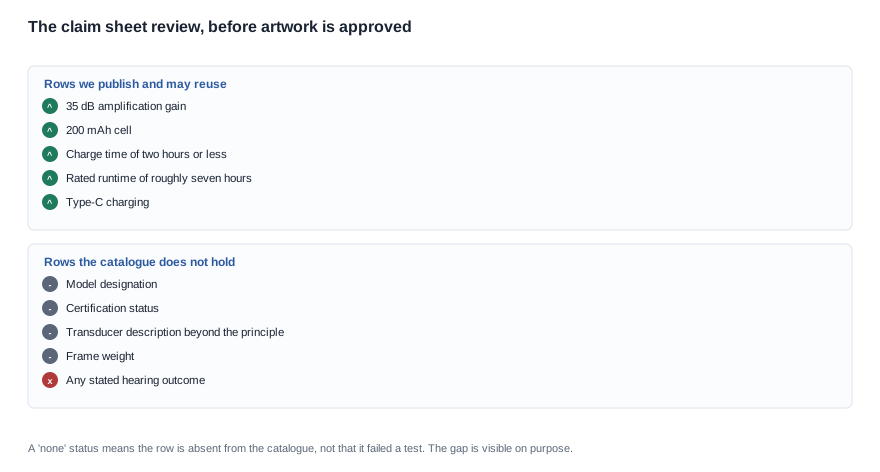
Step one: pull every number out of the material, including the ones in the pictures. Gains, runtimes, capacities, distances, weights, counts of microphones, claims about noise reduction. Build a single list. Every item on that list is either a row we publish, a row the supplier publishes with a condition attached, or a row nobody can explain. The third category is the finding, and it is much cheaper to find it at this stage than during the artwork review.
Step two: for each number, ask what it is a measurement of. A gain figure can be a measurement of the electrical signal, of the transducer output, or of the level at a defined reference point. These are three different quantities that are frequently printed with the same unit. A runtime can be measured at maximum gain, at a typical gain, or under a mixed workload of calls and playback. If the supplier cannot state the condition, the number may still be true and still be useless for comparison.
Step three: ask for the route, in writing, for your market. Not the route the product has elsewhere — the route it will take where you are selling. If the supplier's material already names a device class, that answer has effectively been given. This question is a legal question rather than a technical one, and it should be resolved before product work rather than in the middle of it, because a route can add cost, add elapsed time and remove claims from the copy at once.
Step four: map each surviving sentence to the evidence that supports it. A sentence supported by a row we publish needs nothing further. A sentence supported by a supplier document needs that document attached to the file, with the model designation and the issuing body recorded. A sentence supported by nothing is cut. There is no fifth category, and a programme that creates one is a programme that has found a legal question it would rather not answer.
Step five: write the approved wording into the purchase order rather than into an email. The sentences your brand is allowed to use are a contractual term, not a preference. If a future catalogue revision introduces a phrase that has not been cleared, the purchase order is the place where it is caught.
A useful discipline for step five is to keep a single wording sheet per product, with three columns: the sentence as it appears, the evidence it rests on, and the date the evidence was received. When the file is transferred to a second market, the sheet travels with it, and the second market does not have to re-derive the position.
Where the wording goes wrong, and what it costs
Four failures account for most of the rework in this category, and each one has a recognisable symptom before the cost lands.
A class phrase reaches the listing. The symptom is a customer or a marketplace reviewer asking why the product is described as a hearing aid, followed by a takedown and a reprint. The root cause is that the class phrase came from the supplier's own marketing and was treated as a description rather than as a claim. The prevention is a written rule that no listing in the channel may use a device-class phrase, applied to copy written by agencies and freelancers as well as copy written in-house.
A gain figure is published as a loudness promise. The symptom is a review that says the product is much quieter than advertised, and a return rate that concentrates in one channel. The root cause is that a number in decibels was treated as a volume. The prevention is a single approved sentence for the gain, used everywhere, with no paraphrase.
A runtime is quoted without its condition. The symptom is complaints in the first month of use from customers running the amplifier continuously rather than intermittently. The root cause is that a rated figure was published as a result. The prevention is to publish the condition next to the figure, and to state that the figure is rated rather than tested.
An unevidenced outcome survives into a channel brief. The symptom is a retailer or a distributor asking for the substantiation behind a sentence that was written for a trade show. The root cause is that the sentence was approved as copy rather than as a claim. The prevention is the attribution rule above, applied at the artwork gate rather than at the retailer gate, where it is five times more expensive.
The commercial terms that actually move
The unit price in this category is the least interesting number on the quotation, because it is the one that moves least and because the costs that actually decide the total are documentary. What a buyer can negotiate, and should spend the negotiation time on, is the configuration and evidence scope.
Negotiable: the number of model designations committed to, and whether the quoted price covers one or several; the per-colour and per-configuration minimum, which is where a per-configuration factory cost actually moves; the artwork round count, which is a factory scheduling item rather than a design item; the sample order terms, including how many evaluation units are supplied and whether they are credited against a first production order; the packaging scope, and whether artwork preparation is included; the retention held against the documentation package; and the delivery structure, including whether a split shipment is permitted at the brand's request rather than only at the factory's convenience.
Not negotiable, and worth saying early: the cost of the compliance route itself, because it is a fixed cost per configuration and a queue that the factory does not control; the laboratory fee and elapsed time; the tooling character, which is a one-off cost usually amortised across the first order rather than a rate that can be haggled; and the acoustic behaviour of the product, which is set by the transducer and the frame and is not a commercial variable at all. A supplier who will not change the transducer is telling you the product is fixed, and the programme should be built around that fact rather than against it.
The clauses worth writing into the order are specific. The model designation on the order must match the model designation on every certificate. Notice is required before any change to the transducer, the frame material or the acoustic configuration, since each of those invalidates a measurement. The approved wording sheet is attached as an annex, and any listing outside it requires written approval. And the acceptance criteria from the field test programme become acceptance criteria for the production lot, which is what makes a rejected lot a rejected lot rather than a discussion.
A worked example: a hearing-assist phrase on a European listing
The case below is assembled for this article: it sets out the order of the checks rather than describing an order that was placed.
Assume a consumer electronics brand in Germany that already sells open-ear audio through two retailers and wants to add a bone conduction product for the same channel. The supplier's material leads with "hearing-assist level amplification, 35 dB". The brand's target price band sits in the middle of the range, and the deadline is the autumn retail window.
The first decision is the wording. The phrase names a device class, so the brand does not soften it. It replaces it with a mechanism sentence and asks the supplier for the underlying method. The supplier's answer states the figure is a power amplification gain with no published input reference level, which means the number can be quoted as an electronics figure and cannot be used to make a promise about volume. The brand's wording sheet records exactly that sentence and nothing longer.
The second decision is the route. Because the supplier's own material had named a class, the brand asks directly whether the product will be placed on the market as a medical device in Germany. The answer establishes that it is not, and that the copy will not suggest otherwise. That answer goes in the file as a named document, because it is the only thing standing between the brand and a question from a retailer compliance team six months later.
The third decision is the documentation scope. The brand asks which model designations the certificates name, and the answer covers a designation that does not match the configuration it intends to sell. The brand does not renegotiate the price at this point. It puts a condition in the purchase order: the order proceeds against the designation that is covered, and the artwork refers to that designation. A variant that is not covered is a separate order.
The fourth decision is the commercial ask. With one committed designation and one configuration, the brand asks for the sample order to be credited, for artwork preparation to be included, and for a split shipment so the covered units can reach the channel before the uncovered ones are resolved. None of these three moves the unit price by a visible amount, and all three reduce the working capital tied up in a product that has not been launched.
The fifth decision is the listing. The published sentence is the mechanism sentence, the runtime appears as a rated figure with its condition, and nothing in the copy states an outcome for the wearer. The result is a listing that a retailer can file, which was the actual constraint. The programme did not resolve any acoustic question, because a listing does not require one; it resolved the questions that decide whether the listing can exist.
What our catalogue publishes, and what it will not publish
The boundary we hold: we publish the electrical rows and the gain figure for every model in this range, and we publish the missing model number and the undisclosed customisation capability with the same prominence as the specifications. A buyer who checks a claim should be able to check ours first, which is the only reason the claim vocabulary on this page has any authority.
We will not describe this entry as a hearing aid, and we will not make any medical, hearing-improvement or hearing-assistance claim, because a hearing-related description pulls a product into a framework that a catalogue entry cannot address. We will not present a maximum output capability as a result the wearer receives, because the coupling is the variable and the coupling is not published. We publish no leakage figure, no frequency response, no frame weight and no ingress rating for this entry, and we will not estimate them for you.
What we will do is tell you exactly what does not exist, so that your question to the supplier is the right one. If you send us the market you are selling into and the phrasing you have been given, we will tell you which parts of it are covered by a published row and which parts are not — and that is usually the shortest route to a defensible listing.
Actions that fit inside one week
Build the wording sheet today, even if it is one row long. One table, three columns: the sentence, the evidence it rests on, the date the evidence arrived. It takes under an hour for a single product and it is the artefact that makes the next claim review a ten-minute job rather than an argument.
Send the four questions as a list, not as a question. The input reference level behind the gain figure; the weighting applied; whether the measurement is on the device or on the electrical signal; and the regulatory route in the market you are shipping into. A supplier who answers all four has a documentation habit. One who answers two is telling you something you needed before the deposit.
Take the sentence out of the artwork queue. Find every piece of copy for this product that mentions a device class, an outcome or a comfort guarantee, and mark each one for review. Removing them from the queue now costs an hour; removing them after print costs a reprint, a re-list and a channel conversation.
If you are evaluating this category, the technical background is under bone conduction audio technology, the regulatory boundary is set out in the certification and medical device discussion, and the scale of the gain figure is covered in bone conduction gain levels.
Where this comes from
- Bone conduction audio technology and its limits
- Certification and the medical device boundary
- Health claims and their limits
- Bone conduction glasses in the range
Send us the wording you have been given and the market you are selling into, and we will tell you which rows of our documentation cover it.


