

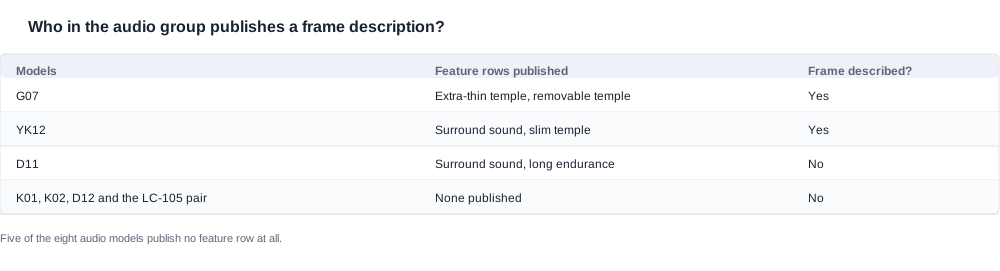
Form factor is the axis most buyers reach for first, and it is the one this catalogue is least able to support. Of the eight audio models in this range, five publish no feature row of any kind: the D12 and the LC-105-1, the K01, the K02 and the LC-105-2. Only three publish anything at all, and of those three only two say anything about the frame — the G07, with an extra-thin temple and a removable temple, and the YK12, with surround sound and a slim temple. The third, the D11, publishes an acoustic descriptor and an endurance descriptor, which are not form descriptors.
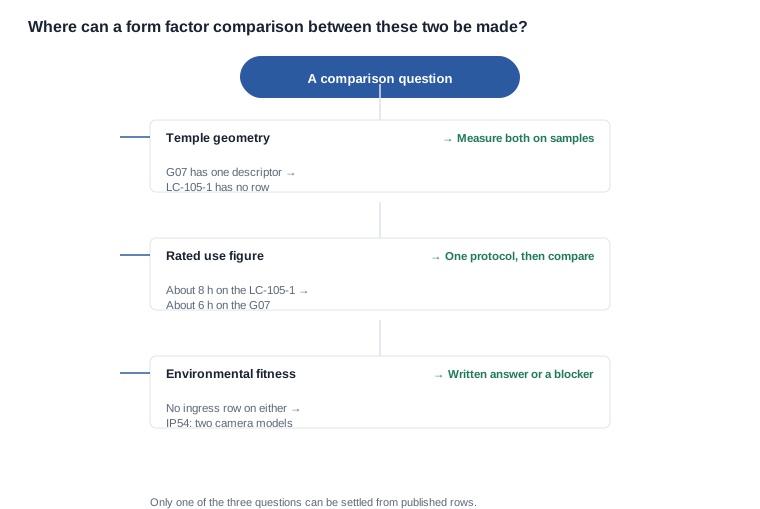
That leaves the comparison in an unusual position. The G07 side of the form-factor question has one published descriptor to work with. The LC-105-1 side has none. There is no catalogue sentence describing the LC-105-1's temple, because there is no catalogue sentence describing the LC-105-1's temple.
This article is about building the comparison anyway, and about the two places where the published data will mislead a buyer who takes it at face value: the form axis, where the catalogue covers one model and not the other, and the runtime axis, where two models carrying identical cells are published two hours apart.
LC-105-1 smart glasses vs G07 form factor: the axis only three models can answer
The useful way to hold this comparison is to start with the coverage rather than with the two models. The audio group has eight members, and the catalogue describes the frame of two of them.
| Model group | Feature rows published | Frame or temple described? |
|---|---|---|
| G07 | Extra-thin temple, removable temple | Yes, in one row |
| YK12 | Surround sound, slim temple | Yes, on the temple |
| D11 | Surround sound, long endurance | No, both rows are acoustic or endurance |
| K01, K02, D12, LC-105-1, LC-105-2 | None published | No description exists to work from |
Read the fourth row as the normal case and the first three as the exception. Five of eight audio models have no feature row, which means a buyer who works across this platform is mostly working with specification rows and no descriptive vocabulary at all. The G07 is unusual in the opposite direction: it is one of only two audio models where the temple itself is described.
The practical consequence for this specific comparison is that it is asymmetric by construction. A form-factor comparison against the LC-105-1 necessarily has a described side and an undescribed side, and a buyer under time pressure will fill the blank with an assumption — usually that a temple nobody described is an ordinary one. That assumption is not published, and it is not safe to build a range on.
It is worth knowing where the form vocabulary in this catalogue actually lives, because it is not in the audio group. The camera group publishes form-adjacent rows on several models: flexible temples on the V03 Pro, an ergonomic frame design together with a removable inner frame on the V06 and the S7. The IP54 marking also appears only on the V06 and the S7, and the single published weight in the whole catalogue belongs to the MT6 glasses body, measured without its folding charging case — a camera model that cannot stand in for either of these audio models.
So the models in this catalogue that carry frame, environment and mass rows are camera models, and a buyer who has read those pages arrives at the audio pages with an expectation the audio pages do not meet. That gap is not a defect to complain about; it is the reason the comparison has to be built differently.
The second thing to know before reading any of this is that the two models agree on everything except two rows. Both publish Bluetooth 5.4. Both publish the same cell configuration, 55mAh*2. Both publish magnetic charging. Both publish a charge time of two hours or less. The two published differences are the rated-use figure and the feature row, and a comparison built on those two rows is a much narrower comparison than the title of this article suggests.

What the G07's temple row says, and the three things it leaves open
The G07 publishes a single row, and it carries two separate design decisions: a temple described as extra-thin, and a temple described as removable. It is the only frame description available for this comparison, so it is worth reading precisely rather than generously.
What the row establishes is narrow but real. There is a thin temple profile, in the catalogue's words an extra-thin one, and the temple is detachable. That is enough to tell you the G07 is not a conventional single-piece frame and that its construction involves a joint somewhere in the temple.
What the row leaves open is where the commercial risk actually sits. There are three gaps, and a buyer who knows their order is a good buyer will close all three before an order rather than after one.
First, what removable means operationally. A temple that the end customer can swap at a retail counter and one that a factory replaces during service are different products with different economics. The first implies a spare-parts stream, a sizing story for a distributor carrying several lengths, and a replacement process your channel has to be trained on. The second implies a service workflow and a stock of factory assemblies. The catalogue does not say which, and the difference between the two is the difference between a spare-parts business and a repair counter.
Second, what the removable element is and what travels with it. Whether the detachable piece is the temple arm alone or a larger assembly, and whether any part of the electrical arrangement sits with it — the cell, the speaker, the radio module. That question decides whether a replacement part is a simple mechanical item or an electronic sub-assembly with its own handling, documentation and conformity consequences. It also decides the number of variants your own quality-control process has to cover, because a detachable element that can come off in the field is a variant that can arrive disassembled, mis-assembled or mismatched.
Third, what extra-thin is measured against. No dimension, no material, no mass, no tolerance appears anywhere in the catalogue for this or any other audio model. For a buyer whose line is built around temple geometry as a visible design element, a descriptor without a number is a direction rather than a specification, and it cannot be checked against a sample without a stated reference.
None of those three gaps is a reason to avoid the G07. They are reasons to convert a catalogue phrase into a written specification before you commit, and they are cheap to ask about compared with changing a range direction later.
One more commercial consequence deserves separate mention because it is easy to miss. A removable temple adds assembly steps at the factory, adds a packaging decision — one piece or two — and creates a spare-parts requirement that a fixed-temple product does not have. None of that has a published number attached to it. The catalogue publishes no cost, no tooling charge and no process for it, so the right treatment is to ask for it as a quotation line: what does the removable temple change in the assembly process, in the packaging, and in the spare-parts position, and how is a replacement part handled at the factory.
The conformity question follows the same shape. Both models publish Bluetooth 5.4, so both sit inside the same radio question — the Radio Equipment Directive (EU) 2014/53/EU — with the EMC framework of Directive 2014/32/EU treated separately by the conformity assessor. The catalogue publishes no per-model certification row for either model, and its text contains no reference to CE, FCC or RoHS at all. So the question worth asking is narrow and specific: does the conformity file for the configuration ordered treat the removable variant as a distinct variant, and if so, what additional evidence does it carry?

Two hours apart on the same cells: a rating difference, not a hardware difference
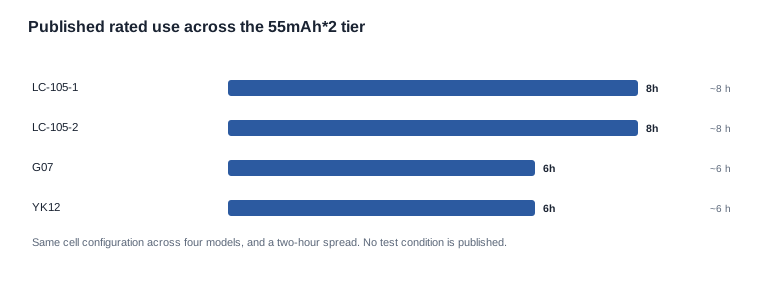
Four models in the catalogue publish the same cell configuration, 55mAh*2, and they are not published with the same runtime figure. The LC-105-1 and the LC-105-2 publish about eight hours of rated use. The G07 and the YK12 publish about six. The published range across this single cell tier is therefore roughly six to eight hours, and the two models in this comparison sit at the two ends of it.
That spread cannot be explained by the battery, because the battery is identical. It cannot be explained by the cell count, because the cell count is identical. It cannot be explained by the charging method, the Bluetooth version or the charge-time ceiling, because all three of those rows are identical too. The remaining candidate explanations are the platform configuration, the firmware behaviour, or the test method — and the catalogue publishes no runtime test condition for any model in the audio group. It publishes no starting state for the cell, no termination criterion, and no indication of whether the figure comes from continuous operation or from a mixed pattern of use.
With the hardware rows identical and the protocol rows absent, the honest conclusion is that the two-hour difference is a difference in how the figures were produced. It is a rating difference, not a hardware difference.
There is a pattern inside the tier that is worth putting to the supplier, because it is visible in the published data and it has no published explanation. Within the four models sharing 55mAh*2, the two that publish a feature row — the G07 and the YK12 — publish about six hours, and the two that publish no feature row at all — the LC-105-1 and the LC-105-2 — publish about eight. We do not claim a cause for that correlation, and we would not publish one. What it does justify is asking, in writing, whether the two figures were taken under the same protocol and, if they were not, what each one was taken under. A supplier who answers that question precisely has given you something more useful than the number itself.
The commercial rule that follows is simple and worth stating without qualification. Until a common test protocol is supplied for both models, the eight-versus-six difference does not go into your listing copy, your channel deck, your comparison sheet or your tender response. Not because it is likely to be wrong in your favour — because it is likely to be wrong in someone's favour, and if a common protocol reverses the order of the two figures, you will have published a claim that the evidence no longer supports, with your name on it.
There is a second-order effect on this particular comparison, and it is the reason this section sits inside a form-factor article. Buyers who want a form-factor reason to prefer one of these two models will reach for the runtime difference, because it is the only other published difference available. That reach is the mistake this section exists to prevent. If the runtime figure cannot be compared, then the form comparison has to stand on the physical rows alone — which is a smaller claim than most buyers want, and a far more defensible one.
One published row does limit what the form comparison can claim in the other direction. Neither model publishes an ingress rating, and the IP54 marking in this catalogue belongs to the V06 and the S7 in the camera group. A channel whose products are exposed to rain, sweat or spray cannot establish environmental fitness for either of these models from the catalogue, and an absent row is a gap to close in writing rather than a difference between them.

Turning a form-factor comparison into a written measurement protocol
Those twelve questions are the criteria for the decision, and the written protocol is the checklist a buyer hands to both factories in one request, so that the two answers come back in the same vocabulary.
Once the catalogue is accepted for what it is, the comparison stops being difficult and becomes ordinary work. It needs a measurement protocol, a written specification sheet, and a short list of questions put to the factory in a single set. The table below is the core of that protocol.
| What the catalogue publishes | What it leaves open | What to establish on a sample |
|---|---|---|
| A temple descriptor on the G07 only | No dimension, material or mass | Temple cross-section, length and mass, per model |
| No frame weight for either audio model | Mass and balance are unknown | Mass per temple and total, measured |
| A removable temple on the G07 | User-replaceable or factory-only is unstated | Mechanism, interchange and tooling |
| 55mAh*2 on both models | Cell placement inside the frame is unstated | Where the cells sit relative to the temples |
| Rated use two hours apart | No test condition published | One protocol, run on both models |
| No ingress row for either model | Environmental fitness is unverified | Sealing evidence, or a written refusal |
| Bluetooth 5.4 on both models | No per-model certification row | Conformity file for the ordered configuration |
These are the questions to put in writing, in the same vocabulary for both models:
- The runtime test condition behind each published rated-use figure, and what the same protocol produces on the other model.
- Whether the removable temple is user-replaceable or factory-only, and what the replacement process is at each level.
- What the removable element physically consists of, and whether any part of the electrical arrangement travels with it.
- Frame weight for each model, in grams, measured on samples, and per temple if the two differ.
- Temple cross-section and length for each model, and the material of the temple.
- The charge path for each model, what is in the box, and whether any charging case is offered.
- Packed weight and the declared cell configuration for each, for the freight and transport documentation.
- The acoustic and microphone specification for each, given that the LC-105-1 publishes no acoustic descriptor.
- The conformity file for each model in the destination market, and whether the removable variant is treated separately.
- Environmental sealing evidence for each model, or a written statement that none exists.
- What separates the LC-105-1 from the LC-105-2, since their published rows are identical and the catalogue publishes no difference.
- The warranty position, defect responsibility and spare-parts commitment for a model with a removable element.

Two of the twelve are worth more attention than their position in the list suggests. Question two decides whether the G07's removable temple is a spare-parts business or a repair counter, and that decision shapes the channel, the stock, the service agreement and the return handling. Question eleven matters because the LC-105-2 publishes rows identical to the LC-105-1, so any specification sheet you write for the LC-105-1 has to record whatever your own evidence distinguishes the two models — otherwise the next order, and the next channel, inherit a distinction nobody can state.
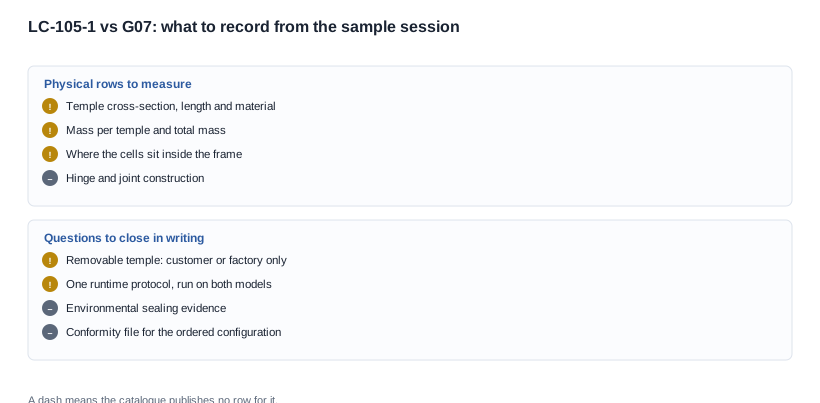
The order of the protocol matters less than the discipline of writing the results down. Measure both models on the same instruments, in the same session, with the same protocol, and record the figures against the model names rather than against a marketing position. A form-factor comparison built on samples from one session is defensible; one assembled from measurements taken weeks apart, under different conditions, by different people, is not, whatever the numbers show. The sample evaluation and quality consistency procedures cover how to run that session, and the audio range battery comparison sets out the runtime question in full.
What we can and cannot state about the LC-105-1 and the G07
The boundary of what we will put in writing is narrow, and stating it plainly is more useful to a buyer than a longer document that overreaches.
We can tell you that these two models publish the same cell configuration, the same charging method, the same Bluetooth version and the same charge-time ceiling; that the LC-105-1 publishes about eight hours of rated use against the G07's about six; that the G07 publishes a temple descriptor and the LC-105-1 publishes no feature row at all; that across the eight audio models only the G07 and the YK12 carry a frame description; and that the four models sharing 55mAh*2 are published across a roughly six-to-eight-hour range without any published test condition to explain it.
We will not describe the LC-105-1's temple, because the catalogue does not describe it and neither will we. We will not attach a mass, a dimension or a material to either model. We will not turn the removable temple into a claim about serviceability or sizability, because the row does not say whether it is user-replaceable. We will not present the two-hour runtime gap as a hardware difference, and we will not repeat the eight-versus-six comparison in any form that implies the two figures were taken under the same method. We will not credit either model with an ingress rating, a frame weight, a charging case, or a certification that the catalogue does not publish for it, and we will not quote a certificate number, a capacity figure, a lead time or a price on the strength of a row that does not exist.
What we will do is put the twelve questions above to the factory as one set for both models, return the answers in identical vocabulary, and hand back a written specification sheet that reproduces the published rows and fills the empty fields with dated answers. If the answer to the removable-temple question is that it is factory-only, or the answer to the runtime question is that the two figures came from different protocols, you will know both before an order is placed rather than after a first shipment.
The published rows for the LC-105-1 and the published rows for the G07 set out the same facts model by model, and what to check before ordering the G07 covers the surrounding due-diligence questions.
Related reading
- The platform range in one place — Bluetooth audio glasses
- The runtime question across the audio group — Bluetooth audio glasses battery comparison
- The charge path and its accessory economics — Bluetooth audio glasses charging options
- Running a first evaluation before a bulk order — sample before bulk
Send the two temple questions and the runtime-protocol question for the LC-105-1 and the G07, and we will come back with the published rows, the empty fields, and exactly which of them we can close from the factory.


