

Bone conduction glasses technology: what the mechanism drives
The mechanism, and why the myths persist
The mechanism is simple, and that is exactly why the misconceptions are durable. A transducer sits against the skull, it vibrates, and the vibration reaches the inner ear through the bone rather than through the air. The interesting part is what that implies for a buyer, and the interesting part is where the compliance and the performance questions live.
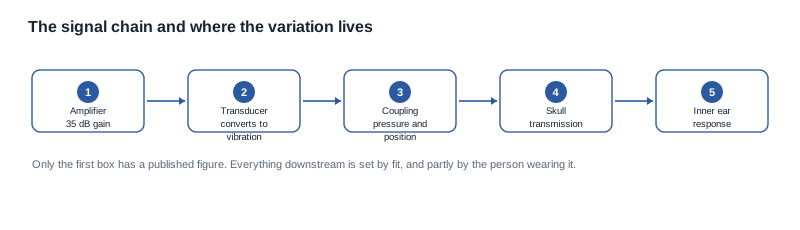
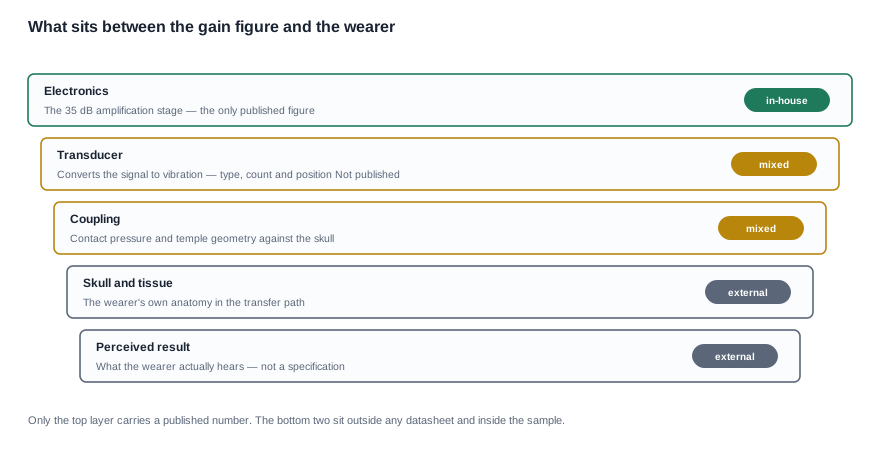
What the mechanism implies is a dependency chain. The 35 dB published gain is the only link in that chain with a number attached to it, and it sits at the very top. Everything that decides what a wearer actually hears is downstream of it: the transducer, the contact pressure against the temple, the skull transmission, and the wearer's own anatomy. Three of those four are physical design variables, and a buyer who treats the frame as a housing rather than as an acoustic component will specify it wrongly and pay for it in returns.
That is the buying decision this article drives. In this category, frame geometry, frame mass and contact pressure are audio specifications. They belong in the acceptance criteria, they belong in the sample protocol, and they are the rows a supplier is least likely to have documented.
The buying task behind the mechanism
A buyer evaluating this technology is usually doing one of three things, and the mechanism matters differently in each.
A product or R&D lead is building a design brief and needs to know which physical variables the architecture puts into it. For them the mechanism is the specification: the temple has to hold contact, the contact area has to be controlled, and the frame mass is part of the acoustic result. It also determines that a camera in the same frame is a power-budget decision, because the cell and the transducer and the sensor compete for the same budget.
A category buyer comparing quotations needs to know which published figures are comparable and which are not. The mechanism gives them the answer: a gain figure is upstream of everything variable, so it cannot be used to compare two products whose frames differ, and a runtime figure is a product of the cell and the radio and the driver rather than of the audio path.
A compliance or legal reviewer needs the boundary. The mechanism decides that this is not an air-conduction device, which is what places it outside the over-the-counter hearing aid definition at 21 CFR 800.30 in the United States, and that is a fact about the hardware rather than about the copy.
What the mechanism would need published about this entry
The specification a buyer would need is narrower than a parameter list suggests, because the mechanism tells you which parameters carry the weight. Our position is that the 35 dB gain, the 200 mAh battery, the charge time of two hours or less, the roughly seven hours of runtime and Type-C charging are the figures we hold, and that we publish them and nothing more. No model designation, no certification status, no acoustic measurement, no microphone specification, no frame weight and no ingress rating are published for this entry — and in this technology the acoustic measurement and the frame weight are the two the mechanism itself turns on, since both set the coupling that the gain is amplified into.

Where the mechanism sits in the supply chain
The four stages
1. An electrical signal is amplified. The published 35 dB is the gain of the power amplification stage, and it is the most aggressive parameter in our entire catalogue. It is a figure about the electronics, and it is not the same as the sound level at the inner ear.
2. The transducer converts it into mechanical vibration. A bone conduction transducer is a small actuator that presses against the skull and vibrates. The coupling between the transducer and the skull matters enormously, and it varies with pressure, with the shape of the contact area and with where on the skull the contact sits.
3. The vibration travels through the skull. Different tissues transmit different frequencies differently. Bone transmits high frequencies better than soft tissue, and the skull's own structure shapes what arrives. The result is a frequency response that is nothing like an air-conduction response, and it varies between wearers.
4. The inner ear receives it. The cochlea responds to the vibration as it would to sound, and the listener hears it as sound originating from inside the head — a perceptual characteristic people describe as being inside their own head, and a genuine difference from an air-conduction product.
Where the variation actually lives
The chain above is where the mechanism is; the useful part for a buyer is knowing which link carries the variation. The electronics link is the most controlled, because it is a circuit and circuits are repeatable. The transducer link is controlled by the component supplier. The coupling link is controlled by the frame, and the frame is where a buyer's specification has the most influence. The skull link is not controlled by anyone in the supply chain at all, which is why a specification sheet in this category is less useful than it is elsewhere.
The practical consequence is that when two units of the same model sound different to two people, the answer is almost never that one unit is faulty. It is that the two people have different skulls, different head sizes, and different temple geometry on their heads, and all three of those are in the transfer path.
Where this mechanism sits in the supply chain commercially
Because the coupling link is controlled by the frame, the frame is where a bone conduction supplier's capability separates from an open-ear supplier's. A factory that has only built open-ear frames has to learn to hold a consistent contact pressure at a consistent position, and that learning is a process-control problem rather than a component problem. It is the reason a bone conduction quotation should be judged on its process documentation and not only on its unit price.
The same reasoning explains the cell. A 200 mAh cell is large for a frame in this category, and it is large because a transducer and an amplifier stage draw more current than a small speaker. The larger pack changes the frame mass, which changes the pressure the temple has to hold, which changes the acoustic result. The power budget, the mechanical design and the acoustic outcome are one decision, and a buyer who negotiates the cell independently of the frame is negotiating against the acoustic design.
The measurements the mechanism actually decides
The chain of acoustic variables
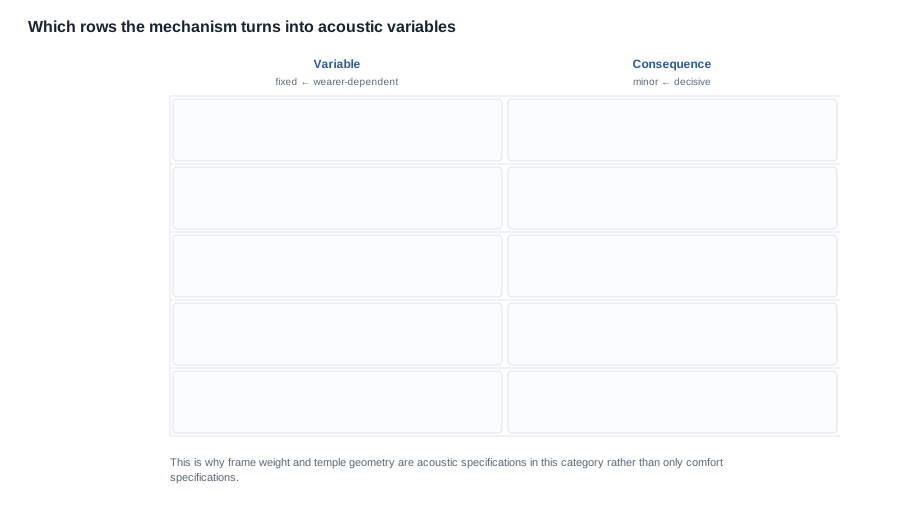
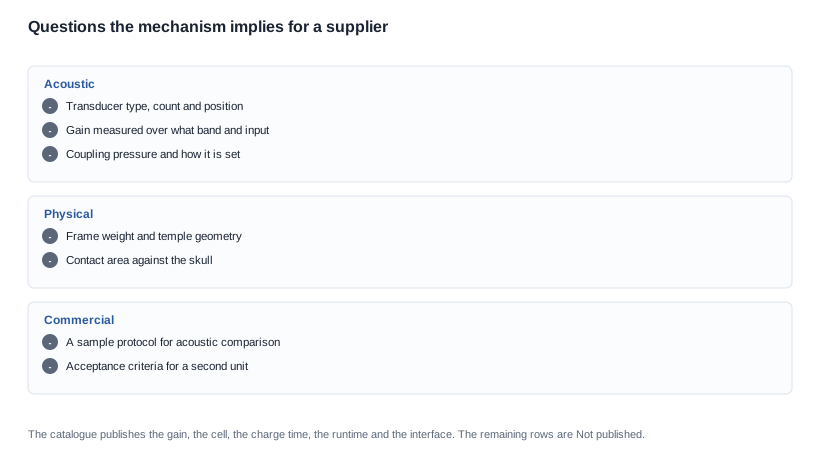
Each of these is a variable the mechanism puts into the design brief, and each one should be on the request list with the supplier and in the acceptance criteria.
Transducer position on the frame. Where the actuator sits determines which part of the skull the vibration enters, and the skull's structure shapes the response. It also determines where the frame has to hold pressure and how much of the frame mass is structural rather than cosmetic. Not published for our entry.
Contact pressure at the temple. This is the coupling, and it is the variable with the widest effect and the least documentation. Too little and the signal does not couple; too much and the wearer gets localised discomfort within a session. The frame's stiffness, the temple's geometry and the pad's material all set it. Not published for our entry.
Contact area against the skull. A larger area distributes the vibration differently and changes the pressure distribution over the session. It is also a comfort variable and a structural one, because a wider actuator needs a wider frame. Not published for our entry.
Frame weight and temple geometry. These are acoustic specifications here, not only ergonomic ones, because they determine the pressure the temple can hold and for how long. Frame weight and frame dimensions are Not published for our entry, and this is a more serious gap in this category than it is in an open-ear platform.
The wearer's own anatomy. Head size, skull density and temple shape. Not a specification at all, and not controllable — which is why the result cannot be promised and why the sample protocol has to involve several wearers.
The thresholds, and how each one is measured
Gain. Measured as electronic signal gain at a stated input level, across a stated band, at a stated point in the circuit. The line: a figure with its method attached. How it is misreported: quoted as though it were a sound pressure at the inner ear. Our entry publishes 35 dB with no method, so it describes the electronics and nothing about the result.
Coupling consistency. Measured as the variation in delivered level across a sample of units, assembled the same way, on a defined head form. The line: a spread small enough that a customer swapping one unit for another does not hear a difference. How it is misreported: absent entirely, which is the normal state for this row.
Session endurance. Measured as the time a wearer can keep the frame on before reporting localised discomfort, with the wearer's own frame adjustment held constant. The line: the session length the product is sold for, with several wearers. How it is misreported: inferred from frame weight, which does not describe it, or from a single wearer's experience.
Environmental interference. Measured as the ratio between the delivered signal and the ambient level in the target environment, on a defined input source. The line: enough margin for the target environment, not a laboratory figure. How it is misreported: expressed as a gain figure, which is a different quantity and cannot be converted into one without the front-end specification we do not publish.
A warning: the numbers here are not directly comparable
The mechanism makes comparison unusually treacherous, because the published gain sits upstream of every variable that differs between two products. Two suppliers can both publish 35 dB, both be correct, and offer products that sound materially different, because their frames differ in weight, temple geometry, contact area and contact pressure, and none of those is in the figure.
The practical rule is to compare at the level the mechanism supports. Compare the published rows that describe the electronics and the cell, and treat any acoustic comparison as a sample outcome rather than a paper outcome. When a supplier offers an acoustic comparison, the question to ask is who was measured and on what fixture, because a figure measured on a head form is closer to the result than a figure measured on a coupler, and neither is a measurement of a person.

Testing the mechanism, and where it misleads
How to test what the mechanism actually decides
Because the mechanism puts the physical variables in the acoustic path, a test protocol for this category has to be physical. The document questions are ordinary; the sample protocol is not.
Before the sample, get the documents. Ask for the model designation and the certificate register, and trace the designation to the label artwork. Ask for the acoustic measurement method behind the gain figure. Ask for the cell specification, because the transport file and the test summary cover a specific cell. Look up every certificate number in the issuing body's public register, using the checklist at certification checklist, and check the transport documentation at battery transport.
On the sample, agree the protocol in writing first. A single wearer, a short demonstration and a quiet room will not tell you what you need to know, because the two things that most often go wrong — coupling consistency and session endurance — need time and repetition to show up.
The protocol that answers the mechanism's questions is: several wearers, not one, and a spread of head sizes where the channel will include a female customer base. A full session rather than a demonstration, because contact pressure fatigue appears over time and a twenty-minute trial feels fine. A defined environment rather than a quiet room, because the environmental interference question only exists in noise. And a written acceptance criterion agreed before the evaluation, so that an enthusiastic impression cannot become an order.
After the sample, compare units rather than impressions. If the product is going into volume, test a second unit from the same batch against the first and listen for a level difference. That is a process-control test — it tells you whether the factory is holding the coupling — and it is the test most often skipped.
The four things the mechanism does not do
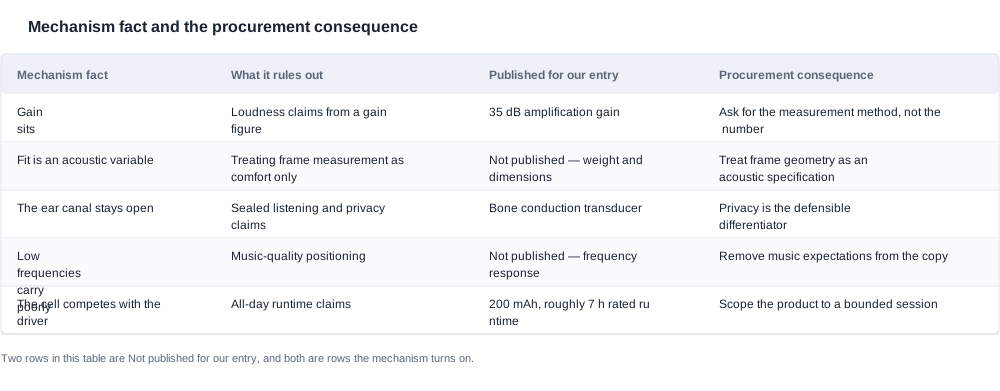
1. It does not make the product a hearing aid. The over-the-counter hearing aid definition in the United States at 21 CFR 800.30 covers air conduction devices, and a bone conduction product is a different device in a different category.
2. It does not remove the need for a microphone. A bone conduction product that takes calls has the full open-ear microphone problem, and no microphone specification is published for any model in our range. In a noisy application the front end decides the outcome, not the gain.
3. It does not mean the wearer hears the same as someone else. The variability is large, and it is the reason a printed specification is less useful here than in an air-conduction product, and the reason any claim in the copy has to stay general.
4. It does not make the amplifier harmless. A 35 dB gain in a product worn on a face is a regulatory question before it is a comfort question. The boundary in the United States is drawn at air conduction, and that is a legal position rather than a technical one.
Where the mechanism misleads in practice
The claim that bone conduction produces no ear fatigue. The mechanism does not establish this. Users report mastoid pressure after long sessions, and the honest test is a multi-hour wear trial with several wearers.
The claim that a louder unit is a better unit. More gain upstream of a variable coupling does not reliably produce more usable output, and the extra gain has to be paid for in cell capacity, which is paid for in frame mass, which is paid for in contact pressure.
The claim that the same model sounds the same to everyone. Two people wearing the same unit can hear materially different things, because fit, head size and the wearer's own anatomy are all in the path.
The claim that a specification sheet settles the comparison. In this category the sheet settles the electronics and the cell. It does not settle the result, and a buyer who signs an order on the sheet alone is accepting a variable they have not measured.

Cost and terms, and a worked specification review
What the mechanism does to the commercial structure
The mechanism splits the cost of this product in a way that is unusual, and it is worth understanding before the quotation arrives.
The part that does not move is the acoustic hardware: the transducer, the amplifier stage and the cell, and the tooling that produces a frame able to hold a consistent contact. Tooling cost is usually amortised across a first order and should be asked about as a separate line rather than folded into the unit price. Certification cost and lead time are fixed, and so is the regulatory classification work, because it is a legal decision rather than a commercial one.
The part that does move is the frame itself, and this is the lever most buyers miss. Frame geometry, contact area, temple pad material and the temple adjustment range are all design variables with real cost consequences, and they are all things the supplier may already have solved. A buyer who specifies the frame tightly without asking what the supplier already has will pay for development that has already been done. The right question is what configurations exist and which do not, and the published position for our own entry is that its customisation capability is undisclosed — which is itself the answer to that question.
Other negotiable items: minimum order quantity tiers, colour and temple configuration, logo, lens tint and retail packaging, which models combine into one purchase order, splitting a first production run into two deliveries against a staged payment, and the number of units taken at the pilot tier rather than the run tier, which is where most of the real room sits because the factory's exposure concentrates in the first run. The clause wording is published at contract terms, and the commercial structure of a first order is published at pricing.
A worked specification review
Assume a product lead has a bone conduction frame on the bench and a budget for a first production run. The claim is a communication frame for a site environment. The target markets are the European Union and the United States.
The review starts at the coupling link, because the mechanism says that is where the design risk is. The questions to ask are what the transducer position is, what the contact area is, what sets the contact pressure, and what the temple geometry and frame weight are. The published position for our entry is that frame weight, frame dimensions and ingress rating are Not published, so this review cannot be completed on paper for this platform — it has to be completed on a sample and in writing afterwards.
The second review point is the power budget, and it is where the camera question belongs. A 200 mAh cell with a roughly seven-hour rating was scoped for a session product. A sensor, a radio, a transducer and that cell compete, and the runtime the customer receives is set by the hardest load. The review conclusion is that a camera variant is a design project with its own schedule rather than a configuration option, and the criteria to evaluate it are how to compare two designs and what trade-offs the cell size forces.
The third review point is the compliance boundary, which follows from the mechanism rather than from the copy. Because the path is bone and not air, the product sits outside the over-the-counter hearing aid definition in the United States, and the listing has to stay on the non-device side of that line. The technical file, the declaration, the labelling and the instructions all have to name a model, and no model designation is published for this entry, so the identity work has to happen before the file can be assembled.
The fourth review point is the test protocol, written before the sample arrives. Several wearers, a full session, a defined environment, a written acceptance criterion, and a unit-to-unit comparison after the first batch lands. The criteria are what turn a sample from a demonstration into evidence, and they are also the criteria a supplier can hold the factory to.
The fifth review point is the commercial conversation, which follows the evidence rather than preceding it. The pilot tier, the split delivery against staged payment, the packaging configuration and the scope of the conformity assessment are the negotiable items, and they are the ones that redistribute first-run risk rather than reduce cost.
What we publish, and what to ask us
Why the gain figure is not a hearing-aid claim
The gain sits upstream of everything that decides what the wearer actually hears. Our position is that we publish the 35 dB gain as the catalogue states it, and that we will not let it be presented as a hearing-aid specification, a hearing-aid benefit or an assistive-listening claim, because 21 CFR 800.30 defines the over-the-counter hearing aid by air conduction and a bone conduction path falls outside it — a boundary drawn at the same point where the mechanism leaves the electronics and becomes a regulatory question, which is the point where the coupling leaves the electronics and becomes an acoustic one.
Two things are missing from this entry, and both of them are about identity rather than about sound: the certification status is not published to us, and no model designation is published. A product in that position cannot be covered by a model-specific document, so we will say plainly that it needs a legal review before it is listed in any market, rather than let a reader assume that a certificate is sitting in a folder somewhere. We will not substitute a typical weight, a driver size or a frequency response for a measured value we do not have.
What to ask us next
If you tell us the destination markets and the intended use, we will say which of these questions are decisive. We can also tell you which published rows cover your configuration, what our own position is on the frame and coupling variables, and what a sample in this category still has to establish. The range is at bone conduction glasses, the compatibility considerations are in bone conduction compatibility, the compliance boundary is at medical device boundary, and the way regulation reaches this product is covered in how regulations reach bone conduction.
Related reading
- Bone conduction glasses range
- Bone conduction compatibility considerations
- Medical boundary compliance
- How regulations reach bone conduction
Tell us the destination markets and the intended use and we will say which questions are decisive.


