

Bone conduction glasses technology: the effect on a range
A bone conduction product's compatibility with the rest of a range is an unusual question, because the compatibility is limited by the regulatory position rather than by the technology, and that distinction is worth making before anything else.
Our published position in this entry: a 35 dB amplification gain, a 200 mAh cell, charging in two hours or less, roughly seven hours of runtime, and Type-C charging. No model designation is published, and the certification status is not published to us. No acoustic measurement, no microphone specification, no frame weight and no ingress rating are published for it either. Everything else in our range publishes at least a model designation and a colour or cell configuration, which is why this entry sits at the edge of the range rather than inside it.
The useful way to frame the decision is that a range is a single asset. One claim set, one documentation family, one SKU and logistics layer, one support script, one channel story — and the commercial value of a range comes from those shared assets, not from the number of models in it. Adding an entry does not add a product to that asset. It adds a claim type, and every shared asset above it has to be examined against the new one.
So the question a buyer is actually answering is not "can this entry be sold" but "does this entry belong in this range", and the honest answer is sometimes no. A range that reads clearly is worth more than a range with one more model in it.
Who plans a range, and what the range already carries
The buyer here is a brand product manager building or extending a line, or a channel buyer assembling a shelf. What they are carrying is an existing range that already works: models with published designations, a shared documentation family, a channel that already understands the story, a support team that already knows the answers, and a compliance position that has been established once for the open-ear models and can be reused across them.
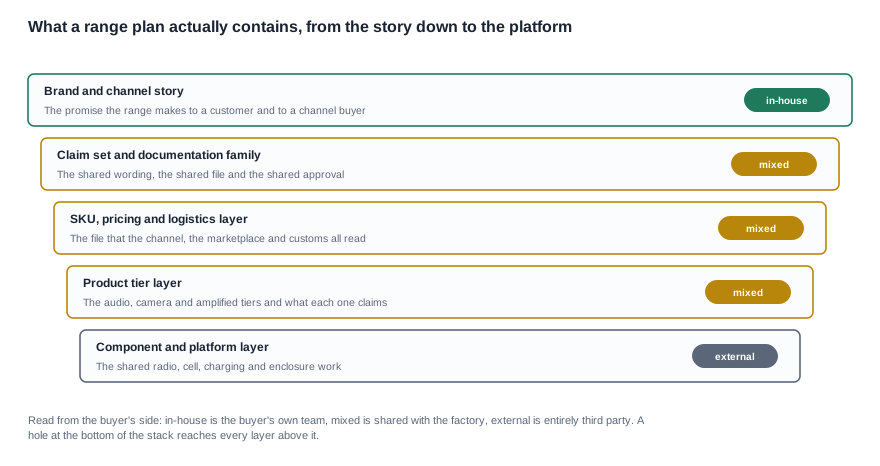
What they are afraid of is a range that stops being coherent. A customer who compares two models on the same product page and finds that one is described as a hearing-assistance device and the other as an audio product will ask a question the support team cannot answer. A channel buyer who has approved the range as a set will ask why one model needs a different document set. And a compliance function that has signed off on one claim set will ask, correctly, whether the new model was assessed against the same wording.
The commercial argument runs in the same direction and is worth putting in the model explicitly, because it is the argument that decides the meeting. A coherent range shares its documentation, its claim review, its packaging work, its channel story and its support training, and those shared costs are the reason a range is worth more than a set of separate products. A model that needs a parallel set of all of them does not simply add cost — it adds a second company inside your first one.
Compare the published positions across our range to see the scale of it. The open-ear audio class publishes model designations, cells from 55 mAh paired units up to 100 mAh, Bluetooth V5.3 and V5.4 variants, roughly six to eight hours of rated runtime, and surround audio, with the IP54 marking published only on the V06 and the S7, with case capacities across the range of 900, 1200 and 1400 mAh. The camera tier runs five to eight hours, and the V03 Pro is an 8 MP platform with a 220 mAh cell, Type-C charging, flexible temples, three published colour options and a photochromic lens listed as a configuration. The dedicated lens entry is described as electrochromic, with Bluetooth V5.4, a 100 mAh cell, magnetic charging, roughly seven hours of rated runtime and no model designation of its own. This entry sits beside all of that with five published rows and no name.
The four axes, and where this entry stands on each
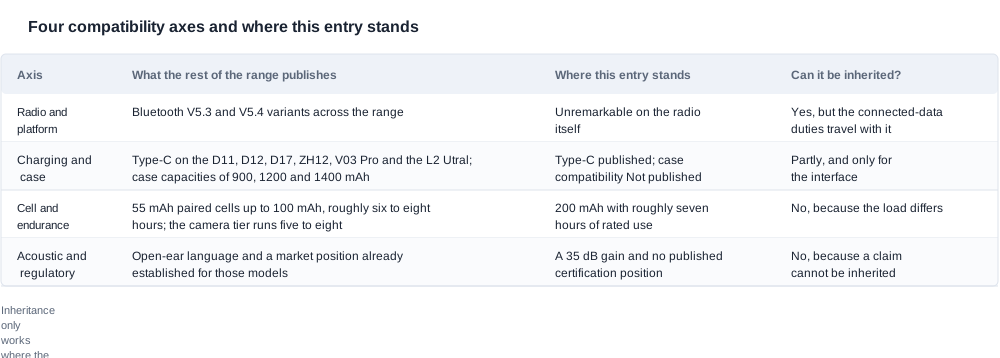
Axis one: the radio and the platform. Bluetooth 5.4 is the version published across most of our range, so the radio side is unremarkable. What is not unremarkable is the regulatory consequence of a connected wearable: in the European Union the Radio Equipment Directive (EU) 2014/53/EU applies, with the EN 18031 harmonised standards cited into it covering the cybersecurity and data-handling requirements that attach to a wearable carrying a microphone and an app, and the General Product Safety Regulation (EU) 2023/988 has applied since 13 December 2024. The United Kingdom runs UKCA on a framework that has drifted, and in the United States FCC equipment authorisation covers the radio. The radio compatibility is therefore high and the data obligations travel with it, which is why the range's existing file may need a review rather than a copy.
Axis two: the charging and the case. Type-C is the interface on ZH12 and the D11, D12 and the L2 Utral, and D17 and V03 Pro, so the interface is shared. The case is a separate question: the case capacities across the range are 900, 1200 and 1400 mAh, and whether this entry shares a case with any published model is Not published. The absence of a model designation turns that from a lookup into a question, and the answer decides whether your range can be shipped as one packaged story or as two.
Axis three: the cell and the endurance. A 200 mAh cell with roughly seven hours of rated runtime sits close to the open-ear tier's six to eight hours, and it is a different product from the camera tier's five-to-eight-hour range. A customer moving between a camera model and this one experiences a step change, and the published data states no load in either case. The interesting inference is that a 200 mAh cell producing a similar rated runtime to a 55 to 100 mAh cell points to the load rather than the cell as the binding constraint — which is worth confirming with the supplier rather than accepting, and which is why runtime is a row to measure and not a row to copy.
Axis four: the acoustic and the regulatory position. This is the axis on which nothing else in the range can help. A 35 dB gain is the most aggressive published parameter in our catalogue, and the boundary at 21 CFR 800.30 — which defines over-the-counter hearing aids by air conduction — means the category has to be established rather than inherited. It cannot be placed in a range alongside a product that makes no such claim without the range's own claims being examined, because a market position follows the claim, and the claim is the thing being sold.
On top of the four axes sit four absences that define the compatibility position. No model designation, which means no model-specific document, no unambiguous contract reference and no field traceability. No published certification status, which means the question of whether it may lawfully be sold in a given market is open. No acoustic measurement — no output at the inner ear, no frequency response, no leakage, and no frame weight — and in this technology the fit and the coupling are part of the acoustic specification. No microphone specification, and no published information about whether the product takes calls at all.
One warning applies to all four axes: the numbers are not directly comparable across the range, because the measurement conventions differ. A runtime quoted with the radio connected is not comparable with one quoted in standby, and a gain quoted at the transducer is not comparable with one quoted at the ear canal. Until the conditions are stated, two numbers in the same row are two different measurements.

The holes a range acquires
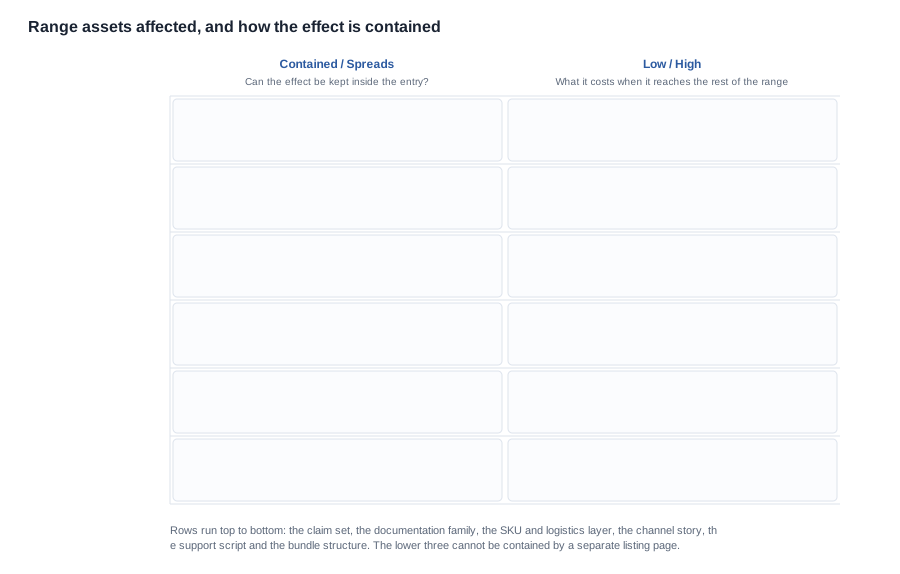
The documentation family stops covering the range. The symptom is a declaration of conformity that names a family and an entry that cannot be named within it. The root cause is that the entry carries no model string, so the family document has nothing to attach it to. The prevention is to ask for a formally identified model before the range is planned, and to make documentation per configuration rather than per family a term of the arrangement.
The SKU and logistics layer develops a blank. The symptom is a channel onboarding that stalls, a marketplace listing that is inconsistent with the range page, or a pricing and promotion tool that rejects the row. The root cause is that the entry was planned as a product and not as a record. The prevention is to include the model string in the range plan as a field, so that the gap is visible before the channel sees it.
The customs description needs its own line. The symptom is a classification query on the first shipment. The root cause is that a product with different characteristics and different documentation was filed under a family description. The prevention is to agree the description and the battery documentation per product, with the UN 38.3 test summary tied to the specific cell that is fitted.
The support script has to branch. The symptom is a customer asking whether the product is a hearing aid and receiving two different answers from two agents. The root cause is that the claim set was decided for the range rather than per model. The prevention is to write the per-model answer into the script, and to train against the specific question rather than the general description.
The bundle structure has to be split. The symptom is a bundle listing that pairs this entry with open-ear models, and the wrong expectation set in the same click. The root cause is that the commercial logic of a bundle outran the claim logic. The prevention is to keep the two mechanisms in separate bundles until the claim sets have been reviewed together.
The channel story blurs. The symptom is a range page where one model's language describes another. The root cause is that a range sheet with a shared cell in the summary row will have a shared cell in the copy block. The prevention is to keep the two categories in separate tables, with separate claims and separate documentation paths, so that no row describes both.

Deciding whether the entry belongs in the range
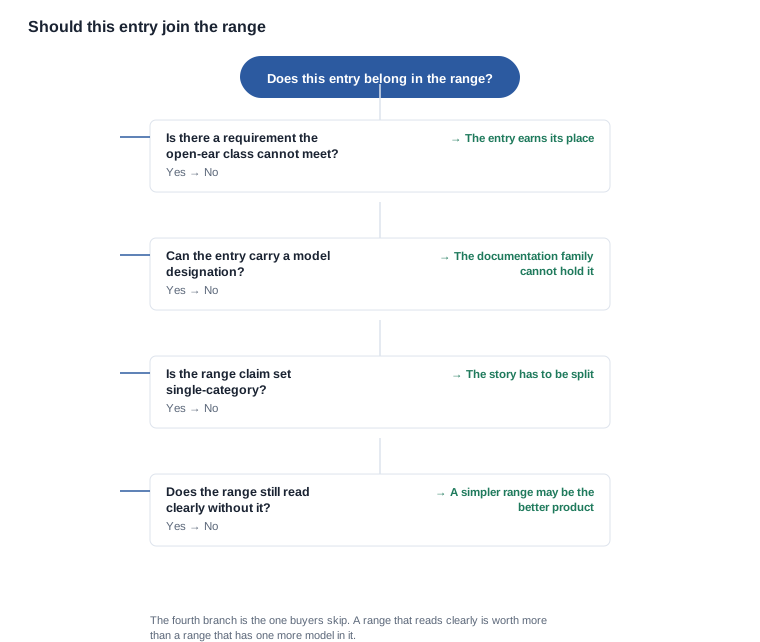
The decision is made on four questions, and the fourth is the one that gets skipped.
Is there a requirement that the open-ear class cannot meet? If the requirement is privacy — that nobody nearby should hear the audio — then this is the design that answers it, because the output is a mechanical vibration in the skull rather than a sound wave in the room. If the requirement is music, general audio, long-session open use or the lowest landed cost, then the open-ear class answers it with better documentation behind it, and there is no reason to add a second set of range assets. This is the first question because it is the only one that can create a reason to proceed.
Can the product carry a model designation and model-specific documentation? Without a string, the range has a hole in it, and the hole reaches every layer above. This is the second question because it is the one with the longest lead time.
Is the claim in the listing consistent with the rest of the range's claims? A range where one product is medical-adjacent and the others are not needs careful description rather than careful silence. This is the third question because it is a review, not a structural change.
What does the range look like if this entry is excluded? Sometimes the answer is that the range is stronger and simpler without it, and that is a legitimate outcome rather than a failure. The open-ear class in our range already covers the audio requirement with published designations and published runtime conditions, and a range that reads clearly to a channel buyer is worth more than a range with an extra row. This is the fourth question because it is the one that requires you to have genuinely compared the two.
The four questions to ask a supplier are equally specific: which regulatory route has been established for this product in each destination market, and does that route hold for the range; what is the model designation and the certification status, for this product and for every model it would sit beside; what is the measured output at the inner ear, on what measurement, and how much does it vary between wearers; and what is the runtime under the amplification load, with the condition stated, and does the charging interface match the models the range already carries.
The shortlist question that stops the range discussion
Before you compare two routes, there is a question that ends the discussion rather than informing it, and asking it first saves a week of evaluation work.
Which of these two problems are you actually solving: a customer requirement, or a gap in your own range? A customer requirement is answered by whichever product meets it, and the range is a consequence. A gap in your own range is answered by adding a model, and the range is the justification — which is a much weaker reason, because a gap in the range is usually a symptom of a product decision you have already deferred somewhere else.
The distinction changes the criteria you should evaluate against. When the driver is a customer requirement, the criteria are acoustic and documentary: does the product meet the requirement, and can it be documented in the markets you sell into. When the driver is a range gap, the criteria are commercial: is a parallel set of assets cheaper than the alternative of leaving the requirement unmet, and is the second product going to have its own claim review, its own packaging, its own support branch and its own per-market files, in which case you are running two ranges in parallel and should plan for that rather than discovering it.
Ask the question in the form of a written requirement with a name on it, a market list, and a description of the environment it is used in. A requirement without those three is a preference, and preferences are what produce a range that acquires a second claim set by accident.
The second question to settle early is the trade-off you are deliberately accepting, so that it is a decision rather than a surprise: this entry cannot share the range's documentation family, cannot share its claim set, and cannot share its support script. Those are the costs of inclusion, and they are large enough that they should appear in the range plan as lines rather than emerge as a schedule problem.
What a range decision is worth, and what we will say about ours
The value of a coherent range is not a slogan, it is a set of costs that are paid once. One claim review instead of several, one documentation family instead of a family and a singleton, one channel story instead of a story with an exception, one support script instead of a script with a branch, one packaged shipping profile instead of two, and one set of per-market files instead of two. A model that cannot join the shared assets pays for all of them again, and the bill arrives as engineering time, review cycles and a documentation pack that has to be assembled by the team that bought the product.
What can be negotiated around a range decision is the containment. Per-configuration documentation rather than a single family document, so that the entry has its own file and the range file is untouched. A separate listing template and a separate product page, so the claim never mixes. A separate case and packaging profile, so the shipped goods are self-describing. Support training for the specific model and the specific question. And a channel agreement that keeps the two mechanisms in separate bundles.
What cannot be negotiated is inheritance. A market position follows the claim, and a claim cannot be inherited from a sibling model however similar the hardware is. A 35 dB gain with no published regulatory position does not pick up a position from a model that makes no such claim, because the position is built on the claim and the claim is what a customer reads. Nor can the acoustic reality be negotiated: if the product does not deliver the thing a customer is expecting, no commercial term turns it into a product that does.
A worked scenario: a six-model range and a new category
The example below is a constructed sequence, not a client project, and it is included to show how the checks run rather than what they returned.
Assume a brand with a six-model range across an open-ear audio tier and a camera tier, selling into three markets through channels that have already approved the range as a set. A channel buyer asks for a private-listening model, because a competitor has launched one and the buyer's customer has asked for it. The brand's product team wants to add this entry to the range in the next cycle.
The first question decides the strategy. The requirement is privacy — the customer says explicitly that they cannot use an earbud at work and do not want audio leaking into the room. That is a requirement the open-ear class cannot meet, because an open-ear frame leaks more the louder it is played. So the entry earns a place on the strength of one requirement, and the brand can now have the conversation about cost and evidence with a clear justification rather than a general ambition.
The second question sets the schedule. The model string request comes back as the one thing that cannot be answered immediately, so the brand puts it in the critical path, on the same plan as the artwork, rather than in the administrative path where it would sit until the launch week. The brand also asks the channel buyer for a tolerance on the launch date, because the honest answer is that the documentation work takes longer than the product work.
The third question splits the range rather than merging it. The brand's compliance function reviews the claim set across the range and concludes that the amplified entry needs its own claim, its own page, its own packaging copy and its own support branch, and that the range story should present it as a separate purpose rather than as another colourway in the audio tier. The brand accepts that, because the alternative is the open-ear language migrating into the copy, which is the failure that costs the most time later.
The fourth question is answered honestly. The brand asks what the range looks like without the entry, and concludes that the range is simpler without it and that the requirement justifies one parallel set of assets rather than a merged tier. It is not a range decision that adds a model; it is a range decision that adds a category with its own paper.
The commercial step. The brand negotiates per-configuration documentation, a separate listing template, a separate case profile, and a separate support branch, and it tells the channel that the two categories sit in separate bundles. The result is a range that reads clearly, a channel that can be given one answer per product, and an added model whose cost is visible and bounded rather than spread across the existing assets.
Which axes can be shared, and which have to be separated
Compatibility in this category is settled by the claim rather than by the hardware. Our position is that we publish the 35 dB gain as the catalogue states it, and that we will not let it travel across a range as a hearing-aid specification, a hearing-aid benefit or an assistive-listening claim, because the United States definition of an over-the-counter hearing aid at 21 CFR 800.30 is written around air conduction and a bone conduction product sits outside it — which means the claim has to be re-established for every product this entry is placed next to.
Two of the four absences decide whether the entry can live inside a range at all. No model designation is published and the certification status is not published to us, so no model-specific document can be issued for it and no market position can be assumed on its behalf; we will state that rather than let a range plan treat the gap as a paperwork item. A 35 dB product with no published regulatory position cannot inherit one from a sibling model, because the claim is what any position is built on.
What we will do is tell you which of the four axes the entry can genuinely share with the rest of the range and which it cannot, and what each shared axis saves you. We will also tell you when the open-ear class is the better answer, because a range that contains both is only worth planning when the reason for each is different. The mechanism is described under bone conduction audio technology, the boundary is set out under medical device boundary, and the alternative architecture is under open-ear audio specifications.
Three things to send with the range plan
Send the range, the destination markets and the intended claim. We will say which of the four axes can be shared and which has to be separated, and what that separation costs in documentation.
Send the requirement that the open-ear class cannot meet. If there is one, it is the whole justification. If there is not, we will say so, and the range decision is simpler for it.
Send the model string you have been given. We will tell you which documents it can be used on and which need a per-configuration document. The range is under bone conduction glasses range and the comparison route is under sample evaluation.
Related reading
- Bone conduction myths that cost money
- Bone conduction certification requirements
- Bone conduction glasses range
- How to choose between models
Tell us the range, the markets and the intended claim, and we will say which questions are decisive.


