

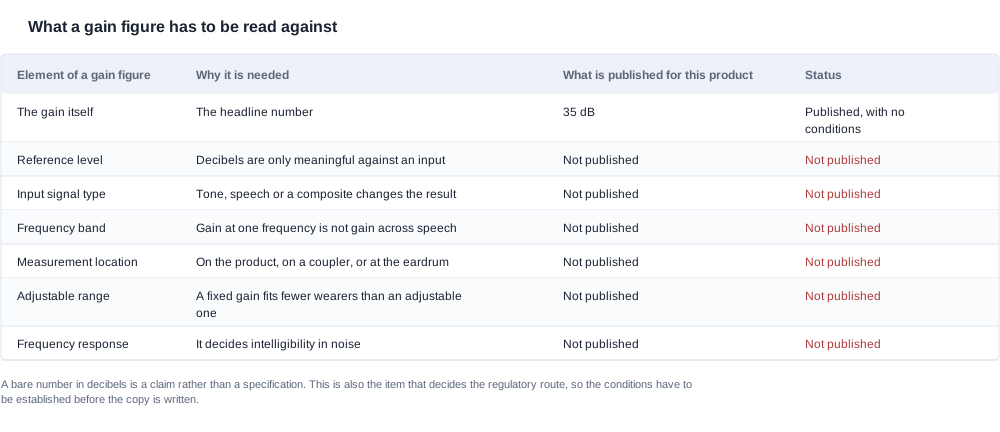
A gain figure in decibels is not a specification on its own. It is a ratio, and a ratio only becomes a specification when the thing it is measured against, the signal going in, the band over which it holds and the place it was measured are all on the page. The catalogue publishes an amplification gain of 35 dB for the bone-conduction entry, and it publishes it without any of those four. That is not a reason to reject the number. It is the reason the number cannot carry a claim on its own.
The scale of the omission is worth registering first. The 35 dB figure is the only acoustic performance figure in the entire catalogue. No other product in the range publishes a gain, a frequency response, a driver size, a microphone count, a pickup distance or a leakage figure. There is nothing in the catalogue to compare it with, which means a buyer cannot triangulate the number from the range around it. It has to be read on its own terms, and the terms are missing.
This article is about how to read the number: what a gain figure is, the six conditions it needs before it can be compared with anything, where this particular 35 dB is ambiguous, what a comparable specification looks like in practice, what to ask a test house, and how we will and will not use the figure in a quotation or a listing.
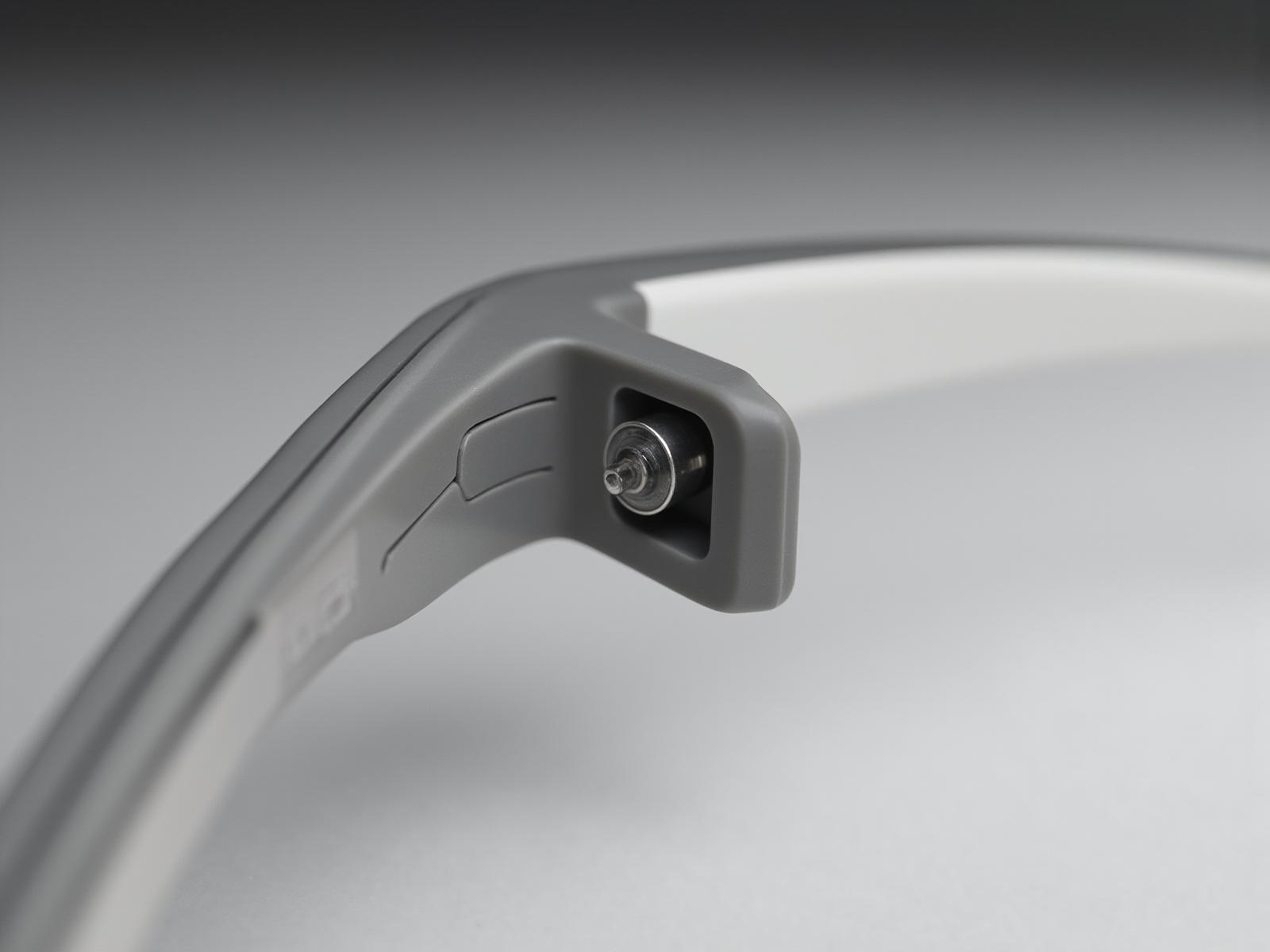
Bone conduction glasses gain levels: reading a ratio
Before the conditions, the arithmetic. Decibels are logarithmic, and the two properties that matter commercially are these.
A gain figure multiplies; it does not add. A 6 dB step doubles the voltage ratio, and a 20 dB step multiplies it by ten. This is why 35 dB is a large number in wearable terms and why a phrase like "thirty-five decibels louder" is not a meaningless exaggeration but a genuinely large ratio. It is also why the figure is a legitimate headline for a product: a real difference in amplification is exactly the kind of thing a customer can notice.
A gain figure describes a change, not a level. It says what the amplifier did to the signal, and it says nothing about the signal itself. Two products can have identical gains and produce completely different results, because one is amplifying a quiet conversation and the other is amplifying a loud street. The output is a function of the input and the gain together, and a gain published on its own cannot tell a buyer what the product will sound like.
That is the whole reason the conditions exist. A gain figure without a reference level, an input signal, a band and a location is a number that can be quoted and cannot be compared, and the four conditions are what turn it back into a measurement.
What the omission means for a procurement file
One practical consequence deserves naming before the conditions are listed. A compliance reviewer does not assess a number; a reviewer assesses a number with its conditions attached, because without them there is nothing to review. An incomplete figure therefore consumes review time without producing a decision, since the reviewer has to send it back. The faster a buyer recognises that the figure is incomplete, the sooner the request for the conditions can go out, and the sooner the review can conclude.
The one thing a gain figure is not
It is not a volume setting, and it is not a sound pressure level. Decibels in an acoustic context usually describe a level relative to a reference pressure; decibels in an amplifier context describe a ratio between two electrical signals. Both are written the same way and they are not interchangeable, which is the source of most of the confusion in this category.
A buyer who compares a published gain figure against a competitor's published sound pressure figure is comparing two different quantities, and will reach a conclusion that has nothing to do with either product. The way to avoid that comparison is to insist on the ratio's own terms before any comparison is attempted at all.
Six conditions a gain figure needs
Here is the set. For each one, what it is, why it is needed, and what the catalogue publishes for this entry.
1. The reference level
Decibels are relative to something. A gain measured against a one-volt electrical input and a gain measured against a calibrated acoustic reference are different quantities, both written in decibels. Only the second can be compared with figures quoted in hearing-related literature, and it is the second that a compliance reviewer will ask about.
Not published for this entry. A gain figure without a reference level cannot be reproduced by a second laboratory, which is a practical problem rather than a philosophical one.
2. The input signal
A pure tone, a speech signal and a composite signal give three different answers, and a composite signal is closer to what a person actually receives in an environment. The input type is the difference between a laboratory number and a usable one, and it is also the difference between a product that suits a voice channel and a product that suits a music channel.
Not published.
3. The frequency band
This is the condition that matters most and is missed most often. Gain at 1 kHz says very little about gain at 4 kHz, and intelligibility in noise depends heavily on the upper part of the band. A figure quoted as "35 dB" without a band is a single point on a curve that has not been shown to you, and a single point cannot be turned into a performance statement.
Not published.
4. The measurement location
On the product surface, through a standard coupler, or at the eardrum are three different numbers, and only the last one describes what a person receives. A transducer pressed against a skull does not produce the same result as a transducer on a bench fixture, which is the practical reason the location row cannot be skipped.
Not published.
5. The adjustability range
Whether the gain is fixed or adjustable, and over what range, decides how many people the product addresses. Hearing impairment is not uniform across a population, which means a fixed-gain product serves a narrower group than an adjustable one, and a single SKU built on a fixed gain may not serve a channel that assumes otherwise.
Not published.
6. The full frequency response
The complete curve, which is what determines how the product behaves across different environments rather than at a single point. A response curve also shows whether the gain is concentrated where speech lives or spread across a band that includes more of the spectrum than the use case needs.
Not published.
Where the 35 dB figure is ambiguous
With the six conditions listed, it is possible to say precisely where this published figure can and cannot be used.
What it supports
A mechanism statement. The product amplifies the sound already present in the environment, by a ratio of 35 dB, and it is the only product in this range that publishes an amplification figure at all. That is a genuine, documentable differentiator against the open-ear audio models, whose pages carry no acoustic rows whatsoever.
A shortlist filter. For a buyer triaging a range, the existence of a documented amplification figure is a meaningful signal: it means the product is a specified acoustic device rather than a general-purpose one, even though the specification is incomplete.
A question with a date attached. "35 dB, with no conditions" is a specific and answerable request. A supplier who can produce the reference level, the band and the location has a product with a measurement programme behind it. A supplier who cannot has a number, and that is worth knowing early.
A basis for a written claim, once the conditions are supplied. This is the commercially important use and it is a downstream one. The catalogue publishes a ratio; a compliance regime in most destination markets requires a claim to be supported by conditions on the record. A brand that has the conditions can make a claim that survives review, and a brand without them cannot make any acoustic claim at all, however carefully the copy is written. That is the real cost of the missing rows: not the number, but the claims that the number cannot be used to make.
What it does not support
A comparison. Nothing else in the catalogue publishes a gain, so there is no internal baseline and no way to triangulate. Any comparison with another supplier's product is between two incomplete numbers unless both are completed against the same conditions.
A claim about output level. The figure does not say how loud the result is, because the input is not stated. "35 dB gain" in a listing, without the environment, is a number a customer can interpret in their own favour and be disappointed by.
A clinical or functional claim. A gain ratio is a characteristic of an output stage. It is not a hearing assessment, and it does not establish what the product does for anyone's hearing. We hold no clinical data, no test protocol and no regulatory assessment for this entry, and the certification and medical device boundary piece works through where that line sits.
A durability or longevity statement. Nothing in the published figure says how the gain behaves as the product ages, and the durability analysis covers what the acoustic path would need in order to support one.

Turning the figure into a comparable specification
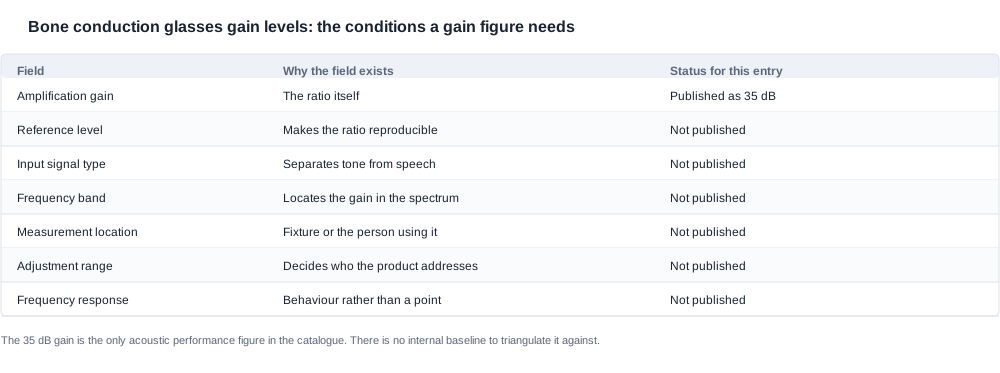
The practical output of this analysis is a document request, and the way to write it is to specify the fields rather than to ask for "the acoustic data".
The specification template
| Field | Why the field exists | Status for this entry |
|---|---|---|
| Amplification gain | The headline ratio | Published as 35 dB |
| Reference level | Makes the ratio reproducible | Not published |
| Input signal type | Separates tone from speech | Not published |
| Frequency band | Locates the gain in the spectrum | Not published |
| Measurement location | Distinguishes fixture from wearer | Not published |
| Adjustment range | Decides who the product addresses | Not published |
| Frequency response | Shows the behaviour, not a point | Not published |
| Delivered output across the adjustment range | What a person actually receives | Not published |
A request written as a field list is answerable, and a request written as "send us the acoustic specification" is not. That is the whole difference between a document request that returns something and one that returns a general data package with the wrong contents in it.
Three uses the completed specification enables
Once those fields are filled, three things become possible that are not possible now, and each of them is commercially material.
Copy that can be defended. A listing can say what the product does in conditions the buyer can verify, because the conditions are on the page. A listing that says only "35 dB" is a listing that a competitor can dismantle in one email.
A like-for-like shortlist. Once two suppliers publish the same fields, the comparison becomes a comparison rather than a contest between two different quantities. That is the point at which a buyer can select on evidence instead of on the size of the headline number.
A defensible cost argument. The price comparison piece covers why the commercial conversation in this category has to start with the claim and the conditions rather than with the unit price, and this table is the document that makes that conversation possible.
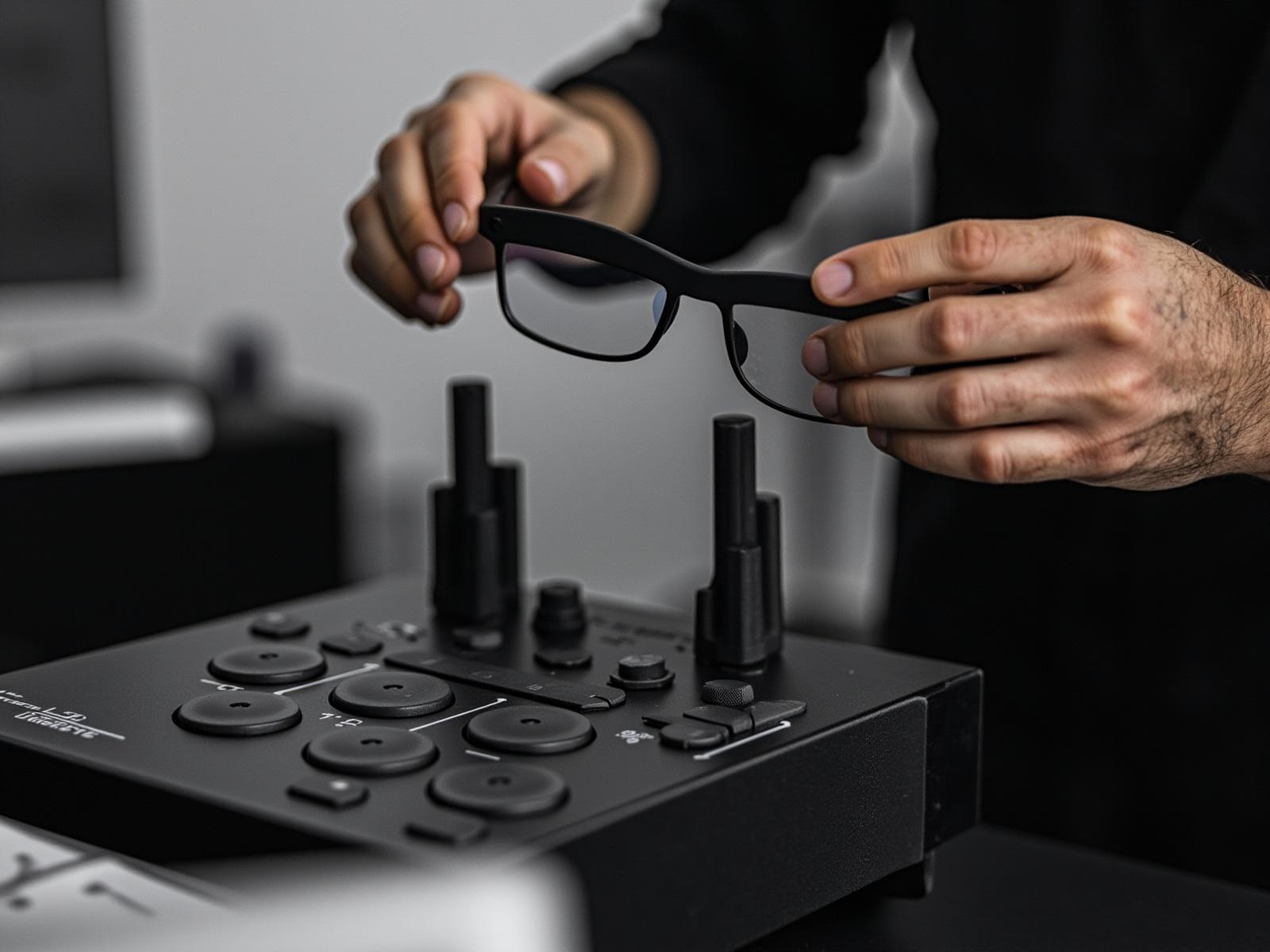
The questions to put to a test house
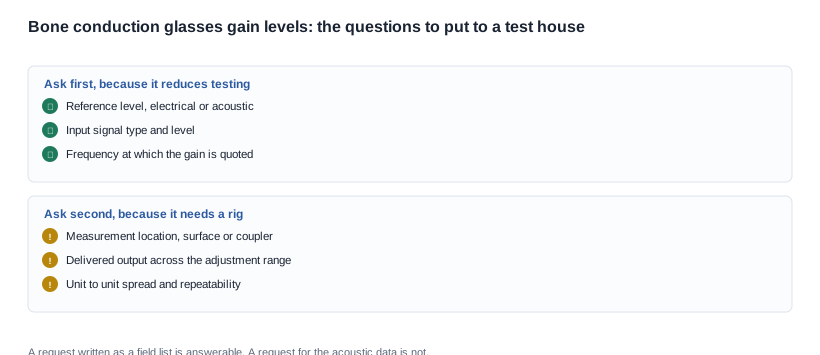
If the supplier cannot produce these rows, a test house can, and the request has to be written in the same field terms. Seven questions, in the order that reduces the amount of testing required.
- What is the reference level the output is measured against, and is the measurement electrical or acoustic?
- What input signal is used — a pure tone, a speech signal or a composite — and at what level?
- At what frequency is the gain quoted, and what is the gain across the band?
- Where is the measurement taken: the product surface, a coupler, or a simulated eardrum?
- Is the gain fixed or adjustable, and if adjustable, over what range?
- What is the delivered output at the extremes of the adjustment range, measured on a defined coupling condition?
- Is the measurement repeatable across units, and what is the spread between units?
The seventh question is the one that buyers skip and that test houses answer readily. A gain figure with a wide unit-to-unit spread is a different commercial proposition from one that is repeatable, and a brand building a range on it needs to know which of the two it is buying.
How to choose what to test first
Testing acoustic performance is not cheap, and a buyer with a limited budget has to choose an order. The order below is not the order of technical elegance; it is the order that produces the most commercial information per unit of testing.
Start with the reference level and the input signal. These two fields are nearly free to establish, because they are properties of the measurement setup rather than of the product, and they determine whether any subsequent number can be reproduced. A laboratory that cannot state these two has not run a comparable test, and a result built on them is not usable.
Then establish the band. A single-frequency measurement is cheaper than a swept response, and it is enough to disqualify a product. If the gain at the mid-band and the gain in the upper band differ by a wide margin, the product does one job well and the other job badly, and the brand needs to know that before it chooses a channel.
Only then commission the delivered-output and repeatability work, which is the most expensive part because it needs a coupling rig and multiple units. A buyer who has established the first two groups already knows enough to decide whether the product belongs on a shortlist at all.
The selection criteria for spending the budget are therefore: reproducibility first, spectral coverage second, unit spread third. A buyer who reverses that order pays for the most expensive measurement first and sometimes finds out that the number cannot be reproduced.
A gain figure in a listing, worked through
This is a worked case rather than a completed deal. It sets out the decision sequence.
A brand is preparing a listing for a bone-conduction product and wants to use the 35 dB figure. The buyer's starting position is that the number is usable because it is the only acoustic figure available.
The first decision is what the sentence will claim. The buyer writes three candidate sentences: one that says the product amplifies the environment by 35 dB, one that says it delivers up to 35 dB of amplification, and one that describes a perceived improvement in a noisy environment. The first is a statement about the published row. The second adds an "up to", which is a claim about a maximum that has not been measured. The third is a functional claim about the result, and there is no data behind it. The first sentence is the only one the documentation supports, so the listing uses the first sentence and nothing else.
The second decision is what goes in the technical page. Rather than a single number, the buyer asks for the field list above, and the supplier returns a reference level and an input signal type. That is enough to write a defensible sentence, and the remaining fields are marked as open in the technical page, which is itself a signal of competence to a technical buyer.
The third decision is what the customer-support script says. Because the conditions are published and the raw number is not a loudness figure, the script has to avoid the phrase "as loud as", and it has a written answer for the question "how loud is it" that explains the difference between a gain and a level.
The outcome is a listing with one accurate acoustic sentence, a technical page that names its own open fields, and a support script that answers the loudness question without making a promise the product has not been shown to keep. The 35 dB figure is still in the listing, because it is the most interesting number on the page; it is simply not doing work it has not been measured for.
How we will and will not use the number
We will publish the 35 dB gain figure because it is documented, and we will not present it without the conditions that give it meaning, because a bare gain figure in a category with this regulatory profile is a claim rather than a specification. We will not invent a reference level, a band, a measurement location, an adjustment range, a frequency response or a noise figure, and we will not describe the product as a hearing aid or attach any hearing-improvement claim to the amplification figure.
The published bone conduction specification is the honest baseline for what this entry contains, the export considerations cover what travels with the goods, and the buying for hearing support guide works through the six questions a buyer should take to a test house. The handling instructions cover the side of the product that the delivered output depends on.
If you want to use the number in a listing, the sequence is fixed: fix the conditions first, then write the sentence. The other order produces copy that has to be withdrawn.

Related reading
- The regulatory question in full — bone conduction glasses certification and medical device boundary
- What the documentation is missing — bone conduction glasses common questions
- The commercial side — bone conduction glasses price comparison
Give us the destination and the claim you intend to make, and we will mark which of the seven items are documented, and which still need the engineering team or a test house to provide them.


