

Bone conduction glasses technology: one question, fewer tickets
Most tickets in the bone conduction category are about a device that is working exactly as designed, and the commercially expensive part of that is not the ticket — it is the replacement cost and the review score that follows it. Seven problems account for the majority, and one diagnostic splits them all: the output path and the input path are two different systems, so a single question about whether the call works halves the case load before any troubleshooting begins.
For a buyer, the practical conclusion is that your support script, your warranty wording and your listing copy have to be written against these seven behaviours, because a category with one unnamed model and no published acoustic measurement cannot be supported by a generic script.
The first question to put on any ticket is this: does the call work? If the other person can hear the wearer clearly, then the device, the pairing, the radio and the output path are all fine, and the problem is on the input side — the microphone, the uplink, or the room. If the call does not work either, the problem is somewhere else entirely. This single question costs a customer ten seconds and removes roughly half the cases before a technician touches the unit.
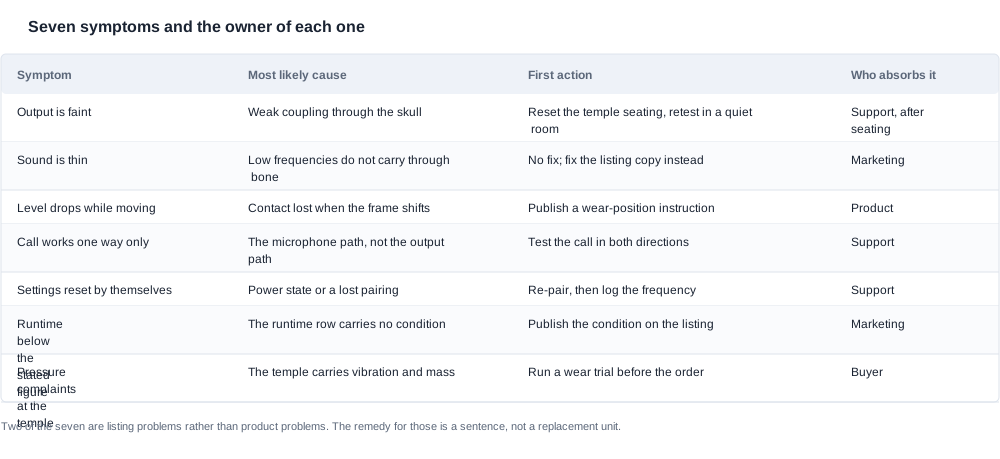
Seven symptoms, and who owns each one
Each of the seven problems below has a different correct response, and the wrong response costs money. One of them is a design behaviour that should be explained in the listing and taught to channel staff. One is a fault that justifies a replacement. One is a compliance question, where the correct response is to describe what the device does rather than what it achieves for the user. Sorting them in advance is what converts a support cost centre into a predictable line item.
There are three common pitfalls in this list, and they are worth naming before the symptoms. The first is treating every faint-output ticket as a fault, which converts a seating instruction into a unit cost. The second is treating every thin-output ticket as a fault, which converts a listing problem into a unit cost. The third is treating a comfort complaint as a fault, which converts a design property into a unit cost. All three of those conversions are trade-offs a buyer can make deliberately, and none of them should be made by accident.
The sound is faint. Transmission through the skull is weaker than the same source through an earbud, and contact quality dominates the result. The first action is to adjust the temple position and seating and retest in a quiet room; if the level is still low there, it is a device fault. The owner is support, but only after the seating check, and the seating check has to be in the script rather than in the agent's judgement.
The sound is thin. Low frequencies do not carry through the skull; this is the technology, not a fault. There is no fix in the hardware. The remedy is in the listing copy, and a listing that promised a music product causes the complaint. The owner is marketing, and this is the one problem in the list that gets solved by changing words rather than by changing units.
The level drops while moving. The frame shifts, the temple contact changes, and the coupling changes with it. The first action is to establish and publish a wear-position instruction, because a wearer who knows where the transducer should sit will seat it correctly most of the time. The owner is product, because a recurring version of this complaint means the temple geometry is the issue.
The call works one way only. The wearer hears the other side, but the other side cannot hear the wearer. That isolates the fault to the input path — the microphone, the uplink, the pairing in the call application — and the output path is cleared. The first action is to test the call in both directions with a second device in the same room, which separates a microphone fault from a mobile network fault. The owner is support.
The settings reset by themselves. The device loses its pairing or returns to a default state, usually after a power cycle or a flat battery. The first action is to re-pair and then record the frequency, because the frequency is the only evidence that distinguishes a hardware fault from a usage pattern. The owner is support, and the frequency is what makes the data useful to the factory.
The runtime is shorter than stated. The published figure of roughly seven hours is a rated runtime, and a rated runtime carries a test condition that is not published for this entry. The remedy is to publish the condition on the listing — what the device was doing while the clock ran — rather than to replace the unit. The owner is marketing, and this is the second of the two listing problems in the list.
Weight and pressure complaints at the temple. The temple carries both the vibration and the mass of the frame, so prolonged use produces pressure points at the mastoid area. This is not a defect, and treating it as one is the most expensive response available. The first action is a wear trial before the order, not a return after launch. The owner is the buyer.
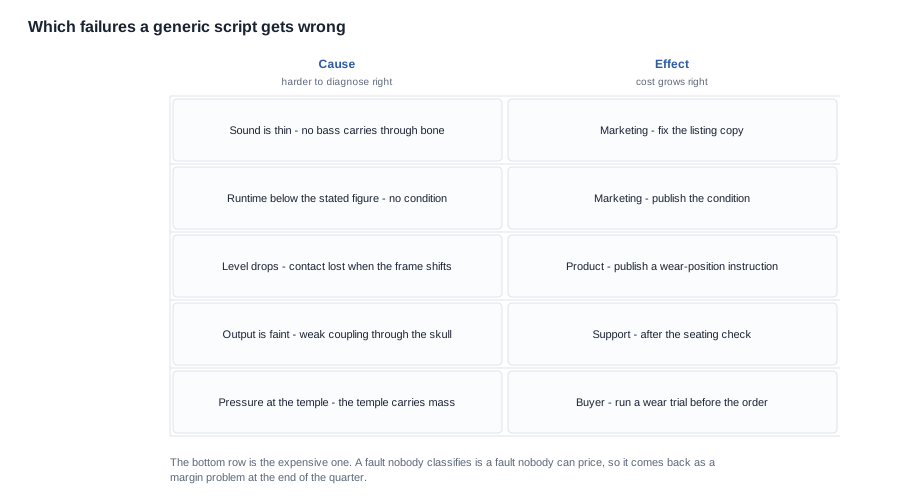

Building the support script before the first unit ships
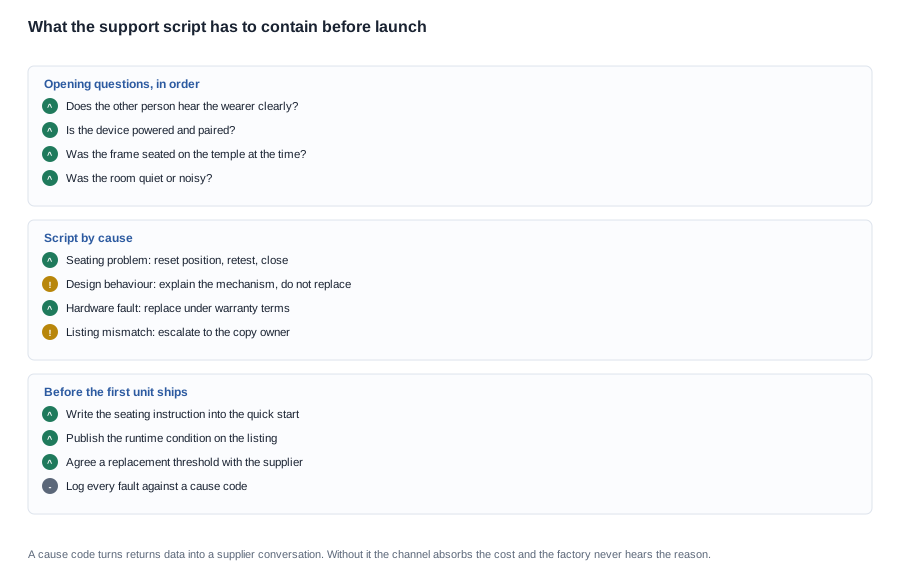
The script is where the seven problems become money, and it is the artefact that most programmes build last and regret first. In this category it cannot be a generic script borrowed from an earbud programme, because the failure modes of a bone conduction frame are not the failure modes of an earbud: there is no silicone tip to degrade, no seal to lose, no driver to fall out of the housing. What there is instead is a variable that no fault can explain — the coupling — and the script has to be written to handle it.
The order of the questions is what makes the script work. Question one is the call test, because it halves the case load. Question two is the power and pairing state, because it eliminates a whole family of soft faults. Question three is whether the frame was seated on the temple at the time of the complaint, because seating explains more faint-output tickets than any other factor. Question four is whether the room was quiet or noisy, because that is the condition under which a level judgement was made.
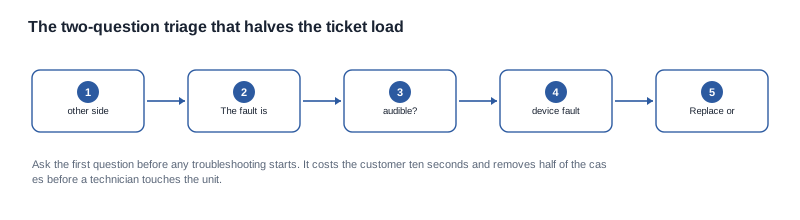
After the questions come the scripts, and each of the seven problems needs its own wording rather than a shared one. A seating problem closes with a reset and a retest. A design behaviour — thin sound, pressure, the rated runtime — is explained and closed, with no unit issued. A hardware fault is replaced under the warranty terms. A listing mismatch is escalated to the copy owner, because the agent cannot fix a sentence.
The last element is the cause code, and it is the one most programmes skip. Without a code, returns data is a count and a count cannot be negotiated with a factory; the only conversation available is about price. With a code, the same data becomes a defect rate by cause, which is a quality argument with a number attached — and for the two listing problems in this list, a number that justifies a copy change rather than a replacement.
Who is buying this product, and what they are afraid of
The reader is a brand product manager, an after-sales lead or a channel buyer who is about to put a bone conduction product into a retail channel and now has to build the support and returns process around it. The specific difficulty is that the published specification for the one entry in this category is a 35 dB amplification gain, a bone conduction transducer, a 200 mAh cell, a charge time of two hours or less, roughly seven hours of rated runtime and Type-C charging — and it carries no model number. With no acoustic figures, no weight, no driver detail and no ingress rating, the only thing that will protect the business is a support process that resolves tickets by mechanism rather than by guesswork.
That difficulty is not an inconvenience; it changes what the buyer is actually buying. In a category with published acoustic performance, the buyer buys a product and a support problem that the factory's warranty already covers. In this category the buyer is buying an operating model as well, because the documentation does not include the information a generic after-sales process assumes exists.
It also changes how a supplier shortlist should be built. When the published rows are six and one of them carries no test condition, the usual shortlisting criteria — specification completeness, model coverage, certification maturity — have little to work with, so the buyer has to substitute process criteria: does this supplier keep cause-coded returns, do they state a measurement method, do they name the model on the file. A shortlist built on those criteria will produce a different ranking from one built on catalogue depth, and the second ranking is the misleading one here.
The three fears are specific, and each one maps onto a section of this article. The first is the returns rate: a category whose published documentation is six rows cannot support a category-standard return policy, because the agent has no reference for what normal output sounds like. The second is the warranty exposure: a warranty written against "malfunction" will be claimed by every wearer whose experience differs, because the difference is a wearer's coupling rather than a unit fault. The third is the listing risk, which is that the copy was written from the gain figure and creates a promise the product cannot keep on a bad seat.
The commercial consequence of getting this wrong is that the cost does not arrive as one large event. It arrives as a drift in the return rate over the first two quarters, by which point the product is in the channel, the packaging is printed, and the returns are attributed to quality rather than to a support process that was never built.
What a category with no published acoustics costs a support team
It is worth being concrete about why the absence of acoustic documentation lands on the support team rather than on the engineering team, because the reasoning is unusual and it is where most of the cost sits.
For a conventional audio product, the agent can compare a returned unit against a reference expectation: this is what it should sound like, this is what a healthy battery duration is, this is what normal pairing behaviour is. That reference expectation is usually held collectively rather than written down, but it exists, and it is what makes triage fast. In this category there is no published frequency response, no leakage figure, no frame weight and no microphone specification for the entry, so the reference expectation does not exist. The agent's only reference is the returned unit itself, and a unit that is working perfectly produces a perfectly reasonable complaint.
That is why the seating check has to be a script step rather than an agent's judgement. A judgement depends on experience with the product, and experience takes volume to build, and volume in this category is small enough that the first hundred units are handled by people who have never heard the category work correctly. A scripted check needs no experience: it is a question, and it produces the same answer from the first agent onwards.
The second structural cost is the ambiguity of the word "fault". In a category where a large share of tickets are design behaviour, "fault" cannot mean "the customer is unhappy". It has to be defined in the warranty text against mechanism rather than satisfaction — the difference between a unit that will not produce output at a defined reference and one that produces output the customer did not expect. A warranty written on satisfaction in this category will be claimed at a rate the business did not model, and the claim will be settled by the brand rather than by the supplier, because the supplier's warranty terms are written in mechanism terms that the agent did not use.
The third structural cost is the one that nobody budgets for: the gap between what the factory considers a fault and what the channel considers a fault. If the factory has never received cause-coded returns, its picture of the product's weaknesses comes from the units that come back through its own aftersales route, which is a fraction of the channel's volume and probably skewed toward manufacturing faults. The channel's picture comes from everything. Neither picture is wrong; they are pictures of different populations, and the cause code is what allows the two to be compared.
Designing the returns and warranty position
The warranty text for this category should be written as a mechanism test rather than a satisfaction statement, and it should be written before the first unit ships rather than negotiated in the first quarter of returns. Three clauses do most of the work.
The acceptance criteria underneath it matter as much as the wording. If the criteria for a genuine fault are a mechanism a support agent can apply in one call, the warranty is cheap to administer; if the criteria require a laboratory, it will be applied inconsistently and the cost will drift upward without anybody deciding to spend it.
A defined symptom list with a defined resolution. For each of the seven problems, the text says what the agent does. No output at the temple contact after a seating reset and a re-pair is a replacement. Output that varies with movement is a wear instruction. Thin or bass-light output is expected behaviour and is described as such. The warranty then says what is covered, and it says it in mechanism terms.
An explicit separation between behaviour and fault. The warranty should state that the coupling between the frame and the head affects the level a wearer perceives, that this is a property of how the product is worn rather than a defect, and that the published gain figure is an electronics measurement rather than a level at the ear. This is the clause that prevents the most expensive category of claim, which is the claim that arrives from a customer who expected a headset and received a different acoustic behaviour.
A replacement threshold the supplier has agreed to. A sample count, a batch number, and a period, agreed with the factory in advance, so that the replacement cost for a genuine fault has a defined boundary. Without it, every warranty decision becomes a negotiation with the factory at the worst possible moment, which is during the first returns cluster.
The returns policy for the channel should be narrower than the warranty for the brand, and it should be written in terms of the mechanism list. A channel that offers a free return on a thin-sound complaint is paying the brand's listing mistake out of its own margin. A channel that offers a free return on a no-output complaint is behaving normally.
Where the returns cost actually lands
The cost of a support failure in this category is not a single line. It is four lines, and they land in different departments and at different times.
The unit cost. Small per unit, and the number of units is not what makes it expensive. The expensive version is the second-unit dispatch that happens because the first agent misclassified a seating complaint as a fault. That second dispatch is the metric to watch.
The reverse logistics cost. Higher than an earbud programme, because the unit has to come back in a condition where the coupling can be assessed, and because a battery-equipped unit returned by a customer raises transport and disposal handling rather than simple restocking.
The review cost. This is the line that hurts the channel most and it is invisible in the returns report. A product in a category where buyers' expectations are set by earbuds accumulates reviews that describe an acoustic difference the product is not wrong about. Each of those reviews is a permanent reduction in the conversion rate of the listing, and it does not appear in any aftersales metric.
The opportunity cost. The one nobody books. A channel with a returns problem in a new category stops listing it, and a stopped listing is not a recoverable cost — it is a channel slot that goes to a competitor who has the same product and a better returns process. This is the line that makes the total cost of a support failure much larger than the sum of the other three, and it is the reason the decision about how to run aftersales belongs to the buying team rather than to the support team alone.
What a buyer can negotiate to reduce this is worth stating plainly. The sample order terms and how many evaluation units are supplied; the warranty replacement threshold and how a genuine fault is confirmed; the cause-code structure, and whether the factory will accept a monthly returns summary broken down by cause; the documentation package, and whether the final payment is tied to it; and the artwork scope, including whether a printed explanation of the seating requirement can be included in the box. None of these is a discount. Each of them reduces a line the brand would otherwise pay.
A worked case: a channel launch with four cause codes
This passage is a constructed example. Its purpose is to make the sequence visible, and nothing in it describes a real order.
Assume a consumer electronics brand launching a bone conduction product through two online marketplaces and one own store, with an after-sales team of four people, none of whom has handled this category before. The published specification they are launching against is a 35 dB amplification gain, a 200 mAh cell, a charge time of two hours or less, a rated runtime of roughly seven hours and Type-C charging, with no model designation, no acoustic figures and no frame weight.
Step one: the script, before the samples. The brand writes the four-question opening sequence and the seven cause codes, and puts the seating instruction into the quick start guide and the box insert rather than leaving it to the listing page. Two of the seven codes are closed with no unit issued, because they are behaviour and listing issues rather than faults.
Step two: the warranty text. The brand writes the warranty in mechanism terms and separates behaviour from fault explicitly. It also names the published gain figure as an electronics measurement, so that an agent declining a claim can point at a sentence rather than a policy.
Step three: the supplier conversation. The brand asks for a replacement threshold — a sample count, a batch and a period — and for a monthly returns summary by cause code. Neither is a discount and both are refused by no supplier in this category that has a functioning aftersales process, because both already exist in some form internally. The questions to ask are deliberately narrow, because a broad question about aftersales support produces a policy statement while a narrow question produces a number.
Step four: the first cluster. In week three the tickets cluster around faint output. Because the seating check is question three, the team resolves most of them without a dispatch, and the cause code shows that the pattern is concentrated in one marketplace, which points at the listing page rather than at the unit. The listing is edited.
Step five: the reviews. By week six, review text describes thin sound and pressure at the temple, both of which are on the behaviour list. The brand does not contest these reviews, because contesting them would be contesting the acoustics. Instead it adds the seating and expected-behaviour language to the listing and to the product page, and it accepts that the category will produce some mismatch reviews because the buyer's reference frame is an earbud.
Step six: the commercial review at month three. The cause-coded returns summary shows a genuine fault rate that is a small fraction of the total ticket volume, most of which is behaviour and listing. The brand now has a number it can put in front of a supplier at renewal, which is the whole point of having collected it. It also has a listing that no longer creates the thin-sound complaints in the first place.
The result is a returns line that behaves like a product category rather than a pilot, and a support team of four that did not need a headset-category script it could not have used.
What our catalogue publishes, and what we will not commit to
Here, we publish the rows we hold and publish the absences with the same prominence. For this entry that means a 35 dB amplification gain, a bone conduction transducer, a 200 mAh cell, a charge time of two hours or less, and finally a rated runtime of roughly seven hours and Type-C charging We publish no model designation, no acoustic measurement, no leakage figure, no microphone specification, no frame weight and no ingress rating.
That absence has a direct effect on after-sales, and we would rather state it than let a buyer discover it through a returns cluster. We cannot supply a reference expectation for a wearer's perceived level, because the coupling variable is not published and cannot be reduced to a figure. We cannot confirm a fault by acoustic comparison against a reference unit, because there is no published reference to compare against and no measured baseline to hold. And we will not commit to a fault rate, a return rate, a defect rate or a production yield, because none of those has been measured to a standard we could defend.
What we can do is support the mechanism list: a seating check before a replacement, a call test that isolates the input path from the output path, and a cause code structure that keeps behaviour, listing and fault separate. If you send us the seven codes you intend to use and the units you are shipping, we will tell you which ones we can settle from the published rows and which ones need a sample measurement first.
What to put in place before the first unit ships
Write the seven codes into the aftersales system, not into a document. If a code is not selectable at the point where a ticket is closed, it will not be collected, and the returns summary will stay unarguable.
Put the seating instruction in the box, not only on the listing. A printed instruction in the packaging reaches the wearer at the moment the problem appears. A listing instruction requires a search.
Ask the supplier for a replacement threshold in writing. A count, a batch and a period. It is the clause that converts a warranty into a costed position.
Decide which of the two listing problems you own. Thin sound and the rated runtime condition are both copy problems. Owning them costs one rewrite; not owning them costs a returns rate that nobody can argue with.
The mechanism behind all of this is covered under bone conduction audio technology, the fit variable is discussed in bone conduction comfort and fit, and the working parts of an after-sales operation are set out in after-sales support documentation.
Where this comes from
- Bone conduction audio technology and its limits
- Comfort and fit in bone conduction frames
- After-sales support documentation
- Returns and RMA handling
- Bone conduction glasses in the range
Send us the cause codes you are using and the units you are shipping, and we will tell you which ones our published rows can settle.


