

Bone conduction glasses are comfortable in a way that no other audio eyewear is, and they have a specific failure mode that no other audio eyewear has. Because the transducer presses against the skull to deliver sound, the seating quality of the product and the delivered level of the product are the same variable. Push the transducer harder and the audio couples better, and the pressure goes up. Loosen it and the opposite happens. That trade-off sits underneath every comfort question in this category, and it is why fit testing has to be done with the audio running rather than with the frame sitting on a table.
Our published documentation for this product is thin, and we would rather say so at the start than at the end. What follows is what the catalogue row actually contains, which wear variables are not measured anywhere, and the order in which a procurement team should close them.
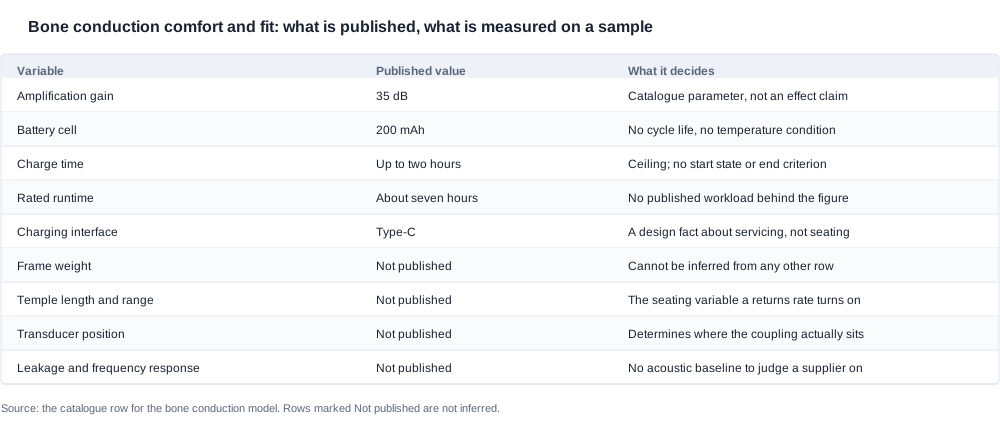
Bone conduction glasses comfort and fit: one variable decides both questions
The published set is five rows, and none of them is a wear variable
The bone-conducted platform in our range publishes an amplification gain of 35 dB, a 200 mAh battery, a charge time of up to two hours, a rated runtime of around seven hours, and Type-C charging. That is the whole list.
Read against the question a sourcing team is actually asking, the gap is structural rather than merely incomplete. No model number is published. The product is listed in our catalogue without a SKU, which is not a detail any buyer can defer: a purchase order, a packaging artwork file and a customs declaration all need a product designation, and none of those three can be produced against an unnamed item. Issuing a formal model identifier is the first thing to resolve, and it gates the measurements described below.
No frame weight, no temple length, no lens dimension and no transducer position are published. For a category where the transducer sits against the temporal bone is the single most consequential physical variable, that is the most expensive gap on the sheet. Weight in particular cannot be inferred from anything else in the catalogue: the only published weight in our entire range is the 158 g whole-unit figure for the MT6, which is a camera model with a folding charging case and is not comparable to a contact-transducer frame.
No acoustic figures are published — no leakage, no driver size, no frequency response, no pickup distance. A sourcing team therefore has no baseline against which to judge a supplier's claim about this product.
No certification status is published per model, and no customisation scope is disclosed. The catalogue lists a company-level export certification page whose content is images rather than text, and the written catalogue carries no CE, FCC or RoHS reference. If a private-label build is planned, the honest position is that the scope has not been defined.
Why one variable decides both the comfort answer and the performance answer
The mechanism is simple and it is unforgiving. A contact transducer delivers sound through bone, and bone impedance is high enough that the coupling has to be maintained by sustained contact pressure. Reduce the contact and the delivered level falls; increase it and the pressure rises until the session becomes intolerable. There is no setting that decouples the two.
That produces an uncomfortable structural fact for a sourcing team: a product can be judged twice and the two judgements are not independent. A unit that scores well on a twenty-minute desk trial and poorly in a full-shift trial is not two different products — it is one product whose seating requirement nobody has established.
What that means for the acceptance criteria
The acceptance criteria for this category cannot be written as a comfort score plus a performance score. They have to be written as a single seating requirement with a defined measurement, a defined duration and a defined workload. If the criteria are written as two independent lines, a supplier can satisfy both lines simultaneously with two different units, and the channel absorbs the difference. The bone conduction audio notes cover the acoustic side of that coupling.
What the 35 dB figure changes about seating, and what it does not
A 35 dB amplification gain is the most aggressive parameter we publish anywhere in the range, and it deserves to be handled carefully in both directions.
Amplification gain is not a hearing-aid claim. A gain figure describes how much the device increases signal; it does not describe diagnostic capability, it does not establish a clinical indication, and it does not make a product a medical device by itself. In the United States the regulatory line runs through the FDA's over-the-counter hearing aid framework, in which a hearing aid is defined as an air-conduction device for adults with mild or moderate hearing impairment, while personal sound amplification products sit outside that definition. A bone-conducted product that claims to treat hearing loss is claiming something entirely different from one that amplifies ambient sound. We make no medical claim for this product and hold no clinical data for it. Any supplier or listing that does so on a buyer's behalf is making a claim the buyer cannot support, and the certification and medical device boundary article sets out where the line sits.
The published 35 dB figure is a catalogue parameter, not an effect statement. It is quoted here because it is published, and it should be carried into any downstream document with the same status attached — a specification row, not a performance promise.
The practical consequence for seating is direct. A high gain means the listener will turn the level up, and the level at which sound becomes usable is the level at which the transducer must couple well. A frame that is acceptable at low output may be delivering less than the wearer wants, and the instinct will be to push it closer to the head. That is exactly the mechanism by which an acceptable-fitting bone conduction product becomes an unacceptable one after three hours.
This is why the 35 dB row and the wear variables belong in the same document even though the catalogue keeps them on different pages. The gain figure sets the level the seating has to deliver; the temple geometry determines whether the seating can be held for a full session.
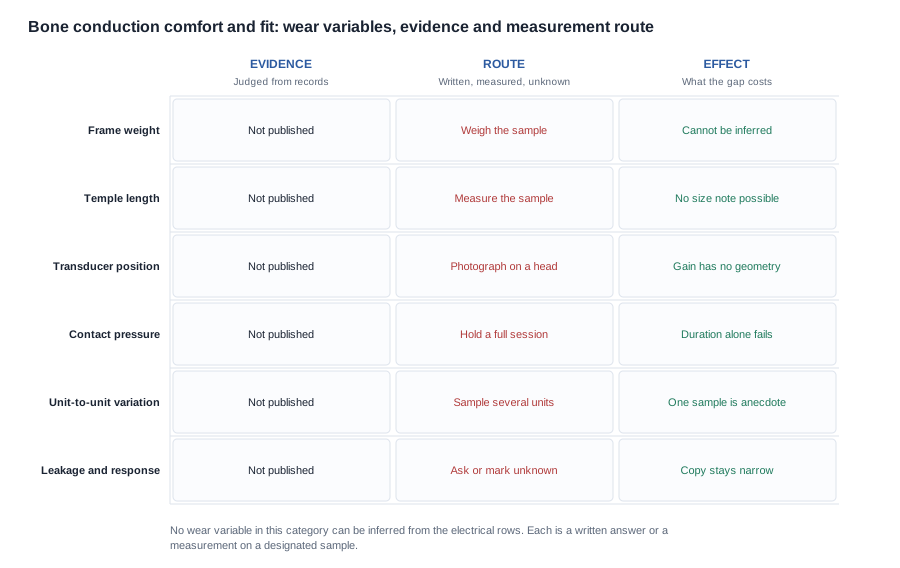
The wear variables that decide the programme, in the order they bite
Temple geometry and the adjustment range
The seating of a contact transducer is a function of temple length, temple curvature and the adjustment range available at the back of the frame. None of the three is published. Without temple length a buyer cannot size the product for a channel listing; without an adjustment range a buyer cannot tell whether the product accommodates more than one head geometry; without a curvature figure a buyer cannot tell whether the contact point sits where the catalogue's gain figure was measured.
The practical consequence is that returns data cannot be read. A return attributed to "uncomfortable" is indistinguishable from a return attributed to a genuine hardware fault unless the adjustment range is known, because in a product where seating is the dominant variable those two descriptions can describe the same unit.
Contact pressure and its duration tolerance
The tolerance is not a single number either. It depends on duration, on output level, and on the point on the head where the transducer sits. A frame that holds contact at a conversational level for twenty minutes may fail at a higher level across a full shift. Any acceptance criterion therefore has to name the workload and the duration together; a duration criterion without a workload is not testable.
Nose bridge load and weight distribution
Frame geometry distributes load between the temple contact and the nose bridge. In this category the temple contact is not decorative — it is functional — so the geometry that improves transducer seating can increase nose-bridge load, and the two trade against each other. The catalogue publishes nothing about either, so the only route to an answer is a measurement on a designated sample.
Unit-to-unit variation
Fit variance between units is real and is measurable, but only with a protocol. A single sample is an anecdote. A defensible fit claim needs a defined sample size, a defined duration, a defined workload and a defined scoring method — which is a sampling problem, and a supplier who will not state the sample size is telling the buyer something.
What none of this can be read from
None of these variables can be inferred from the cell capacity, the charge time, the interface or the Bluetooth version. A product that shares a platform with an air-conduction model shares its electronics and not its geometry. This is the practical reason the bone conduction glasses buying guide reads the parameter rows in the order they constrain each other: the electrical rows describe what the product does, and none of them describes how it sits on a head.
Running a fit test that produces an answer rather than an impression

Testing order matters more here than testing technique, and running it in the wrong order produces a false result in either direction.
- Establish the geometry with the audio off. Record temple length, the adjustment range actually available, and where the transducer sits relative to the ear once the frame is on a head. A frame that cannot be dimensioned cannot have its seating requirement documented later either.
- Hold the frame for thirty minutes with no audio running. This is the baseline. It answers whether the frame itself is wearable at all — pressure at the temple, load across the nose, whether the frame slides during movement. A frame that fails here will not be rescued by good audio.
- Look for pressure marks at the temple, not at the ear. The mark appears where the transducer housing contacts the skull, and it appears slowly. Thirty minutes is a reasonable minimum for a first read, and it is a floor rather than a target.
- Then run the audio at the level the wearer would actually use. Seating judged with the sound off and comfort judged with the sound on are different assessments, and the second is the one that predicts a return.
- Test for contact fatigue specifically. The complaint pattern in this category is not ear fatigue, because the ear is not involved. It is a dull ache at the side of the head that builds across a session. Ask about it directly, because people report it as a headache.
- Repeat the whole sequence on a second unit. Variance between units is the number that decides whether a channel absorbs the cost.
- Only then test the acoustic behaviour with a second person. Speech intelligibility, background noise, and whether the wearer can hear the environment while the device runs belong to an observer rather than to the wearer.
What to score, and what a score has to be attached to
A fit score is worthless without its conditions. Each observation should carry the unit identifier, the duration, the output level, the environment and the scorer. Without the unit identifier it cannot be attached to a first article; without the duration it cannot be reproduced; without the scorer it cannot be defended in a dispute with the supplier.
The care and maintenance instructions for this category exist precisely because the contact surface is the part most likely to be damaged by careless handling, and a unit whose contact surface has been scratched is a unit whose seating has changed without anyone recording it.
Why the sample has to be the designated first article
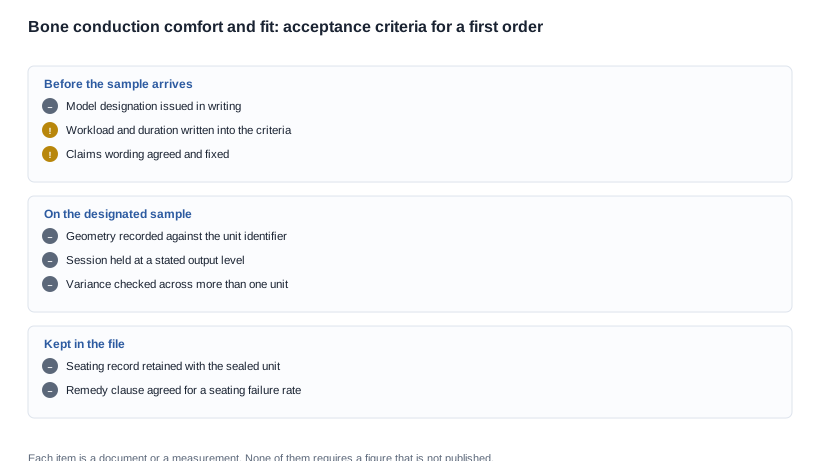
A fit result recorded against a sample that is then returned to the supplier is a result with no reference. The unit that carries the acceptance record has to be signed, versioned, sealed and retained, with its configuration recorded. In a category where no model designation has been issued, that record is the only thing that ties a measurement to a deliverable — which is also why durability and export considerations both have to be settled against a named unit rather than against a sample.
Where a seating complaint lands, and who absorbs it
The four ways this category fails commercially
The seating requirement is never established. The product is listed, sold, and returns begin at a rate that cannot be explained from the published rows. Because the catalogue publishes no geometry, the channel cannot separate a design characteristic from a defect, and the default assumption in a dispute is that the product is defective.
The gain figure is used as an effect statement. A published 35 dB parameter is turned into a listening-outcome claim in listing copy. That crosses into territory we do not occupy, and it is the single highest-risk item in the whole category — see the price comparison notes on what a listing can defensibly say.
Fit is assessed on a table. A twenty-minute desk trial with low output produces a pass, the units ship, and the failure appears only after the product reaches continuous use. The cost of that error lands in the returns channel, not in the trial.
The variation is never sampled. One unit passes, the programme is approved for a quantity, and the first production batch carries a distribution of seatings wider than the sample suggested. This is the failure a fit test is supposed to catch and the one most often skipped.
What the seating clause should actually say
A seating clause that says the product must be "comfortable" is unenforceable, because both parties read the word differently and neither can produce evidence. A workable clause names four things instead: the unit the result was taken from, the duration the unit was held, the output level the audio ran at, and the failure description that counts as a failure. With those four in place, a rejection is a comparison between two recorded sets rather than an argument about a word.
The output level is the element buyers most often leave out, and leaving it out is what makes the clause unusable in practice. Without it, a unit evaluated at a low level and a unit evaluated at the level implied by the 35 dB parameter are being described by the same clause even though they are different products from the wearer's point of view. If the intended environment is unknown at the time of contracting, the defensible fallback is to write the level into the clause as a value the buyer sets and can change by written agreement — rather than as a value the supplier nominates.
The failure description matters for the same reason. "Pressure mark at the temple after the stated duration at the stated level" is a defect report. "Feels tight" is not, and a channel that accepts the second description will absorb the cost of every unit that later turns out to have the first problem.
Where the commercial terms should intervene
Three clauses do most of the work in this category. A seating clause that states the measured acceptance conditions for the first article rather than a subjective comfort level. A claims clause that fixes the wording, so that no downstream party can widen a 35 dB parameter row into an outcome claim. A remedy clause that says what happens when a defined seating failure rate is exceeded, and who carries it.
All three are ordinary commercial terms, and none of them requires a figure we do not hold. They require a measurement protocol that the buyer writes before the sample arrives rather than a number that the supplier produces afterwards.
What we will write down, and what we will mark as unknown
Four items are published for this product: a 35 dB amplification gain, a 200 mAh cell, a charge time of two hours or less, a rated runtime of about seven hours, and Type-C charging. We will repeat those rows as they are written, including the ceiling nature of the charge time and the absence of the conditions behind the runtime rating.
Five items are not published and we will not supply them from memory: the model designation, the frame weight, the temple length and adjustment range, the transducer position, and any acoustic or leakage figure. Where a buyer needs them, they are measurements to be commissioned on a designated sample, and the certification checklist covers the written-answer items in the same round.
We will also not characterise what this product does for a person's hearing. We hold no clinical data, no test protocol and no regulatory assessment for it, and drawing a conclusion from a single gain figure would be wrong regardless of how the figure is phrased.
What we will do is make sure the test is run in an order that produces a real answer, and tell you plainly which of the gaps we can close and which we cannot. The category is covered on our bone conduction glasses page, the electrical side is set out in battery life, and the documentation gaps are collected in common questions.
If you send us the target market, the environment the product will be used in, and the volume, we will come back with what is available and what is not — and we will flag the bone conduction seating question as open until it has been measured rather than answered from a brochure.
Related reading
- How this category's audio actually behaves — bone conduction audio
- Where the regulatory line sits for an amplified product — certification and medical device boundary
- Reading the parameter rows in dependency order — bone conduction glasses buying guide
Tell us the market, the environment and the volume, and we will be direct about which of these variables we can measure and which we will keep marked as unknown.


