

Bone conduction glasses technology: results, not datasheet rows
Real-world performance of a bone conduction product is determined less by the device than by where it is pressed and how firmly, so the figure a buyer can safely carry into a product title is not the performance figure. What a procurement team should take from this article is an acceptance protocol: four field tests to run on samples before a purchase order is signed, four measurements to request from the supplier before the price is agreed, and the two published numbers that will not survive the first customer complaint. The honest headline for a category this thin on published data is that performance varies more between wearers than between models, and the only defensible way to qualify a product is behaviourally, in the environment it will actually be sold into.
That last sentence carries the whole commercial argument. A product that is excellent on a bench and inconsistent in a warehouse is a returns problem, and the returns problem is discovered by the customer rather than by the buyer. An acceptance programme moves that discovery forward by two to three months and converts it from a complaint into a decision, which is the only lever a buyer has in a category where nobody publishes acoustic measurements.
Three numbers appear in the catalogue for this entry, and they are worth reading precisely because of what they leave out. The 35 dB amplification gain tells you what the electronics can do. The coupling into a specific skull determines what a specific wearer hears, and the variation between wearers is larger than the variation between products. The roughly seven hours of runtime carries no stated condition, so it does not describe the user who runs the amplifier on a call outdoors for an hour. The 200 mAh cell and the charge time of two hours or less are the practical half of the equation, and they are the reason a charging routine is a genuine requirement rather than a detail. Type-C identifies the connector. What is not published for this entry: the model designation, the certification status, any acoustic measurement, the microphone specification and the frame weight and the ingress rating A buyer who treats those open rows as zero assumptions is the one who gets a surprise at the pre-shipment inspection.

The four field tests, and the pass condition for each
A field test without a pass condition is a preference, and preferences do not survive a negotiation with a factory that has a different preference. Each of the four tests below therefore has a defined condition, a defined pass line and a defined recording format, all of which are agreed before the first sample arrives.
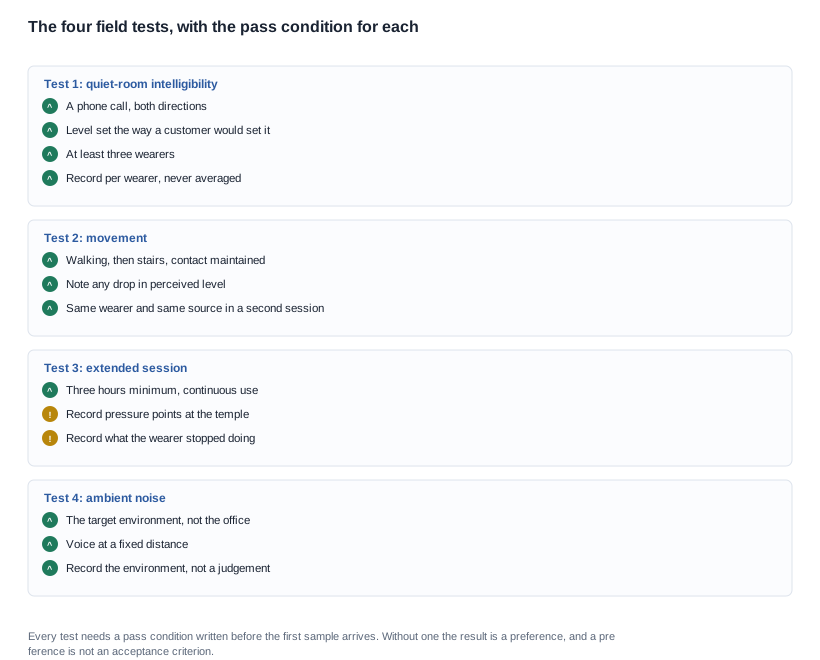
Test one: quiet-room intelligibility. A phone call with the test participant seated, in both directions, with the level set the way a customer would set it rather than the way an engineer would set it. The pass condition is not a percentage of words understood; it is a simple binary: the participant reports that the far end can be heard clearly, and the far end reports that the participant can be heard clearly. Record it per participant, never averaged, because an average across three participants hides exactly the variation the buyer needs to see.
Test two: movement. The same participant, the same source, the same setting, while walking and then while climbing stairs. The pass condition is a written statement of what the participant notices — no drop, a drop when the head turns quickly, a drop on stairs. The reason to run this test at all is that it is the cheapest way to find out whether the product is a stationary product, and the answer changes the wear instruction, the channel training and, sometimes, the positioning of the transducer on the frame.
Test three: the extended session. Three hours of continuous use as a minimum, because anything shorter does not reach the point where the temple contact becomes uncomfortable. The pass condition covers two things: whether pressure points appear at the temple, and what the participant stopped doing. The second of those is the more useful signal. A participant who stops turning their head, or stops taking calls in that position, has told you something that no comfort score would have captured.
Test four: the target environment. The test belongs in the environment the product will be sold into — a construction site, a warehouse, a street — and not in an office. A voice at a fixed distance, with the environment recorded rather than judged. The pass condition should be written as an intelligibility statement tied to the source, because "can you hear it" in a noisy space is a question with no answer.
Two rules make the programme work. The same participants are used across tests, so the results are comparable. And the tests are run on the configuration that will actually ship, because a test on a sample with a different frame is a test of a different product.

The acceptance criteria to write into the inspection plan
Field testing produces evidence. The inspection plan is where that evidence becomes a standard, and the translation is where most programmes lose the benefit of the work they have done.
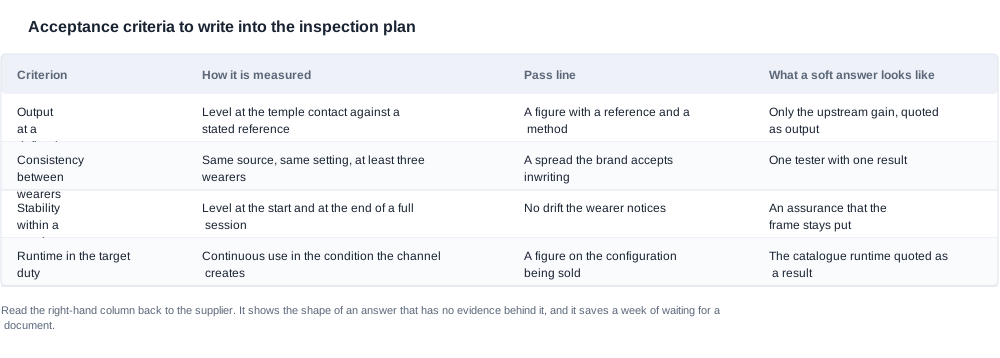
The first criterion is output at a defined reference. A buyer who wants a level to compare against something else needs a reference point, and the reference has to be stated. The soft answer here is to quote the upstream gain as though it were output, which is the single most common error in this category and the reason so many comparisons between suppliers are meaningless.
The second criterion is consistency between wearers. A minimum of three participants, the same source, the same setting, and a spread that the brand has decided in writing it can accept. The spread is the useful number, and the decision about it is a business decision: a wide spread means the product is for a specific use case rather than a general one, which is a positioning decision rather than a quality failure.
The third criterion is stability within a session: a level at the start and a level at the end, with a pass line that says what counts as drift. Without this, the first complaint of the form "it gets quieter" has nowhere to go.
The fourth criterion is runtime in the target duty. The catalogue figure of roughly seven hours is a rated figure, and the criterion should be a figure measured on the configuration being sold, in the condition the channel creates, recorded as a duty cycle rather than as a single number.
Read the right-hand column back to the supplier before you sign anything. It describes the shape of an answer that has no evidence behind it, and a supplier who responds to it with an actual method has given you more than a supplier who responds to the criterion with a reassurance.

Who is running this programme, and what they are signing
The reader is a brand product manager, a sourcing buyer or a channel buyer who is being asked to sign off on a bone conduction product before it goes into a production run. The situation is specific: there is one entry in the category, it carries no published model designation, and the only numeric claims in the catalogue are a 35 dB amplification gain, a charge time of two hours or less, a 200 mAh cell and a rated runtime of about seven hours. The buyer's fear is not that the product is bad; it is that the specification cannot be defended when the first batch returns, or that the listing copy written from the gain figure creates a legal exposure that nobody signed off on.
The programme has to be owned by a person, because a programme owned by a committee produces a report instead of a decision. In most organisations the natural owner is the product manager, with the sourcing buyer supplying the commercial context and the quality lead supplying the inspection criteria. What the owner needs is a written scope, a budget for evaluation units and test time, and the authority to say no to a purchase order that the results do not support. That last one is the difficult permission to obtain, because the schedule pressure is real and the evidence is ambiguous.
The participants are a second consideration that is usually forgotten. The test needs people whose skull geometry and temple geometry resemble the channel's customers, and it needs enough of them that a single outlier does not decide the outcome. Three is a floor, five is better, and a mixed group is better than a homogeneous one. Recruiting participants takes longer than running the tests, which is why the programme should start recruiting in the same week it starts the paperwork.
There is also a fourth participant, and it is the one that decides whether the results mean anything: the far end of the call. Test one is a two-way test, and the person on the other end is the one who tells you whether the microphone path works. A programme that only tests what the wearer hears has tested half of the product.
Why the same product performs differently in two channels
The reason performance varies more between wearers than between models is structural, and it is worth understanding because it determines where a buyer should spend the test budget.
Bone conduction output is delivered mechanically, through the frame, into the skull. Three variables sit in that path: where the transducer sits on the frame, how firmly and where the temple contacts the head, and the structure of the head itself. The first is a product variable and is the same for every unit. The second is a wear variable. The third is a person variable, and it is the one that no product decision can change. Two people wearing the same unit in the same room with the same source will hear materially different things, and a supplier that publishes a single performance figure has implicitly claimed otherwise.
The commercial consequence is that a channel is a performance environment, not just a sales environment. A product sold to cyclists will be worn with a helmet strap over the temple, which changes the coupling. A product sold to warehouse staff will be worn with a hat. A product sold for calls will be worn with a headset over it, and the temple may not be in contact at all. Each of these is a configuration the brand knows about and the datasheet does not.
That is also why the "one-size" question is not a sizing question but a performance question. A bone conduction frame does not have one size; it has a range of couplings, and the range of couplings is wider than a conventional frame's range of fit. A brand that sells one size and has not tested the coupling variation is making an implicit claim about the range.
The second structural factor is the charging routine. With a 200 mAh cell, a charge time of up to two hours and a rated runtime of roughly seven hours, a product that is used across a working day has a charging obligation attached to it. A channel where the product is sold as an all-day item is selling a charging habit, and the habit is part of the performance. Instructions, packaging, and the listing's power expectations all carry part of the burden.
The third factor is the ambient environment, and it cuts both ways. Bone conduction's defining advantage is that the wearer still hears the world, which means the product performs best in the environments where an earbud fails. That is the strongest argument for the category, and it is also the reason the field test has to happen in the target environment: the advantage only exists there.
Sampling, and the decision at the end of the programme
How many units to test is a decision with three inputs: the spread you need to resolve, the cost of each unit, and the cost of being wrong. In a category with a wide coupling variation, three units tell you almost nothing about the population; a spread measured across three units is an anecdote with a table attached. Five to eight units, sampled from more than one production batch if the first batch is available, is the point at which the results start to mean something.
The sampling design matters more than the sample size. Three units from the same box, built in the same week on the same shift, will agree with each other and tell you nothing about the line. If the factory can supply units from more than one build date, take them. And if the first production lot is not yet available, say so in the file, because a sample-based result is a different claim from a lot-based result and the distinction becomes important when a lot is rejected.
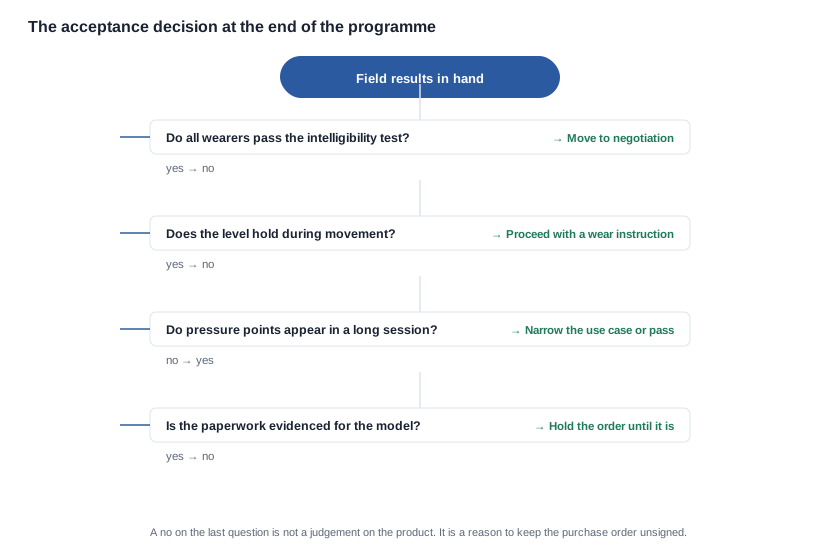
At the end of the programme, four decisions are available and they are not equally reversible. The decision to proceed is easy to reverse later, which is why it is the wrong default. The decision to narrow the use case — to sell it into one channel rather than two — is cheap and often correct. The decision to require a configuration change is expensive but preserves the product. The decision to stop is the one a programme should be able to reach, and a programme structured so that stopping is difficult will usually end up shipping something instead.
The evidence that supports each decision is the same four test results, and the decision rule should be written down before the results exist. A rule written afterwards is a rationalisation, and a rationalisation is worthless in a dispute with a supplier.
Putting the acceptance programme into the order
An acceptance programme is paid for in two currencies: the cost of running it, and the cost of the evidence it produces. The terms that matter are the ones that connect the two.
Negotiable: the quantity of evaluation units supplied and whether they are credited against the first production order; whether the samples are drawn from a single batch or across several; the cost of the brand's own field test labour and the time the factory allows for it; the sampling and inspection plan for the production lot, including the units pulled for destructive or teardown checks; the delivery of the production lot in stages so that a failed first stage does not block the whole order; the acceptance criteria themselves, and the cost allocation when a lot fails them; and the re-test procedure and who pays the freight in both directions.
Not negotiable: the elapsed time of the compliance route and the laboratory queue, which are set by the laboratory rather than by the order; the acoustic behaviour of the product, which is fixed by the transducer and the frame; and the test conditions themselves, because a pass condition negotiated down to a level nobody would notice failing is a condition that produces no protection at all.
The clauses worth writing are the acceptance criteria, the failure allocation, the retest procedure, the notice obligation on any configuration change, and the requirement that a lot failing the criteria may be refused. The last one is the clause that makes the rest of the programme binding, and it is the one most often left out because it feels adversarial until the first lot is rejected.
A worked scenario: qualifying a line for a noisy workplace
The scenario that follows is put together to demonstrate the sequence. It does not report a result from a real programme.
Assume an industrial distributor selling hearing-adjacent personal audio into manufacturing environments, where the end users wear hearing protection and a hearing aid is not an option for them. The distributor is evaluating a bone conduction platform and has to decide within one quarter, because their channel partner's programme starts in the following quarter.
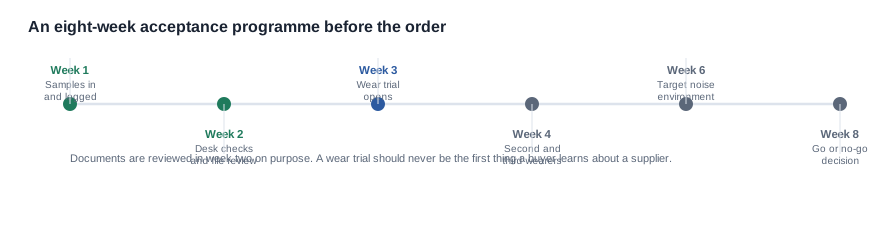
Step one: the programme is scoped, not improvised. The distributor sets eight weeks, with paperwork in weeks one and two, the wear trial opening in week three, a second and third participant group in week four, the target environment test in week six, and the decision in week eight. The participants are recruited in week one, from the channel partner's own floor, because a factory floor and an office are different acoustic environments and the wearers' temple geometry matters.
Step two: the paperwork is reviewed before the trial opens. The published specification is a 35 dB gain, a 200 mAh cell, a charge time of two hours or less, a rated runtime of roughly seven hours and Type-C charging, with no model designation and no certification status. The distributor asks two questions: which model designation appears on the documents, and what the route is in the markets being served. The answers do not cover the intended configuration, so the distributor makes the covered designation a condition of the order rather than proceeding on an assumption.
Step three: test one, in a quiet room, both directions. Two of the three participants pass. The third reports that the far end cannot hear them reliably. The triage from the support protocol applies: the output path is clear because the participant hears the far end, so the fault is on the input side. The distributor asks the supplier about the microphone path and gets an answer about the microphone specification, which the catalogue does not publish.
Step four: test four, in the target environment, changes the shape of the decision. In the plant, with hearing protection in use, the participants hear the far end and can hear the plant. The intelligibility of a phone call is good for two of them and marginal for the third. The marginal result is not a failure; it is a finding about the use case, and it converts the distributor's brief from "hearing support in a noisy workplace" to "calls and machine-status audio in a noisy workplace, with hearing protection in use".
Step five: the acceptance criteria are written with the spread in them. The criteria now state three participants, a stated source, a stated level, and a spread the distributor accepts in writing. The runtime criterion is written as a duty cycle matching the plant's shift pattern rather than as a single number. The criteria are attached to the purchase order with the failure allocation attached as well.
Step six: the commercial terms follow the findings. The distributor asks for a staged delivery so that the first stage is the covered configuration, and asks for the retest procedure and freight allocation in writing. The unit price does not move. What moves is the distributor's exposure, because the lot can now be refused against a criterion that exists, and the returns exposure is reduced by a brief that no longer promises more than the product delivers in a plant with hearing protection.
The result is a narrow, well-evidenced product in one channel rather than a broad, unevidenced product in two.
What our catalogue publishes about field behaviour, and what it does not
The boundary we hold: we publish the electrical rows and the gain figure for this entry, and we publish what is missing with the same prominence. For this entry that means a 35 dB amplification gain, a bone conduction transducer, a 200 mAh cell, a charge time of two hours or less, a rated runtime of roughly seven hours and Type-C charging — and no model designation, no certification status, no acoustic measurement, no leakage figure, no microphone specification, no frame weight and no ingress rating.
That absence is the reason this article is a protocol rather than a set of results. We cannot publish a field performance figure, because the coupling variable makes any single figure a statement about a method rather than about a product, and no method is published for this entry. We will not publish a typical wearer experience, or an intelligibility result, or a comfort figure, because none of them has been measured to a standard we could defend.
What we will do is tell you which parts of a protocol the published rows can support and which parts have to be established by the buyer. If you send us the four test conditions you intend to use and the channel you are qualifying for, we will tell you which criteria our rows already support, which ones need a measurement the supplier has to make, and which ones depend on the coupling and therefore have to be established on wearers before they can be used at all.
Actions that follow the test programme
Write the pass conditions before the samples arrive. Every criterion that lacks a written pass line becomes a preference the moment the results are in, and a preference cannot be used to refuse a lot.
Recruit the participants in the same week you start the paperwork. Recruitment takes longer than testing, and a programme that starts recruiting in week three finishes in week eleven.
Test the configuration that will ship, not the configuration that arrived. A sample with a different frame or a different package is a different product, and a result from it is not transferable.
Keep the results as a file, not a slide. The results are what lets a buyer argue about a lot, a return rate or a specification change six months later, when nobody remembers the test.
The underlying mechanism is covered under bone conduction audio technology, the variable that makes performance wearer-dependent is discussed in bone conduction comfort and fit, and the measuring discipline is in how to measure an IP rating.
Where this comes from
- Bone conduction audio technology and its limits
- Comfort and fit in bone conduction frames
- How to measure before ordering
- Bone conduction glasses in the range
Send us the four test conditions and the channel you are qualifying for, and we will tell you which criteria our published rows can already support.


