

Bone conduction glasses technology: the wearer decides
Testing bone conduction glasses before ordering is a different discipline from testing any other pair, because the variable that decides whether the product works is not a component but a person. How to test before ordering bone conduction glasses technology smart glasses therefore puts a wear-time test first and an acoustic test second, which is the reverse of the order a datasheet review would suggest, and the reverse is the right order because a product nobody can wear for a full session fails on every other measure.
The catalogue publishes a 35 dB amplification gain, a 200 mAh cell, a charge time of two hours or less, roughly seven hours of rated runtime and Type-C charging for an entry that carries no published model number and no measured performance data. That is a complete set of rows for a battery product and an almost empty set of rows for an acoustic product, and the reason is structural: acoustic performance is a property of the assembled frame in use, not a property of a part on a bill of materials.
What this protocol settles
Whether the frame can be worn for a working session. A bone conduction transducer has to be held against the skull for sound to be transmitted, and the frame has to press. A product that needs more pressure to deliver the same result is a frame problem, and it is invisible in every acoustic figure in existence.
Whether the published gain survives a real environment. A 35 dB figure tells you that the maximum output exists. It does not tell you that a voice at arm's length in traffic is followable at that setting, and those are different claims.
Whether the claim is legally and commercially safe to print. The positioning of a bone conduction product in a given market is a regulatory question, and it is decided before the copy is written rather than after it is challenged.
Whether the result can be reproduced. A measurement with no named wearer, no baseline and no protocol cannot be reproduced by a colleague, defended against a supplier, or cited in a customer dispute.
The buyer with a sample, a gain figure and a deadline
A buyer running this protocol is usually deciding whether a bone conduction product belongs in the channel they sell into, and holds a sample, a supplier datasheet with a gain figure on it, a target price and a customer profile. What they will not hold is an acoustic data set, and the reason is that acoustic data belongs to the transducer supplier and, in a finished product, to the frame that surrounds it.
The constraint that shapes the whole protocol is time. A bone conduction product cannot be evaluated in a five-minute demonstration, because the variables that decide it — pressure accumulating over time, intelligibility in noise, and behaviour at the end of the charge — all need sustained use. A buyer who allocates an hour to the test will get a result that flatters the product, and the flattering result is the expensive one.
A channel buyer in this position is usually evaluating a line for a workplace or safety channel, where the environment is loud and the customer wears the frame for a whole shift. Their exposure is the return rate on a product that sounded fine in a quiet room, and the returns in this category cluster exactly there.
A compliance reviewer is usually the person who notices the copy. A single phrase about hearing in a listing is enough to move the product into a regulatory framework that a catalogue entry cannot address, and the phrase is easier to remove before the artwork than after it.
Where a bone conduction programme spends its money, and where the regulatory line sits
The four cost layers behind a bone conduction line
The transducer and its drive electronics. The part that converts an electrical signal into mechanical motion against the skull, plus the amplification chain that drives it. A 35 dB gain figure belongs to this layer, and it is the layer with the least negotiating room once a platform is chosen, because the transducer, the frame geometry and the drive electronics are designed together. A supplier who will not change any of them is telling you the acoustic result is fixed.
The frame geometry and the contact pressure. The frame is not a carrier for the transducer; the frame is what creates the acoustic seal against the skull, and the pressure it applies is a design variable with a direct relationship to the wear-time result. A thicker temple or a differently positioned contact point changes both the transmission and the comfort, which is why the two cannot be tuned independently.
The electronics and the firmware. The pairing behaviour, the volume control, the end-of-charge behaviour, the equalisation and the build. These are ordinary firmware decisions in most categories and are acoustic decisions here, because a change to the processing changes what the customer hears. This is also the layer that determines whether the product is supportable in year four.
The evidence and the copy. The acoustic data, the regulatory positioning per market, the instructions, the care guidance and the support script. In this category the copy is not a downstream artefact of the product. It is a constraint on the product, because the positioning determines which product is permissible.
The regulatory line that decides the copy
The line is worth stating precisely, because it is the single most expensive mistake available in this category, and it is made in marketing copy rather than in engineering.
In the United States, the FDA regulation at 21 CFR 800.30 defines an over-the-counter hearing aid as an air-conduction device intended for a person aged eighteen or older. A bone conduction product is neither air-conduction nor a hearing aid, and it cannot be sold in that category. The legitimate positioning for a product of this type is a personal sound amplification product, and the practical consequence is that a hearing-improvement claim cannot be written, because writing one moves the product into a framework it has not been assessed against.
The rule that follows is simple enough to put in a copy checklist: the listing describes what the product does with sound, not what it does for a person's hearing. "Amplifies ambient sound" is a description of a function. Anything phrased as an outcome for a person's auditory capability is a claim that changes the regulatory category of the product, and that is a legal question rather than a copywriting question.
The same discipline applies to the reverse case, where a buyer wants to claim more than the evidence supports in the other direction. A product that transmits sound through the skull is a different proposition from one that plays audio into the ear canal, and a listing that implies an earphone experience is a listing that will be tested by customers who expect to hear nothing at all around them.
Note on evidence level
Everything in this article is either a published catalogue figure, a method you can run yourself, or a compliance boundary. We do not publish acoustic performance figures for this entry because we do not hold measured data for it, and we will not estimate them.
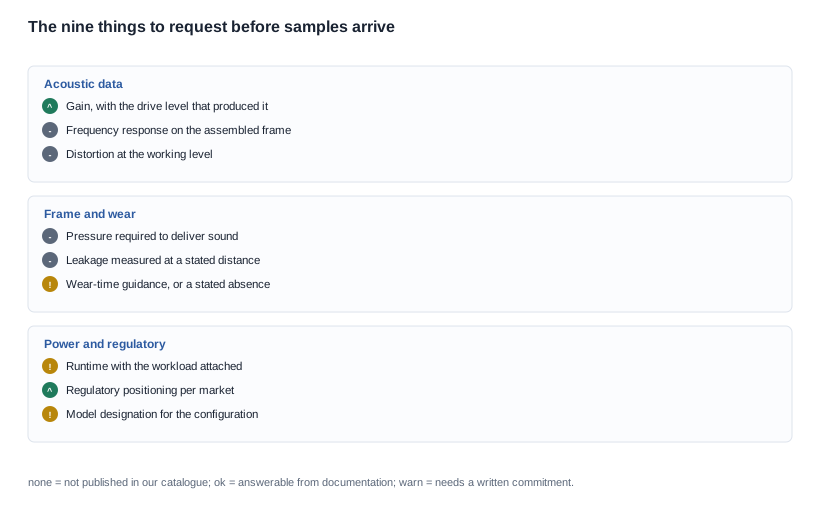
The nine rows a supplier has to answer before samples arrive
The thresholds that decide a pass on an acoustic programme
The request below goes out before the samples ship, and the right-hand column separates a supplier who has measured this product from one who is relaying a component specification. None of the four "not published" rows is a defect in the supplier; they are the reason the protocol below exists.
| What to ask the supplier for | The pass line | What a soft answer sounds like |
|---|---|---|
| Amplification gain, with the drive level | A figure plus the input level that produced it | 35 dB with no condition |
| Frequency response, on the product | A curve or a stated band measured on the assembled frame | A component datasheet |
| Distortion at the working level | A percentage at a stated gain and signal | Low distortion |
| Pressure required to deliver sound | The force the frame must apply against the head | Not offered |
| Leakage to a nearby listener | Measured at a stated distance and a working level | Not offered |
| Runtime, with the workload | A figure plus the load it was measured under | About 7 hours |
| Wear-time guidance | A stated continuous-use limit, or a stated absence of one | Comfortable all day |
| Regulatory positioning, per market | The category the product is placed in, per market | Classified as a hearing device |
| Model designation | A published designation for the exact configuration | A series name only |
Two of those nine rows deserve extra attention from a procurement manager, because they are the ones a copywriter will otherwise fill in with a plausible number. The contact pressure row decides the wear-time result, and it is invisible from the outside of the product. The wear-time guidance row decides what the customer believes they are agreeing to, and a supplier who cannot state a limit has not tested one, which means the first customer will discover the limit for you.
Why a gain figure is not an outcome
The 35 dB gain published for this entry is a real number and it is not a result. It says the maximum output exists. It does not say what a listener can follow, at what distance, in what noise, with what artefact, or for how long before the discomfort makes them take the frame off.
The four things that convert a gain figure into something a buyer can act on are the input level that produced it, the environment in which it was measured, the intelligibility of what was transmitted, and the behaviour of the frame under sustained wear. None of the four is published for this entry, and each of them is answerable on a sample in a single afternoon, provided the protocol is written down first.
There is a commercial version of the same point. A product sold on "35 dB" is sold on a number, and the number is the easiest thing in the category for a competitor to publish too, because it costs nothing to print. A product sold on intelligibility in a named environment, with a stated protocol and a stated result, is considerably harder to match, and it is the version of the claim that survives a customer who tests it.

The four-stage protocol, in the order that saves a programme
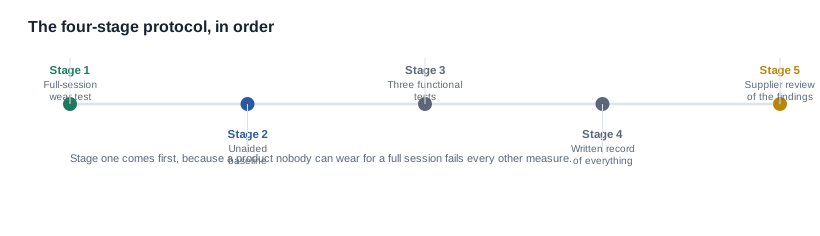
Stage one and stage two: the session and the baseline
Stage one: wear it for a full session. Three hours, and the time is not negotiable. The reason for removal matters, and it has to be recorded separately from the fact of removal: discomfort is a frame problem, and loss of usefulness is a product problem, and the two have different owners, different fixes and different costs. A programme that confuses them will spend six months asking the factory to fix something the factory cannot fix.
The note should record where the pressure lands, how long the frame was worn before it came off, whether it was taken off once or repeatedly, and whether it was taken off because it hurt or because it stopped helping. That last distinction is the one that decides the programme.
Stage two: establish the baseline before the product. What is audible to that wearer unaided, in the same spot, at the same moment, with the same ambient noise. Without a baseline, a gain figure and a reaction are two disconnected observations, and neither one of them can be defended in a supplier discussion or reproduced by anybody else.
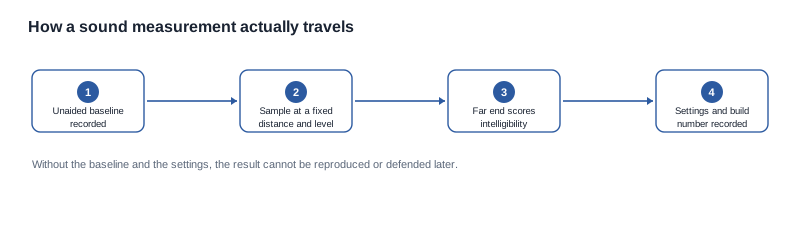
Stage three and stage four: the functional tests and the written record
Stage three: the three functional tests, in order. Gain in a real noisy place, using a fixed phrase at a fixed distance, with the far end scoring intelligibility rather than volume. The charge and the runtime, run through a full day of actual use rather than a bench cycle. And the privacy check, with a second person at arm's length.
The first of these decides the acoustic claim, the second decides the endurance claim, and the third decides the privacy claim. All three are the kind of claim a customer will make to themselves, so all three belong in the listing or in the instructions, and the third is the one most often left out.
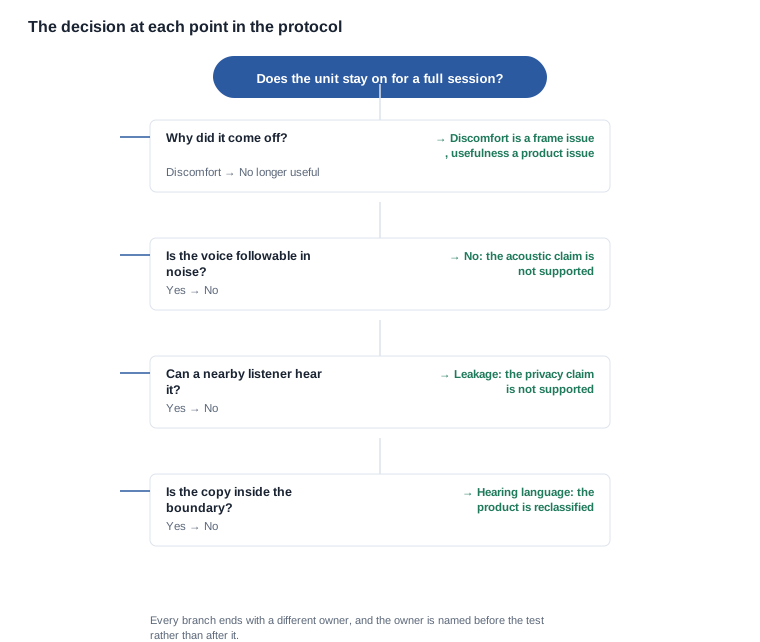
The branch structure above is the part of the protocol that turns observations into a routing decision. Every branch ends with a different owner, and the owner is named before the test rather than after it: a frame complaint goes to the tooling and geometry conversation, an intelligibility failure goes to the transducer and drive conversation, a leakage result goes to the claim and the instructions, and a hearing-related phrase in the copy goes to the regulatory review. A protocol that produces a score without producing a route leaves the programme with a number and no next action.
The three checks that catch the less obvious problems. The behaviour at the end of the charge: does the unit shut down cleanly, or does it start dropping out, refusing to pair and behaving errably while it is still drawing power. The frame's effect on the wearer's own glasses, if they wear them. And the pairing behaviour in a realistic environment, because a device that will not hold a connection is not a daily product, and it does not matter how good the acoustic result was.
Stage four: write everything down before you discuss it. Name the wearer, record the baseline, record the settings, record the results, record the environment, and keep it with the sample paperwork. A supplier disputing a written observation is arguing with evidence. A supplier who has never seen the test is arguing from theory, and the second conversation takes three times as long.
The acoustic file to request before the deposit
The gain figure with the drive level that produced it. The frequency response on the assembled frame, or a written statement that it is not published. The distortion figure at a stated gain and a stated signal, or a written statement that it is not published. The pressure the frame applies to the head, or a written statement that it is not published. The leakage measured at a stated distance and a working level, or a written statement that it is not published. The runtime with the workload attached, alongside the published 200 mAh cell and the two-hour-or-less charge time. The wear-time guidance, or a stated absence of it. The regulatory positioning statement for each target market. The model designation for the exact configuration, which this entry does not currently publish. The certificate numbers with the issuing body and the validity dates.
The value of a written statement that something is not published is that it converts a silence into an answer. A supplier who says "we do not publish that" has told you where the boundary is, and you can plan around it. A supplier who says nothing has told you nothing at all, and the distinction is worth keeping in the file.
Where a bone conduction programme fails, and what the transducer holds
Five failure modes, and the answer that holds
The product is comfortable in a demonstration and comes off after an hour. The symptom is a return cluster with a comfort description that no defect supports. The root cause is that the demonstration was short, and pressure only accumulates over time. The answer is to make the full-session test the first stage and the one stage that cannot be skipped, and to record the reason for removal so the failure can be routed to the right owner.
The customer reports that the glasses do not work, and no defect is found. The symptom is a complaint that cannot be reproduced by the support team. The root cause is that the customer expected an earphone-like experience from a product that transmits through the skull, or expected a passive lens-like experience from a powered frame. The answer is to fix the claim wording before the product page is written, to keep the positioning to personal sound amplification, and to state plainly what the product does and does not do acoustically.
A hearing-related phrase appears in the copy and the product is reclassified. The symptom is a listing pulled, a market reopened, or a compliance enquiry that arrives after the artwork is printed. The root cause is that the copy was written from the benefit rather than from the regulatory position. The answer is to run the listing copy past someone qualified for the target market, and to keep every sentence about what the product does with sound rather than about what it does for a person.
The runtime gap is discovered by the customer rather than by the test. The symptom is a complaint from a shift worker who found the unit flat before the end of a shift, when the published figure says roughly seven hours. The root cause is that the rated figure was quoted without its condition. The answer is to measure through a real day of use, to publish the workload next to the figure or to publish the figure you measured, and to keep the 200 mAh cell and the two-hour-or-less charge time as the two rows you can stand behind.
The test result cannot be reproduced when a customer complains. The symptom is a dispute that becomes a chargeback because nobody can say what was measured. The root cause is that the protocol was improvised rather than written. The answer is to record the script, the distance, the level setting, the environment, the named wearer and the scores, and to keep that record with the sample paperwork for the life of the programme.
The commercial terms, and the acoustic engineering inside them
The negotiating room on a bone conduction line sits in the configuration and the packaging, not in the acoustic specification. The minimum order quantity is negotiable, and it is worth negotiating against a committed configuration count rather than a unit count, because the acoustic tier is often configured per market. Packaging and insert design, including the market labels, the language of the documentation pack and the wear-time guidance printed on the quick start guide, is a low-cost negotiation with no tooling implication, and the wear-time guidance is unusually valuable in this category because it is the instruction that prevents the most common return.
Delivery splitting against a wear-time approval milestone is often granted more easily than a price concession, and it is the natural milestone here, because the wear-time result cannot be demonstrated in a photograph. The staging of an order's payment is standard ground: a deposit on the contract, a balance on the inspection before the shipment is booked, and a holdback on the documentation set, which on this product protects you on the failure that costs most, which is a unit that arrives with a positioning statement nobody can evidence.
The acoustic engineering is not a commercial variable. A supplier who will not change the transducer, the frame geometry or the firmware tuning is telling you the acoustic behaviour of the product is fixed, and the programme has to be built around that fact rather than against it. Certification cost and certification time are also not levers: the cost is per product family and the elapsed time belongs to the testing body and the review queue. Tooling is a one-off cost usually amortised across the first order, so the questions worth asking are over what volume it is amortised and what happens to the tooling if the programme is discontinued.
The clauses that carry a bone conduction order
Four of them. The model designation as a line item, with the certificate numbers attached. The acceptance criteria for the sample, referencing the four-stage protocol, including the baseline and the named wearer. A clause on the regulatory positioning per market, with the buyer holding the right to require that the copy be amended, which is the clause that makes the positioning a commercial term rather than a matter of opinion. And a notice obligation before any change of transducer, firmware or frame geometry, because each of the three alters the acoustic result while leaving the outside of the product unchanged.
A distributor evaluating a product for a full-shift workforce
The scenario and the protocol outcome
This is a hypothetical scenario, written to show the decision sequence rather than to report an outcome. No customer, project or order is being described.
Assume a distributor evaluating a bone conduction product for a warehouse and logistics channel, where the end user wears the frame for a whole shift in a loud environment and needs to take calls. The binding constraint is not the price and not the gain figure. It is that the distributor cannot find a way to write a listing for this product that is both true and sellable, because every useful sentence sounds like a hearing claim.
Step one, the regulatory line. Before anything else, the distributor establishes the positioning. In the United States, the product cannot be sold as an over-the-counter hearing aid under 21 CFR 800.30, because that category is defined for air-conduction devices. The positioning is personal sound amplification, and the listing will describe what the product does with sound. The distributor also decides that the phrase "for hearing" will not appear in any description, because that is a claim about a person's auditory capability rather than about the product.
Step two, the request. The distributor sends the nine-row request before the sample is even shipped. The answers establish that the gain figure's drive level is not published, that the frequency response, the distortion, the contact pressure and the leakage are all unpublished, and that the wear-time guidance is written as an absence. The absence statements are useful, because they tell the distributor which claims cannot be made and where the copy has to be narrower.
Step three, the session. The distributor runs the full-session test with a named wearer from the target channel, on a warehouse floor, over a full shift. The frame comes off twice, and the record notes that the first removal was discomfort at the temple contact point and the second was a loss of usefulness as the battery fell. Two different problems, two different owners, and the distributor now knows that the frame geometry is a conversation with the supplier while the endurance is a conversation with the cell and the firmware.
Step four, the functional tests. The intelligibility test in a loading bay shows a voice followable at a stated setting with a stated phrase and a stated distance. The privacy check with a second person at arm's length returns nothing audible. The end-of-charge behaviour is a clean shutdown rather than erratic pairing, which the distributor would otherwise have discovered from a customer.
Step five, the listing. The listing describes the amplification, the environment in which the test was run, the wearer and the protocol, and the wear guidance printed in the box. It does not quote a figure that was never measured, and it does not describe what the product does for a person's hearing. The distributor discovers that the narrow listing sells better than the broad one would have, because a buyer who is being sold a hearing claim is a buyer who will test the claim and complain.
Step six, the commercial structure. The distributor negotiates the minimum against a configuration count, asks for the wear-time guidance to be printed on the insert in the channel's language, and puts the positioning clause and the transducer notice clause into the purchase order.
Step seven, the outcome. The programme proceeds on a product that can be described accurately, tested by a protocol that can be reproduced, and positioned inside a regulatory line that nobody has to walk back.
The decisive steps were the first one and the third. The regulatory line took an afternoon, and the full-session test took a shift, and between them they removed the two failures that a five-minute demonstration would have hidden.
What our catalogue publishes for this entry
We publish the 35 dB gain, the 200 mAh cell, the two-hour-or-less charge time and the roughly seven-hour rated runtime because the catalogue states them, and we publish the absence of a model number and of any measured performance data with the same prominence. We will not present the gain figure as an outcome, and we will not write a hearing-improvement claim, because a hearing-related claim in this category can pull the product into a regulatory framework that a catalogue entry cannot address. We publish no frequency response, no distortion figure, no leakage figure, no contact-pressure figure and no wear-time guidance for this entry, and we will not estimate any of them from typical values.
We will also be direct about a boundary that is easy to miss: the absence of a model designation means that no document can name this unit today. That is a finding a buyer should know before a deposit, not after.
What we will do is supply units and a written test script, and tell you plainly which rows our documentation answers and which have to come from a measurement on your own units. The category background is under bone conduction audio, the regulatory boundary is under medical device boundary, the evidence structure is in bone conduction case study template, the published rows are in bone conduction key specifications, and the claims to interrogate are in bone conduction manufacturer claims.
Three requests to make this week
Fix the positioning before the copy exists. Write the one sentence that describes what the product does with sound, and check that no sentence in the draft describes what it does for a person's hearing. This is the cheapest hour in the programme and the most expensive one to redo.
Run the full-session test on a wearer from the target channel, and record the reason for removal. A shift is enough, and the reason for removal is the part that decides whether the problem belongs to the frame or to the electronics.
Send the nine-row request, and treat a written "not published" as a usable answer. It tells you which claims you cannot make, and a claim you do not make is a return you do not have.
Related reading
- The evidence structure — bone conduction case study template
- The catalogue rows — bone conduction key specifications
- The claims to interrogate — bone conduction manufacturer claims
Send us your completed protocol and we will tell you which findings are consistent with the published figures.


