

Smart glasses frame materials: the four costly beliefs
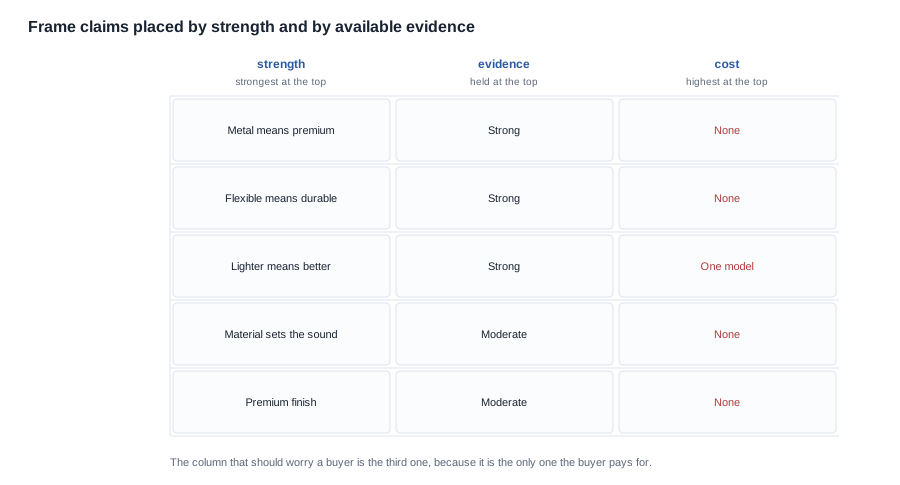
Frame material is the one specification in this category that everybody discusses and nobody publishes. No frame material is published for any model in our range — not the audio frames, the camera frames, the sport frames or the children's frames. That is not a gap in this article; it is a gap in the documentation of the whole catalogue, and it applies to every supplier in the category rather than only to us.
Which means the myths about frame materials are doing the work that data should be doing. Four of them are expensive, and they are expensive in a specific way: each one produces a plausible decision that a buyer cannot later audit. The myths do not stay as beliefs. They get written into a purchase order, a product listing and a warranty term, and by the time the evidence arrives, three commitments have been made on the strength of them.
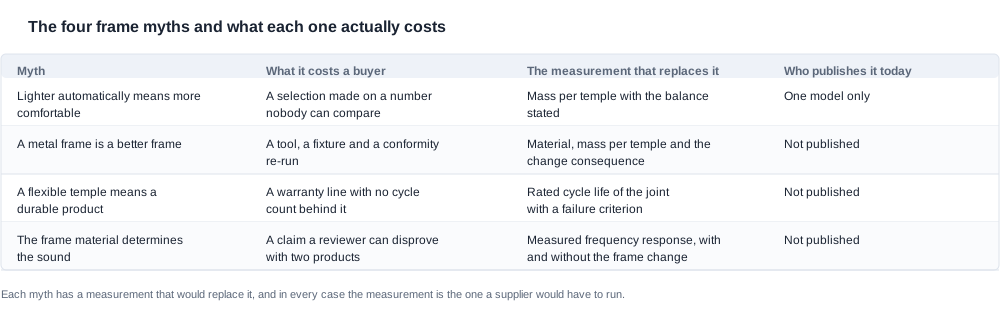
The four are: a lighter frame is a better frame, a metal frame is a better frame, a flexible temple is a durable product, and the frame material determines the sound. Each is partly true, each is used as if it were complete, and each has a measurement that would replace it — a measurement the supplier has to run, which is why the belief persists.

A lighter frame is not automatically a better frame
Mass is one input into how a frame feels in service, and it is the input most often asserted on its own. A lighter frame is generally less of a burden over a long session, but the relationship is not a straight line. A light frame with a badly balanced temple can be worse over six hours than a heavier one that sits evenly, and what decides it is where the mass sits relative to the head, not how much of it there is.
There is a second reason the mass claim is unreliable, and it is specific to this category. A frame carrying a battery, a radio and — on the camera platforms — a camera module is not the same object as a pair of glasses with a chip in the temple. Adding electronics changes the balance, and no published figure tells you where the mass distributes. The 158 g whole-unit figure we publish, for the MT6 glasses unit including the 265 mAh cell and the camera and excluding the foldable charging case, is a total rather than a distribution, and it is the only mass we publish for any model.
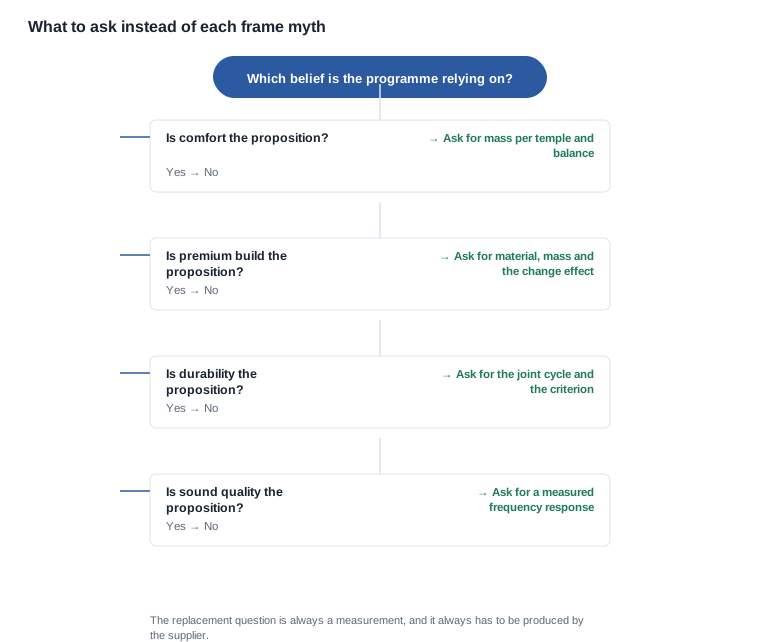
The question to ask instead: what does the frame weigh per temple, with the cell installed, and how is the mass distributed front to back? A number in grams is worth something; a number with a distribution is worth a lot more, and the second one is the one that predicts the first complaint your channel will receive.
There is a commercial version of this myth that is worth naming separately. A mass-led proposition cannot be substantiated from published data. If the channel strategy depends on "the lightest thing on the market", then the buyer needs a measurement programme, not a catalogue row — and the measurement programme has to be commissioned and paid for, because no supplier in this category is going to volunteer a number that undermines its own premium models.
What the mass myth costs in the channel
The cost of accepting the myth is not a technical loss; it is a commercial one, and it appears in three places.
The first is the returns line. A channel that buys on a mass claim and receives a product that sits badly on the head generates returns that are individually unremarkable and collectively expensive, because each one is a sizing complaint rather than a fault. The buyer paid for a proposition that did not survive contact with the product, and the evidence that would have prevented it was available at sample stage at a cost of a scale.
The second is the listing rewrite. A mass-led listing is a listing that leads on a number, and a number that cannot be substantiated is a number that has to be removed or defended. The first option costs the listing its main hook; the second costs the buyer a round of evidence requests. Neither is expensive individually, and both are more expensive than measuring the units before the artwork is written.
The third is the supplier conversation it distorts. A buyer who argues about mass is arguing about a row the supplier may never have measured, while the rows that are cheap to establish — the joint, the section, the distribution — go unasked. The myth does not only cost money; it redirects attention away from the questions that would actually settle the programme.
That is the general shape of all four beliefs in this article. Each one resembles a product discussion and is actually a redirection of the buyer's attention away from a measurable row.
Metal is not automatically the premium answer
Metal is widely assumed to be the premium choice, and in conventional eyewear it is partly true. In an electronics frame it is more complicated, because the frame is doing three jobs at once: it is the structure, it is the enclosure for the electronics, and it is the acoustic path for the speaker.
That third job is where the material claim quietly becomes a performance claim. A rigid frame of a given mass resonates differently from a flexible one, and a frame that resonates can colour the sound coming out of it. No frequency response is published for any model in our range, and no material is published either, so there is no way to connect the two from the documentation.
The second thing the material claim usually hides is the manufacturing consequence. A moulded logo, a coloured frame and a different finish are achievable on an existing mould; a new material is a new tool, a new fixture and new process parameters, and it can move a product out of the scope of an existing test report. The certification checklist covers the case.
The question to ask instead: what is the frame made of, what does it weigh per temple, and what does a material change do to the conformity position? A supplier who cannot answer the third question has not scoped the change, and the third question is the one that decides whether the change is a purchase decision or an assessment.
Why a metal temple in a resin front is often the right answer
The combination is worth a specific note because it is the answer that most often gets overruled by a brand wanting a uniform appearance. A metal temple carrying the hinge load, bonded or riveted into a resin front, puts the strength where the torque is and keeps the front light and easy to mould. It also lets the front carry the lens and the appearance work, which is what the channel is actually buying.
The trade-offs are real and should be stated rather than assumed. The joint between two dissimilar materials is a corrosion and fatigue question, and it is the joint that needs a stated cycle figure. The antenna environment changes when a metal structure enters the temple, which is a radio question. And the unit price is not simply the sum of a resin price and a metal price, because the two parts are produced by two processes.
The order of the decision still holds: specify the joint, then the material around it.
What a metal decision actually costs in the quotation
Three lines move when the material family changes, and a buyer who examines only the unit price is examining the smallest of them.
The tooling line moves first. A metal front is a different process from a resin front, and in most programmes it is a different supply route. That means a separate tool, a separate fixture set and a separate set of process parameters, and it means the amortisation question has to be answered for the metal tool rather than for the frame as a whole.
The compliance line moves second. A change of material reopens the substance declaration for the frame stack, and where the geometry moves with it, the radio assessment and the safety evidence move too. Those are queues at a test laboratory rather than factory slots, which means the metal decision has a schedule that the factory quote does not show.
The service line moves third and lasts longest. A metal front at skin contact introduces the plating question, and the plating question is the one that produces a complaint three months after delivery, when the alloy has not changed and the plating house has. It is also the line that a retailer's incoming inspection is most likely to catch.
The negotiating consequence is that a metal decision should be taken with all three lines on the table, and that the useful question to put to a supplier is not "what does the metal version cost" but "what does the metal version add once the tooling, the declaration and the plating are in the programme".

Flexible does not automatically mean a durable product
Flexibility is often presented as durability, and the two are opposites in a specific way. A temple that flexes is a temple that is storing energy and returning it, and the joint, the catch or the bonding line is where a cycle failure begins.
This matters more in some of this range than in others. Our catalogue publishes ultra-thin and detachable temples as configuration options on the G07, and flexible temples on the V03 Pro. Both are mechanical features whose failure mode depends entirely on the mechanism, and neither the release mechanism, the cycle life nor the failure behaviour is published. A detachable part that a customer can install at home is a convenience; a detachable part that fails at a cycle count nobody has tested is a warranty line, and the two are priced very differently by a channel.
And the counter-argument is that a rigid frame is not automatically the durable one. A rigid frame can crack at the hinge, and it transfers every impact directly into the electronics it contains. What determines durability is the joint, the material at the joint and the load path — engineering information rather than a material label.
The question to ask instead: what is the rated cycle life of the joint, what happens at the end of it, and what is the replaceable-part policy? Cycle life and replaceability are testable and publishable. "Flexible" is not, and the phrase is not even a specification of the joint, because a flexible temple can be flexible in the moulding, in the bonding line or in a replaceable segment.
Telling a genuine flexible joint from a marketing adjective
There are three distinct mechanisms that a supplier might call flexible, and they have different costs, different failure modes and different service implications. A buyer who knows the difference can ask the right question without needing any frame data at all.
Flexible in the moulding. The resin itself is compliant, so the temple bends rather than snapping. The failure mode is progressive and slow: the temple takes a set, and the frame returns with a geometry that no longer matches. The relevant number is the number of cycles before a permanent set exceeds the tolerance, and the relevant commercial consequence is a rising return rate over months rather than a spike.
Flexible in the bonding line. A rigid core is bonded to a compliant outer, or a compliant segment is bonded into a rigid structure. The failure mode is a bond failure, which is abrupt and is visible as a separation at the joint. The relevant number is the bond's peel and shear behaviour under the load case, and the relevant commercial consequence is a sharp failure that appears in a short period.
Flexible in a replaceable segment. A segment that can be detached and replaced by the customer or a distributor. The failure mode is the release mechanism, and the relevant number is its cycle life together with the torque it holds. The relevant commercial consequence is that a replaceable part can be sold as a spare part, which turns a warranty cost into a revenue line, or it can become a warranty cost if the release mechanism is not characterised.
Which of the three is meant determines everything downstream: the sample protocol, the spare-parts policy, the warranty and the listing copy. The question that settles it in one sentence is: what exactly flexes, and what holds the flexing part in place? A supplier who answers "the temple" has not answered it, and a supplier who answers "the segment is a separate bonded part with a stainless release catch" has answered it completely.

The frame material does not set the sound on its own
There is a real mechanism here, which is why this one is the hardest to retire. The frame is the structure the speaker is mounted in and the enclosure the sound radiates through, so its stiffness, mass and damping all affect the acoustic result. A frame that resonates adds colouration; a frame that is heavily damped loses output.
But the connection cannot be made from anything published in this range. No material, no frequency response, no driver size and no leakage figure appears on any model row. A brand that connects the two is making a claim it cannot evidence, and the claim is exactly the kind a reviewer tests by playing the same track through two products.
The question to ask instead: what is the measured frequency response, and does the frame change it? If the supplier has not measured it, the material is not doing the work the copy is claiming for it. The more useful version of the question is comparative: compare the same unit with the front changed and the temple held constant, and compare the same unit with the temple changed and the front held constant. That separates the two contributions, and it is the only way to establish whether a material change is worth paying for on an audio product.
For a buyer whose channel proposition is sound quality rather than features, the practical instruction is to treat the audio claim as a measured property of the finished assembly and to write it into the acceptance criteria. The mechanism behind open-ear listening is covered separately under open-ear audio, and the point here is narrower: the frame is one variable among several, and a material name is not a substitute for the measurement.
Where a sound claim can be evidenced, and where it cannot
The distinction is worth drawing sharply, because the buyer who cannot draw it will either over-restrict the supplier or over-promise to the channel.
A sound claim can be evidenced when it refers to the finished product and is measured on it. A frequency response curve, a leakage figure, a maximum output level and a comparison against a reference unit are all properties of an assembly, and they can be measured on a sample with a written protocol. If a brand wants to claim a difference in sound between two products, this is the route, and it is the route that survives a channel review.
A sound claim cannot be evidenced when it attributes a performance property to a component. "The acetate frame gives warmer sound" is a claim about a material, and there is no test for it that does not require the finished assembly to be measured first. Similarly, "the metal temple improves the sound" cannot be confirmed without holding the front constant and changing only the temple, which is a controlled comparison the supplier has to run.
The commercial difference between the two is the difference between a claim the channel can be shown and a claim the channel cannot. And the practical cost of getting this wrong is asymmetric: an evidenced claim survives a listing review and an unevidenced one does not, while the effort of producing the evidence is usually a day of measurement on a sample rather than a redesign.
The four questions that replace the four beliefs
The four questions, in the order that produces the most information per unit of effort.
- What is the frame material, and what does the frame weigh per temple with the battery installed? A number in grams with a distribution beats a material name, and it settles the first myth on its own.
- What is the joint, the catch or the bonding line, and what is its rated cycle life? This is the durability number that actually predicts a return rate, and it settles the third myth.
- What is replaceable by the customer, and what is replaceable only by the factory? The two answers imply completely different service models, and the difference between a user-replaceable temple and a factory-only one is the difference between a spare-parts line and a warranty claim.
- What changes if the material, the finish or the geometry changes? Anything that touches the enclosure needs a conformity review, and this is the question that settles the second myth and the fourth.

There is a fifth question that is not about the frame at all and that belongs in the same email: which of these four propositions is the channel actually built on? If the answer is that the product proposition is lightness, then the programme needs a measurement it does not currently have and the decision about whether to proceed is a commercial one rather than a technical one. Buyers who treat that question as a technical one end up funding a programme whose central claim was never going to be evidenced.
Our position on frame materials
Stated plainly: frame material is a marketing word until it is weighed, measured at the joint and tied to a conformity position, and a buyer who asks the four questions above will learn more than one who reads a material name.
We will not publish a material, a mass, a cycle life or a frequency response, because none of them is published for these models, and we will not connect a material to a sound quality. What we will do is confirm which models publish a mass and a case, and help you build the specification from measurements rather than from adjectives.
The family is on our Bluetooth audio glasses page, the frame assessment in practice is covered under frame assessment in practice, and the mechanical side in the most demanding category is set out under kids durability.
Related reading
- How a frame is actually assessed — frame assessment in practice
- What the frame does to the sound — open-ear audio
- The mechanical side in the harshest category — kids durability
Tell us the channel, the volume and the target market, and we will come back with the published rows.


