
The short answer to photochromic smart glasses faq questions is that our range offers two routes to a light-responsive lens and publishes no performance figure for either. One is a configuration on the V03 Pro camera platform; the other is a separate catalogue entry described as electrochromic with no model designation at all. Beyond that, we can tell you what the products do electrically and nothing about how the lens performs.
That is an unusually thin answer for a manufacturer, and it is worth explaining rather than apologising for. This article is the honest inventory of what we publish, what we do not, and — the part that matters to a buyer — what you can do about the gap.
Photochromic: the light-responsive routes in the catalogue
Two routes, and they are not the same thing
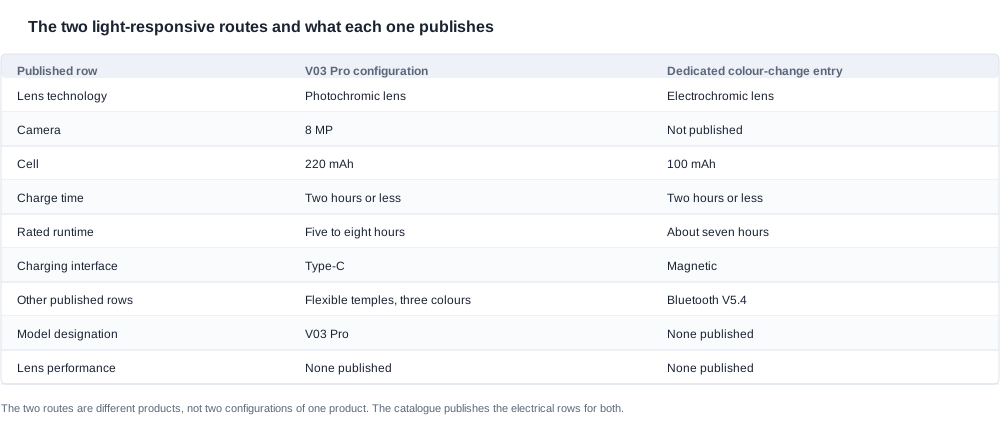
The V03 Pro route is a photochromic lens configuration on an existing 8 MP camera platform. The catalogue publishes the platform rows: 8 MP, a 220 mAh cell, charging in two hours or less, a rated runtime of five to eight hours, Type-C charging, flexible temples, and three published colour options. The catalogue confirms the lens option exists. It says nothing about the lens — no tint depth, no speed, no range, no coating description.
The separate entry route is a distinct catalogue entry described as electrochromic, with Bluetooth V5.4, a 100 mAh cell, charging in two hours or less, roughly seven hours of rated use and magnetic charging. It carries no model designation, which means it cannot be listed, shipped under a declared name or filed in a compliance document without first obtaining one.
The practical difference between the two is the one that decides a programme. The V03 Pro route is a lens on a platform that already exists, which makes it the cheaper engineering route and the one with a documented host product. The separate entry is a product in its own right, which makes it the route with a dedicated bill of materials and its own conformity questions — and the route with the unresolved documentation.
If you are choosing between them for a private-label programme, the comparison method is in how to compare photochromic smart glasses, and the selection logic is in how to choose photochromic smart glasses.
Which route a requirement actually needs
Four questions settle it, and two of them can stop a programme before a quotation is even requested.
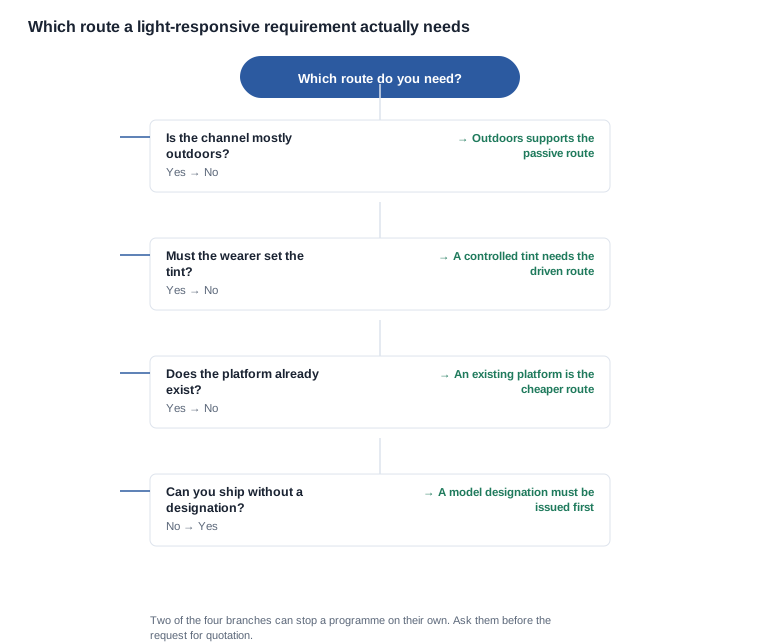
Is the channel mostly outdoors? Outdoors in daylight supports the passive ultraviolet-driven route and excludes the driven route from any cost advantage it might otherwise have. If the channel is indoor, a light-responsive lens is a cost with no customer-visible benefit, and a standard platform from our range serves the channel better.
Must the wearer set the tint? This is the question that separates the two technologies completely. A passive lens responds to the environment; a driven lens responds to a command. No commercial term turns one into the other.
Does the platform already exist? If it does, the lens is a variant and the engineering cost is small. If it does not, you are buying a second product.
Can you ship without a model designation? No. A designation is required for the certificate, for the packaging, for the customs description and for the alignment of the units in your warehouse. For the separate entry, that designation has to be issued before the order — a fact worth establishing at the start rather than at the artwork stage.
Where the two routes sit in the supply chain
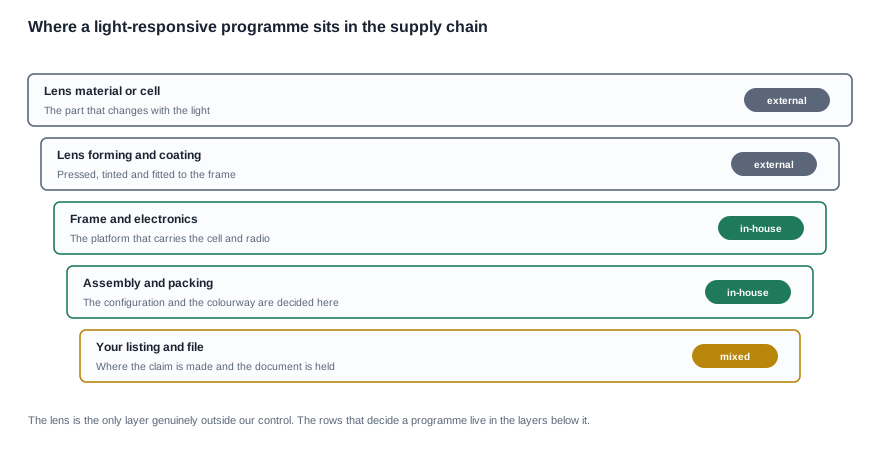
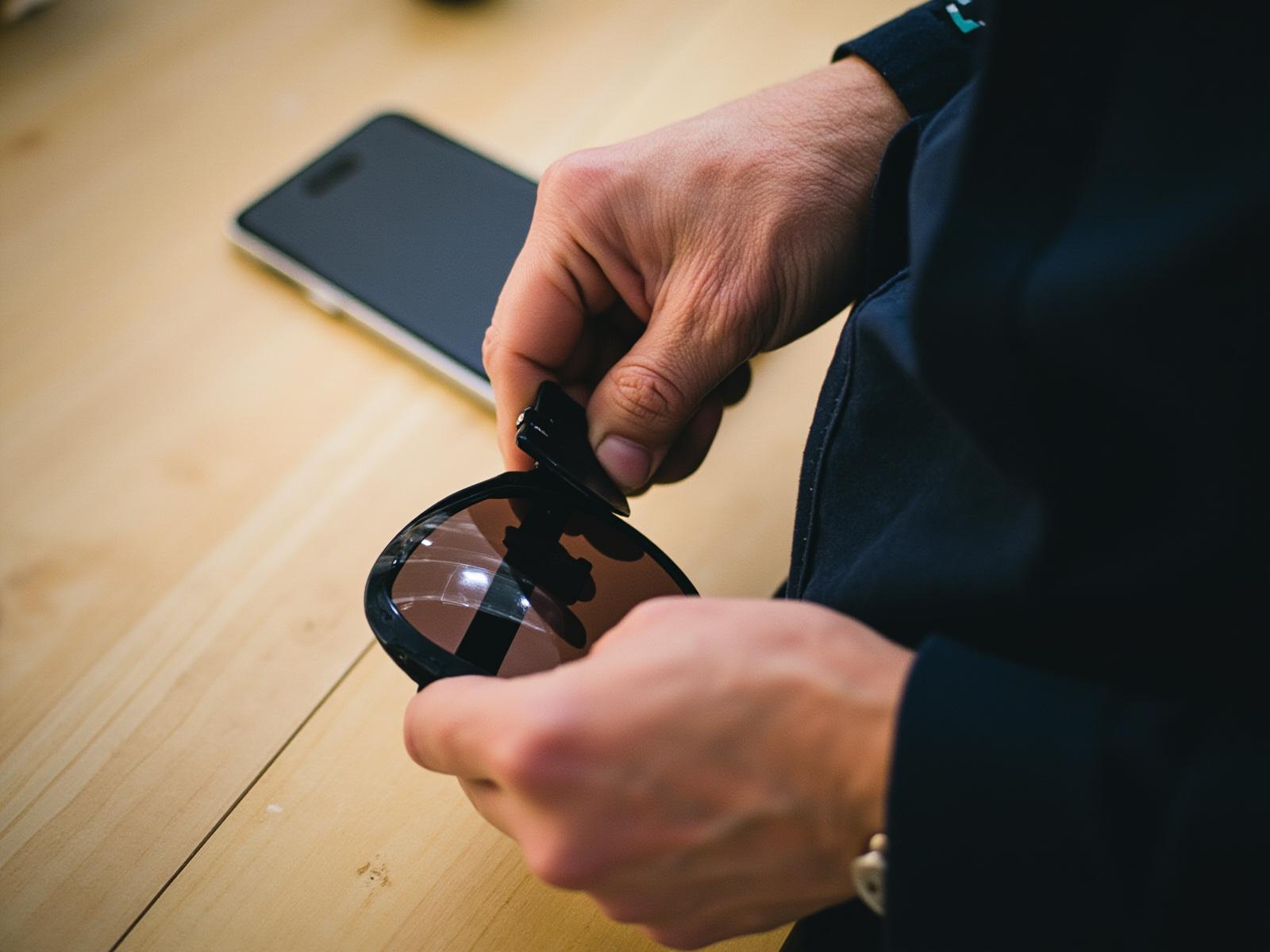
The layer diagram above is the honest picture of where a light-responsive programme lives. The lens material and the forming and coating are outside our direct control; the frame, the electronics, the assembly and the packing are ours; and your listing and compliance file sit above everything, where the claim is made.
Two consequences follow. The first is that the rows that decide a programme — the lens performance figures — belong to a layer we do not own, which is why they are not in our catalogue. The second is that the layer we do own is where the documentation decisions are made, and those decisions are entirely within your reach.
What each route publishes, row by row
The published rows
| Published row | V03 Pro configuration | Dedicated colour-change entry |
|---|---|---|
| Lens technology | Photochromic lens | Electrochromic lens |
| Camera | 8 MP | Not published |
| Cell | 220 mAh | 100 mAh |
| Charge time | Two hours or less | Two hours or less |
| Rated runtime | Five to eight hours | About seven hours |
| Charging interface | Type-C | Magnetic |
| Other published rows | Flexible temples, three colours | Bluetooth V5.4 |
| Model designation | V03 Pro | None published |
| Lens performance figures | None published | None published |
Those electrical rows are useful for narrowing the field. The V03 Pro route sits on the Type-C interface within the camera class; the separate entry uses magnetic charging with a 100 mAh cell. Those rows answer a structural question — which platform class the product sits in, what the charge route is, what the cell is — and they do not answer a performance question, which is where most buying conversations in this category actually happen.
And one weight, across the whole range
Across the entire catalogue, one unit weight is published: 158 g for the MT6 camera platform, excluding its foldable charging case. A lens changes that weight, and no model has a published weight with a lens fitted.
For a product sold on comfort and on all-day wear — which is exactly how a photochromic product tends to be positioned in retail — that is an undefendable row. It is also a row that a buyer can close in thirty seconds with a sample and a scale, which makes its absence from the catalogue more annoying than it is serious.
What we publish about the wider range
For context on where these two routes sit among our other products, the catalogue also publishes, for the other camera models, the resolution class, the charging interface, the charge time, the rated runtime and the cell capacity. The charging-case capacity is published on five of them — 1400 mAh on the CY03 and the CY05, and the L1 Pro, 900 or 1400 mAh on the L2 Utral, and a 1200 mAh foldable case on the MT6. Two further camera models are fitted with a case whose capacity is not published. The V03 Pro has no charging case.
The V03 Pro row is the one that matters for this article, because it is the platform the photochromic configuration sits on, and it is the platform whose Type-C charging and three colour options are what make the lens variant a manageable one.
The rows the catalogue cannot answer
Nine questions we get, and the honest answer for each
Does the photochromic lens reach sunglass darkness? We do not publish a transmission figure for any lens, so we cannot answer that. What we can tell you is that the question should be asked as two numbers — the clear state and the dark state — with the method stated, and that a supplier quoting only the darkened figure has quoted the flattering half.
How fast does it change? No switching time is published, in either direction. The threshold to hold is two figures, one per direction, each with a light level and a temperature, and a statement of whether the figure is typical or best case.
Does it work behind a car windscreen? The mechanism answers this, not a figure. A passive ultraviolet-driven lens does not respond meaningfully behind glass, because the glass has filtered out most of the ultraviolet that drives it. That is a limitation of the technology rather than of a particular unit, and it belongs in the listing.
How heavy is it with the lens fitted? Not published. See the weight paragraph above.
What is the frame material? Not published for either route.
How many cycles does it last? No cycle life is published, for either route, and no failure criterion exists with it.
Does the tint stay uniform across the lens? No uniformity tolerance is published.
What does it do when the battery is flat? Not published as a written behaviour. For the driven route this is a product behaviour and a support-script line, and it has to be specified rather than discovered by a customer.
Is it certified for my market? Our catalogue carries an export certification statement at company level. It does not carry a per-model certification row, so we cannot tell you from the catalogue which document covers which model — and we will not infer a per-model position from a company-level capability. That row has to come from the supplier for the specific configuration.
Why the gaps are consistent rather than accidental
The pattern across all nine rows is not sloppiness. It is the same pattern you will find in the wider camera range: the catalogue publishes the electrical and mechanical rows of the product it assembles, and does not publish the performance characteristics of modules it buys. The lens is a bought module. The battery is bought, and its capacity is published because it is a configuration parameter. The lens's behaviour is not, because it is not.
Knowing that rule lets you predict what a supplier's catalogue will contain, which is useful when you are comparing three suppliers rather than one. It also tells you which rows you will have to establish yourself, so you can budget for that work rather than discovering it.
The rows that are worth closing first
If you are short of time, close these four first, in this order, because each one can change the decision rather than merely confirm it.
The mechanism. It decides the product, and it costs a single observation: put the lens behind a window. If nothing changes, the route is passive and the car case is a known limitation. If it changes on a button, the route is driven and the flat-battery behaviour joins your acceptance criteria.
The measured weight with the lens fitted. It is the row a comfort-led listing leads on, it does not exist for any model in our range, and a scale settles it in a minute. The only published weight in our catalogue is 158 g for the MT6 platform, excluding its foldable case, and no lens-fitted configuration inherits that figure.
The two transmission figures. These decide whether a sunglass-style claim is available at all, and therefore whether your listing copy has to be narrower than the feature. Both numbers, both states, with the method.
The model designation. For the separate entry this is a precondition rather than a detail, because without it the certificate, the packaging, the customs description and your warehouse records have nothing stable to align against.
How to get an answer on the rows we leave open
The route from a question to a filed answer

The catalogue can start the first step. Steps two to five have to be established on your own units, and they are cheaper than most buyers expect — an afternoon of observations, done properly, closes most of the nine rows above.
Name the route your requirement needs, using the four questions above. This is a decision, not an investigation, and it takes twenty minutes.
Ask the manufacturer for the rows the catalogue does not publish, in writing, before the sample order. The four performance rows, the temperature range, the weight with the lens fitted, the flat-battery behaviour, and the model designation for the separate entry. Ask for them against the specific configuration rather than the model family, because a family-level answer is not a configuration-level answer.
Agree a sample protocol with the criteria written in advance. The observations are set out in how to measure photochromic smart glasses, and the sample route is under sample evaluation. The part that matters is writing the criteria down before the readings are taken, because a criterion written afterwards describes what you saw.
Measure one unit and record the conditions, then repeat on a second unit from a later date. The second unit is what turns a batch observation into a process observation.
Write the criteria into the purchase order. In a category with no published standard, the contract is the standard. A criterion that lives only in an email is not binding; a criterion attached to the order is the acceptance standard, and a lot that fails it is a lot you can refuse.
The commercial terms this route negotiates
The lines worth pushing on are the number of configurations and their individual minimums, the artwork round count, the packaging and insert design including the market labels and the language of the documentation pack, the delivery split against a sample-approval milestone, and the payment node structure — a deposit, a balance on inspection before shipment, and a retention held against the documentation package. Minimum order quantity is negotiable, and the per-colour minimums on a configuration route are the line worth pushing hardest, because a lens option multiplies them.
The lines that are not a lever are the certification cost and the certification elapsed time, which are fixed per product family and set by the test laboratory's queue, and the tooling, which is a one-off cost normally amortised across the first order — where the useful questions are over what volume it is amortised and what happens to it if the programme is discontinued. The mechanism is not a commercial variable at all.
Customisation and private-label arrangements, including where the lens configuration question is usually answered, are covered under OEM and ODM customisation.
A hypothetical programme working through both routes
This is a worked scenario, not a client project, and it is written to show the decision sequence.
Assume a channel buyer for an outdoor and cycling brand, with four colourways and a price band that leaves no room for a second product line. Three markets, one of which has a driving-heavy usage pattern.
Route one: the V03 Pro configuration. The buyer starts here because the platform exists. The platform rows are published — 8 MP, 220 mAh, Type-C, flexible temples, three colours — and the buyer adds a fourth colourway for the lens configuration, taking the range to four combinations. The buyer negotiates on the combination count rather than the unit count, and asks for the per-configuration minimums in the same conversation. The brand's own listing copy says the lens adapts to light conditions and does not claim sunglass depth, because no transmission figure was available. The car caveat appears in the listing and in the instructions, because the passive route cannot cover it.
Route two: the dedicated entry. The buyer looks at the separate entry because the driven route would let the customer control the tint, which the cycling channel asks for. The mechanical difference is attractive — a 100 mAh cell, magnetic charging, roughly seven hours of rated runtime. Two things stop it. The mechanism changes the power budget and adds the flat-battery behaviour to the acceptance criteria, which nobody has written. And there is no model designation, so the certificate, the packaging and the customs description cannot be finalised.
The decision. The buyer goes back to the customer's actual request and finds it was about swapping glasses outdoors, not about controlling tint. That is a passive route requirement, so route one is the right route, and the whole second evaluation was worth the hour it took because it settled the question by elimination.
What the buyer still has to do. Four performance rows on a sample, a measured weight with the lens fitted, a written flat-battery statement for the driven route in case the brief changes, a model designation confirmed in writing, and per-configuration certificate numbers. None of those is a catalogue row. All of them belong in the purchase order.
The point of the walk-through is that the catalogue settles the electrical rows and nothing else, and the remaining work is short, cheap and entirely the buyer's to schedule.
The claims we will and will not make about our own lenses
Stated plainly: we publish the rows we hold for both routes and mark the rest as open, and a buyer who asks us for a lens figure we do not hold gets the honest answer rather than a plausible one. We will not quote a switching time or a transmission value from a typical value, and we will not describe a passive ultraviolet lens as though it were an actively controlled one.
There is a commercial reason for that, and it is worth stating for a buyer who is deciding how much of our catalogue to rely on. A quoted performance figure is not a neutral convenience — it is a commitment that will be repeated back at you in a dispute, in a listing review, or by a customer who measured differently. A figure we publish without the conditions attached to it is a liability that transfers itself. An absent row costs you one afternoon of your own measurement and costs the supplier nothing, because we have not put ourselves in a position where we have to defend it.
The same reasoning applies to the certification question in particular. Our catalogue carries an export certification statement at company level. That is a statement about the organisation, and it is not a statement about a specific model in a specific configuration with a specific radio. If we inferred a per-model position from it, a buyer would eventually file against a document that does not say what we implied it said — and the gap would be ours to explain.
We will also be direct that the separate entry's missing model designation is a real operational limitation rather than a documentation quibble, and that a private-label programme should establish it at the start rather than at the artwork stage.
We publish one weight in the whole catalogue — 158 g for the MT6 platform, excluding its foldable case — and no weight for a lens-fitted configuration of any model.
We state no claim of vision or health efficacy for any product we publish. A device that detects a position or a distance and reminds is not a clinical intervention, and a listing that implies otherwise is a regulatory exposure rather than a marketing decision. If your channel is built on an eyesight concern, this is the wrong category, and we would rather say that before the sample order than after the copy is written.
The technology background is under photochromic lens technology, the measurement method is in how to measure photochromic smart glasses, and the sample route is sample evaluation.
Where the range position comes from
Tell us which route you are considering and we will tell you which of the nine rows is still open.


