

The honest answer is that we cannot tell you, because no frame in our range publishes a nose pad arrangement. No frame material, no temple length, no bridge width, no nose pad specification and no head-size range is published for any model in the audio, camera, sport or children's ranges. The only frame weight published anywhere in the catalogue is 158 g for the MT6, glasses only, excluding its foldable case. Whether the pads are replaceable is therefore a question about the product rather than about the catalogue, and the product is the sample in your hand.
That sounds like an unhelpful answer, and it would be if the question had one dimension. It does not. Replaceability is decided by three separate physical facts — how the pad is attached, whether the pad exists as a spare part, and whether the bridge can be adjusted independently of the pads — and each of them is answerable in a single paragraph by a supplier or in a single minute by anyone holding a sample. The answer is cheap to obtain. What is expensive is the alternative: a brand that assumed replaceability and built a service line around it, or a brand that assumed the opposite and found itself replacing whole frames for a comfort complaint.
This page is written for the buyer who needs to establish it, and it sets out what decides the answer, how to find it, and what the answer is worth commercially once you have it.
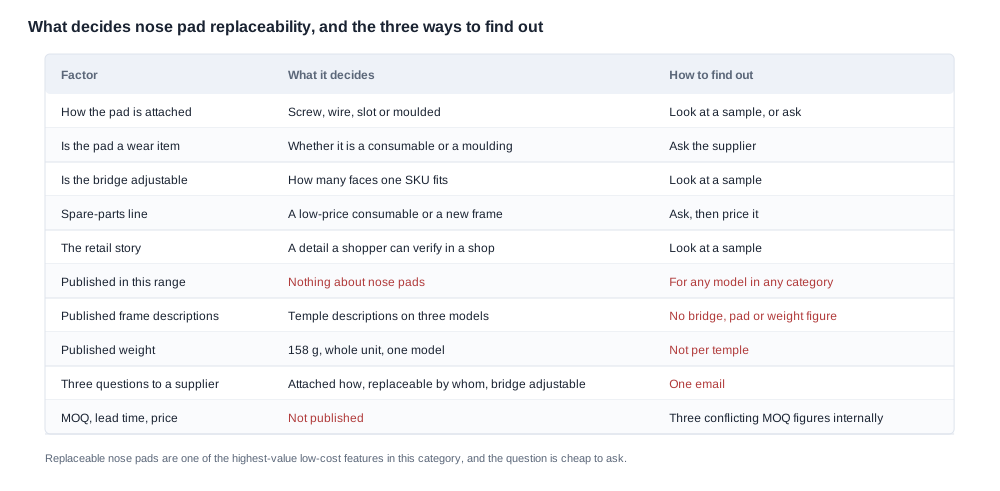
Can nose pads be replaced: what decides it
How the pads are attached. A pad moulded into the frame is not replaceable, and that is the end of the question. A pad on a screw is replaceable by the customer with a tool. A pad on a rivet is replaceable by a technician. A pad in a slot is a consumable. A pad on a carrier wire is replaceable without tools, but the carrier is a part in its own right and has to be available and identifiable for the swap to work. These are not six shades of the same answer. They are six different service models with six different costs, six different minimum order quantities and six different customer experiences, and a buyer who hears "yes, they can be replaced" has learned almost nothing.
Whether the pad exists as a spare part. This is the row that separates a genuine consumable from a repairable-in-principle frame. A pad that can be physically removed but has no part number, no availability and no reorder process is not a spare part, it is a component that will be unavailable the first time somebody needs it. The question to ask is not "are they replaceable" but "what is the part number and what is the lead time on it", and the answer to that question is what decides whether a service line is real.
Whether the bridge can be adjusted independently of the pads. A frame whose bridge position is adjustable fits a wider range of faces with one SKU, because the adjustment is a function of where the pads sit on the bridge. A frame with fixed pads is a fixed-size product, and the sizing question then falls back on the dimensions and the weight that the catalogue does not publish. This is the variable that decides the return rate in an eyewear channel, and it is worth more attention than it usually gets, because it is the difference between one product and a fit range.
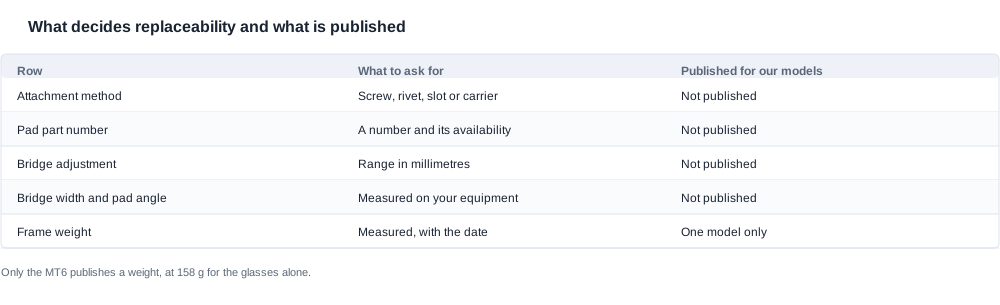
What our catalogue does publish on frames is very little, and it is worth being precise about the boundary. A handful of models carry a frame-related description: the G07 with an ultra-slim detachable temple, the YK12 with a slim temple, the V03 Pro with flexible temples, and the sport family with a detachable inner frame. Those are the only frame descriptions in the range, and not one of them says anything about nose pads. Everything else — frame material, temple length and curve, bridge width, lens dimensions, head-size range, nose pad arrangement, and weight for all but the MT6 — is not published for any model in any category. The frame materials discussion covers why a material name does not answer the fit question, and the compatibility article covers the prescription and over-glasses questions that sit alongside this one.
The reason this gap matters more here than for most specification questions is that nose pads are the part of a frame that a wearer notices first. They soften, they discolour, they lose their shape, and once they have gone the frame feels wrong in a way that the customer describes as the product being broken. If the pads are a replaceable consumable, that event is a five-minute fix and a customer for the next two years. If they are moulded in, that event is a warranty claim and possibly a whole-unit replacement, and the cost of that lands on the brand.
The three questions, and can nose pads be replaced on any model
The request to send is short, and it should be sent per model rather than for the range, because the answer is a product fact that varies across the twenty-eight models in the catalogue. Here is the form it should take:
- How are the nose pads attached on this model — moulded in, screwed, riveted, slotted, or on a carrier wire?
- Is there a spare part number for the pad or the pad-and-carrier assembly, and is it available separately from a complete frame?
- Is the bridge position adjustable independently of the pads, and over what range, in millimetres?
- Do the pads appear as a wear item in the frame's wear schedule, and what is the expected service life before a replacement is normal rather than a fault?
- Is the carrier, where one is used, itself orderable, and does it have its own part number?
The distinction in question two between "we can replace them in the workshop" and "the customer can replace them" is the one that changes the economics of the whole programme, and it is worth pressing for. In the first case the pad is a repair cost absorbed by the warranty; in the second it is a consumable the customer buys, which turns a cost centre into a revenue line and turns the customer's frustration into an order. The same physical pad, attached the same way, produces both outcomes depending on whether a part exists and a process exists to sell it.
Question three deserves a follow-up as well, because a bridge that adjusts is only useful if it adjusts by enough. A range of a few millimetres is a comfort refinement; a range of ten millimetres or more is a materially different product in terms of the face range it serves. The number to ask for is the adjustment range, and the follow-up is whether the adjustment is intended for the wearer to do or for a technician to do. That is a service-design question as much as a fitting one, because an adjustment the wearer cannot perform is an adjustment that comes back as a warranty event.
The wear-schedule question is the one most buyers forget, and it has a commercial consequence beyond the pad itself. A frame whose pads are listed as a wear item at eighteen months sets an expectation, and that expectation has to be met by somebody. If there is no pad stock and no reorder process, the expectation is being set for a return that will be handled as a warranty case. If there is a pad stock with a published price and a reorder route, the same eighteen months produces a repeat purchase from a satisfied customer. Same hardware, completely different commercial outcome.
One category deserves its own note. The kids range is the A05, the A06 and the A07, and a child's fit changes faster than an adult's. In that range the question of whether the pads and the bridge can be adjusted is not a comfort detail but the mechanism by which one SKU survives a growing face, and it is worth asking whether the adjustment is intended to be used by a parent. Nothing about that is published for any of the three models.

How to find out, and can nose pads be replaced by the customer

The order of effort below is deliberately cheapest first, because most of the answers come from the first two steps and the third is only worth doing on a unit you have permission to open.
Ask the supplier directly. Three questions, one message, per model. Every supplier in this category should be able to answer them from their own production documentation, because the factory knows how it assembles the frame. A supplier who cannot answer is telling you something useful about their documentation, and it is worth knowing before the order rather than after.
Look at a sample. Whether there is a screw, a rivet, a slot, a carrier or a mould line is visible in about a minute, under any light, without tools. Whether the bridge moves independently of the pads is visible in the same minute. Neither of these requires disassembly, and together they answer most of the question.
Pull a pad, on a sample only. A pad that comes out by hand is a pad the customer can change. This is the definitive test of the customer-replaceability question and it cannot be done any other way, because the difference between a slot and a carrier wire is invisible until the pad moves. Do this on a sample unit and say so in the sample request — never on a production unit, never on a unit that is about to ship, and never on a unit that has to pass incoming inspection afterwards.
Measure what you cannot be told. The bridge width, the pad height, the pad angle, the temple length and the weight, on your own equipment, with the date and the unit recorded. A number with a source is a specification. A recollection is what a customer argues with. The weight row is the clearest illustration: only the MT6 has a published figure, so for every other model the only weight you can put in your listing is one you measured, and the moment you publish it you have to publish its conditions.
Two things about the measurement are worth doing properly, because they cost nothing and they are the difference between a usable specification and an unusable one. First, measure more than one unit if you have more than one, and record the spread rather than only the average, because a fit claim built on a single unit is a claim about that unit. Second, keep the measured unit as the golden sample for incoming inspection, exactly as you would for a camera or a battery specification. Fit is the row most likely to vary between units, because the bridge and the pad positions are assembly adjustments that a production line makes by eye.
There is a third thing worth measuring if you have the equipment for it, and it is the one that quietly determines whether the adjustment is usable: how far the bridge actually travels between its extreme positions, measured on the assembled frame rather than inferred from the mechanism. A bridge that is designed to adjust but that a production adjustment has left at one end of its range is a bridge that will never be adjusted, and the units that leave the line that way are the ones that come back. If the measurement is repeatable across the sample set, the variation is an assembly capability question and it belongs in the incoming inspection criteria rather than in the product description.
There is one more check that only a sample can give you, and it is the one with the biggest commercial payoff. Put the frame on more than one wearer and look at whether the bridge adjustment actually moves the fit. A bridge that is described as adjustable and that only moves a fraction of a millimetre is a bridge that does not solve the fit problem it was supposed to solve, and finding that out on two wearers in ten minutes is much cheaper than finding it out in a returns figure two quarters later. The comfort and fit page sets out the fit variables that this test is really probing, and the Bluetooth audio glasses range is where the audio models that most often raise these questions sit.

The commercial weight, and can nose pads be replaced into a service line
The pad and the bridge adjustment are the cheapest fit improvement available in this category, and they are invisible in the specification. A frame that can be adjusted at the bridge serves one SKU across a face range, which is worth more than a marketing feature because it removes returns rather than adding them.
Three consequences follow, and they are not equally important.
The spare-parts line. If the pads are replaceable and the carrier is standard, the pads are a consumable a brand can sell at a low price, and they keep the product in use rather than in a drawer. If they are not replaceable, the customer's remedy is a new frame, and a brand with a warranty has to carry that cost. The deciding factor is the minimum order quantity on the pad, and this is where the service-line idea usually breaks: a spare-parts minimum order quantity that is close to the frame minimum order quantity is not a service line, it is a second product with a long lead time, and a customer who needs a pad in week three will not wait for it.
The fit story. A frame with replaceable and adjustable pads fits more faces with one SKU. A frame with fixed pads is a fixed-size product, and the sizing question comes back to the dimensions and the weight that are not published. In a channel where the return rate on fit is the difference between a profitable model and a loss-making one, this is the row that moves the number, and it is not the row that appears in the catalogue.
The retail presentation. A replaceable pad is a visible, tactile detail that a customer can see and try, and it is one of the few fit features a shopper can verify in a shop without a specification sheet. A frame with integrated pads looks like every other frame, which is not a criticism of the frame, but it does not give the brand anything to say in a product comparison.
The commercial terms worth negotiating, in the order they protect you:
- The spare-parts set and its minimum order quantities — pads, carriers, temples, inner frames — because this line decides whether a warranty event is a five-minute fix or a whole-unit replacement.
- Unit price and volume tiers, and whether the parts line has its own tier structure rather than being sold at the frame's price.
- The warranty period with a stated response, and whether a pad replacement is treated as a warranty event or as a sale.
- Return terms, since fit is the driver of returns in this category and the pad question determines how many of those returns are avoidable.
- Packaging specification, delivery splitting, payment nodes against inspection, and the terms of a pilot order.
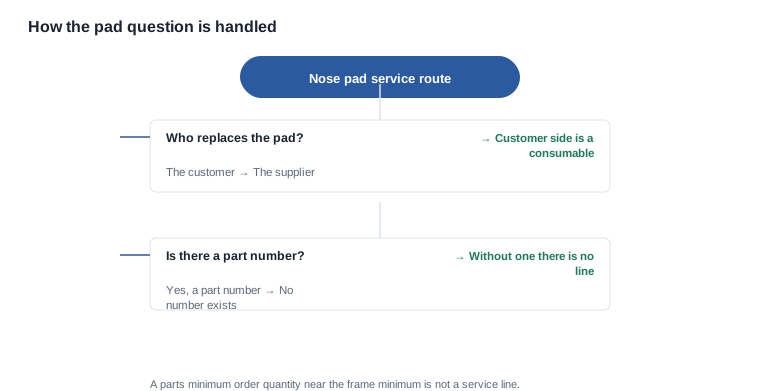
The spare-parts line deserves one more paragraph of its own, because it is the item most often left out of a shortlist and it is the one that changes the most once it is on the table. A spare-parts programme that covers only pads is a consumable line. One that also covers the carrier, the temple and the inner frame is a service programme, and it is the difference between being able to fix a customer's frame in the customer's market and having to replace it. The practical questions are how many of these parts the factory actually holds as stock, whether the parts are sold on the same terms as the frames, and whether they can be shipped to the customer's local service address rather than back to the factory. A parts line that can only be dispatched from the factory origin is a parts line that does not meet the warranty it was built to support.
Two lines on a quotation are not the negotiator's to move. Certification cost and its lead time follow the process and the testing body. Tooling is usually amortised across the first order while certification cost sits per product family, and the two are frequently bundled into a single figure that hides which is which — ask which one you are being quoted.
The agreement should carry the published rows for the configuration ordered, plus the nose pad attachment method, the pad part number and its availability, the bridge adjustment range, the measured bridge width, pad height and pad angle, the frame weight as measured, and the warranty period with a stated response. What should stay out is any pad arrangement, bridge width or frame weight that has not been given or measured, and any fit claim that has not been measured on a sample. The most common version of this mistake is a weight figure carried across from a sibling model, which is not a shortcut but an error waiting to be quoted back at you.
What we can state, and can nose pads be replaced on our models
Replaceable nose pads are one of the highest-value low-cost features in this category, that our documentation cannot confirm them for any model, and the question is worth asking precisely because the answer is cheap and the alternative is expensive. A brand that has asked and knows is in a completely different position from one that assumed.
We will not publish a nose pad arrangement, a bridge width or a frame weight, because none of them is published for these models and we will not guess. What we will do is tell you which models publish a frame description at all, and help you turn a sample into the specification you need.
So, concretely, what should a buyer do next:
- Send the attachment, part-number and adjustment questions in one message, per model.
- Look at a sample and check the attachment, the carrier and the bridge movement.
- Measure the bridge width, the pad height, the pad angle and the weight, and record the date, the unit and the source with each figure.
- Ask for the part number, not just for the answer "yes", and ask what the lead time on the part is.
- Put the part number, the adjustment range and the measurements into the agreement, and put the fit claim into the copy only if you measured it.
Which model you should be evaluating is a trade-off rather than a ranking, and it depends on which of the three determinants matters most to your channel. For a channel where the fit return rate is the dominant cost, the bridge adjustment is the one to chase and the model with the widest published or measured adjustment range wins. For a channel that expects a long service life and counts warranty events, the part number and its availability matter more than the attachment method. For a retail-facing brand that wants something a shopper can see and try, the customer-replaceable pad is the feature worth having, and it is the one that also has to exist as a stocked item.
Tell us the models you are looking at and the fit promise you want to make, and we will say which parts of it the documentation supports and which parts have to come from a sample.
Related reading
- The models and the data behind them — Bluetooth audio glasses
- Why a material name does not answer the fit question — frame materials myths
- The fit and compatibility questions that sit alongside this one — frame materials compatibility
- The fit variables a specification cannot carry — comfort and fit considerations
Tell us the models and the fit promise you want to make, and we will say which parts of it the documentation supports.


