
A frame is not just a frame once it carries electronics, and the compatibility questions that follow are the ones a buyer discovers in the eyewear channel rather than in the electronics one. A customer who already uses prescription glasses is not a new customer for the product. They are a customer with an existing frame, and the product has to coexist with it.
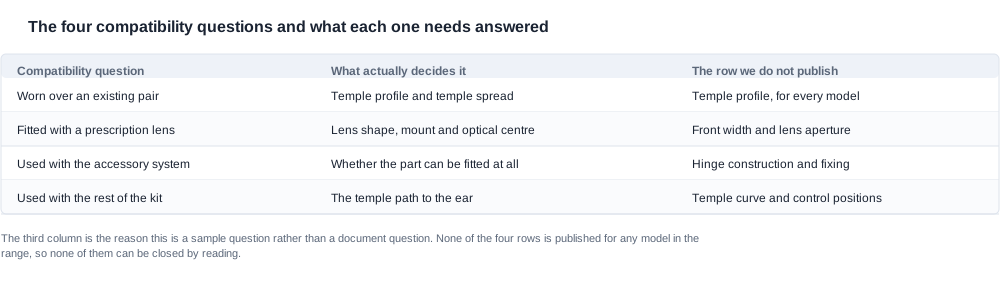
The honest starting point is that no frame material, temple length, lens dimension, bridge width or weight is published for any model in our range. The compatibility questions therefore have to be answered with a sample rather than with a specification, and a buyer who plans around that will spend an afternoon once instead of a quarter once.
What follows are the four compatibility questions in the order they matter, what each one actually turns on, and the six measurements worth taking if you take none of the published ones.
Smart glasses frame materials: the first compatibility case, on an existing pair
This is the question that decides whether the eyewear channel exists for your product, and it is not answered by the frame material.
A frame with a fixed temple will sit over another pair and stay there. A frame with a slim or flexible temple may not, because a slim temple has to clear the customer's own frame at the temple and then settle at the ear, and the two requirements pull against each other. The variable is the temple profile and the temple spread, and neither is published for any model in this range.
What we do publish is uneven. The G07 is listed with an ultra-slim and a detachable temple, the YK12 with a slim temple, and the V03 Pro with flexible temples. For every other model in the catalogue, the temple construction is not published, which means the question is not answerable from a document for most of the range. The frame assessment from a sample procedure covers how to establish it from a sample.
The second half of the answer is about volume, not about the temple profile at all. A temple slim enough to clear another frame may not have room for a cell, a radio and a camera module, which is why the models in this range that publish slim temples are generally the audio platforms. The V03 Pro is the exception worth examining, because it is a camera platform that publishes a flexible temple. The mechanism that makes a slim temple possible on a camera product is the same thing that decides whether the frame can be made at all, and it is a design answer rather than a sourcing answer.
There is a third consideration that catches buyers who plan for the eyewear channel. The compatibility is not only front-to-back, it is also side-to-side: does the customer's own frame have a raised nose piece, and does your bridge clear it? A low bridge on a product with a bridge-mounted camera module has a different clearance problem from a high bridge on the same product, and the published front dimensions that would settle it are not published.
The commercial consequence of this question is larger than it first appears. A product that cannot be used over existing eyewear excludes a large part of the prescription customer base, and a product sold into an eyewear channel will discover that exclusion in the returns channel, where it is expensive and slow. This is a case where the total cost of a compatibility failure is dominated by the cost of not knowing.
The one measurement that decides the channel question
If you are choosing which models to evaluate for an eyewear channel, there is a single measurement that predicts the outcome better than anything else on the specification sheet, and it is the clearance between the temple and the customer's own frame.
The measurement is straightforward. Put the product on over a pair of glasses of a typical size, with the temple at the position it would be in normal use, and measure the gap between the inner face of the product's temple and the outer face of the customer's frame at the point of the ear. Write the number down with the date and the instrument.
Three results are worth distinguishing, and the middle one is the one buyers miss.
A positive gap that stays positive when the head moves means the product can be used over existing eyewear without the two frames fighting each other. The head movement test matters: a product that is clear at rest can close as the head turns, and the closing point is where the customer notices it.
A gap that closes under head movement but never goes negative is the case that is usually reported as a pass. It is not a pass. It means the product is usable in a static position and unusable in a moving one, and a customer in a shop will hold still and a customer in a shop will not keep the frame on.
A negative gap at any point means the product cannot be used over existing eyewear, full stop, and the channel decision is a different decision from the one you were making.
This one measurement takes a few minutes with a sample and a ruler, and it is worth more than a page of catalogue copy, because it is the number your channel partner will want and the number that determines whether the prescription part of the range is viable at all.

Compatibility two: the lens, the mount and the optical centre
Three separate questions sit inside the prescription question, and they have three separate answers.
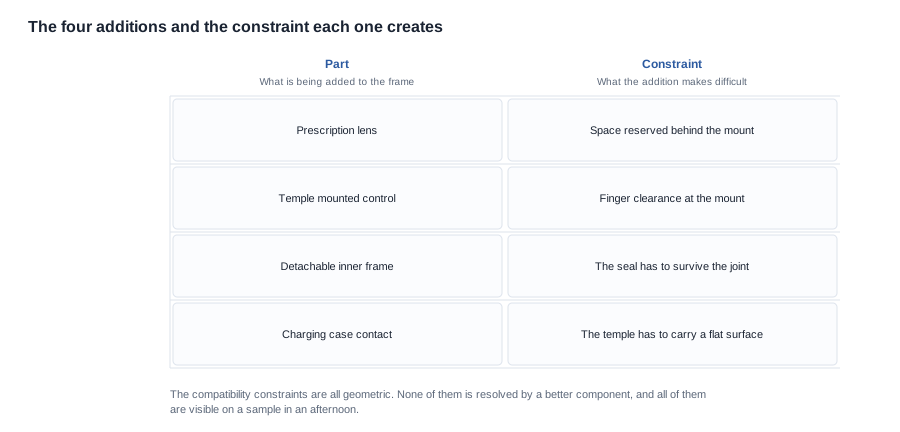
One: does the frame accept a prescription lens at all? That depends on the lens shape and the mount, and it is a property of the frame rather than of the electronics. A front that is too narrow or too shallow for the lens the customer needs is a front that excludes them, and no amount of feature equivalence compensates for it.
Two: can an optician mount a lens without modifying the frame? Modification is the word to be careful about. A frame can be modified in ways that are entirely normal in optics and entirely unacceptable in a product that carries electronics, because the modification changes the geometry, the seal or the alignment of the speaker to the ear. In a sport model, a modification can also break the configuration that an ingress marking covers.
Three: does inserting a lens affect the product's function? On a camera platform a lens changes the optical path, and the field of view the customer actually gets is the product of the sensor and the front. On a frame with a directional speaker, a heavy lens can shift the temple's position and with it the alignment to the ear, which changes both the audio level and the leakage into the room.
And the fourth question is the one that catches eyewear buyers out. Does inserting a lens affect the control positions? A capacitive touch control, where a build carries one, sits on the temple, and the optician's hands are on the temple. If the control is close to where a lens is fitted, the two interfere — and the interference is not a documentation problem, it is a customer discovering that the touch control stopped responding after their glasses were fitted. No model in our range publishes a touch row, so the temple control has to be established with the supplier before a lens is fitted, and it is a live question for any platform that carries a temple control.
None of this is published for any model in the range, and all of it is settled by taking a frame to an optician and asking them to do the job they are being asked to do.
What to ask an optical partner before the range is fixed
If the programme is going anywhere near an optical channel, there is a conversation to have with a dispensing optician before the range is frozen, and it is a conversation most buyers have far too late. The optician is the only party in the chain who does this work every day, and their answer is worth more than a factory's because it comes from the service end.
The questions worth asking are narrow. Can a lens of this shape be edged into this front without the technician touching the frame? Where on the temple do the technician's hands go, and where are the controls? Does a raised nose piece change the bridge clearance? What does the technician do when the customer brings the frame back because the temple moved after fitting?
The third and fourth questions are where the cost lives. A raised nose piece changes the bridge clearance is a statement about a product that will be sold to a channel that also serves older customers, and it is the kind of thing that is obvious to an optician and invisible to a buyer. And the fourth question is a service-cost question: if the frame moves after a lens is inserted, the return belongs to whichever party promised the customer it would not move, and the answer changes your warranty position, your spare-parts position and your channel negotiation.
What to take from the conversation is a written list of the frames the optician would refuse to work on and why. That list is a shortlist filter, and it is one you can apply to any supplier's range without asking them anything at all.
Compatibility three: the accessory system and the conformity position
A detachable part is a compatibility question before it is a feature. The G07 publishes a detachable temple, and the sport camera platforms V06 and S7 publish a removable inner frame. Detachable means that the part can be attached, and the attachment has to be possible.
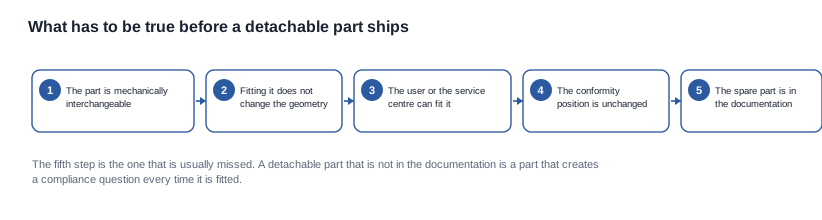
Three things decide whether a detachable part is a feature or a liability.
Whether the user can do it, or whether it has to go back to the factory. This is the difference between a spare-parts line and a warranty claim, and it is a service-model decision before it is a mechanical one. A temple that requires a tool and a technician is a return, and it will arrive in your returns data as a complaint about the product rather than about the part.
Whether the part is interchangeable between sizes and variants. If one spare covers a range, your parts inventory is simple. If every SKU needs its own, the inventory multiplies with the range, and the range multiplies with the number of colourways you add.
Whether attaching it changes the geometry. This is where a frame that settled well becomes one that does not. The detachable inner frame on a sport product is the clearest case: removing it changes the structure that carries the load, and the seal geometry around it is part of what the ingress marking is about.
And then the question that matters commercially. Does a replacement part carry the same conformity position as the original? A detachable temple is part of the enclosure, and an enclosure change is a product change in most frameworks. Our certification checklist covers the general case, and the G07 pre-ordering checks put the mechanism question first for exactly this reason. The practical version of the question is simple: if a customer replaces a temple, does the product remain inside the configuration the documentation covers?
For a buyer, the red flags here are specific. A supplier who describes a part as user-replaceable without naming the fixing method has described a marketing position. A supplier who names the method and says the part changes the configuration has given you the information you need to price the after-sales position correctly.
Compatibility four: the frame inside the customer's own kit
A customer who uses a helmet, a headband, a hat or a pair of sunglasses has a compatibility question that no specification sheet answers, because in all four cases the frame is being asked to work in an environment it was not drawn for.
Helmet compatibility is the specific one for this category. A rider in a helmet has to get the frame on under it, and the temple has to end up in the right position for the speaker to reach the ear — which in a helmet is not the same position as on a bare head. The published runtime figures assume a bare head, and the geometry under a helmet is a different geometry. The failure mode is not a pressure complaint; it is that the audio stops reaching the ear and the customer concludes that the product does not work.
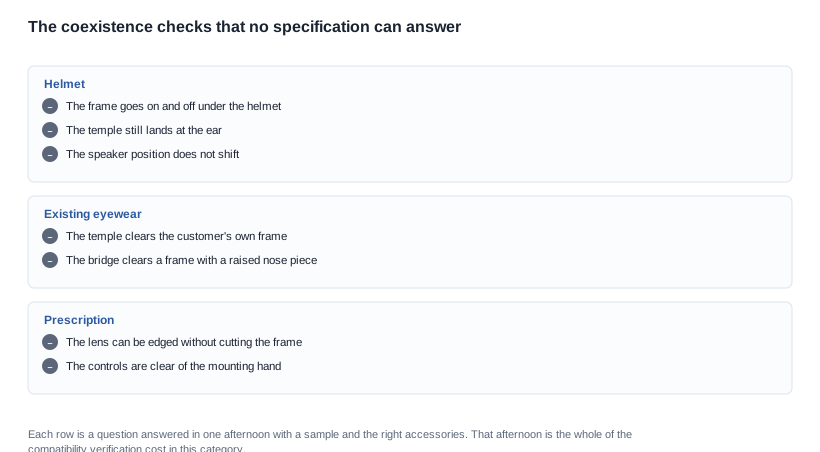
The second case is the customer's own prescription glasses, which is compatibility one above. The third is a hat, and a temple that a hat brim presses on is a temple that moves.
The fourth case is the one most often forgotten in a channel decision: the phone, the music and the meeting. A frame with a directional speaker is used next to other people, and a customer in a quiet office hearing their own audio is a customer who will return the product and describe it as defective. The question here is the leakage question, and it is a geometry question rather than an electronic one — the same temple curve, the same finish on the temple surface, the same relationship between the speaker port and the ear.
None of these can be answered from a specification sheet, and all of them can be answered in an afternoon with a sample and the right accessories. That asymmetry — an afternoon against a quarter — is the strongest argument for ordering a sample early, and it is worth weighing against the sample cost when a buyer is deciding which models to evaluate.
The six measurements worth taking, and the position we can hold
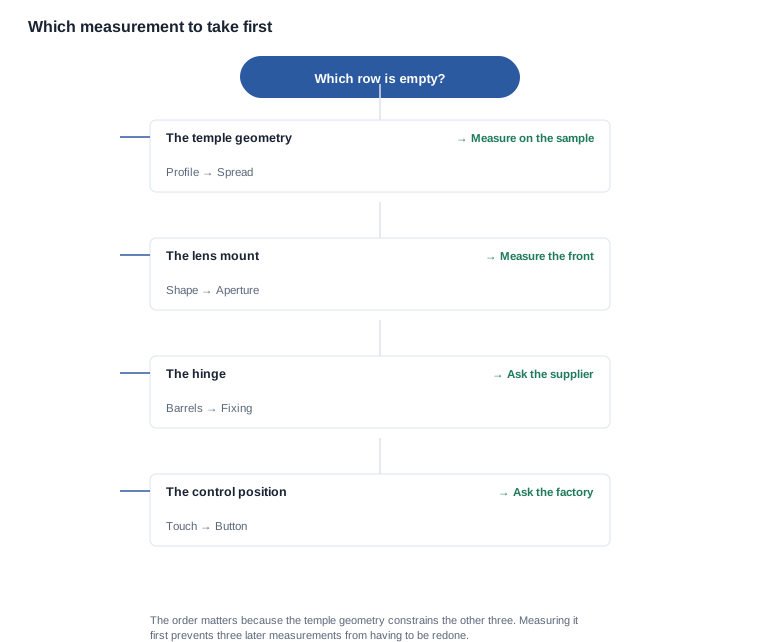
If a buyer takes only one thing from a sample, it should be these six.
- The frame weight in grams, for the exact configuration, with the cell fitted. Our catalogue publishes one figure for the whole range, and it needs its exact terms: the MT6 glasses unit at 158 g including its cell and its camera and excluding the foldable charging case, whose capacity is 1200mAh and whose weight is not published. The weight of a bare frame is not published for any model.
- The temple length and the temple spread in millimetres, plus the head size the frame was designed around.
- The temple profile at the point where the ear sits, because that is where the speaker has to land and where the geometry decides the audio.
- Whether the temple clears an existing pair of glasses, and by how much.
- The control positions relative to the lens mount, for the prescription question above.
- The front width and the lens aperture, for the camera field of view and for the prescription question.
Record the measurements on your own equipment, in a note, with the date and the unit. A number with a source is a specification; a number without one is a recollection, and a recollection is what a customer argues with.
Stated plainly: compatibility in this category is a geometry problem and a mechanical problem, not a materials problem, and the frame material name on a catalogue page tells a buyer nothing about whether the product will sit over a customer's existing glasses or under a helmet. We will not publish a material, a weight, a temple dimension or a head size, because none of those is published for these models, and we will not guess at a compatibility answer.
What we will do is tell you which models publish a detachable or a slim temple, which questions we can close once you have a sample in hand, and where the model count matters for a programme. Of the twenty-eight entries in our catalogue, eleven carry a camera — eight at 8 MP and three at 13 MP — and for those eleven the frame is the enclosure, which makes every change to it a change to the build rather than to the appearance. The family is on our Bluetooth audio glasses range page, and the wider frame topic is under materials and ergonomics.
The limit of what compatibility we can answer
There is a boundary here that is worth stating in the same breath as the offer, because a buyer who expects a compatibility answer from a catalogue will be disappointed and a buyer who expects one from a sample will not.
We cannot answer compatibility from a document, and that is not a service limitation — it is a property of the category. Compatibility between a frame and a customer's own eyewear, an optician's hands, a helmet or a hat is a geometric relationship between three objects, two of which are not ours. No supplier can resolve it without the other two. What any supplier can do is make the frame's own geometry available, and that is what we will do once a sample is in hand.
We also cannot tell you whether a particular model will suit a particular channel, because the channel's expectations are a commercial fact rather than a technical one. A brand selling into an optician-led channel and a brand selling into a sports channel have opposite priorities on the temple profile, and both are legitimate. What we can do is describe the geometry accurately enough that you can work out which priority your channel has, and we will not present a general preference as though it were a channel requirement.
The last thing we will not do is infer a compatibility claim from the material name. It is tempting to read a material as a proxy for geometry and a geometry as a proxy for a channel, and it is the step where a specification starts making promises that no sample can keep. Our frame materials myths piece covers that failure mode in full.
Tell us the channel, the volume and whether the customer already uses prescription glasses, and we will come back with what is available and what is not.
Related reading
- How to assess a frame from a sample — frame assessment from a sample
- Why the material name does not answer it — frame materials myths
- The question that decides the temple strategy — G07 pre-ordering checks
Tell us the channel, the volume and whether the customer already uses prescription glasses, and we will come back with what is available.


