
Yes, and the useful part of the answer is not the yes. It is what the visit is going to be allowed to look at, and what you will still be unable to prove when you get on the plane home. Buyers who fly to Shenzhen for a factory visit usually arrive with one of two expectations, and the first one is much more common: they expect to see whether the supplier is real. That part is the easy part. The harder question — whether the factory you are shown is the factory that will build your order, and whether it will build it at your volume with the quality you were shown — cannot be closed by a morning on the floor, and the visit is worth the trip for a different reason.
We will host a visit. This page explains what we would show you, what we would rather answer in writing, and how to design the trip so that it produces evidence rather than reassurance.
Before the detail, one framing point that determines whether the trip is worth the cost. A visit is cheap relative to the decision it informs and expensive relative to the alternatives, which is why buyers tend to skip it at exactly the wrong moment — either before the order is scoped, when there is nothing to look at, or after the tooling is paid for, when the finding is too late to act on. The window where a visit produces the most value is the middle: after the product and the quantity are defined, before the purchase order is released. In that window you can still change the model, the inspection method, the packaging, the accessories and the payment structure, and a finding on the floor is still a specification change rather than a dispute. The same trip six weeks later is just a tour.
A second point that is worth stating because it is not what people assume: this category is unusually well suited to a visit and unusually badly served by documents. The product is small, the production steps are visible to a non-specialist, and the cost of a bad lot is borne by whoever holds the inventory. Which means the value of a visit scales with how much inventory risk you are about to take on — a small e-commerce pilot does not need one, and a first container does.
Can we visit the factory: what the visit is actually for
A factory visit is a sample of the supplier's operation on one day, in one direction, presented by the people who want your order. That framing sounds harsh and it is meant to be, because most buyers arrive expecting something closer to an audit, and an audit has an adversarial structure — a defined scope, a defined checklist, evidence collected against the checklist, and a finding written down whether or not it is comfortable. A visit is softer than that, and it is useful only if you bring the checklist with you.
The practical purposes, in the order they matter to a buyer at the stage where the trip is worth taking.
Establishing that production is physical. Not that it is described, photographed, or claimed — that there are people on a floor assembling units, benches with test equipment, a packaging area, and a flow of work. Every catalogue operation has a photograph of a workshop somewhere, and the photograph tells you nothing. An hour on the floor tells you a great deal, mostly because you can see how many steps there are between a bag of components and a boxed unit, and compare that to what the quotation implied.
Confirming the tooling, if you own any. This is the highest-value use of a visit for a buyer who has already paid for a mould. Tooling is the one asset in this category that is physically identifiable, physically stored, and physically at risk. You can look for the marks on it, ask where it lives when it is not on the line, and see whether the storage area looks like an asset register or like a corner. The smart glasses OEM quality expectations page sets out what belongs in the written quality agreement, and the tooling clauses are the part a visit can corroborate.
Reading the order discipline. Whether units are tracked individually or by lot, whether inspection records exist and look maintained, whether the shelf of finished units matches the samples you approved. These are visible only in person, and they are a better predictor of your own defect experience than any figure in a capability deck.
Calibrating the people. Ask the same question twice, once of someone on the floor and once of someone in the office. Divergence between the two answers is informative in a way that neither answer alone can be.
The thing a visit cannot be is a substitute for the written quality agreement. The failures that cost buyers money happen in month four, at volume, in a lot that was built after the visit, on a line that was staffed differently. No visitor is present for those.
There is also a version of the visit that is worth recognising early and declining, which is the hospitality visit. A day that consists of a tour, a meal and a presentation is not a diligence visit and should not be booked as one. The tells are that the agenda is arranged around you rather than around the production line, that the inspection station is not on the route, and that no one from engineering is present. If that is the visit being offered, the useful response is to ask for the other kind — a half-day on the floor with the quality contact and the production manager, and the meeting room afterwards. Most suppliers will accommodate that, and the ones that cannot usually explain why, which is also information.
A second tell is a shop floor where every visible unit belongs to a different customer, none of it resembles the model you are quoting, and the walk takes two hours because there is a lot of other work to pass. That is a legitimate business — a job shop with many small customers — and it is fine for some orders. It is a poor fit if you need one specific model built to one specification at one volume, because the line that will touch your product is not the one you were shown, and the set-up time on it belongs to somebody else's schedule.

Why the answer to can we visit the factory is itself a due diligence signal
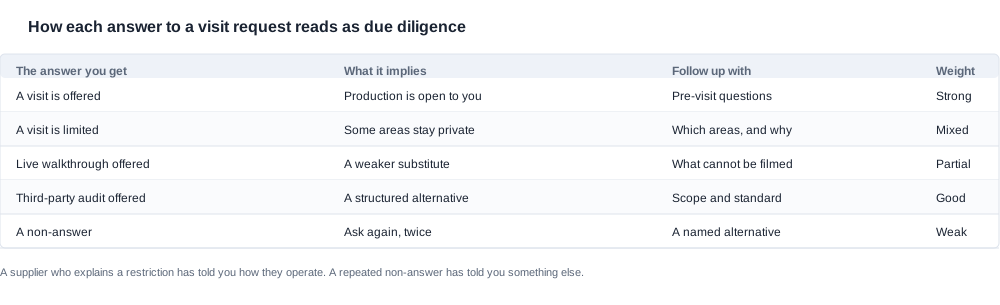
The question gets deflected, sometimes with a reason and sometimes without one. The legitimate reasons are real and worth separating from the non-answers.
A working production floor may restrict entry during sensitive operations. Another customer's goods may be on the line, and showing you a competitor's product is a confidentiality breach the other customer would rightly object to. Photographic records may be restricted by a site security policy. Some factories work under customer confidentiality obligations that prevent them from showing a visitor a customer-specific line. Export and data rules can apply to what may be photographed or exported.
All of those are defensible, and a supplier who explains one of them has told you something useful about how they operate. What is not defensible is the pattern: a non-answer that does not change across two contacts, or a supplier whose answer is that the factory is somewhere else and who cannot say what the arrangement is. A factory that contracts production to another factory, and will not describe the arrangement, is describing a supply chain you have not done due diligence on.
The intermediate position is common and workable: a live video walkthrough, conducted on request, with your questions answered during the walk. It is weaker than a visit in three specific ways. You cannot check whether the storage room actually contains the tooling. You cannot take a photograph of the non-conformance log. And you cannot read the inspection records. It is still much better than nothing, and it is a reasonable fallback when travel is genuinely impractical.
Three questions to ask before you decide a visit is or is not available:
- Is a visit possible, and if not, what is the substitute you propose — live walkthrough, third-party audit, or a named reference call?
- If a visit is possible, are there any parts of the site we will not see, and why?
- If a visit is possible, who from your side attends, and will someone from engineering be present rather than only sales?
The third question is the sharpest one available to a buyer, because the answer reveals whether the visit is being run as a relationship exercise or as an evidence-gathering session. An engineering attendee means the technical questions will be answered by people who know the answers. A sales-only attendee means your visit will consist of a tour and a lunch.
How much a visit matters also depends on where you sit in the buying cycle, and the right question to ask changes with it. A brand owner with tooling already paid for needs to see the tooling, the storage, and the set-up on the line — everything else can wait. A distributor committing to a container needs to see traceability and inspection, because their risk is inventory and their margin does not survive a lot they cannot trace. A first-time importer with a pilot order needs something different again: they need to see that the factory will answer a question honestly when the question is uncomfortable, which is a different skill from running a line and is better tested by asking one question the supplier does not want to answer.
Can we visit the factory and still not know what you need to know
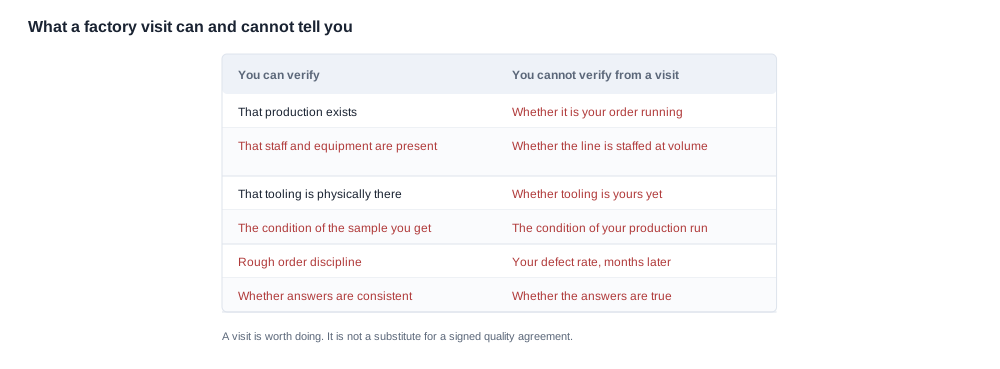
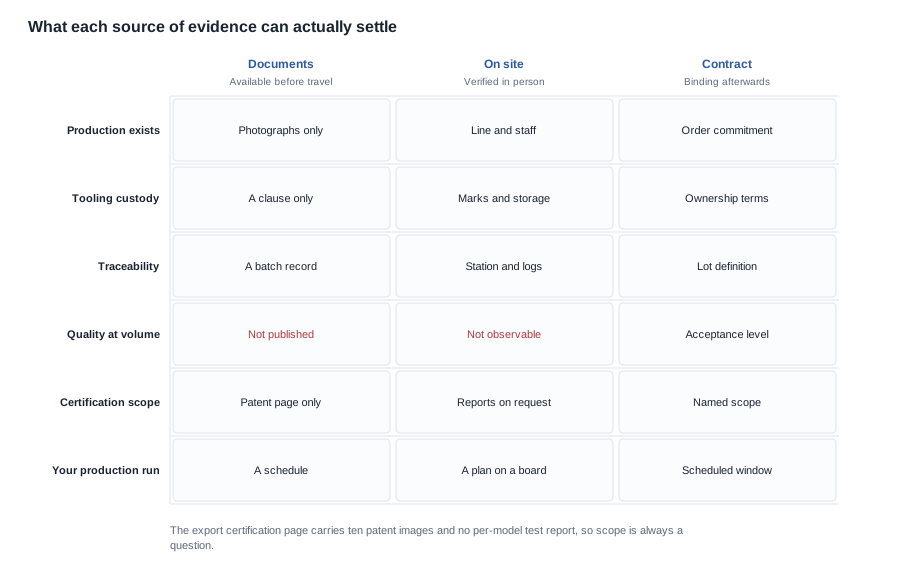
This is the part buyers are most often disappointed by, so it is worth stating plainly. A visit settles some categories of question completely, settles others partially, and leaves a third group exactly where it started.
Settled by presence. That assembly, test and packaging operations exist and are staffed. That your tooling exists and is marked. That inspection stations exist and hold records. That the people you would deal with are identifiable.
Partially settled. How order traceability works in practice — you can see the mechanism, but the evidence of it working over time is in the record, not in the room. Whether the sample shelf matches what you approved — you can compare one unit, but you cannot see the history of changes to it. Whether the factory is stable — a busy floor in December tells you about December.
Not settled at all. Whether your order will run on the line you saw. A factory runs several customers' work, and the line that assembles a small audio order may be a different line from the one that assembles a large camera order. Whether the defect rate at your volume resembles what you saw. Whether an answer is true. Whether the sub-tier suppliers behind the finished unit are sound. Whether the financial position of the company you are contracting with will hold through your payment schedule.
The category that surprises people is documentation. Our own export-certification page is a picture page: it carries ten patent certificate images — eight design patents and two utility models — and no per-model test report, no certificate number and no scope. So if you arrive expecting a wall of test certificates for the models you are quoting, you will be disappointed, and that disappointment is a signal about how any supplier's paperwork should be read. A photograph of a certificate proves that a certificate exists. It does not prove which model it covers, which standard it was tested against, or whether it is still inside its validity period.
Ask for the certificate number, the model it covers, the standard and the date, and cross-check the model against the catalogue row you are buying. This is not pedantry. It is the cheapest available test of whether a supplier's documentation attaches to the product, and in a category where the same mould gets sold under several brand names, a certificate that belongs to a neighbouring model is a common and expensive mistake. A supplier who cannot produce the four fields for the specific model has told you something about the rest of their paperwork.
The same caution applies to the specifications themselves. Our catalogue publishes an IP rating for the V06 and the S7 only, and nothing else in the range carries an IP marking. It publishes a weight for one model only. It has no capacitive-touch row and no translation row anywhere. A visit genuinely helps here, because you can hold the unit and see the interface. But the deeper point is the same one: what a document does not say is not evidence of absence, and a factory floor showing you a touch panel does not establish that the catalogue publishes a capacitive-touch specification. The catalogue and the visit answer different questions.
One last category that a floor visit gives a false reading of: sub-tier supply. A factory can assemble a finished unit from components bought from four other factories, and the finished-goods inspection will not reveal which. If your risk depends on a specific battery cell, a specific mainboard revision or a specific lens supplier, the visit is where to ask how that component is specified, who supplies it, and what happens when the incoming lot is out of tolerance. You may not get to see the sub-tier site. Getting a written answer about the incoming inspection method for that part is usually the best available compromise.
Preparing the questions that make can we visit the factory worth the trip
Send the questions in advance, in writing, and ask for the answers in writing as well. The written answers are arguably more valuable than the visit, because they arrive before you have spent the travel and they create a record you can hold the supplier to later. Four are worth asking:
- Which line and which production window is our order scheduled on, and what has to be true for that schedule to hold?
- What is the incoming inspection method — by lot, by unit, or by sampling — and who signs it off?
- Who owns the tooling once it is paid for, where is it stored when not in use, and how is it marked?
- What can change in the bill of materials between now and the production run, and what notice do we get?
Notice how each of those is answerable in a sentence and none of them is answered by a photograph. That is the test for a good pre-visit question: if the answer would be the same no matter which supplier you asked, it is not a due diligence question.
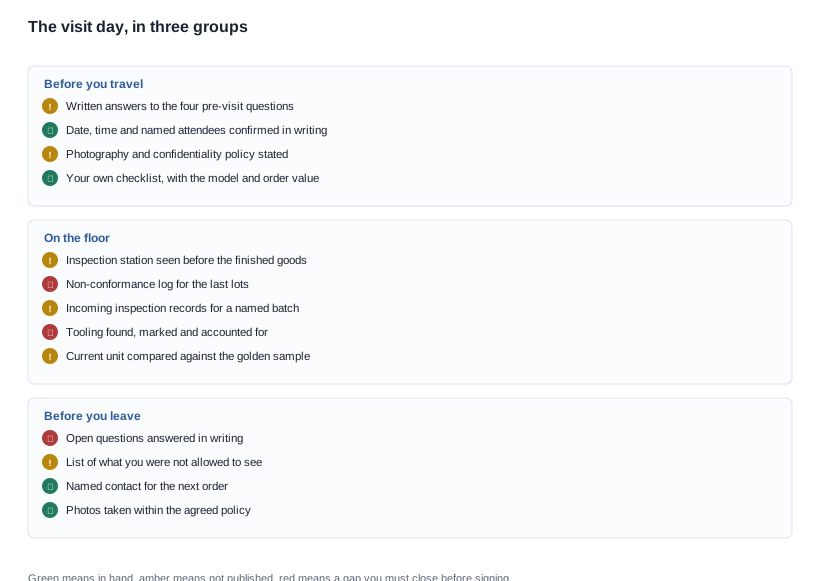
Then plan the day itself. Arrive with a written list, split into three groups, and do not let the day reorder them.
The first hour is for the floor. Assembly, test, packaging, in that order, and ask to see the inspection station before you see the finished goods, because a factory that is proud of its inspection will show it to you, and one that is not will defer it.
The middle is for records. Ask to see the non-conformance log for the last few lots, the incoming inspection records, and the finished-goods traceability record for a batch you can name. If the logs do not exist, that is not necessarily disqualifying — smaller operations run leaner — but you need to know it now, not at month four.
The last part is for the golden sample. Bring, or arrange to have, the unit you approved. Put it next to a current unit. Check the fit, the finish, the port, the accessories, the packaging print. Small drifts here are the cheapest thing you will ever find, because they are found before the order rather than after it.
Two practical details that matter more than buyers expect. Photography: ask in advance whether you may photograph, and on what terms, because a policy discovered on arrival wastes the visit. People: ask who attends, and insist that the person who owns the quality system is there, not only the account manager. And timing — a visit in the middle of a project is worth far more than a visit after the order is placed, because in the middle you still have something to influence.
Then there is the part of the visit that most people underestimate: the note-taking. Bring two people if the trip allows it, and split the work. One person watches and asks; the other writes. A single person taking notes stops watching within about forty minutes, and the most valuable observation of the day — the one that says more than any answer given — usually arrives after that point. Write down the answers as they are given, in the words used, not in your summary of them. "Which line and which window is our order scheduled on?" gets you a line number and a month. "How do you manage the risk?" gets you a story.
If you can only take one thing away from the day, take the list of what you were not allowed to see, together with the reason given for each. It is short, it is unambiguous, and it maps directly onto the clauses that will have to carry the weight in the agreement.

Turning can we visit the factory into a shortlist decision
A visit produces evidence that belongs in the shortlist scorecard, not a feeling that you have made the right choice. The scorecard approach is what separates buyers who enjoy a good factory tour from buyers who do not get a defective shipment.
Weight the evidence like this. Presence of production and staffing: heavily weighted, because it eliminates a whole category of supplier that cannot be corrected by negotiation later. Tooling custody and marking: heavily weighted if tooling is on the order, irrelevant if it is not. Order discipline and traceability: heavily weighted, because this is the mechanism that produces your defect rate. Certification and test documentation: weighted on completeness and scope rather than on presence — ask which model, which standard, which date. Process maturity overall: moderately weighted, with the caveat that a mature process at a small scale is not a mature process at yours.
The commercial terms are where the visit's value is cashed out. A visit that ends with a warm impression and no changed clause has cost you a flight. A visit that ends with a written inspection method, a named quality contact, a tooling custody clause and a defined acceptance level has changed the price of the order in a way that persists.
The list to work through, once you have seen the floor:
- The inspection method and the acceptance level, expressed so that both sides can apply it to the same units.
- What happens to a non-conforming lot — who decides, in how long, and whether the cost lands on the supplier.
- The tooling custody clause: ownership, marking, storage, and what happens to the tooling if the relationship ends.
- The warranty position, with a stated response time and an agreed freight position on replacements.
- Spare units, their minimum order quantity, and whether they can be shipped separately from the sale order.
- The notification commitment on any bill-of-materials change.
- A named contact for the next order, with the authority to answer on the day.
Certification cost and test lead time follow the process and the testing body rather than the negotiation. Tooling is usually amortised across a first order while certification work is per product family, and a supplier who quotes one bundled number for both is hiding which is which — ask for them separately so the quotation is comparable across a shortlist.
What to write down the same week, while the detail is fresh: the answers to your pre-visit questions, whether they matched what you were told in person, the photographs you were permitted to take, the records you were shown, and a plain list of what you were not allowed to see. That last list is the most valuable item in the file. It tells you exactly which claims in the proposal are still unverified, and therefore exactly which clauses the agreement needs to carry.
Send that follow-up within a fortnight, while the visit is still the most recent thing on both sides. A written note that recaps what was shown, what was agreed, and what remains open does two useful things: it prevents the conversation from decaying into a general sense of goodwill, and it gives the supplier a simple, specific list of things to do. Suppliers remember a buyer who arrived with a written list, because it makes their own work easier. A buyer who arrives with a list and leaves without one appears not to have been paying attention.
Where the visit sits in the negotiation is also worth deciding in advance. A visit before the first price discussion keeps the relationship friendly and produces evidence you can use later. A visit after the commercial terms are agreed lets you use the findings as a condition, which is stronger — but requires that the findings are specific enough to be conditions. "The line looked busy" is not a condition. "Inspection is by lot on the four models we discussed, with the inspection record retained for twelve months" is.
We would rather you came mid-project than at the end, when there is nothing left to influence. Our own published figures for capacity, staffing and defect rates are not published, and a visit is partly how you find out for yourself — which is one of the reasons we think it is worth doing. If your question is whether the operation behind our catalogue is a factory or an intermediary, factory versus trading company sets out the distinctions that separate the two, and it is worth reading before you travel rather than after.
Related reading
- What to agree in writing before you travel: smart glasses OEM quality expectations
- The distinctions a factory makes and an intermediary cannot: factory vs trading company
Tell us the stage you are at and the market, and we will tell you what we can show you and what we would rather answer in writing instead.


