
Yes. And the useful answer is not about willingness — it is about what the document has to do. A non-disclosure agreement is one of the easiest documents in business to produce and one of the easiest to produce badly, and the badly produced version leaves a buyer with a signed agreement and no protection at all on the material that actually needed protecting.
The reason this category has a particularly clear answer is that the commercially sensitive material is unusually well defined. Our published customisation list — logo, colour, temple shape, system and user interface, Bluetooth device name and firmware, and packaging — tells you what a programme is made of. Almost all of the design and engineering content sits in those items. What sits outside them is the pricing, the lead time, the certification position and the customer plan, and those are exactly the things a confidentiality agreement is written to protect.
Can you sign an NDA: the part that decides whether it protects anything
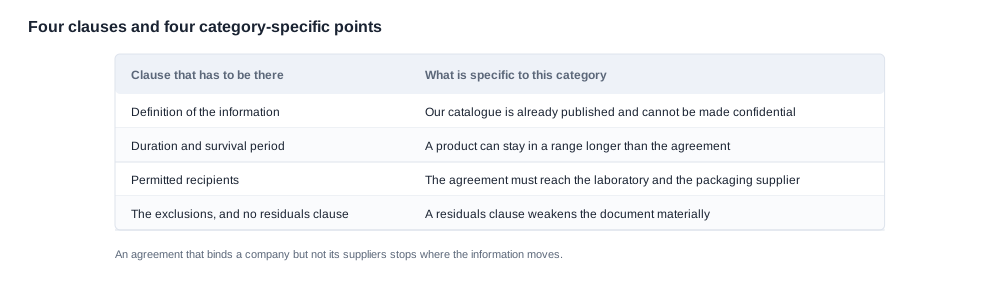
An NDA does three jobs, and a document that only does the first one is a piece of paper. It defines what is confidential, it binds the people who may see it, and it survives for long enough to be worth anything. Most agreements in this category are strong on the first, adequate on the second, and silent on the third, which is why a buyer can end up with a signed document and a product launch where the design has already appeared on a competitor's shelf.
The definition is usually the least contentious part, and it should still be written carefully. A broad definition — anything disclosed in connection with the programme, whether or not marked — is more useful than a narrow one, because a narrow definition produces arguments about whether a particular document was covered. Marked-only definitions are common and workable, provided the marking practice is agreed in advance, because the failure mode is a design file that was never marked and therefore never covered.
The binding is the clause that does the real work. Information moves in this category: a design file goes to the packaging supplier, a firmware build goes to a test laboratory, a pre-production unit goes to a third-party inspector. An agreement that binds the signing company but says nothing about the people who need to know stops exactly where the information actually moves. So the permitted-recipients clause has to name employees, subcontractors, advisers and testing laboratories, and it has to require those parties to be bound by obligations that are at least as protective as the ones the signer owes.
The survival is what almost nobody argues about and everybody should. The signature date is irrelevant. What matters is the period during which the obligations continue after the last disclosure, and it needs to be longer than the commercial relationship for the design material and longer than the product life for anything that would let somebody rebuild your product. Two to three years is the market convention for ordinary commercial information. It is not long enough for an industrial design that will be in a range for years.
And there is a fourth thing that is easy to miss and expensive to discover late: the agreement has to be signed by the legal entity that actually owns the material. A development programme can run through a trading company while the design belongs to a brand entity, and an NDA signed by the wrong entity protects nothing that matters. Check the signatory's authority and check which company is actually in the programme before the document circulates.
The negotiation dynamic is worth understanding before you send anything, because the two sides are usually asking for different things and both are reasonable. A buyer is usually protecting design, firmware, pricing and the launch plan, and is usually asking for a long survival period and a broad definition. A supplier is usually protecting the buyer's brand, the artwork and the volume commitments, and is usually asking for narrowness and a short term. Neither side is trying to write a bad agreement; they are describing the risk differently. A buyer who arrives with a marked-up template rather than an unsigned request will usually get one round of comments rather than three, and the round count is where schedule is lost in a programme.
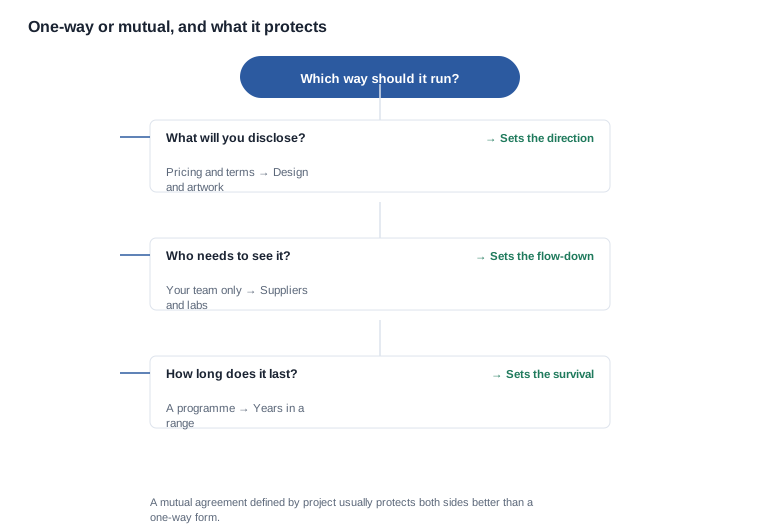
One practical thing that costs nothing and saves a week: agree the structure before you agree the words. Decide mutual or one-way, decide the term, and decide the survival period. If those three are agreed by both sides before anyone drafts, the clause-level review becomes a short exercise rather than a re-negotiation of the premise.
What is actually confidential in a smart glasses programme
The most useful exercise is to build the inventory of sensitive material before you sign anything, because it changes what you are asking for. In our category it divides into six groups, and they differ sharply in how much protection they need.
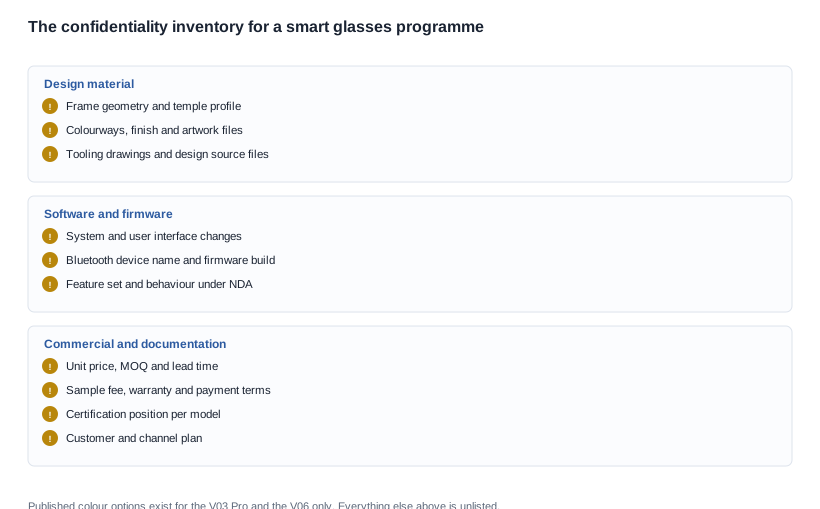
The industrial design. The frame geometry, the temple profile, the colourways, the surface finish. Our catalogue publishes the colour options for two models, three for the V03 Pro and four for the V06, which is the public part of the design story. What is not published is the geometry itself, the tooling drawings and the file that everything else is drawn from. This is the material that a buyer is actually paying to develop, and it is the material most likely to be worth protecting for years.
The firmware and the software. The system and user interface and the Bluetooth device name and firmware are published customisation points, so it is public that they can be changed. What is not public is what the change is: the feature set, the behaviour, the build. In a category where the firmware is often where the product's differentiation lives, this is frequently the most commercially sensitive item in the entire programme, and it is the one most NDAs forget because it does not look like an industrial property.
The commercial terms. Unit price, minimum order quantity, lead time, the sample fee, the warranty position, the payment terms. None of these are published on our catalogue, which is exactly why they are confidential by default — and it is exactly the information a buyer does not want circulating among a supplier's other customers, because a published price becomes an expected price.
The certification position. Which documents exist, for which models, with which scopes. This one is unusual in that it is commercially sensitive and something your own file needs, which creates an odd dynamic: you want it protected from the market and you need it given to you. Our export-certification page is a picture page carrying ten patent certificate images — eight design patents and two utility models — and our catalogue publishes no per-model certification row, so the document-level position has to come from the supplier directly rather than from a page.
The tooling and the design files. These have an ownership dimension as well as a confidentiality dimension, and the two need separate clauses. A design file can be confidential and still be yours; an NDA that only covers confidentiality leaves the ownership question open, and the ownership question is the one with a price tag on it.
The customer and channel plan. Where the units go, which retailer is stocking them, what the launch looks like. In a category with a small number of visible channels, a channel plan disclosed to a supplier can reach the competitor who buys from the same supplier, which is a risk that a pure technical NDA does not address.
Two more items that sit in the inventory without being obvious. The pre-production and inspection units are a real leakage path: a unit sent to a third-party inspector or a certification laboratory carries the design in physical form, and a physical sample is outside the reach of a paper agreement in a way a drawing is not. And the factory's own internal documentation — the build notes, the test records, the work-instruction documents for your private label — sits inside the supplier's organisation where your NDA may not reach it, which is a reason to ask how the supplier protects customer-specific documentation internally rather than assuming that signing a document with you protects it inside their building.
The inversion worth noticing: a lot of what people want to protect is already published, and a lot of what is genuinely sensitive has not been written down anywhere yet. The agreement is more useful when it is drafted against the real inventory than when it is drafted against a fear.

The clauses that decide whether can you sign an nda is worth anything
Read the document against the inventory above rather than against a general impression of fairness. These are the clauses that carry the weight in this category.
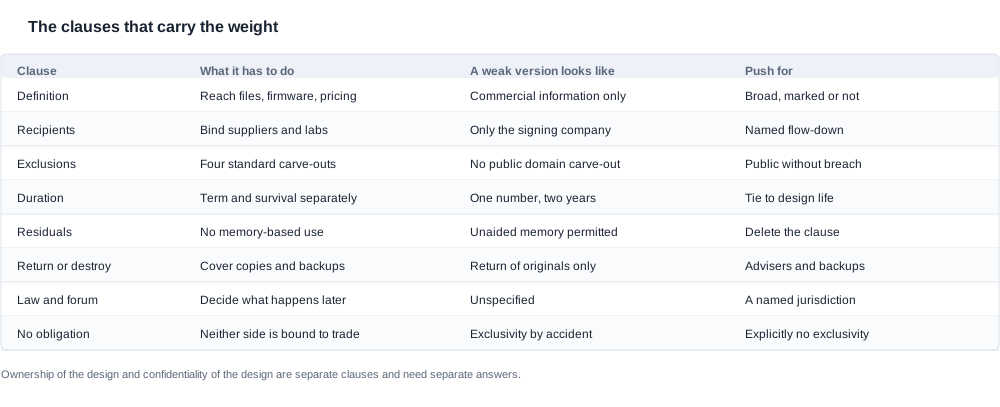
The definition. Confirm that it reaches design files, firmware builds, tool drawings, artwork files, pricing and the certification position — and not only "commercial information" in the abstract.
The permitted recipients and the flow-down. The clause has to permit disclosure to employees, subcontractors, packaging suppliers, test laboratories and professional advisers, and require those recipients to be bound. It also needs a carve-out in the other direction for the case that is real: benchmarking, or a distributor briefing, where you intend to speak to a competitor. If that is going to happen, say so in the document, because discovering it later is the expensive way to find out.
The exclusions. Information that was already known without restriction, that is independently developed, that is lawfully received from a third party, and that enters the public domain without a breach. Every agreement has these. The clause to check is the last one: public domain through no breach by the recipient, and not public domain because the supplier released it.
The duration and the survival period. Get them separately. The term governs the disclosure window; the survival period governs how long the obligations continue afterwards. For a design that will be in a range for years, the survival period should be tied to the life of the design rather than to an arbitrary number of years.
The residuals clause. If the agreement permits the recipient to use information retained in the unaided memory of its personnel, that is a meaningful weakening and it should be deleted rather than accepted. It is one of the most common clauses to find in a template and one of the easiest to remove.
Return or destruction. What happens to the design files, the firmware builds and the artwork when the programme ends, and whether the obligation reaches copies held in the systems of advisers and in backups. A clause that says "the Receiving Party shall return or destroy all Confidential Information" without addressing the automatic copies everyone actually has is a clause that gets argued about at the end.
Governing law and forum. The clause that decides what happens if the relationship turns bad. For a cross-border agreement this is worth real attention, because the cost of enforcement in a distant jurisdiction is what makes a right worth less than it appears.
No publicity and no use of the other party's name. This one is skipped constantly and it is the clause that protects the reputational part of the commercial risk. A factory that has supplied a known brand can name that brand on its own website, in its exhibition material, in a retailer's pitch, and in a press release — and in a category where the visible relationship is itself the qualification, the buyer who allowed that has given away something that cannot be got back with a clause. A mutual confidentiality of the relationship, separate from the confidentiality of the information, is the right instrument.
No obligation to transact. And, for the supplier's side, the absence of exclusivity. If the agreement contains a standstill or an exclusivity that nobody negotiated on purpose, it is in there by accident.
One thing worth checking on the buyer's own side: whether your company can actually return and destroy material when asked, and whether your own subcontractors are already bound. It is an awkward conversation to have during an exit if the answer is no.

What differs about confidentiality in this category
Four things make smart glasses different from the standard NDA template, and buyers who know them negotiate better.
Published information cannot be made confidential. Our catalogue publishes the model list, the electrical rows, the charging methods, the colour options and the customisation scope. A signed agreement cannot turn any of that back into a secret, and an attempt to do so creates a document nobody will honour. The same applies to information that is genuinely already in the public domain. This is worth saying plainly to a supplier who asks you to treat the published range as confidential: the only sensible reading of that request is that something in it is about to change — a price, a model being discontinued, a specification — and a buyer is entitled to ask which. The OEM confidentiality page sets out how we handle this in practice, and the OEM intellectual property protection page covers the ownership side of the same material.
The relationship outlasts the document. A model that stays in a range for five years, with tooling that has to be maintained and firmware that has to be fixed for years after launch, needs confidentiality that survives the agreement and the signature. Most NDAs are drafted for a transaction, and this is a programme. The survival period and the tooling ownership clause are where the real protection lives.
Design ownership and design confidentiality are different rights. An NDA does not give you ownership of a design file and does not prevent you from using it. Those need separate clauses, and the customary sequence is ownership first, confidentiality second: you need to know that the file is yours before the confidentiality of it means anything to you.
The physical sample is outside the agreement entirely. You own the unit you receive, and reverse engineering a unit you own is not something an NDA can prevent. What the agreement can cover is the source material — the design files, the firmware build, the tooling drawings — and it is worth being clear with your own team about which category of protection they are relying on, because the two are often confused.
One further point that is not specific to this category but is specific to cross-border programmes: a confidentiality agreement governs the parties' conduct, and it does not override the export control, data protection or competition rules of either jurisdiction. Where information is genuinely sensitive under another regime, the NDA is one layer rather than the whole structure.
The questions worth asking before can you sign an nda goes to a signatory
Ask these before the document circulates, not after, because the answers determine which version is worth negotiating over.
- Do you have a standard form, and who is the person who can sign it?
- Does your form cover design files, firmware builds and pricing, or only general business information?
- Does it flow down to subcontractors, packaging suppliers and testing laboratories?
- Is it mutual, and does it protect our design as well as yours?
- What is the survival period, and what is the return or destruction process?
- Does the agreement contain a residuals clause?
- Which legal entity is the signatory, and is it the entity that owns the design in this programme?
The third question catches people most often, and the reason is worth spelling out. An agreement that binds the company but not its suppliers and laboratories stops precisely at the point where the information actually moves, and in this category the information moves to a packaging supplier and a test laboratory in the first week of a programme. If the flow-down is not in the agreement, it has to be in your own contracting with those suppliers instead, which is work you can do, but only if you know it is needed.
On the fourth question: one-way in the buyer's favour is the normal arrangement in this category, and a supplier who wants the agreement to be mutual is usually doing so because it will be receiving your design and your branding, not because it wants your pricing. Mutual is the right answer when you will be sending artwork, firmware and a private label, and the cleanest solution is a mutual agreement with the confidential information defined by project rather than by direction, so both sides are protected on the material they actually hold.
The negotiation trade-offs are short and known. One-way against mutual. A two-year survival period against five. A narrow definition against a broad one with an agreed marking practice. A residuals clause in or out. For each, the criterion to apply is simple: does the clause protect the material in the inventory from the list above, and does it survive for as long as that material would still hurt you? Everything else is preference.
On the buyer's own side, four checks before the document circulates, because a good agreement that nobody can execute is worth nothing. Can your company actually sign it, or does it need to be routed to a legal entity that is not in the programme? Can your legal team execute in the time the programme allows, and if not, does the programme need to start without it? Are your own packaging suppliers and testing laboratories already bound by something equivalent? And is there a named person who will collect the design files at the end, rather than an assumption that the email address that received them will remember?
The last point is worth expanding, because it is the failure mode that shows up years later. A design file is delivered to an individual engineer over email, the programme ends, the engineer changes role, and nobody can say where the file is or whether it was ever deleted. A return and destruction clause only works if somebody is accountable for executing it, and that person should be named in the agreement rather than implied by the process.
We will sign a confidentiality agreement covering the programme, and we will put in place the internal process that keeps the information inside the people who need it, including our subcontractors and our laboratory. We will also say plainly what we cannot do: we cannot treat our published catalogue as confidential, and we will not sign an agreement that prevents either party from describing the product in a form that can be defended, because a claim neither party can publish is a claim neither party can make.
Send your form, or tell us you would prefer ours, and we will come back with what we can sign and the points we would want to discuss. The customisation options page shows exactly what a programme would contain, which is the inventory this agreement has to cover, and the OEM service scope page sets out the engagement the agreement sits inside.

Related reading
- Smart Glasses OEM confidentiality
- OEM intellectual property protection
- Customisation options
- Smart Glasses OEM service scope
Send your form or tell us whether you would prefer ours, and we will come back with what we can sign.


