

OEM ready platforms are frequently sold on the strength of a single sentence — that branding is available — and that sentence is close to useless at a purchasing desk. What a buyer needs is a list of surfaces, a list of what is decided on each one, and a list of what has to be asked before any of it can be quoted. This piece is that list, arranged by surface rather than by promise. It covers on-device branding, printed surfaces, colour as a brand asset, naming and model designations, and the documentation that has to accompany a branding request. Nothing here is a commitment on our side: the catalogue publishes product structure, not a list of customisation services, and every commercial term discussed below is something to ask for and have written into a quotation rather than something a product page should have told you.
OEM ready platforms and the branding surfaces a brand can actually claim
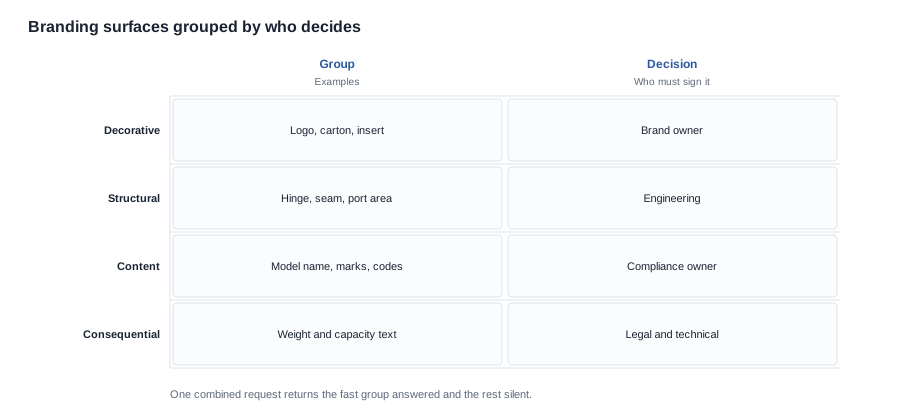
Branding surfaces fall into four groups, and the difference between them is who makes the final decision.
Decorative surfaces are the ones the buyer chooses outright: the logo on a temple, a brand mark on a charging case, a printed carton, an insert card, a sticker or a sleeve. The decision is the buyer's, and the constraint is production feasibility — process, minimum size, substrate and cost. This is where most private-label programmes live and where most of the predictable risk sits.
Structural surfaces are constrained by the hardware: the hinge of a foldable case, the seam between two parts of a frame, the area around a camera module, a port cover. The buyer chooses what to place there, but the available area, the surface angle and the tolerance are set by the mechanical design. In this range, one camera model carries a case described as foldable, which means the hinge is a structural surface with its own wear behaviour and its own transit risk.
Content surfaces are the ones that carry text: model designations, variant names, capacity statements, declarations, handling marks, serial or identification codes. These are not decorative and they are not free. Every item of content has an owner, a language set, a minimum size and a regulatory context, and text placed here without those four things becomes a compliance question rather than a brand question.
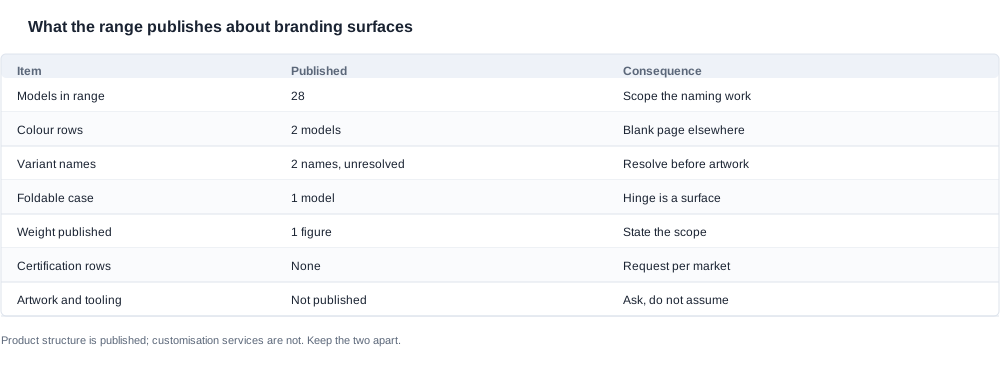
Consequential surfaces are the ones that carry a claim. If your packaging states a weight, a capacity, an endurance figure or a certification position, that text is a statement your business will be asked to defend. This range makes the point unusually clearly: exactly one weight figure is published anywhere, and it explicitly covers the eyewear body and excludes the foldable charging case. A brand that inherits that number without its scope inherits a contradiction.
The practical consequence of the four-group framing is that a branding request should be submitted as four lists rather than one. A supplier can answer the decorative list quickly, and the structural list requires engineering input, and the content list requires a compliance owner, and the consequential list requires your own legal or technical sign-off. A single combined request will come back with the fastest group answered and the other three silent.
On-device branding: temple, hinge, case and the surfaces nobody lists
The device surfaces available for a brand mark are more numerous than most suppliers volunteer, and the useful way to approach them is by asking which process fits each surface rather than by asking what can be branded.
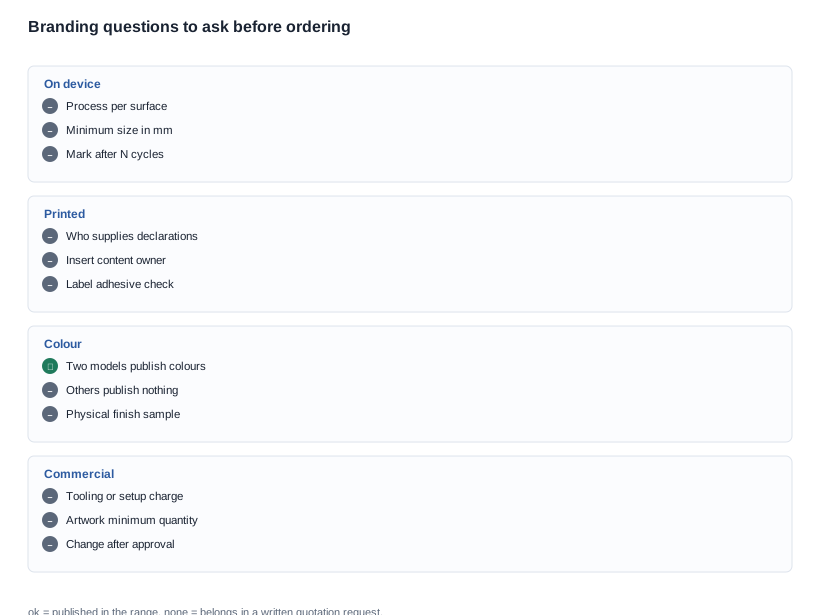
The temple is the primary surface on every model in this range, and it is the one that appears in product photography, so it carries the highest brand value. The questions that decide it are which process is used — pad printing, silk screen or laser engraving — what the minimum legible size is in millimetres, and what the surface finish does to the mark's contrast. A logo that reproduces cleanly on a matte finish can disappear on a gloss one, and the finish is a property of the model, not of your artwork.
The hinge is the interesting case. On the one model in this range whose case is described as foldable, the hinge is a visible mechanical feature that a buyer will assume is deliberately branded. If it is not, the omission is visible. If it is, the mark sits on a moving part, which changes its risk profile from a printing question to a wear question — and the acceptance criteria should include what the mark looks like after a stated number of cycles, not only how it looks on the sample.
The charging case is a second high-value surface, and it is not available on every configuration. Across the camera models, five publish a case capacity, two are described with a case whose capacity is not published, and four have no case row at all — the V03 Pro and the V06, and the V03 and the S7. Before any case branding work is scoped, establish which configuration you are actually buying, because a brand mark on a case is meaningless if the configuration you order does not include one.
The port area and the interface area are worth asking about even when the answer is that nothing can be placed there. A documented "no" is useful; an unasked question leaves a line manager free to decide.
For the audio side of the range, the geometry questions that affect decoration are set out in the weight comparison across audio models note, and the category-specific customisation surface list is in audio glasses customisation options. The broader question of what can and cannot be changed on an existing model is treated in how deep customisation goes.
Printed surfaces: carton, insert and the declarations that are not yours
Printed branding is the part of the programme that is easiest to plan and easiest to get wrong, because it carries content the factory cannot supply.
The outer carton carries the model designation, the variant, the quantity marks and, for cross-border channels, a set of market-specific declarations. Establish early who supplies the declaration content. If the answer is "the factory prints what is on the artwork you send", then your business is the declared party for everything on that carton, and the compliance review sits with you rather than with your supplier.
The insert is the layer between product and customer and is frequently left undefined. An insert that carries a serial number, a pairing instruction or a support route is a content surface with an owner; an insert that carries only a logo is decorative and much cheaper to change later.
The label on the device or the case is where identification codes usually go. The constraints here are practical rather than regulatory: minimum size, adhesive behaviour on the surface finish, and whether the label interferes with a charging interface or a hinge.
The documentation set — packaging insert, safety or handling information, and anything a destination market expects to accompany the product — is the surface with the longest lead time, because it is the one that depends on answers from outside the factory. That is the reason to request it first even though it is signed off last.
A useful discipline here is to produce a surface inventory: a list of every place a mark or a piece of content appears, with the owner, the process, the artwork version and the approval status for each. Once that inventory exists, the cost conversation becomes concrete, because a supplier is quoting against a defined scope rather than against an intention. The packaging side of the programme is covered in packaging design options, and the documentation discipline in development process documentation.

Colour as a brand asset, and what two published colour rows permit
Colour is usually discussed as a preference. In a private-label programme it is a specification, and this range makes that unusually clear because so little colour information is published.
Across the whole catalogue, exactly two camera models publish colour options. One publishes three — orange, cream white and black. The other publishes four, including two that are variations on a dark tone. The rest of the range publishes no colour row at all.
Two rules follow, and the second is the one teams get wrong.
The first is that a colour-led private-label plan has a documented starting point on two models and a blank page everywhere else. If your brand identity depends on a specific finish, establish per model whether that finish is available, producible at quantity, and stable across repeat orders — and expect the answer on the other models to require a written request rather than a catalogue lookup.
The second is that an unpublished colour row is not a statement that one colour exists. It is the absence of the information. A brand that plans a range around "all models in black because the catalogue does not list colours" has made a decision on the basis of silence, and will discover the actual default finishes during pre-production, after artwork is approved and packaging is printed.
There is a related point about contrast. A brand mark has to hold against the finish it sits on, and the finish on a model with no published colour row is the one variable in the branding specification that you currently cannot control. The way to handle that is to ask for a physical sample of the finish, place the artwork on it, and inspect it — rather than approving a mark against a screen render.
The wider customisation scope across the camera category is set out in camera glasses customisation options, and the case and accessory surfaces that often carry a brand mark are covered in charging case options.
Naming, model designations and the data-feed consequences
Naming is the branding decision with the longest tail, because it propagates into the product feed, the carton, the manual, the listing and any regulatory document, and it is the hardest thing to change later.
This range contains a live example of why. One camera model publishes two variant names and two case capacities without stating which name corresponds to which capacity, and without stating which is the base configuration. A brand that adopts that model without resolving the relationship passes the ambiguity into its own data model, and the ambiguity then behaves like a defect: the wrong configuration arrives, the margin assumption behind the price breaks, and the cause is a field that was filled in by inference.
The rules that avoid this are unglamorous. Resolve the correspondence before the artwork is finalised. Use the same designation on the carton, the feed and the documentation. Decide explicitly whether a colour variant is part of the model identity or a separate SKU, and write that decision down. Keep the model designation distinct from the marketing name, and record both in a single place.
There is one further naming trap specific to this range. A feature such as a photochromic lens may appear in a model's feature row without appearing in its model name, which means a data pipeline that derives attributes from the name will silently drop it. Attribute data has to come from the structured rows, and a brand that has an in-house catalogue should hold both the designation and the attribute as separate fields rather than assuming the name carries them.
The model-readiness question — which models in the range carry enough published structure to build a programme on — is treated in which models are ready, and the photography requirements that follow from a branding decision are in product photography.
Building a branding request your quotation can answer
A request that produces a comparable quotation has a fixed structure, and the structure is what makes responses comparable at all.
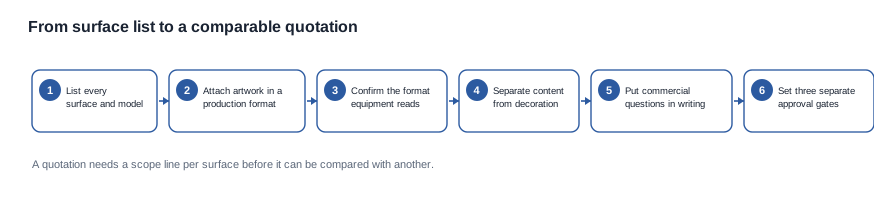
List the surfaces, one line each, with the model, the surface, the process if you know it, and the artwork version. This is the scope line, and without it a supplier is quoting against an intention.
Attach the artwork in the format you believe is required, and ask the supplier to confirm the format their equipment consumes. If they need a different format, that is a one-line change now and a production delay later.
State the content items separately from the decorative items, with an owner against each. This is what keeps a market declaration from being quietly accepted as factory-supplied.
Ask the commercial questions in writing, in advance: whether logo customisation carries a separate tooling or setup charge, what the minimum order quantity is for customised artwork, what a sample order costs, what the lead time is for artwork approval versus production, and how change requests after approval are handled and charged. None of these is published in product documentation for this range, and all of them belong in a quotation rather than in a conversation.
Set the approval sequence. Artwork approval, pre-production sample approval, and first-article inspection against the approved sample are three distinct gates, and collapsing them into one is how a brand ends up approving a mark it has never seen on the real finish.
The programme controls that keep this repeatable across orders — and the evidence that a supplier can actually hit the same standard twice — are covered in quality consistency and in sample before bulk. The commercial structure of a relationship of this kind is treated in partnering with a factory and in pricing tiers.
How to evaluate the response before you commit
The request goes out and the answers come back. The next step is where programmes are usually lost, because a response is easy to read as complete when it is not, and because the criteria for judging a branding answer are rarely written down before it arrives.
Set the evaluation criteria before the answers land, so that you are applying them rather than constructing them. Four criteria do most of the work: specificity — is the answer measurable, or is it a description of intent; verifiability — could somebody check it against a sample or a document; coverage — does it address the surface you asked about, or a nearby one; and consistency — does it contradict anything on the product page you are working from.
The fourth criterion is the one that produces the most useful information. A supplier who answers a question about a foldable case with a durability adjective has not answered it. A supplier who states that the hinge is a moulded mechanical part with no decoration surface has answered it, and that answer lets you move the mark to a different surface and re-scope the quotation in an afternoon rather than a month.
Coverage is where partial answers hide. Check the response against your surface list line by line rather than against its overall tone, and mark each line with one of three states — answered, partially answered, unanswered. A response with twelve lines, eight answered and four partially answered is not an eighty-percent-complete response; it is an eight-unit response with four risks attached, and the four risks are what should appear in your commercial model.
Verifiability is where private-label programmes quietly degrade. An answer about minimum reproduction size that gives a range rather than a figure cannot be checked against a sample, and it will resolve itself at the pre-production stage with the artwork already approved. Convert ranges into figures as a condition of acceptance, and record who confirmed them.
Then apply the test that matters most commercially: does the response let you compare this programme against another one? If a quotation cannot be compared line by line with a competitor's — because one includes artwork setup in the unit price and the other lists it separately — the comparison you are making at the purchasing desk is meaningless regardless of the headline numbers. Ask for the quotation structure itself: what is per unit, what is one-off, what is excluded, and what changes at which volume. Those four answers are what turn a branding conversation into something you can negotiate.
Two final criteria sit outside the response and are worth checking anyway. Confirm that the artwork version referenced in the response is the version you sent, and confirm the date on the response — a branding answer that predates your artwork upload may describe a different product configuration entirely.
The sequencing that follows is straightforward: evaluate against criteria, convert ranges to figures, mark the uncovered lines as risks, and only then take the response into a commercial negotiation. Doing it in the other order — negotiating first, discovering the gaps when the first article approval does not go through — is the pattern that turns a modest programme into an expensive one.
The honest summary is that this catalogue publishes product structure and nothing about customisation services. That is normal, and it is not an obstacle — it means the branding conversation starts from a defined scope that you build, rather than from a list of promises you have to discount. What you should not do is treat the absence of a branding page as an absence of capability, or treat a general statement that branding is available as a specification.
Related reading
- Customisation scope — OEM ready platforms customization depth
- Packaging scope — packaging design options
- Programme controls — OEM ready platforms quality consistency
- Model readiness — OEM ready platforms which models are ready
Send us the models you are considering, the surfaces your mark has to appear on and the markets you ship to, and we will tell you which parts of a branding request can be scoped from published product structure and which parts have to be quoted separately.


