

The box is where a product's claims become binding. The temple can be beautiful and the firmware can be quick, and none of that protects a buyer from a manual that states a water resistance the product does not have, a battery runtime with no test condition behind it, or a charging case in the photograph that is not in the carton. That is why the customization options for manuals, inserts and box content deserve to be treated as a controlled document set with a version, an owner and a proof cycle, rather than as the packaging department's problem.
Our published position shapes this more than most buyers expect. The catalogue carries no translation row for any model, so a multi-language programme is a print and proof programme rather than a stock feature. It carries no per-model certification row, and the catalogue body names CE, FCC, RoHS, RED and EN 18031 not at all — the export certification page is a picture page carrying ten patent certificate images, eight design patents and two utility models. And it carries a long list of product rows that a manual is expected to quote: charging by magnetic or Type-C, charge time, case presence and capacity, camera resolution, an ingress rating on two models, a frame weight on one, and a Bluetooth version published for fourteen of the twenty-eight entries.
Every one of those rows is a sentence in a manual, and every absent row is a sentence a manual must not contain.
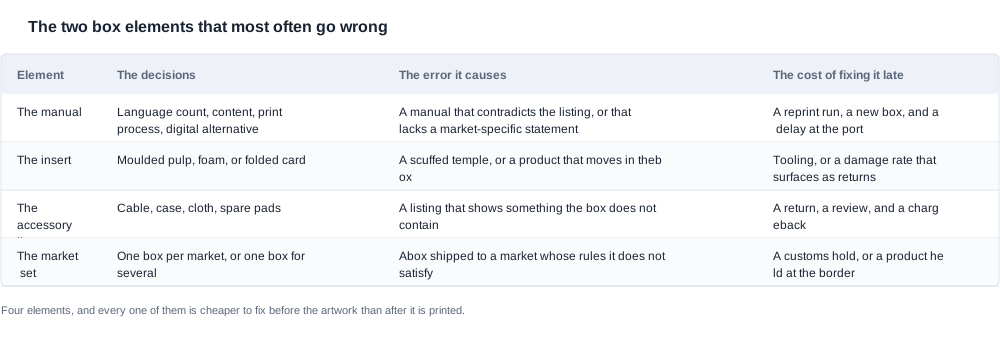
Customization options for the printed set: the document you sign for
A printed set for this category typically contains more pieces than buyers expect, and each one has a different owner and a different failure mode.
The user manual. The longest document in the box and the one with the most claim risk. It contains setup steps, operating instructions, charging guidance, pairing instructions, care instructions, a warranty statement, and — for a product with a radio — market-specific statements whose wording depends on the jurisdiction.
The quick-start card. One page, or two, with pairing and charging in pictures. It is the document that most reduces support calls, and the document most often printed last.
The warranty card or policy sheet. It carries the term, the exclusions, the claim route and the jurisdiction. It is a legal document wearing a printed shirt, and it changes more often than any other piece in the set.
The insert. The physical element that holds the product. It is discussed separately below, because it is a part with tooling rather than a document with a print run.
The label. The regulatory and identification label on the product or the carton. It is where the model designation, the electrical ratings, the origin and the importer information live, and it is the piece with the highest consequence for a customs problem.
The conformity and documentation leaflet. Where a market requires the conformity information to travel with the product rather than to sit on a website, this is the leaflet that carries it. What your market actually requires is a question for your compliance adviser, and the answer is not in our catalogue.
The reason to treat these as one set is that they are versioned together. A change to the hardware changes the manual, the quick-start card, the label and the leaflet — and a set where one piece is updated and another is not produces a box that contradicts itself on the shelf.
That gives a simple rule for the approval cycle, which is the subject of its own section below: the set carries a single version, and the version changes as one.

Customization options and what the catalogue does and does not let a manual say
This is the part of the manual programme that most often goes wrong, because it is written by people who are thinking about the product rather than about the published record.
The catalogue rows a manual can quote, exactly as published:
- Charging method. Magnetic on seventeen models, Type-C on seven. Four models publish neither: the MT6 and the CY05, and the CY03 and the L1 Pro. A manual that says "charge with the included USB-C cable" is wrong for those four, and wrong in a way that produces a support call in the first week.
- Charge time. "2 hours or less" is the published figure for twenty-six models, while the D17 and the ZH12 are the two that publish approximately one hour. A manual can state the published figure for its own model and should not generalise it to the range.
- Case presence and capacity. Capacity is published for five models: the MT6's 1200 mAh foldable case, the L2 Utral at 900 or 1400 mAh, and 1400 mAh on the CY05 and the CY03, and the L1 Pro. A case is listed for the KY06 and the MT5, but no capacity is published for either. Not one of the V06 and the S7, and the V03 has a case row, and the V03 Pro is published as having no case at all. That is a long list of ways to put a case in a photograph that will not be in the box.
- Camera resolution. 8 MP on eight models, 13 MP on the L2 Utral and the S7, and the L1 Pro.
- Ingress rating. IP54, published for the V06 and the S7 only. No other model in the range carries an ingress rating, so a manual that describes a product as splash resistant has made a claim the catalogue does not support for that model.
- Weight. 158 g for the MT6, published as the glasses alone and explicitly excluding its 1200 mAh foldable case. No other model publishes a weight, so a specification sheet with a weight on it has to carry the model and the exclusion.
- Bluetooth version. Published for fourteen of the twenty-eight entries, and not published for the eleven camera models, for the A05, for the A06 and for the bone conduction entry.
And the rows a manual must not contain, because they are not published anywhere:
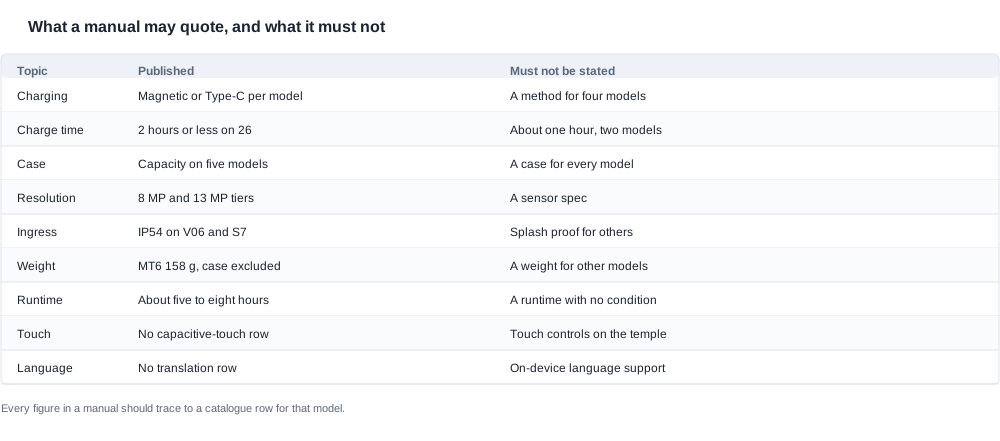
Battery runtime is the sharpest of these. The catalogue publishes camera batteries in the 220–290 mAh band with a rated runtime of roughly five to eight hours, and it publishes no test condition for that figure. A manual that converts "about five to eight hours" into "up to 8 hours of playback" has created a claim that no document in the catalogue supports and that a customer can test in an afternoon.
The same applies to capacitive touch. The catalogue has no capacitive-touch row for any model, so a manual, a quick-start card or a packaging panel that says "touch the temple to control" describes a feature that is not published for that product.
And the same applies to translation. With no translation row anywhere in the catalogue, no model can be described as supporting multiple languages on-device. Multi-language support in this range means multi-language printed material, which is a print programme with its own proof cycle.
The practical conclusion is worth stating plainly: a manual is the place where the gap between what is published and what is claimed becomes a legal exposure rather than a technical one. Every figure in the document should be traceable to a catalogue row for that model, and every figure that is not should either be qualified with its test condition or left out.

Customization options for market sets and language versions
One box for several markets is the cheapest structure and the riskiest. The compromise most brands settle on is a printed box per market with a common product configuration underneath, which keeps the tooling and the configurations shared while letting the marks, the documents and the operator details change.
The decision has three parts.
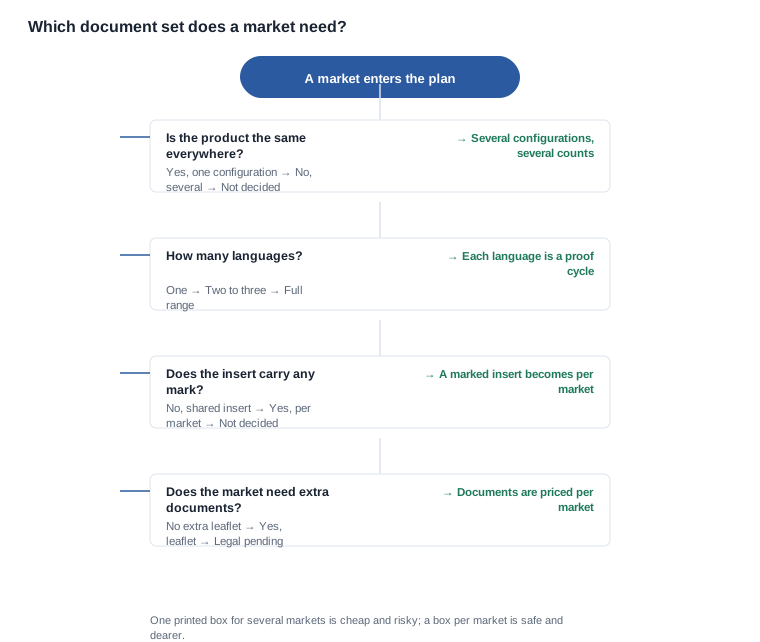
The product side, which is shared. The model, the colour, the case, the accessories and the configuration are the same in every market. Where they are not, you are running several configurations rather than several markets, and the customization options checklist asks you to count them that way.
The document side, which varies. The manual, the label, the leaflet and the warranty statement vary by market, and the variation is driven by what each market requires rather than by what is convenient to print.
The language side, which multiplies. Each additional language is a separate block of layout, a separate proofing cycle and, for a printed manual, a separate set of pages. The cost of a language is not the translation, it is the layout and the proof. This is why the printed set is a print-run decision rather than a writing decision, and why the number of languages belongs in the commercial discussion next to the packaging minimum rather than in the marketing discussion.
Two practical points about the export documentation, which is the part of this work most often deferred. The OEM-ready platform export documentation article covers what a market set usually has to contain and how the document ownership is usually structured. The certification impact article covers the consequence of a requirement changing what the product is — because a document that described the old configuration is now wrong, and every market set carrying it has to be reissued.
A third point belongs in the same place, because it is the one that gets discovered late: the operator and importer details on a label change when your structure changes, not only when your product changes. A brand that appoints a distributor in a new country, or moves from direct sales to a marketplace, has changed the legal operator on the label. That is a new print file, a new proof and a new run, and it arrives with the same cost as any other artwork change. Where the label carries those details, they should be written as a variable in the artwork rather than as fixed text, because they are the field most likely to move.
The rule that saves the most money: a change to the product invalidates the document set. Decide early whether a requirement is a marketing statement or a product change, because the two have very different document consequences and only one of them needs a reprint.
The same rule applies to the accessory list, and it is worth saying separately because the accessory list is part of the document set whether it is printed or not. It appears in the quick-start card, on the box, in the packing list, in the listing, and in the channel partner's stock system. A case added to the box in month two is five documents and one more physical item, and the first four are the expensive part.

Customization options and the insert: protection, tooling and appearance
The insert is the one element in the box that is a moulded part rather than a printed one, and that changes its commercial character completely.
Material choices. A folded card tray is the cheapest and the least protective, and it is only defensible for a product with nothing fragile. A moulded fibre tray protects well, ships well and does not shed into the product. A foam tray protects well and is increasingly awkward under waste and shipping rules in some markets. The choice is a question about your distribution rather than about your factory.
Tooling. A moulded insert needs a tool, with a one-off cost and a lead time, and it needs to be right: an insert designed for a model that has since changed its temple profile will not locate the product properly. That is an argument for freezing the product before the insert tool is cut, not after.
The second job. The insert positions the product in the box, and the box is what the customer photographs, what the reviewer photographs, and what the listing image is made from. An insert that leaves the device sitting at an angle produces listing images that look accidental, and listing images are the first marketing asset the programme produces.
The market question. Inserts are usually shared across markets because they carry no marks. The exception is a market where the insert has to carry a statement or a warning, which turns a shared part into a per-market part and adds a minimum per market.
The accessory list is the element most often out of step with the product. The cable, the case, the cleaning cloth, the spare pads and the charging adapter are a line in the bill of materials and a line in the listing, and those two lines have to agree exactly. A listing that shows a case the box does not contain produces a return and a review, and the review is the expensive part — because it is visible to every other buyer of the product.
The catalogue gives you a good way to check this. Case presence and capacity are published per model, with capacity for five models, a case without a published capacity for the KY06 and the MT5, no case row for the S7 and the V06, and the V03, and an explicit no-case statement for the V03 Pro. A box-content list built from those rows will be right in a way a box-content list built from assumption will not.
Customization options and the approval cycle that governs the box
The printed set has an approval cycle, and the cycle belongs to the buyer. It is the part of a launch that a factory cannot compress and that a buyer routinely forgets to plan.

The cycle, in order:
- Content freeze. The claims, the figures, the model names and the market scope are settled. Everything downstream is layout.
- Draft, in the working language. Written against the published rows for that model, with every figure traceable and every non-published figure either qualified or removed.
- Legal and compliance review. This is where the warranty wording, the market statements and the claim language are settled. It is the longest stage in the cycle and the one most often left until after the artwork has been laid out.
- Translation. Only after the source text is final, because a translation started against a moving source is a translation that has to be redone.
- Layout and proof. Per language, with the proof checked against the physical product rather than against a rendering.
- Print file release. With a version number and a release date, so that the carton artwork, the manual and the label all refer to the same version.
- Print and delivery. With the print minimum, the run length and the arrival date confirmed.
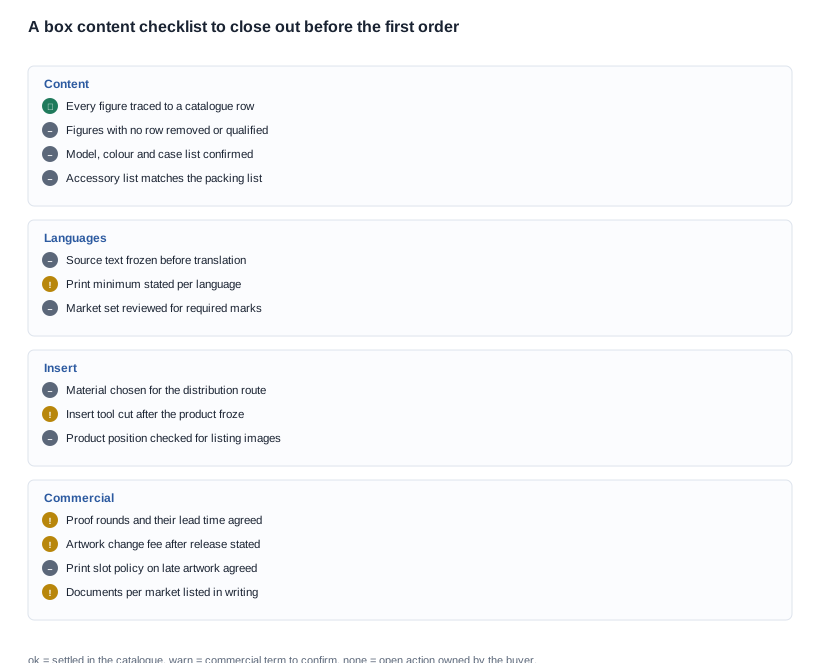
The questions to send the supplier and the printer:
- Which documents are supplied by the factory, and which are supplied by us?
- What is the file format and the template for the manual, the quick-start card and the label?
- What is the print minimum per language, and per market version of the carton?
- How many proofs are included, and how long does each take?
- What is the artwork change fee after the print file is released?
- What is the lead time for printing, and what is the lead time for delivery to us?
- What is the insert material, and is the insert tool owned by us or by you?
- Which accessories are included in the box for each model, and how is that list confirmed against the packing list?
- What happens to the print slot if the artwork is late — does the slot move or does the cost move?
- Which documents ship with the product in each market, and which are provided separately?
Questions 3 and 9 are the ones that decide the schedule. A print minimum per language means that adding a market can mean adding a whole print run, and a printer who holds a slot for you and charges for the delay is a different commercial position from a printer who releases the slot and charges for a new one.
Two red flags. The first is a manual supplied by the factory and reused without being checked against the model's published rows — it will describe a generic product, and it will be wrong about charging, about the case and about the pairing for some models. The second is a carton printed in one language for several markets where the labels or the leaflet have to differ by jurisdiction.
A third is worth naming because it is the most common failure in a first programme: a manual that is correct and a box that is wrong. The document set can be accurate while the physical contents are not, because the two are often assembled from different sources — the manual from the factory's document library, the contents list from a product page written earlier in the year. The only reliable check is to take the packing list for the actual configuration and check the box against it, which takes an hour and prevents the most common packaging complaint there is.
The pitfalls: writing the manual before the product specification is frozen, translating before the source text is final, letting the box artwork be released while the manual is still in legal review, and building a listing from a photograph of a prototype box rather than from the packing list.
Our published position is narrow and deliberate. The catalogue publishes the product rows a manual can quote, and it does not publish claims, translations, certifications, test conditions or market statements. We will supply the factory-side documents and the templates for the ones we own, we will tell you which figures in the draft have no published row behind them, and we will not write a claim for a model on the strength of a figure published for a different one.
Related reading


