

The CY03 smart glasses configuration earns its place in one specific channel shape: a first-person video business that sells the charging case in the box and accepts an 8 MP still camera as its image source. It does not earn a place for a buyer whose listing leads on resolution, for a channel that ships the product without an accessory, or for anyone who needs a published frame weight before the order is placed. The catalogue publishes five rows for the CY03 — an 8 MP camera, a 290 mAh frame cell, a charge time of two hours or less, about seven hours of rated endurance, and a 1400 mAh charging case. It does not publish the charging method for this model, nor the sensor, the field of view, the frame weight, or the certification scope. Nothing below recommends the CY03 over another model. It sets out the filters a procurement team runs before this configuration is shortlisted at all, and the questions that have to be closed afterwards.
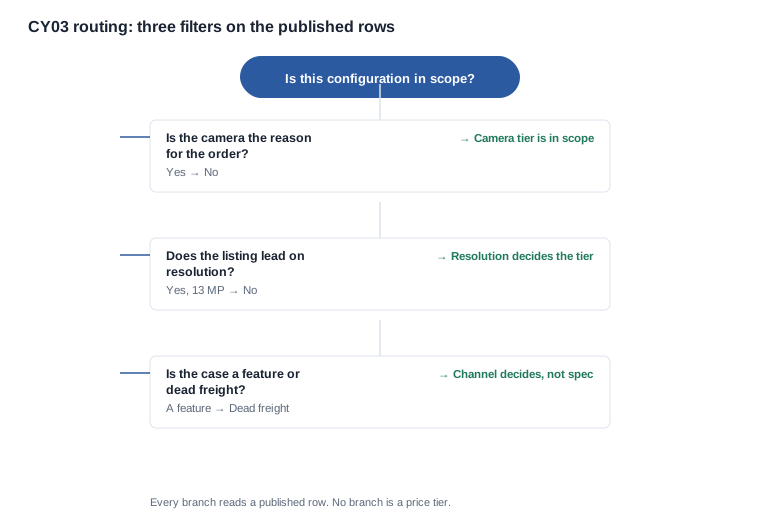
CY03 routing: three filters that decide whether this configuration is in scope
Most procurement conversations about this model start with a photograph of the product and end with a question about the case. That order is backwards, and it is where a lot of sourcing time is wasted. Start with the customer the listing is written for, and the routing becomes much shorter. The three filters below are the criteria a procurement team should apply when deciding which configuration to shortlist at all — the trade-offs between them are usually decided before any quotation is requested.
The first filter is whether the camera is the reason for the order at all. If the customer is buying a first-person video product, the 8 MP tier is in scope and the CY03 is a legitimate candidate. If the product is really an audio wearable that happens to carry a camera, the buying criteria are entirely different — battery-to-frame ratio, Bluetooth version, the presence of a microphone and an audio profile are the rows that decide the order, and the CY03 publishes none of them. This is a category question, and it is cheaper to answer it on a phone call than in a purchase order.
The second filter is whether the listing leads on resolution. The catalogue carries an eleven-model camera range at two published pixel tiers. Eight models sit at 8 MP: the MT6 and the CY05, the MT5 and the V06, the KY06 and the V03, and the V03 Pro and the CY03. Three sit at 13 MP: the L2 Utral and the L1 Pro, and the S7. If the channel compares pixel counts on the product page, an 8 MP configuration loses that comparison on paper regardless of what the rest of the sheet says. There is no published argument that moves a 13 MP buyer to an 8 MP row — the pixel figure is the one number a competitor can match at a glance. The question at this filter is not "which is better" but "is the pixel count the argument, or is the case the argument".
The third filter is what the case does to the channel. A 1400 mAh charging case is a visible feature in a product photograph and an invisible line in a freight model. For a consumer retail proposition sold direct to end customers, the case is the reason the customer believes the product lasts through a working day. For a channel that ships into a job site, a corporate fit-out, or a uniform programme, the same case is dead freight that inflates the parcel, adds a second lithium cell to the transport file, and takes up warehouse volume per unit that earns nothing. These two channels want different products, and the published rows let you tell them apart before anyone signs anything.
If the answer to the third filter is "the case is a feature", the CY03 configuration is in scope and the rest of this article is the interrogation of that case. If the answer is "the case is freight", the camera range has cheaper-to-move configurations, and the honest next step is to price the two against each other rather than to argue about the picture.

What the CY03's five published rows commit a brand to
The catalogue page for the CY03 lists five specification rows and nothing else. That is unusual density for a consumer electronics product, and it is genuinely useful, because every published number is a fact a brand can put on a product page and a distributor can put in a tender response. It also makes the comparison work unusually clean: how to compare this configuration against another model comes down to a small number of published rows, and the rows that are missing are the rows you have to ask for.
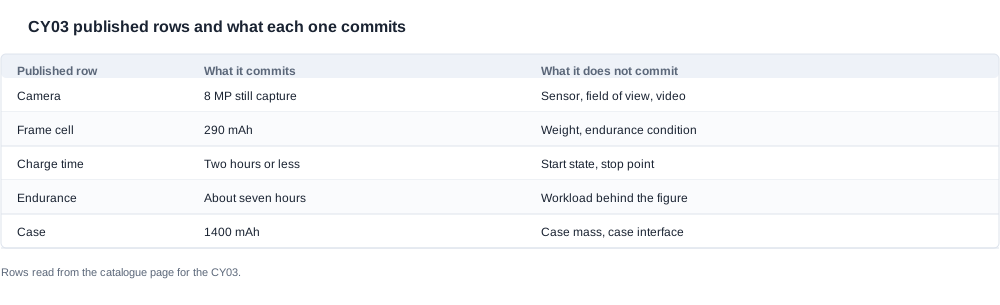
The camera row reads 8 MP. That is a resolution class, not an image quality statement, and the difference matters more in this category than in most. A sensor with small pixels can produce a weaker image than a lower-resolution sensor with larger ones, particularly in the indoor light where first-person content is usually recorded. The catalogue publishes no sensor model, no field of view, no video resolution, no frame rate, no aperture, no stabilisation and no low-light behaviour for this model. Eight megapixels tells a buyer that the capture is at the entry class of this range. It does not tell them what the picture looks like, and it cannot be used to support a quality claim on a listing.
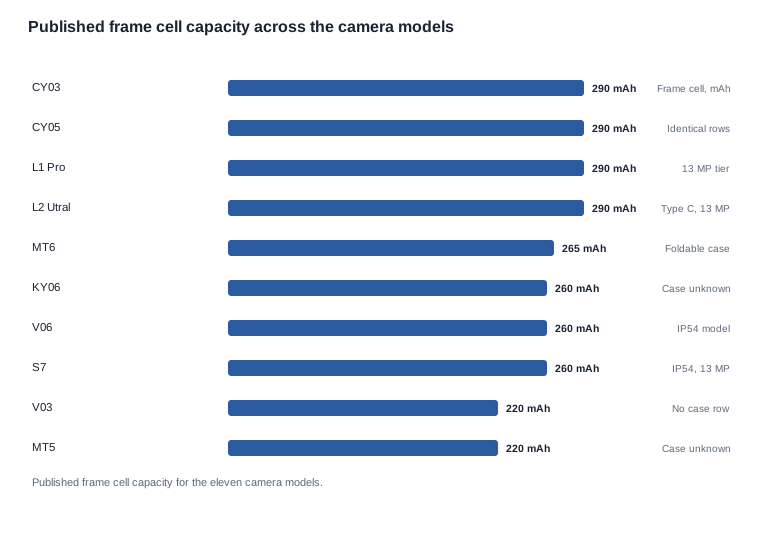
The frame cell row reads 290 mAh. That is the largest frame cell published anywhere in the camera range. The V03 and the V03 Pro carry 220 mAh, the MT5 carries 220 mAh, the S7 and the KY06, and the V06 carry 260 mAh, and the MT6 carries 265 mAh. A 290 mAh cell is not a unique specification, because the L2 Utral and the CY05, and the L1 Pro all publish the same figure, but it is the top of the ladder and it is the number that lets a buyer argue "highest published frame capacity in the camera category" without overreaching.
The charge time row reads two hours or less. This is a ceiling, not a typical figure, and it is a specific kind of ceiling: the catalogue does not state the state of charge at the start of the measurement, and it does not state the point at which charging is considered complete. "Two hours or less" permits exactly two hours. It is a statement about the longest credible charge, and a buyer who converts it into "under two hours" in a listing has tightened a published bound into a claim the source does not support. For a product whose proposition is a weekly top-up courtesy of the case, the missing start state is a minor issue. For a product whose proposition is a nightly charge on a bench, it is the whole question.
The endurance row reads about seven hours. A point figure with no attached test condition. On a camera product the camera is the largest load in the system, so the difference between a rating taken with the camera running and a rating taken with the camera idle is the difference between a full working day and half of one. The catalogue does not say which applies. The published figure is also shared with the L1 Pro and the CY05, and the L2 Utral and the MT6, which means it does not separate this model from its own platform — it only positions the platform.
The case row reads 1400 mAh. That is the largest case capacity published in the range, shared with the CY05 and the L1 Pro, and published alongside a 900 mAh option on the L2 Utral. The MT6 publishes a 1200 mAh foldable case. The KY06 and the MT5 both carry a case whose capacity the catalogue does not publish, and the S7 and the V03, and the V06 have no case row at all. The V03 Pro is published explicitly without one. That last distinction matters more than it appears: "the catalogue does not list a case" and "the catalogue states there is no case" are different statements, and a buyer who treats them as the same will draw the wrong conclusion about whether a case can be specified later.
One row is missing, and its absence is more consequential than any of the five that are present. The catalogue publishes no charging method row for the CY03. The same is true for the CY05 and the L1 Pro, and the MT6. By contrast, seventeen models in the range are published as magnetic and seven as Type C, including the V03 Pro, the L2 Utral, the D11, the D12, the D17, the ZH12 and the bone-conduction model. So the interface question is not an unusual one — it is a row that the catalogue publishes for almost everything except these four, and for these four it simply does not appear. Any statement about how the CY03 frame charges, in either direction, has to come from a supplier in writing.
The CY03 charging case as a channel decision, not a battery
The case is where this configuration earns or loses its commercial argument, so it is worth being precise about what it does.
It is not a second battery in the technical sense that would extend the frame's own endurance claim. The frame cell is 290 mAh and the case is 1400 mAh, which is more than four times the frame capacity. That ratio is what makes the retail story work: a customer puts the frame into the case at the end of a working day and collects it charged, without carrying a cable. The arithmetic supports the story. The arithmetic does not extend the published seven-hour rating, and no listing should imply that it does.
It is a second lithium cell in the logistics sense, and that is where it costs money. Two cells travel in every unit, which means:
- The packed unit weight changes. The case mass, the case dimensions and the resulting packed unit weight are all unpublished. These are the numbers that decide a freight class, and they are absent from the catalogue.
- The transport documentation covers more than the frame. A lithium cell inside an accessory is a regulated item in its own right. The battery file and the packing instruction have to cover both cells, and the declared watt-hour rating follows the larger one.
- The warehouse footprint grows. Case volume per unit is space that earns no revenue, and it matters most for the channels with the highest stock-turn expectations.
- The packaging design cannot be finalised early. The carton, the insert and the printed material all have to absorb an accessory whose dimensions nobody has published.
For a brand that prices the product before it has measured the parcel, this is the single largest uncontrolled variable in the model. For a brand that prices it after a sample arrives, it is a line item with a known value. The distinction between those two situations is not the product — it is the order of operations, and it is the difference between a total cost model and a guess.
The second-order effect is on the customer routine, and this is a merchandising question rather than a technical one. A case gives the customer a weekly charging rhythm; a pad or a cable gives a nightly one. The product page can only claim "through a working day" if the case genuinely is in the box, with the case genuinely capable of delivering it. That claim is therefore a packing instruction as much as a marketing line, and it should be checked against the actual carton.
CY03 questions the catalogue cannot answer, and the order to ask them
The catalogue is a product sheet, not a compliance file, and the gap between those two things is where a first order is usually lost. The questions below are not a complaint about the catalogue. They are what to ask a supplier, and the order in which the questions to ask are put saves weeks. For a buyer with no prior relationship with a factory, the due diligence sequence matters as much as the answers themselves.
Ask the identity question first, before any measurement. The CY03 and the CY05 publish the same five rows in the same catalogue, and the catalogue does not state what separates them. It may be a colourway, a temple, a firmware revision, an enclosure change, or nothing at all. A purchase order that names one model and a consignment that contains the other is a dispute that one email resolves and that a shipment dispute does not. Get the answer in writing, in the same message as the price and the lead time, and record it against the order.
Then ask the camera question, once for the platform. Sensor model, field of view, video resolution and frame rate. If the answer is the same across the 290 mAh platform, ask for it as a platform statement, because a per-model answer invites four times the negotiation for the same document.
Then the endurance question. Ask whether the camera was running during the seven-hour measurement, and what the discharge endpoint was. Record the answer verbatim, because the difference between the answer and your summary of it is usually where the dispute lands.
Then the physical questions. Frame weight, frame dimensions, case mass, case dimensions, packed unit weight. None of these are published for this model, and the only published weight anywhere in the catalogue is the MT6 at 158 g, which is the eyewear body including its cell and camera and excluding the foldable case — so it is not a proxy for this model in either direction. A sample measurement fills this gap faster than any amount of correspondence.
Then the interface question. The charging method, the connector on the frame, the case's input port, and how the case indicates its state. These determine the cable that goes in the box, the instructions that go in the box, and the certification scope of the accessory.
Then the compliance question. The catalogue carries a company-level export certification page whose content is images rather than text, and the catalogue text carries no reference to CE, FCC or RoHS. There is no per-model certification row anywhere in it. So the model-level certificate number, the issuing body, the validity period and the covered model schedule are all things to request in writing. Buyers routinely ask about CE, FCC and RoHS, and the accurate answer is that our published sheet does not carry that information for this model — which is a reason to request the file, not a reason to assume it exists.
And then the commercial question. Minimum order quantity, lead time, production capacity, the quotation basis, the payment terms and the warranty terms. None of these are published, and all of them belong in the quotation rather than in a product discussion.
CY03 qualification sequence before the first order
The sequence below is deliberately ordered by cost of delay. Each step has a completion condition that can be checked, and each one is cheap relative to the step that follows it. Read it as a checklist to close before you order, not as a formality: the common pitfalls in this category all come from skipping a step that looked expensive in time and cheap in money.
- Confirm the channel shape. Write down who buys the product, what they compare it against, and whether the case is part of the proposition. Completion condition: a one-paragraph channel definition that the sample request and the quotation both reference.
- Request the sample and the written answers together. One message, one model named, one list of rows. Completion condition: answers that name the CY03 specifically, not the platform in general terms.
- Measure the physical rows. Frame weight, case mass, packed unit weight, on at least three units. Completion condition: a recorded mean and a recorded spread, because the spread is the acceptance criterion you will actually use.
- Run the endurance test under your own workload. One fixed workload, one declared start state, one declared end point. Completion condition: a measured figure that you would be willing to put on a product page.
- Compare camera output across units from the same batch. You cannot test against a specification, because no sensor specification is published. You can test consistency. Completion condition: a judgement on whether unit-to-unit variation is acceptable for your channel.
- Price the delivered cost with the measured weight. Only now does the freight class have a number attached. Completion condition: a delivered cost per unit that includes the case, the second cell's documentation, and the packaging.
- Close the commercial terms in writing. Minimum order quantity, lead time, payment nodes, warranty, defect remedy, and the certification scope. Completion condition: terms in the quotation or the agreement, not in an email summary.
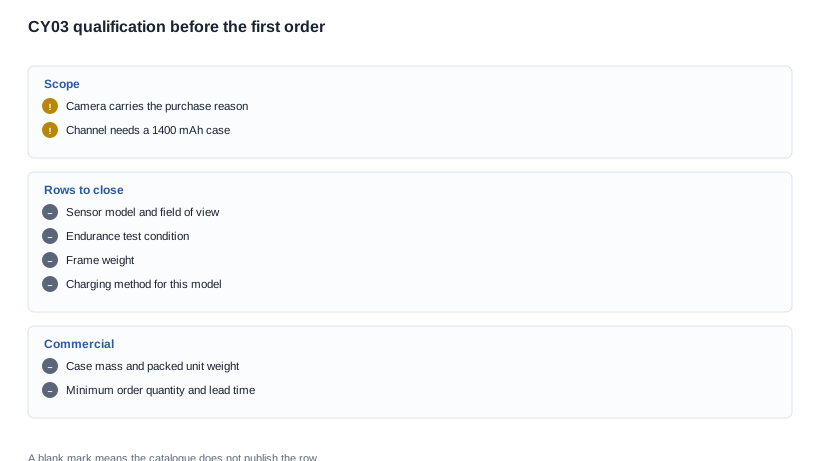
The CY03 boundary: what we will confirm and what we will not
On this model, our position is that its case is the strongest commercial feature in the camera range and its heaviest parcel, and that the two facts come from the same cell. We will publish the 1400 mAh case capacity and the 290 mAh frame capacity because both are documented, and we will publish the 8 MP figure as a resolution class rather than as an image quality claim. We will not present the roughly seven hours as a working day, because the test condition is not published and the camera load is the whole question. We will not describe the charging method for this model, because the catalogue carries no such row for it, and we would rather tell you that than fill the gap with the interface used by neighbouring models. We will not quote a frame weight, a case weight, a sensor, a certificate number or a minimum order quantity that our documentation does not contain.
If your channel is the one this configuration actually serves, tell us the segment, the volume, the destination market and whether the case is part of the proposition, and we will tell you what the published configuration supports and what has to be closed first. If it is not, the three filters above will have told you that before you spent a week on it — and that is a better outcome than a purchase order that has to be unwound.
Related reading
- The platform this model shares — CY05 smart glasses specifications
- Packaging decisions that follow from the case — AI camera glasses packaging options
- Checking a sample when it arrives — smart glasses sample policy
Tell us the segment you sell into, the volume and whether the case is part of your proposition, and we will confirm what is available in the CY03 configuration.


