

The single most consequential sentence in this article is that the conformity work for a private-label product belongs to the brand, not to the factory. A factory can supply a product that is compliant, and a factory's compliance does not transfer to a product sold under your name, on your listing, into your market, under your economic operator details. That is not a legal opinion; it is the structure of how conformity assessment works in every market we ship into. This article sets out what the CY03 documentation actually holds, what a private-label seller has to complete in their own name, and the order in which the two should happen. Nothing here is a certification claim. Our catalogue carries no per-model certification row for this model, and we will not present anything else as one.

Who owns the conformity work on a CY03 private label
There are two bodies of work in a private-label launch, and they belong to different parties. Confusing them is the most expensive mistake in this category, because the factory's part is quick, cheap and largely invisible, while the seller's part is slow, expensive and entirely public.
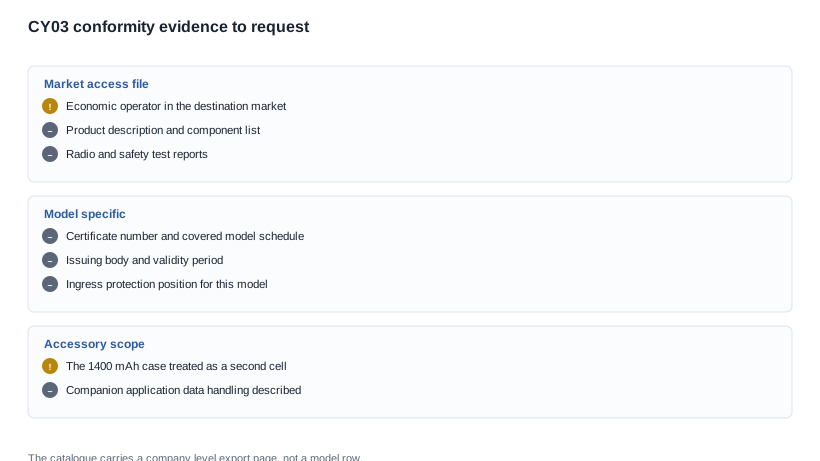
The factory's part is producing hardware that can be assessed. That means a defined configuration — a specific radio module, a specific cell, a specific enclosure, a specific firmware baseline — that a test house can evaluate and a technical file can describe. It also means supplying the underlying evidence: test reports for the radio and safety claims, a component and module list, the product description, the battery documentation for both cells that ship in this configuration, and the marking artwork. We can supply that, and the certification checklist sets out the scope of the request.
The seller's part is everything that attaches to the person placing the product on the market. In the European Union, the general product safety regulation (EU) 2023/988 has applied since 13 December 2024, and its requirements attach to the economic operator responsible for the product rather than to the hardware. That operator has to be established in the European Union, and their name and contact details have to appear on the product labelling, on the accompanying documents and on the online listing. A factory in another country cannot be that operator for a European launch. The listing change is regularly the longest lead item in a European launch programme, and it is invisible in the factory's quotation because it is not the factory's work.
There is a practical way to hold the two apart. If a task can be answered by pointing at a test report or a component list, it belongs to the factory's evidence pack. If a task can only be answered by naming a company, an address or a person, it belongs to the seller and it has to be resourced separately. Most of the delay in a private-label launch comes from tasks in the second category being scheduled as if they were in the first.
The third category is the one that catches people out most often, because it is neither party's list: what it takes for the product to be lawfully placed on a particular market under a particular economic operator with particular labelling and particular instructions. That layer is a property of the seller, the packaging, the listing and the paperwork, and it is the layer that determines whether the goods can be sold at all.
Three meanings of certified and what our catalogue holds for the CY03
Buyers use the word "certified" for three different things, and the disappointment in this category almost always comes from buying the first and needing the third.
The first meaning is that the product complies with the applicable rules. This is a technical position about the hardware, and it is what most suppliers mean when they use the word. It is the least useful of the three to a buyer assembling a market access file, because it is stated in general terms and carries no document.
The second meaning is that a conformity assessment has been carried out and documented for this exact model and configuration. This is what a file needs, and it is model-specific. A report covering one model's configuration does not extend automatically to a variant with a different radio module, a different cell, a different lens, or a changed enclosure — and for this particular model the charging method row is absent from the catalogue altogether, which means the frame-side interface has to be established before any variant discussion can be had on a solid footing.
The third meaning is that the product may lawfully be placed on a particular market, under a particular economic operator, with particular labelling and instructions. This is not a property of the hardware at all. It is a property of the seller, the packaging, the listing and the paperwork.
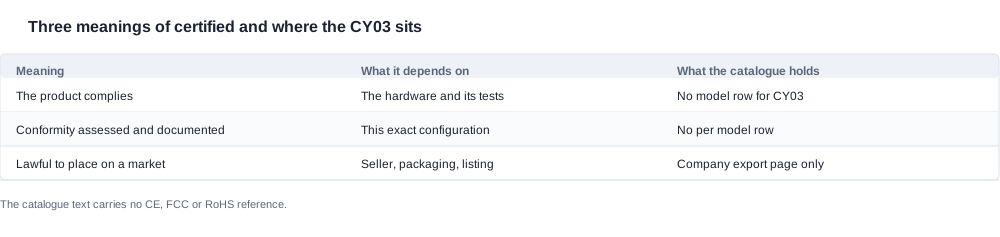
Now what our own documentation holds, stated exactly. The catalogue shows a company-level export certification page the content on it being images rather than text, and those images show ten patent certificates — eight appearance-design patents and two utility-model patents. The catalogue text contains no reference to CE, FCC or RoHS, and it contains no per-model certification row anywhere, for the CY03 or for any other model. There is also no per-model ingress protection rating for this model, so there is no IP claim of any kind to support.
We will not convert the first of those into the second. A buyer who asks us for "our CE certificate" and receives the company's position has been given something real and something that will not satisfy a market access question on its own. The accurate answer to that question is that our published sheet does not carry model-level certification information for the CY03, and that the document which does cover it is something to request in writing from the supplier, naming the model and the configuration. That is the correct commercial answer, and it is also a normal due diligence request that any competent factory will recognise.
There is one consequence of the no-row situation that buyers should plan for rather than discover. If the certification document covers a set of models by name, then deciding the range early matters. A range decision taken before the file is scoped, and then changed after, means the scope has to be reopened, and reopening it costs more than deciding it correctly the first time.
The CY03 market access sequence for the European Union
The sequence below is the order that keeps the long pole at the front. Each step has a completion condition, and each step is a prerequisite for the next.
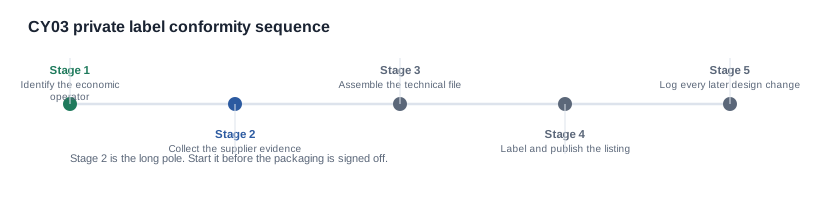
Step one is the economic operator. Before any evidence is gathered, identify the party in the European Union whose name will appear on the product, the documents and the listing. Completion condition: a named legal entity, a registered address and a contact route, agreed before the packaging artwork is locked. Every downstream document carries this identity, so changing it later is expensive.
Step two is the supplier evidence request. One request, one model, one configuration: the product description, the component and module list, the test reports supporting the radio and safety claims for that build, the battery documentation covering both cells, the marking artwork and the user-facing instructions. Completion condition: a document set that names the CY03 and the configuration rather than the platform in general terms. Ask for the platform version where a fact genuinely applies to the platform, and for the model version where it does not — the camera row is one of those facts, because the catalogue publishes only the eight megapixel resolution class for this model and nothing further about it — no sensor model, no field of view, no frame rate — so the camera data has to be requested for this configuration rather than taken from the platform.
Step three is assembling the technical file. This is not a document you receive from the factory and file away. It is the evidence base for your product, and the factory's file for the factory's model is a starting point rather than a substitute. Expect it to contain the product description, the component and module list, the test reports, the marking and instruction artwork, the battery documentation for the frame cell and for the 1400 mAh case, and the batch or serial traceability approach. Completion condition: a file that a market access reviewer in your own market could read without calling you to explain it.
Step four is the labelling and the listing. The economic operator details, the product identification, the warnings and the instructions, in the languages your destination market requires, and the listing itself carrying the same information. Completion condition: every item on the product is present on the listing, and the listing is live only after the file behind it is complete.
Step five is change control. This is the step that gets skipped and then becomes the problem. It is covered in its own section below.
Two adjacent regimes are worth knowing about because buyers ask about them in the same breath. For the United Kingdom, UKCA marking runs in parallel and is a separate conformity claim from the European one, so a European file does not satisfy it. For the United States, the FCC equipment authorisation route applies, and the radio side of the product has to be covered by it. The red directive notes cover the radio side, and it is worth being precise about instruments here: the Radio Equipment Directive is (EU) 2014/53/EU, while (EU) 2014/32/EU is the separate electromagnetic compatibility directive. Mixing them up in a file is a small error that generates a large round of questions.
Buyers also ask about the EN 18031 series of standards, which address privacy and cybersecurity requirements for radio equipment and are becoming part of the European conformity picture for connected products. Rather than assert a position on scope or timing from this page, treat it as a question to put in the request: ask what the manufacturer's stated position is on vulnerability handling and on the security documentation, and ask what documentation will be available to support it. That question costs nothing and the answer is genuinely useful.
Camera-specific additions: the charging case and the application
A camera product with a charging case adds documentation items that an audio product does not, and both of them are commonly overlooked because they sit outside the radio and safety scope that most people think of as "the certification".
The charging case is a second battery. The CY03 ships with a 1400 mAh case, and a lithium cell inside an accessory is a regulated item in its own right for transport purposes. The battery documentation has to cover the case as well as the frame, and a case that was added to the product after the original documentation was written is a gap that is easy to miss because nothing on the packaging announces it. The declared watt-hour rating follows the larger cell, and the packing instruction has to cover the configuration that actually ships. The battery transport notes set out the general position.
The application is part of the data-handling picture. Our documentation does not publish where the footage handled by the companion application is stored, whether the transfer is local or mediated, what the retention policy is, or who publishes updates to the application. For a product that captures video and carries a microphone, that is a reasonable question to put to a supplier before the listing goes live, and in the European market it is a question that is easier to answer before launch than after.
The camera specification is the third one, and it is not a compliance item at all, but it behaves like one. No sensor model, no field of view, no video resolution and no frame rate are published for this model. That does not block a market access file, but it does mean a technical file that describes the product will have to describe the camera from whatever evidence the supplier provides. Ask for it in the same request as the radio and safety evidence, because it is the same supplier conversation and the same file.

CY03 change control after the launch
The compliance file is a snapshot, and the product is not. Every change after the file is dated is a question about whether the file still describes what is being sold.
The changes that most often trigger that question are the ones a private-label programme treats as routine. A firmware update is a change. A different supplier for the radio module, the cell or the enclosure is a change, and it is the change that matters most, because the evidence in the file was gathered for a specific configuration. A packaging or labelling change is a change, because the marking artwork is part of the file. A new colourway or a new regional variant is a change if the model scope names models rather than configurations.
The control that works is simple and cheap: a change log that records what changed, when, who approved it, and whether the file was reopened. It needs one named owner and one location where it lives. It does not need a quality system to be worth having.
The commercial reason to keep that log is straightforward. A scope question arrives at customs or at a market surveillance authority, and the answer to it is a document trail. A supplier with a change log answers it in a day. A supplier without one either re-runs the assessment — which costs money and time — or gives an answer that the authority may not accept, and that uncertainty lands on the importer. In practice the trade-off is not between strictness and speed; it is between a small record-keeping habit now and an unbudgeted reassessment later.
The second commercial reason is the range. If you plan to extend the private-label line with further models, the change log and the scope of the first file are the same asset. A brand that has documented one model properly has a template for the next one, and a brand that has not has to build the template under launch pressure.
How to read a supplier's answer about certification
Because the catalogue publishes no model-level certification row for this model, the answer you receive is the evidence. It is worth knowing what a strong answer looks like, because the weak versions are fluent and easy to accept.
A strong answer names the model designation and the configuration. It identifies the document by its reference, the issuing body and the date, and it tells you which model numbers the document covers. It states the scope of the assessment rather than implying it, so you can see whether the build you are ordering is inside the scope or adjacent to it. It tells you what happens to the document when the configuration changes, because a file with no change conditions attached to it is a file that will be out of date without anyone noticing. And it tells you where the underlying test reports live, so that they can be produced later for a market surveillance enquiry rather than reconstructed under pressure.
A weak answer, by contrast, describes the supplier's general capability. It talks about what the factory has done for other customers, what the company's policy is, and what the team is able to handle, without ever attaching a document to a model. It offers a company-level statement where a model-level document is what was asked for. It describes a report without giving a reference number, an issuing body or a date, on the reasonable basis that these will follow later. And it treats the certification question as a product feature, which it is not.
The practical test is whether the answer can be filed. If a reply cannot be attached to a technical file with a name, a date and a scope, it has not answered the question yet, however confident the language. The due diligence criterion to apply before you order is simple: ask for the document reference in writing, and treat a reply that cannot supply one as an open item rather than as a completed one.
There is a second dimension worth checking while you are doing this. A supplier who answers the scope question precisely is also answering the change-control question precisely, because both come from the same place: an accurate configuration record. Suppliers who can describe exactly what is covered usually also have a change log. Suppliers who answer in general terms usually do not, and that is the supplier whose file will need to be rebuilt after your first firmware update.
What we can and cannot confirm about CY03 certification status
We will state the company's position and the absence of a model-level document for this model, in that order, and we will not present the first as though it were the second. The catalogue shows a company-level export certification page the content on it being images rather than text, showing ten patent certificates — eight appearance-design patents and two utility-model patents — and the catalogue text carries no reference to CE, FCC or RoHS and no per-model certification row. That is the whole of our documented position, and we would rather give you an accurate gap than a reassuring phrase.
Here is the list, stated as a list, so it can go straight into your own file:
- Certificate numbers, issuing bodies, validity periods and covered model schedules for the CY03 — not published in our catalogue, and to be requested in writing.
- The ingress protection position for this model — no rating published, so no IP claim is available.
- The technical file and the traceability approach for a private-label build — assembled per customer, not published.
- The charging method row for this model — the catalogue lists none, so the frame-side interface has to be established before any variant work.
- The companion application's ownership, data handling, storage location and update path — not published.
- The battery documentation covering the 1400 mAh case — a scope question for the programme, and the one most easily overlooked.
- Frame weight, camera specification, storage behaviour, minimum order quantity, lead time and price — not published.
The certification work is not optional, it is not free, and it sits inside your landed cost, which is why a range with many models carries many sets of documentation. Tell us the target market, the volume and the required configuration, and we will come back with what is available and what is not, and with a straight answer on which of the rows above we can close for you. The camera family is on our AI camera glasses range page, and the platform options are on our OEM ready platforms page.
Related reading
- How to scope the compliance work — certification checklist
- The European launch sequence — GPSR route
- How a lithium accessory is handled in transit — battery transport
Tell us the target market, the volume and the required configuration, and we will come back with what is available and what is not.


