
Start with the row that does not differ, because it decides the shape of this comparison. The CY03 and the L2 Utral publish the same frame cell at 290 mAh, the same charge-time ceiling of two hours or less and the same rated use figure of roughly seven hours. Neither model publishes a frame weight, a sensor, a field of view, a video format or a colour list. The power architecture of these two is the same size and the same length, which means the runtime a customer experiences between them cannot be explained by the cell.
What separates them is narrower and more useful than a battery table usually produces. The L2 Utral publishes a Type C charging interface and offers two case capacities. The CY03 publishes a 1400 mAh case and no charging interface row at all. So the comparison is really about two things a battery table normally hides: how the frame is put back on charge, and what the case in the box can do.
There is a third difference, and it is not a charging row: the camera tier. The CY03 is an 8 MP model and the L2 Utral is a 13 MP model. It is listed here because a procurement team comparing battery rows is often comparing a whole configuration, and the configurations are not otherwise the same.
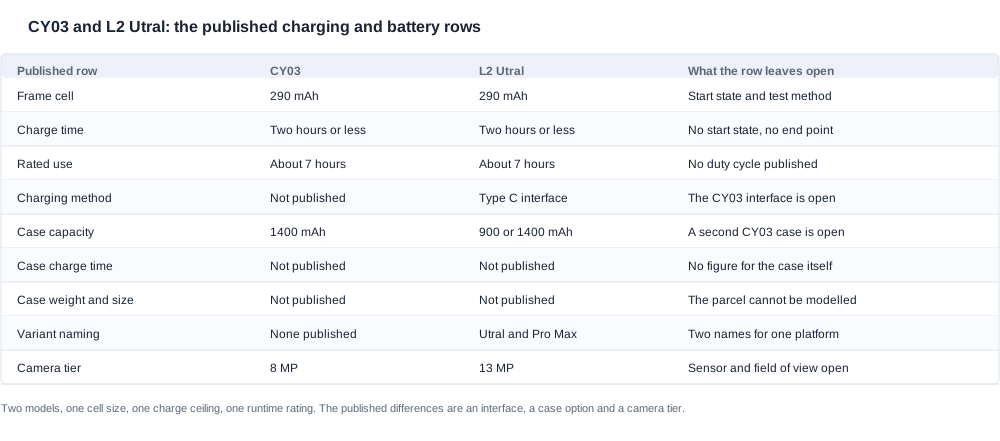
The practical conclusion is this: a buyer choosing between these two on runtime grounds is choosing between two equal figures, and the real decisions are the interface, the case configuration and the price band — none of which the catalogue publishes in full. The rest of this article is the method for closing those rows rather than a ranking.
CY03 and L2 Utral charging: the published rows and the missing ones
Nine rows are published across the two models, and they fall into three groups that behave differently in a quotation.
The identical group. Frame cell, charge-time ceiling and rated use match exactly. Two models on the same cell and the same power target is not unusual in a camera range — the CY05 and the CY03, and the L1 Pro and the L2 Utral all sit on 290 mAh — but it is worth noting what it buys and what it does not. It buys an accessory line, a firmware path and a qualification exercise that can be shared across the group. It does not buy a runtime difference, and a product page that presents the L2 Utral as running longer than the CY03 is making a claim the documentation does not support.
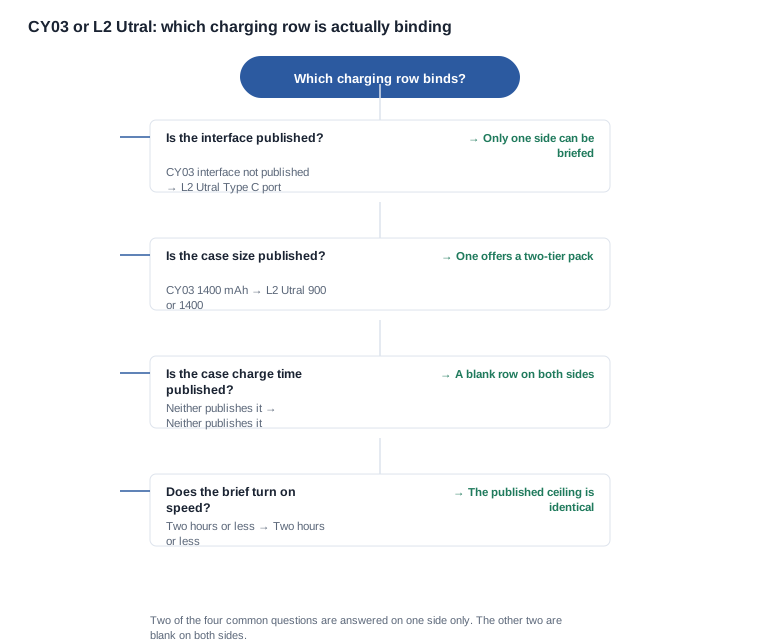
The different group. The L2 Utral publishes a Type C charging interface and two case capacities, 900 mAh and 1400 mAh. The CY03 publishes a 1400 mAh case and no charging interface. That absence matters and is easy to misread: the catalogue does not publish a charging-method row for the CY03, so the interface it uses is an open question, not a magnetic one. Three other camera models — the L1 Pro and the CY05, and the MT6 — sit in the same position, and four camera models in total publish no charging interface at all.
The absent group. For both models: the charge time of the case itself, the interface the case charges from, the weight and dimensions of the case, whether the case carries a visible charge indicator, whether the frames can be charged without the case, the accepted input current and voltage, and every runtime test condition. These are the rows that turn a frame specification into a charging system, and they are blank on both sides.
Why the identical runtime is the most useful data point
Two models with the same cell arriving at the same rated figure is a strong signal that they were built to the same power target, and it lets you retire one question immediately: you are not choosing between a long-runtime model and a short-runtime model.
It also tells you what you cannot compare. If two models publish the same runtime, they may well have been measured on different rigs with different duty cycles, and no test condition is published for either. Put the two figures next to each other on a product page and they are like for like as statements. Put them next to another supplier's figure and you are comparing two test methods you have not seen, which is the comparison that produces a customer complaint three months after launch.
The rule that follows is worth writing into your specification sheet: a runtime figure without a condition is a marketing number, and a runtime figure with a condition is a specification. Ask for the condition, and if the supplier cannot state it, ask to measure it on the sample and record the condition next to your own number.
The interface row, published on one model and absent on the other
The L2 Utral publishes a Type C charging interface. The CY03 does not publish a charging interface. The comparison that normally follows from that is the familiar one about cables and contacts, and it is worth doing properly — because the difference between a magnetic contact and a wired port is not a preference, it is a different failure mode, a different packaging decision and a different support question.
What a wired interface does for the customer. A port either accepts a cable or visibly does not. The failure is legible, which means the customer's conclusion is that the cable or the port is at fault rather than that the product is broken. It also means the customer already owns the cable, because it is the same one used for everything else in their bag. For a channel selling into markets where a single connector type has become normal, that is a genuine reduction in friction, and it is why the L2 Utral publishing Type C is commercially meaningful even though its charge ceiling is identical to the CY03's.
What a contact interface does for the customer. The frame seats on a contact and charges. When the contact is misaligned, nothing about the frame looks wrong and no error appears. On a metal desk, in a bag with a laptop, in a drawer where it lands at an angle, the conclusion the customer reaches is that the product is faulty. This is not a hypothetical: it is the most common way a well-built pair of glasses generates a returns ticket. The handling for it is procedural rather than technical, and it consists of two things: a charge indicator that shows the state, and instructions that say what to do when the light does not come on.
What this means for the comparison. You cannot run that contrast on the CY03, because the catalogue does not publish which interface it uses. The CY03 is one of four camera models where the charging-method row does not exist. So the CY03 is not the magnetic alternative to the L2 Utral — it is the model whose interface you have to ask for.
That is a more useful framing for a buyer than the old one, because it converts an unanswerable comparison into a single document request with a clear consequence. What to ask is short: which interface does the CY03 use, does the frame charge without the case, does the case carry a charge indicator, and what is the accepted input current and voltage. The last one is the row that quietly invalidates the two-hour ceiling: a ceiling published for the supplied charger is not a promise for the customer's own adapter.
Two hours or less is a ceiling, not an interruption window
Both models publish a charge time of two hours or less, and the wording is worth defending in your own documentation.
Two hours or less permits exactly two hours. "Under two hours" is a stricter claim than the catalogue supports, and a specification sheet that uses the stricter phrasing says something the underlying document does not. If a buyer compares your sheet against ours, the discrepancy is visible and it lands on your sheet.
A ceiling is not an interruption window. This is the practical point, and it applies equally to the D17 and the ZH12, which are the only two models in the catalogue publishing a charge time of about one hour. What none of the published charge times carry is a starting state or an end point. So a figure of two hours or less cannot be turned into "how long is the frame unavailable during a shift", because the answer depends on what the battery was at when the shift started and what counts as finished. It is also not the case's own refill time, which is a different number and is not published for either model.
The consequence for a range plan is that charge speed is not a lever in this pair. If your brief says "the product has to be back on charge within an hour", neither model satisfies it on published evidence, and the models in this catalogue that publish about an hour of charge time are the D17 and the ZH12, which are sport models with a different cell and a different form factor entirely. That is a useful thing to learn before a design review, rather than after a customer tells you the product was down for two hours.
Case configuration: the one lever that actually separates the two models
This is where the comparison has a genuine asymmetry, and it is a commercial one rather than an electrical one.
The CY03 publishes a single 1400 mAh case. That is one packaging decision: one box, one artwork, one bill of materials, one configuration code. For a distributor already managing a wide range, that simplicity has real value, and it is the reason the CY03 is straightforward to specify.
The L2 Utral publishes 900 mAh or 1400 mAh. That is a range decision. The electronics are the same and the box is not, which means you can run two retail tiers off one product: an entry configuration at 900 mAh and a premium configuration at 1400 mAh, with the same frame, the same firmware and the same support burden. Nothing else in the camera range publishes two case capacities for one model, so if your channel needs a good-better-best ladder inside a single platform, this is where the catalogue offers one.
Two things are not published for either model and both matter to this decision. Whether the 900 mAh and 1400 mAh configurations are available at every order quantity, and whether the two carry different pricing, are both open. A two-tier configuration that can only be bought in volume is a range plan with a condition attached.
The case is the largest single input in the carton
Whichever model is chosen, the case carries the freight. A 1400 mAh case against a 290 mAh frame cell is close to five times the cell, it ships in every unit, and it changes the volumetric weight, the freight class, the warehouse space per unit and the battery transport documentation. The case's own weight and dimensions are not published for either model, so the delivered parcel cannot be modelled from the catalogue alone — but the ratio between the cell and the case is published, and that ratio tells you where the weight is going before you weigh anything.
There is a second consequence that is a compliance question rather than a cost question. A device that ships with a charging case contains two lithium cells in one carton rather than one, and the transport file has to cover the configuration that actually travels. The case is therefore not an accessory decision; it is a change to what the shipment is. See the battery transport notes for how that scope is normally scoped with a test house.
How to evaluate a two-tier case configuration commercially
The 900 mAh and 1400 mAh options on the L2 Utral are only as useful as the pricing gap between them, and neither the pricing nor the demand split between two configurations is published. That is the point at which this comparison stops being a specification exercise and becomes a commercial negotiation, and the way to handle it is to treat the two configurations as two quotes rather than one quote with an option attached.
The criteria that matter in that negotiation are ordinary procurement criteria and they are worth stating before the conversation rather than during it:
- The unit price gap between the two configurations. This is the number that decides whether a two-tier ladder exists at all. A small gap makes the lower tier pointless, because the customer sees no reason to choose it; a large gap makes the premium tier look like a margin opportunity rather than a battery.
- Whether the lower tier can be ordered at the same minimum order quantity as the premium tier. A configuration that requires a larger commitment to unlock is a configuration most buyers will not take, and it quietly reduces the range to one SKU.
- Whether the lead time differs between the two. A faster lower tier and a slower premium tier is a workable structure; a slower lower tier is a structure nobody will use.
- Whether the packaging artwork, the carton and the freight class differ. They will, because a 900 mAh case and a 1400 mAh case are not the same object, and that is a tooling and artwork line that belongs in the quotation rather than in a discovery later.
- Whether the two configurations carry the same model designation. The L2 Utral page publishes two variant names, Utral and Pro Max. Whether those names travel onto the carton, the invoice and the compliance documents is worth knowing before the artwork is approved, because a mismatch between a designation and a document is the cheapest thing to fix before production and the most expensive thing to fix after it.
This is where the trade-offs between the two models actually sit, and they are commercial rather than electrical. The CY03's single 1400 mAh case is the low-complexity answer for a distributor who wants one SKU and one artwork. The L2 Utral's two case capacities are the answer for a channel that has to present a choice at retail. Which of those two situations you are in is the whole decision, and the published rows tell you which answer exists — they do not tell you which one to take.
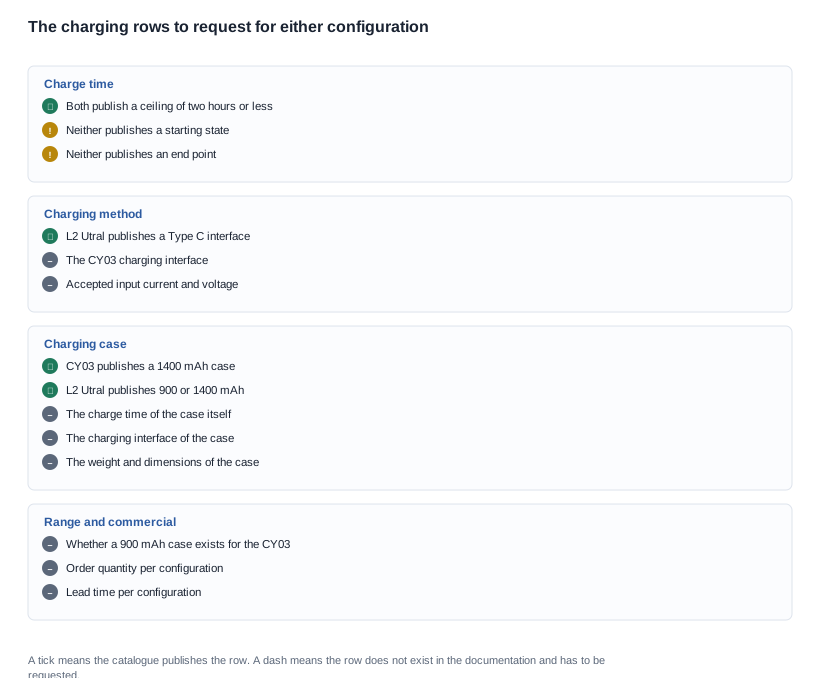
The CY03 and L2 Utral charging rows that still have to be requested
Here is the consolidated request, in the order that tends to work. It is deliberately short, because a long list sent without a sample gets answered selectively.
- The charging interface on the CY03, and whether the frame can be charged without the case on either model.
- The accepted input current and voltage on both models, and the charger that the published ceiling assumes.
- The charge time of the case itself, and the interface the case charges from.
- The weight and external dimensions of the case on both models, and the resulting packed unit weight.
- Whether the case carries a visible charge indicator, and whether the frames report their own charge state.
- The runtime test condition behind the roughly seven-hour figure on each model, including the camera state and the radio duty cycle.
- Whether the L2 Utral's 900 mAh and 1400 mAh configurations are available at your quantity, and whether the two are priced differently.
- Unit price, minimum order quantity, lead time and production capacity for each configuration, none of which is published.

Items 3, 4 and 5 are the ones that decide whether a charging-led product story holds, and all three are blank on both models. That is the strongest argument for treating the charging comparison as a sample exercise rather than a document exercise, and it is also why a buyer who is comparing two suppliers' charging claims should ask to see a measured case-to-frame cycle rather than a frame charge time.
One more request, which is not about either model but about the range: the CY05 publishes rows identical to the CY03, and our documentation does not state what separates them. If the range is built around a charging story, that ambiguity lands on the charging story, because a customer comparing the two SKUs on a product page will find them indistinguishable. Get the answer in the supplier's own words before the range plan is frozen, because the answer determines whether you are running two tiers or duplicating one.
Getting the answers into the order rather than the inbox
A request list is only worth what happens to the answers, and the usual failure is not that the supplier refuses to answer. It is that the answers arrive as an email, get read once, and are then lost — because nothing on the purchase order refers to them and nobody at goods-in knows they exist.
The mechanism that fixes this is unglamorous. Once the eight items come back, each answer becomes a line in the specification for the configuration, and each line is checked at three moments: against the quotation, against the sample, and against the first production shipment. A line that is checked at three moments catches a configuration change; a line that sits in an email catches nothing.
For the charging rows specifically, the two items worth writing as hard lines rather than as notes are the CY03's charging interface and the case's own charge time. The first one determines whether the packaging instructions and the product page can describe how the frame is charged, and the second one determines whether the case can be described as a usable accessory rather than as a box. Both are open today on both models.
This is also the point at which due diligence on the supplier is worth a formal step rather than a judgement call. The catalogue publishes a company-level export certification page the content on it being images rather than text — ten patent certificates, split eight appearance-design patents and two utility-model patents — and the catalogue text leaves CE, FCC and RoHS unmentioned marking and no per-model certification row for the CY03, the L2 Utral or any other model. So the certification position for both configurations has to come from written material supplied on request, and because a case is a second cell in the carton, the file has to cover the case as well as the frame. Treat the request as a commercial term with a stated cost and a stated lead time, which is how you find out whether the supplier has run that assessment for this configuration before or whether the cost is still ahead of you.
The last point is negotiation rather than diligence. Where the catalogue has no row — the case charge time, the case weight, the interface on the CY03 — there is nothing to negotiate against, because there is no published figure to move. What can be negotiated is scope and schedule: which configuration the file is written for, how long it takes, and what happens to the lead time when the configuration changes. That is a better subject for a purchase order conversation than an argument about a number that does not exist.
What the L2 Utral charging comparison can and cannot settle
A buyer choosing between these two models on battery grounds is choosing between equal published figures, and the differences worth arguing about are the interface, the case configuration and the camera tier — of which only one is published on both sides, and that one is a tier label rather than a picture. We will not estimate the CY03's charging interface, the case's own charge time, the accepted input current or the runtime test conditions, and we will not describe the L2 Utral's 13 MP as better image quality, because the sensor, the field of view and the video format are not published for it either.
What we will not do is present a two-hour ceiling as a working-day interruption window, or treat the catalogue's silence on a charging-method row as an absence of a charging method. And we will not turn the L2 Utral's two case capacities into a recommendation, because a two-tier packaging option is only useful against a price band that is not published and a demand split that is yours to forecast rather than ours to invent.
What we will do is send you the published rows for both configurations, put the eight-item request behind them, and tell you plainly which rows are already settled and which have to be measured. The L2 Utral battery analysis covers how a runtime figure should be read before you rely on it, the charging options guidance covers the range-wide picture, and the CY03 common questions set is the same material in a form you can hand to a supplier.
Related reading
- How a runtime figure should be read before you rely on it — L2 Utral battery life
- The charging detail across the range — charging options
- What the lower tier's documentation covers — CY03 common questions
Tell us the channel, the volume and the target market, and we will come back with what is available and what is not.


