
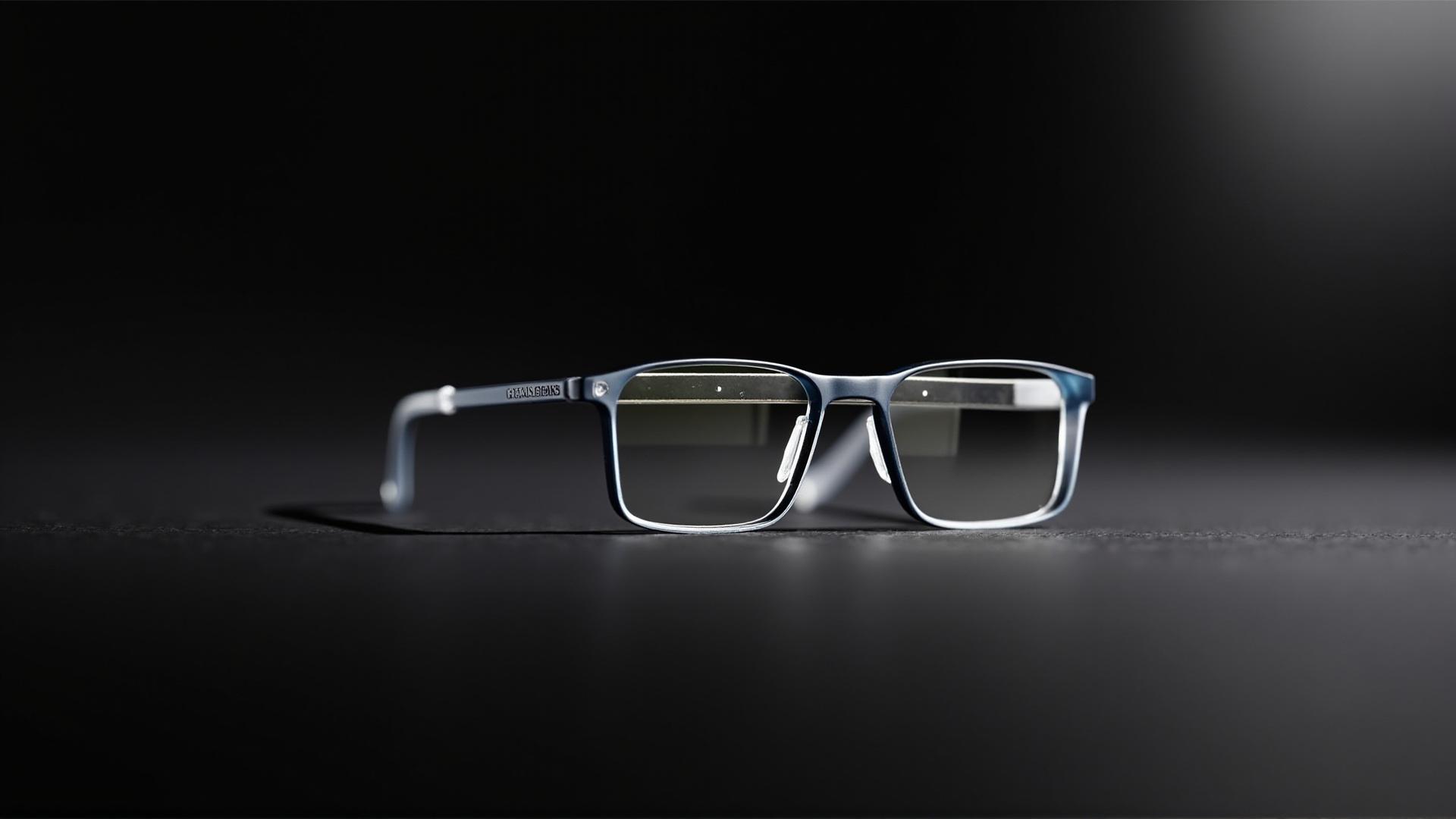
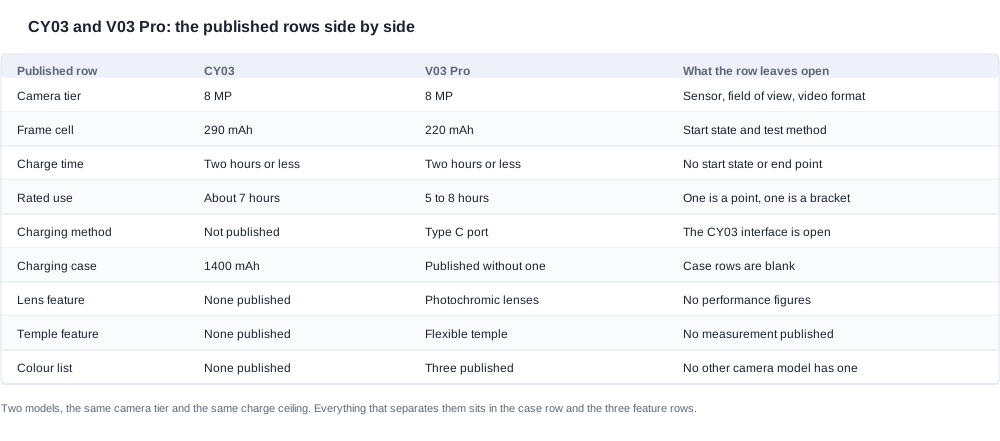
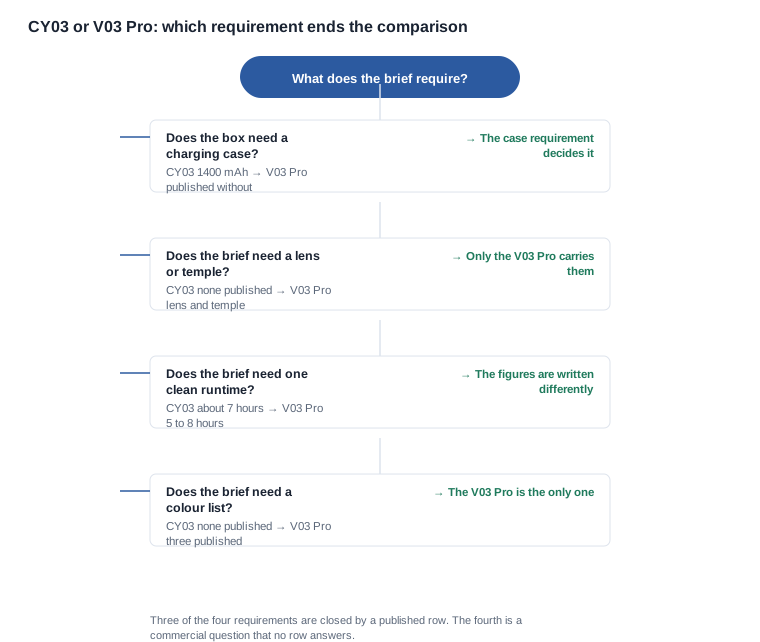
These two models are the easiest and the hardest to choose between at the same time. They publish the same camera tier — 8 megapixels — and the same charge-time ceiling of two hours or less. After that they diverge in kind rather than in degree. The CY03 publishes the larger frame cell, a rated-use figure written as a single number, and a 1400 mAh charging case. The V03 Pro publishes the smaller cell, a rated-use figure written as a bracket, a Type C port, a flexible temple, photochromic lenses and three colour options.
There is no middle ground between them, because the one thing each of them has is different in kind. That is what makes this a decision rather than a ranking, and it is why the useful entry point is not a feature list but the question of what your channel's product has to contain.
The framing matters because the two configurations fail in opposite ways. A case-driven retail model that takes the V03 Pro is missing the accessory that carries the whole endurance story. A lens-driven channel that takes the CY03 is missing the only camera model in the catalogue that publishes a photochromic lens at all, and there is no version of the CY03 with a colour-changing lens in it. Neither of those is a compromise you can negotiate at a lower order quantity; they are different products.
What is published also has a sharp edge worth stating before the comparison: the catalogue publishes no charging-case row at all for the V03 and the V03 Pro, and the V06 or the S7. That silence is one statement, and the difference between it and a published case matters when you are writing a specification sheet. The V03 Pro is not a model the catalogue describes as having no case; it is a model the catalogue says nothing about.
CY03 and V03 Pro: a power-and-case model against a feature-led model
The CY03 brings power and a case. 290 mAh, a rated use figure of approximately seven hours, a charge-time ceiling of two hours or less and a 1400 mAh charging case published as part of the configuration. That case is close to five times the frame's own cell, it is the highest published case capacity in the camera range, and it is the accessory that lets a channel talk about a device that is not recharged every night.
The V03 Pro brings flexibility and lenses. The same 8-megapixel camera and the same two-hour charge ceiling, but a 220 mAh cell, a rated-use figure of five to eight hours, a Type C charging port rather than a magnetic one, a flexible temple, photochromic lenses and three published colours: orange, cream and black.
Neither model's charging method is a published row on the CY03's side — the catalogue gives that model a cell, a charge ceiling, a runtime rating and a case capacity, with no charging-interface row at all — so the interface contrast between these two is half published and half open. What is fully published is the difference in kind: one configuration is built around what comes in the box, the other around what the frame itself can do.
Feature rows are rare in this range, and rarity carries obligations
Look across the eleven camera models and the picture is striking: only three of them publish anything beyond the standard specification rows. The V03 Pro publishes a flexible temple, photochromic lenses and a colour list. The V06 publishes an ergonomic design line, an extended-runtime line, a removable inner frame, an IP54 marking and four colours. The S7 publishes an ergonomic design line, a high-resolution pixel line, a removable inner frame and an IP54 marking. Every other camera model in the catalogue publishes pixels, a cell, a charge ceiling, a runtime figure, a charging method and possibly a case capacity, and nothing else.
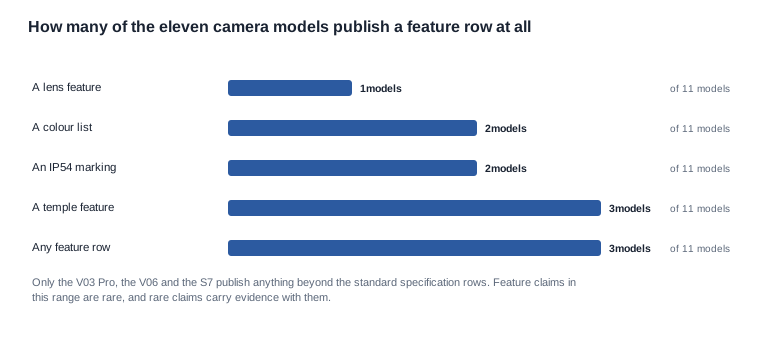
That rarity is commercially useful in two directions. It tells you the V03 Pro's feature set is genuinely differentiated rather than standard, and it tells you that a feature claim in this range arrives without the performance detail that usually accompanies one. A photochromic lens claim with no transition speed, no tint depth and no temperature range is a claim, not a specification, and the same is true of a flexible temple with no measurement attached to it.
For a buyer, the rule is straightforward: the more distinctive the feature, the more evidence you should require, because a distinctive feature is also the one a customer will test. Customers notice a lens that takes a minute to darken. They notice a temple that bends. They notice a colour that is not the one in the photograph.
The case question that ends the comparison on its own
If your product has to ship with a case in the box, the comparison is already over. The CY03 publishes one at 1400 mAh; the V03 Pro publishes no charging-case row at all.
A case is worth more than most rows on a camera specification sheet, and the reasons are commercial rather than technical. It removes the recharge objection that a customer forms in the first hour of use. It raises the value of the box, which is what makes a general consumer channel willing to pay for the product. And it changes the packaging design and the shipping weight, which is a cost line rather than a feature line.
Do not let the case become an assumption. For the V06 and the V03, and the S7 and the V03 Pro, the catalogue publishes no charging-case row at all, and that silence should not be paraphrased as "has no case". The distinction is not pedantic: one of the two readings gives you a parcel you can plan, and the other does not. If your retail model is built around a case and the V03 Pro is on your shortlist, the first question is whether a case is available for it at your quantity, and the second is what that case would cost in freight.
The camera range is not short of case-equipped models, and each of them publishes its case capacity differently, which is itself informative:
- The CY03, the L1 Pro and the CY05 publish a 1400 mAh case.
- The L2 Utral publishes 900 mAh or 1400 mAh, so it is the only camera model offering two case configurations.
- The MT6 publishes a 1200 mAh folding case.
- The KY06 and the MT5 publish magnetic charging with a charging case and no capacity for it.
- The V03, the S7 and the V06, and the V03 Pro have no charging-case row published.
That list is the honest answer to "which camera model is right if the case is the story" — it is a screen, not a recommendation, and the commercial rows that would decide between the four case-equipped models are not published.
The freight consequence of the case is worth putting on the same page as the retail consequence, because a buyer evaluating the total cost of a configuration will find that the case and the frame are not the same order of magnitude. A 1400 mAh case against a 290 mAh frame cell is close to five times the cell in stored energy, it ships in every unit, and it changes the volumetric weight, the freight class, the warehouse space per unit and the battery transport scope. The case's own weight and dimensions are not published for the CY03, so the delivered parcel cannot be modelled from the catalogue alone — but the ratio is published, and it tells you where the weight is before anyone weighs a carton. A configuration decision that is taken on the retail story and never revisited on the freight line is a decision that has been made twice, once consciously and once by default.
When the lens is the requirement
A lens-led brief works in the opposite direction, and it carries a different set of obligations. A channel that leads on photochromic lenses is selling a promise about how the product behaves as light changes, and the promise is made at the point of sale by a customer who will test it in a stairwell or a parked car within a week of delivery. The evidence behind that promise has to arrive before the order, because a lens that cannot be substituted late becomes a packaging and artwork change rather than a product change.
There is a second route worth putting in front of a buyer at the same time. The catalogue carries a separate AI photochromic smart glasses entry with a 100 mAh cell, a charge time of two hours or less, roughly seven hours of rated use and magnetic charging, published without a model designation of its own. It is not a camera model and it does not publish a lens performance row either, so it offers a different configuration rather than a documented alternative. Which route serves a brief depends on what the brief needs the product to be, and that is a question to answer before either is quoted.
What a photochromic lens row does and does not tell you
The catalogue publishes a 变色镜片 line for the V03 Pro and nothing beyond the existence of the lens. It does not publish a transition speed, a tint depth, a light-transmission figure, an operating temperature range or a cycle life. It also carries a separate AI photochromic smart glasses entry — a 100 mAh cell, a charge time of two hours or less, roughly seven hours of rated use and magnetic charging — published without a model designation of its own, so a buyer shopping for photochromic has two catalogue routes and one of them has to be specified before it can be quoted.
What the row is worth. A lens that changes is the only thing in the camera range that moves the product into a different category. It is also the only camera-model feature row in the catalogue that changes what the product is rather than how it is built, and that is why the V03 Pro cannot be replicated by adding a feature to the CY03.
What the row does not settle. Whether the lens is any good. A photochromic lens that takes a minute to darken is a complaint, and the customer who files it will not frame it as a slow lens; they will frame it as a product that does not work. That is the commercial asymmetry behind the checklist below: a feature claim that is slow is worse than no feature claim at all, because the customer has formed an expectation.
The evaluation criteria that apply here are ordinary and testable, and they are the criteria to ask the supplier for in writing before the order rather than after the first batch:
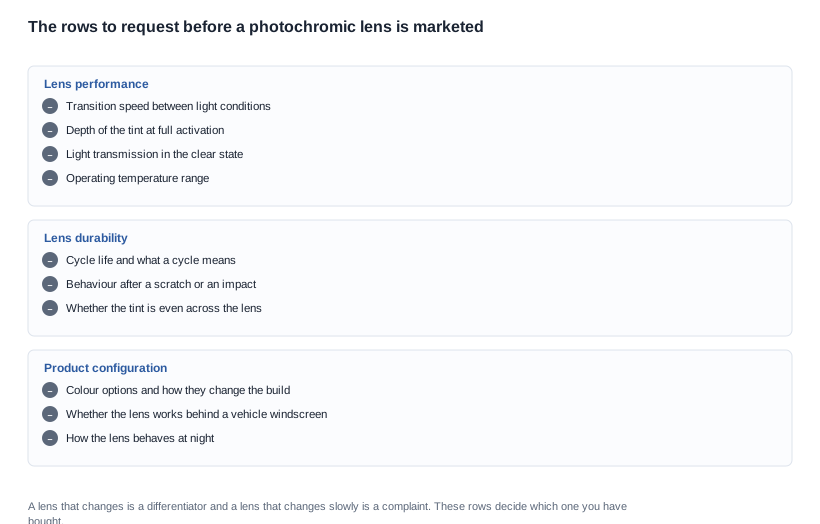
- Transition speed, stated in seconds for a defined change in light level, because a lens that takes thirty seconds and a lens that takes three seconds are different products.
- Tint depth at full activation, because the depth is what a customer sees at the end of the transition.
- Light transmission in the clear state, because it decides whether the wearer can read a screen or drive at night.
- Operating temperature range, because a lens that performs at twenty degrees and not at thirty-five is a seasonal product in several markets.
- Cycle life, and what a cycle means, because a figure without a definition is not a figure.
- Behaviour behind a vehicle windscreen, because a large proportion of photochromic enquiries in this category come from drivers, and lenses that do not darken behind glass create a returns problem that the product page cannot solve.
The photochromic lens guidance covers the same ground in more detail, and it is worth reading before the specification is written rather than after the first complaint.
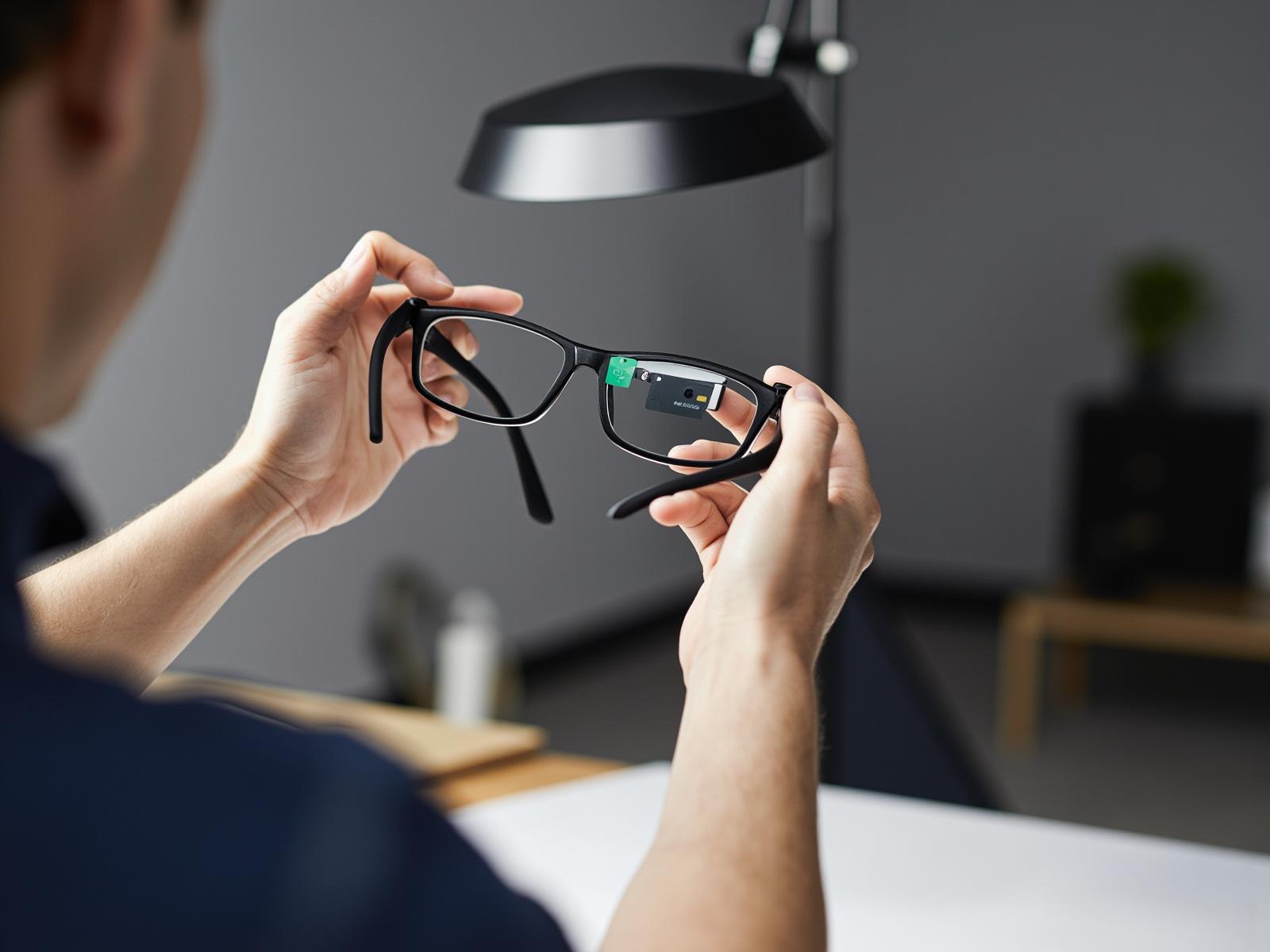
The flexible temple and the three published colours
Two smaller rows carry more commercial weight than they look like they will.
The flexible temple. The V03 Pro publishes 灵活镜腿 and publishes no measurement, no material and no cycle figure for it. Structurally, a flexible temple is a promise about durability and about what a customer is allowed to do to the product — put it in a bag, sit on it, twist it. It also changes the packing volume, because a temple that flexes is a temple that can be packed tighter, and packing volume is a freight line. A buyer should treat the flexible temple as a construction claim that needs a cycle figure behind it, and ask what the test was.
The three published colours. Orange, cream and black. The V03 Pro is one of only two camera models in the catalogue with a colour list at all, the other being the V06 with four. The commercial consequence of a colour option is that it is usually a finish change or a new mould texture rather than a sticker, which makes it a tooling and artwork question: a second colour is a second approval, and in many cases a second production line setup and a longer lead time. Three colours on one model is three approvals.
This is also where the two models are least comparable in a way that is not about the specification. The CY03 publishes no colours at all, which means the colour decision for that model sits entirely on your side of the table — with a supplier, on tooling, and on the artwork. A channel that has decided it needs orange, cream and black in year one and a single colour in year two has a different launch plan for each model, and the model that publishes the colour list is not automatically the cheaper one to launch in three.
What neither model publishes, and where it lands
Neither the CY03 nor the V03 Pro publishes a sensor model, a field of view, a video resolution, a frame rate, a frame weight, temple or lens dimensions, an ingress rating, a storage capacity, a file format, an overwrite behaviour, a colour-independent warranty, a certificate number, an issuing body, a validity date or a covered-model schedule.
Two of those absences are worth pricing. Frame weight is not published for either model, and the only camera model in the whole catalogue that publishes one is the MT6 at 158 grams for the glasses body with the cell and camera fitted, excluding its folding charging case; using that figure as a proxy for these two would be wrong. Ingress rating is not published for either, and the IP54 marking in this catalogue appears on the V06 and the S7 only.
One row from the old version of this comparison has been removed deliberately. A statement about conflicting minimum order quantity figures held in internal documentation was not something a buyer can act on and not something we can substantiate, so it is not repeated here. The published position is simpler and more useful: unit price, minimum order quantity, lead time, production capacity, warranty and payment terms are not published for either model, and all six belong in the quotation.
The V03 Pro rows that have to be requested before a lens is marketed
If a lens is going to be marketed, the claim on the product page is a promise, and these are the rows that have to sit behind it. Nothing in this list is published for the V03 Pro, and all of it is obtainable from the supplier in writing.
The same list applies with one adjustment if you are looking at the separate photochromic entry rather than the V03 Pro: that entry publishes a 100 mAh cell, a charge time of two hours or less, roughly seven hours of rated use and magnetic charging, so the charging rows are settled and the lens rows are not.
There is a second, shorter list that applies whichever model you take, and it is the list that should go into the purchase order rather than into the specification:
- Unit price at your planned quantity, with the price breaks at the two tiers above it.
- Minimum order quantity, and whether it applies per model or per configuration.
- Lead time from deposit to shipment, for the specific configuration rather than for the model in general.
- Production capacity per month, and whether it is shared with the rest of the camera range.
- Warranty terms, and whether the charging case is covered on the same basis as the frame.
- Which model designations appear on the compliance documents that will travel with the goods.
On the last point, our published position is narrow and worth stating exactly. The catalogue carries a company-level export certification page whose content is images rather than text: ten patent certificates, eight appearance-design patents and two utility-model patents. The catalogue text contains no reference to CE, FCC or RoHS marking, and there is no per-model certification row anywhere for the V03 Pro, the CY03 or any other model. So there is no certification evidence to attach to either model from the catalogue today, no status can be inferred for either from the company-level page, and the request has to be made in writing, with its cost and its lead time stated, as part of the quotation rather than as an administrative afterthought.
What the CY03 and V03 Pro comparison leaves open
This is not a comparison of two cameras, because neither model publishes anything about its camera beyond the resolution, and it is not a comparison of two batteries, because the charge ceilings are identical and the runtime figures are written in two different styles. It is a choice between a power-and-case product and a feature-and-lens product, and both are legitimate constructions.
We will not tell you that the resolution difference is worth a price difference, because there is no resolution difference here and no sensor or video figure is published for either model. We will not describe the CY03's charging interface, because the catalogue publishes no charging-method row for it. We will not fill the lens performance rows with typical values, and we will not describe the V03 Pro's flexible temple as durable without a cycle figure. And we will not recommend one model to you, because unit price, order quantity, lead time, capacity and warranty are unpublished for both, and the answer that follows from the published rows is a statement about which requirement your brief has — not about which model is better.
What we will do is put the requirement screen in front of you: if the box has to contain a case, one of these two models is not in the running; if the product has to carry a colour-changing lens or a flexible temple, one of them is the only candidate in this range; and if neither requirement is present, then the decision falls through to the quotation and to the runtime figure you intend to publish. The V03 Pro against the V03 comparison covers the published rows behind the feature-led model, the CY03 common questions set is the same material in a form you can hand to a supplier, and the camera range charging case options analysis covers what the case does to the delivered cost of a configuration.
Related reading
- The published rows behind the feature-led model — V03 Pro against the V03
- What to ask about a camera product — CY03 common questions
- What to ask about a lens that changes — photochromic lens
Tell us the channel, the volume and the target market, and we will come back with what is available and what is not.


