

The D11 draws the same set of questions every time it appears in a quotation, and the answers are the same each time, which is either reassuring or a warning. Here is the set, answered from our published documentation, with the gaps marked where they exist.
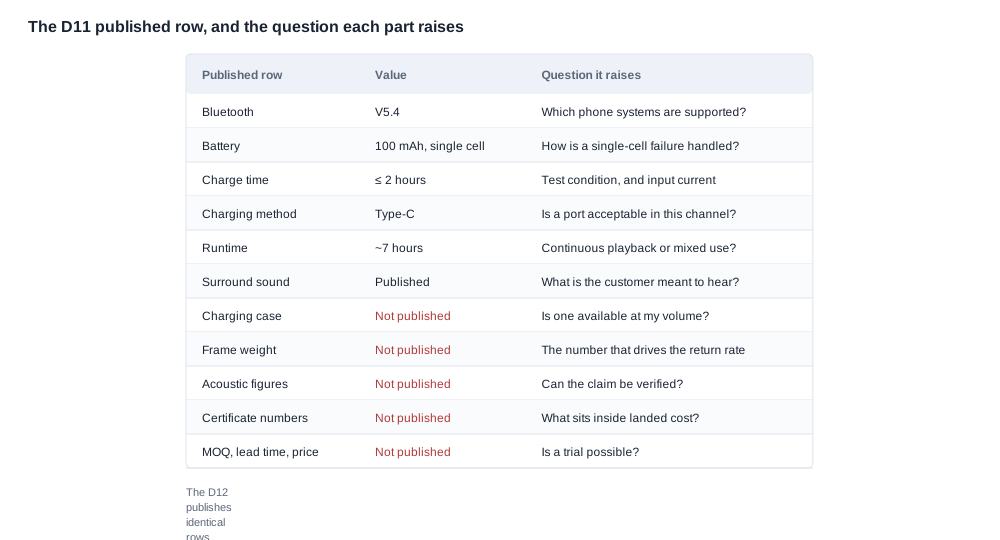
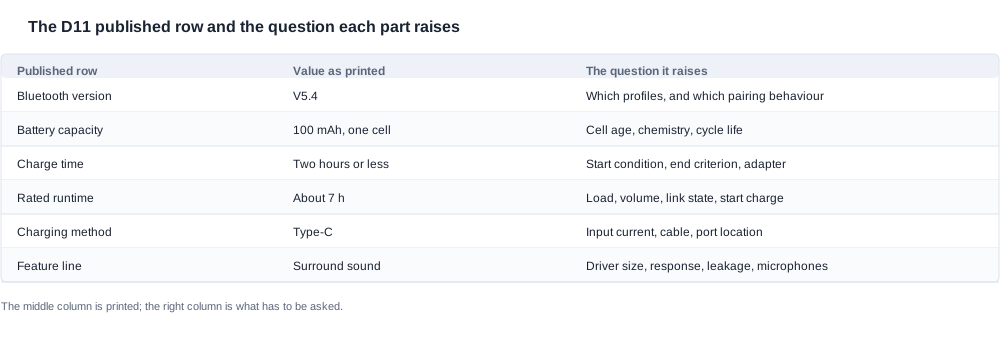
The published row is short and complete: Bluetooth V5.4, a 100 mAh battery, a charge time of up to two hours, a rated runtime of approximately seven hours, Type-C charging, and surround sound.
How long does the D11 battery last?
About seven hours as rated, and the test condition is not published. Treat that as a ceiling under favourable conditions rather than a working day.
The D11 carries a single 100 mAh cell, which is unusual in this range. The other models around it split their capacity: 90 mAh × 2 on the K01 and the K02, 55 mAh × 2 on the YK12 and the LC-105-1, and the G07 and the LC-105-2. A single larger cell is simpler internally and it is a different thing to service, and it is worth asking how a single-cell failure is handled.
A rated figure is not a mixed-use figure. The seven hours will not be what a customer gets if the phone is calling every fifteen minutes, because the radio work and the calls are part of the load. The battery specification guidance lists the questions to ask a supplier about how a runtime was produced, and asking them is the difference between a listing that survives contact with a customer and one that does not.
The three questions behind a seven-hour figure
A rated runtime is a claim about one configuration, and the configuration is what has to be asked for. Three things turn an average of seven hours into a number that can be checked on a sample, and each of them changes the answer enough to matter.
- The load. Playback at a stated volume on a stated content type is one product. Playback at maximum is another. A figure that does not name the volume cannot be reproduced, and it cannot be compared with the eight hours published for the twin-cell models either.
- The link state. A paired frame in standby and a paired frame in active use draw different amounts. If the seven hours was measured with the link idle between intervals, the number describes a duty cycle that a working customer will not reproduce.
- The start charge. A figure measured from a full cell and a figure measured from a part-charged cell are different claims, and the second one is the one a customer in the afternoon will experience.
What to do with the answer. If the supplier states the condition, the figure becomes a claim a listing can carry with its condition attached, and the sample test can confirm it. If the supplier cannot state it, the honest treatment is to publish the figure as a rated ceiling, attach the wording "under favourable conditions", and make the listing's expectation match the label rather than the number. A measured figure on one sample, with its condition written next to it, is worth more than a catalogue figure that cannot be reproduced.
The single cell changes the accessory chain, not only the arithmetic. One 100 mAh cell means one item in the battery documentation chain rather than two, and it means the failure case is different: a twin-cell frame can keep working with one temple drained, while this one cannot. That is a support question before it is a spec question, and a channel that sells into places where charging is intermittent is asking about the wrong number if it is looking at hours.

What is surround sound, and is it worth paying more for?
Surround sound is published for the D11, and it is the only published difference between the D11 and the D12. It is also the one published difference in the whole audio range that is an audio feature rather than an electrical one, which is why it carries the price gap between the two models.
What is not published is anything measurable. What is absent is anything measurable: driver size, frequency response, leakage, microphone count and pickup distance are all missing. So a buyer cannot verify the claim on paper, and a listing cannot quantify it.
The question to ask is what the customer is supposed to hear differently. Surround sound in an open-ear frame is about a wider or more enveloping sound field from the temple speakers rather than a louder one, and it is audible in a way that a leakage figure would not capture. The trade-offs that the missing numbers would have covered are set out in our open-ear audio guidance.
What a buyer can and cannot do with a feature line
Three models in the published range carry a surround-sound line: this one, the YK12 and the YKC02. All three publish the name and none of them publishes the measurement behind it, so a buyer comparing them is comparing three names of equal size. What separates them on paper is the rest of the row — the cell format, the charging method and the published endurance — and the feature line itself is the part that has to be judged by ear or not claimed at all.
The question worth asking is what a customer is expected to hear differently. In an open-ear frame the word usually describes a wider or more enveloping field from the temple drivers rather than a louder one, and that difference is audible in a demonstration in a way no leakage figure would capture. The problem for a listing is that an audible difference is not a documentable one, so the honest version of the claim is comparative and qualitative, and it has to be written that way.
The missing numbers are not a formatting failure. A driver size, a frequency range and a leakage figure would each make the claim checkable, and the reason they are absent is the same reason the weight is absent: the catalogue publishes what the product sheet states and does not fill the gaps with figures borrowed from the category. A buyer who needs those numbers is not asking for a formality — the numbers decide what a buyer may write on a product page, and a page that asserts a figure the supplier cannot document is a page that has to be taken down.
Three ways a channel gets this wrong. Listing a driver size or a frequency range that the documentation does not contain. Comparing the models on a feature line while ignoring that the two without a line still publish a cell format and a charging method. And putting a numeric claim on a page that was built from a word. Each of those is a page that has to be withdrawn later, which costs more than leaving the feature line as a name.
How does it charge, and do I need a case?
Type-C, up to two hours, and no charging case is published for the D11 — or for any model in the Bluetooth audio range. Every camera platform in the range publishes a case, and no audio platform does. If your retail model depends on a case in the box, this model does not currently offer one, and that is a question to ask before you design the packaging.
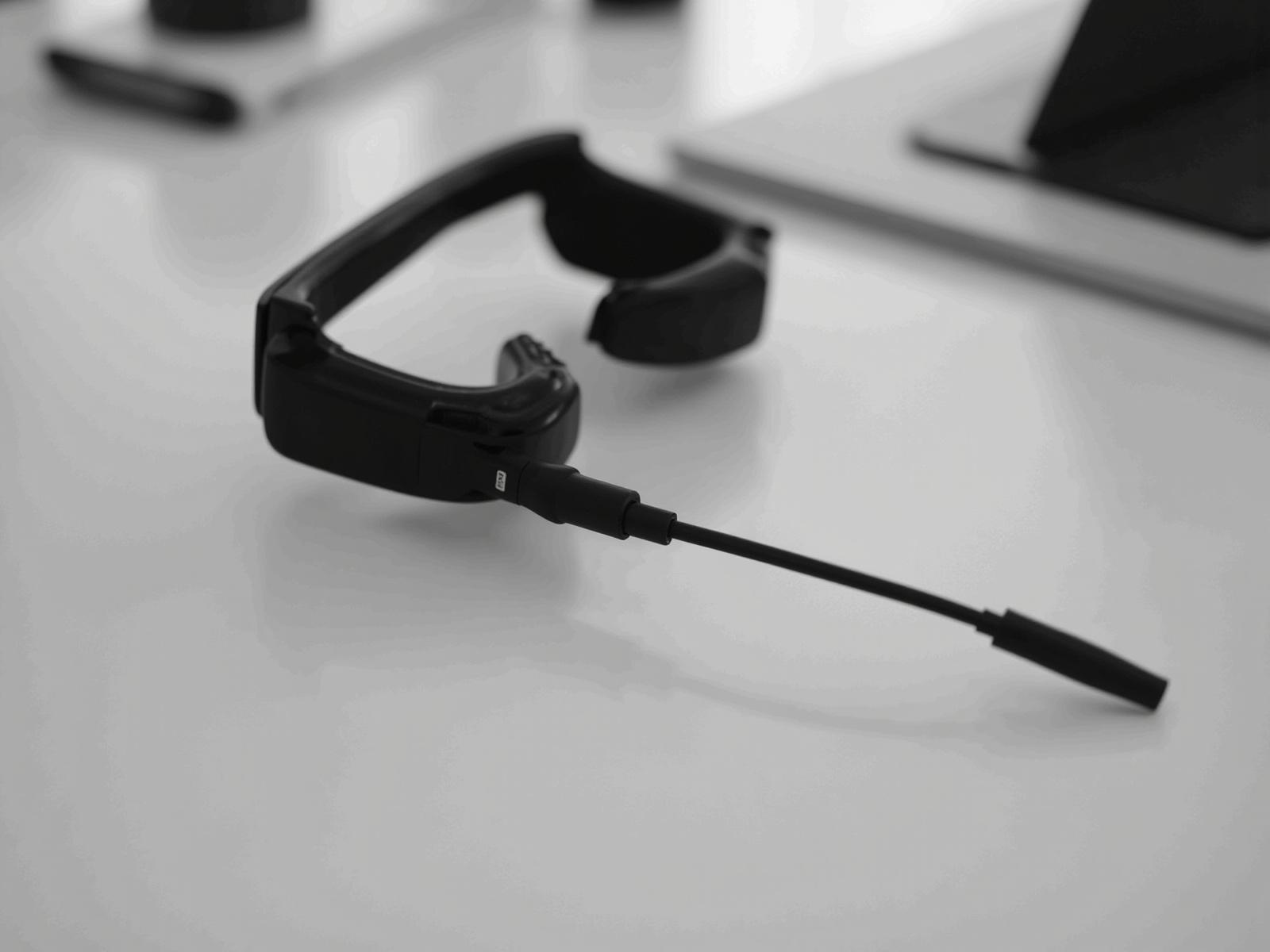
A USB-C port in the temple is a visible detail, and for a fashion channel it is the difference between a product that reads as glasses and one that reads as a gadget. It also wears, and it has to be sealed.
Three charging details are not published and they all belong in the same conversation: the input current and voltage the device accepts, whether the port carries data or supports a wired audio mode alongside Bluetooth, and the charge indication behaviour. If a customer charges from their own adapter rather than the supplied one, the two-hour figure is not a promise.
The accessory question in practice
No model in the published audio range carries a charging-case row, while the camera platforms in the same catalogue do. For a channel that has already designed packaging around a case, that is a packaging decision to take before the first order rather than after it, and the answer to ask is whether a case exists for this model at all — a charging case, a storage case, or neither.
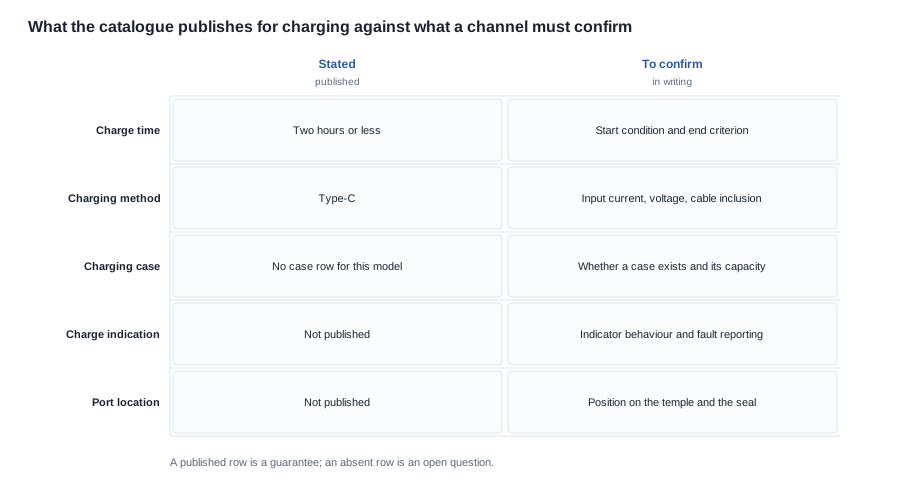
The distinction that costs money is between a row that is published and a row that is simply absent. A published charging time of two hours or less is a guarantee the product does not exceed. An absent row is an open question, and an open question on a retail model becomes a support ticket in week one. The five items in the matrix above are the ones that decide whether the charging experience on the product page matches the box the customer opens.
A second accessory question is the cable. Type-C tells a buyer which cable family to plan the packaging around, and it says nothing about whether a cable is included, what the input rating is, or whether the port carries data alongside charging. For a channel that ships a bare frame to an end customer, the included cable is often the difference between a product that works on arrival and one that needs an accessory sold separately.
The port is a wear item and a seal. A charging socket in a temple is exposed to sweat, dust and pocket friction, and the failure mode is a unit that will not charge in a customer's hand rather than a unit that fails on a bench. That is why the sealing and the indicator behaviour belong in the same conversation as the input current: three small items that decide whether a charge complaint is a one-off or a pattern.
What is the difference between the D11 and the D12, and which should I stock?
The published rows are identical apart from surround sound. The D12 is the value tier of the same platform, and the D11 is the step up. Our documentation does not publish what else, if anything, differs, and we are not going to invent a difference to make the pair look more distinct than it is.
The two answers we give most often
Most of the questions that reach this model arrive in one of two forms, and they deserve two different answers.
The first form asks for a number that exists. How long does it run, how fast does it charge, what Bluetooth version, what capacity. Those answers are on the published sheet, and the right response is to give them with the wording the sheet uses — a runtime of about seven hours, a charging time of up to two hours, a 100 mAh cell, Bluetooth V5.4, Type-C charging, and a surround-sound feature line. The wording matters more than it looks. "Up to two hours" is a ceiling the product does not exceed, and "two hours" is a typical figure that the supplier has not committed to. "About seven hours" is a rating, and "seven hours of playback" is a claim about a condition nobody has published.
The second form asks for a number that does not exist. How much does it weigh, how long is the temple, what is the driver size, what is the ingress rating, is there a case, when can we ship, what is the minimum order quantity. The right response to each of those is the same: it is not published, and here is what we would need in order to publish it. A weight needs a scale reading on a sample. An ingress rating needs a test report. A case capacity needs a specification. A lead time needs a production plan rather than a catalogue row.
Why the second answer is worth more than a guess. A number given at the support desk becomes a commitment the moment a customer relies on it, and a commitment the product cannot keep costs more than a missing row ever did. The buyer who is told "not published, and here is what we would need" can decide whether to pay for the sample, the test or the document. The buyer who is told an estimate cannot tell it apart from a fact, and will treat it as one.
What a channel should do with the second kind of answer. Put it on a register with an owner and a date, close the items that a sample or a document can close, and keep the rest on the product page as a gap rather than a number. The register is short, the answer is written once, and the pages stay correct as the gaps close.
As a range decision, that is simple and workable. The D12 for price-led channels where the sound claim does not help; the D11 where audio is the story and a step up in price can be defended by a feature the customer can hear. If your channel compares on specification sheets rather than on sound, note that the D11's only advantage is a word rather than a number — and make sure your listing does not imply otherwise.
A range decision in practice
The pair is easy to place on paper and awkward to place in a catalogue, because the two models publish the same rows and one of them publishes a feature line. The decision below is the one we would work through with a channel, and every branch is settled by a published row or a printed gap rather than by a preference.
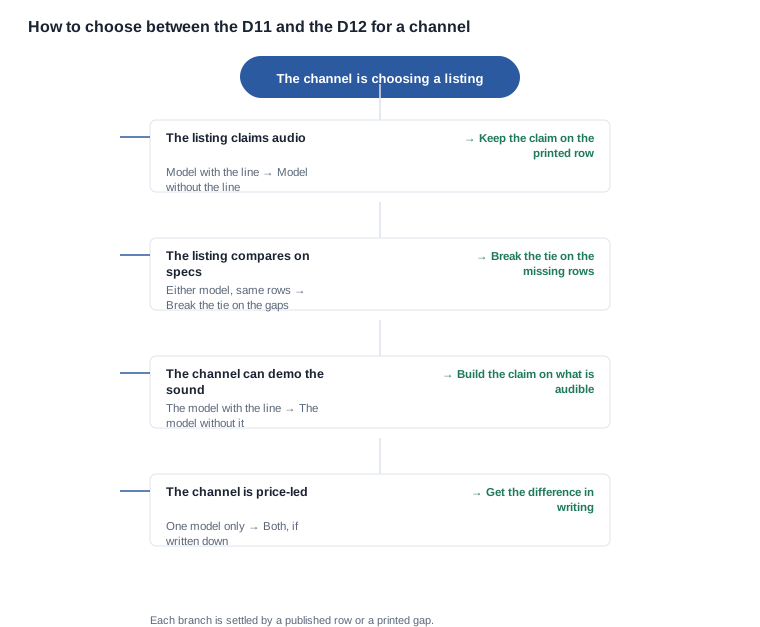
The branch that decides most conversations is the third one. A channel that compares on specification sheets has nothing to choose from, because the only difference is a word. A channel that can demonstrate the difference has a claim, and the claim is worth more than a specification advantage the customer will never see. The branches that follow it are commercial rather than technical: the same product in a different box, or the same product at a different price point, and both need the supplier to state the difference in writing so the listing can be built on it.
What to ask before the range decision is made. Which rows are shared, which differ, and whether the difference is in the hardware, the packaging or the commercial terms. A supplier who answers in writing has given a usable row. A supplier who answers only that the models are different has given the channel a question to put to the next supplier.
Stocking both is a decision with a cost. A range that carries two models with identical published rows creates two listings, two sets of support answers and one honest answer for both of them, and the channel pays for that duplication in stock and in page work. The case for stocking both is a segmentation the published sheet cannot show, and that is exactly the case that has to be argued with the supplier in writing before the packaging is designed.
What about weight, fit and the things we do not publish?
No frame weight, no temple length, no lens dimension and no head-size range are published for this model. This is the row that decides your return rate, and it is the same gap every model in this range carries. The materials and ergonomics guidance covers what to measure once a sample arrives.
Also not published: the control method, the acoustic figures, the ingress protection rating, the certificate numbers and covered model schedules, the storage capacity and overwrite behaviour, the minimum order quantity, the lead time and the price. Our internal documentation currently holds three conflicting minimum order quantity figures that have not been arbitrated, so none of them is going into this article.
If your customer asks a question we have not published, the right answer is that you do not know yet — not a guess from the industry. A number invented at the support desk becomes a commitment, and a commitment your product cannot keep is worse than an honest "we will confirm and come back to you".
The sample checklist that closes the open rows
The gaps above are not unusual for this category, and they are all closable. The order below is the one that costs the least per closed item, because the physical rows are settled on a single unit while the commercial rows are settled in an email.
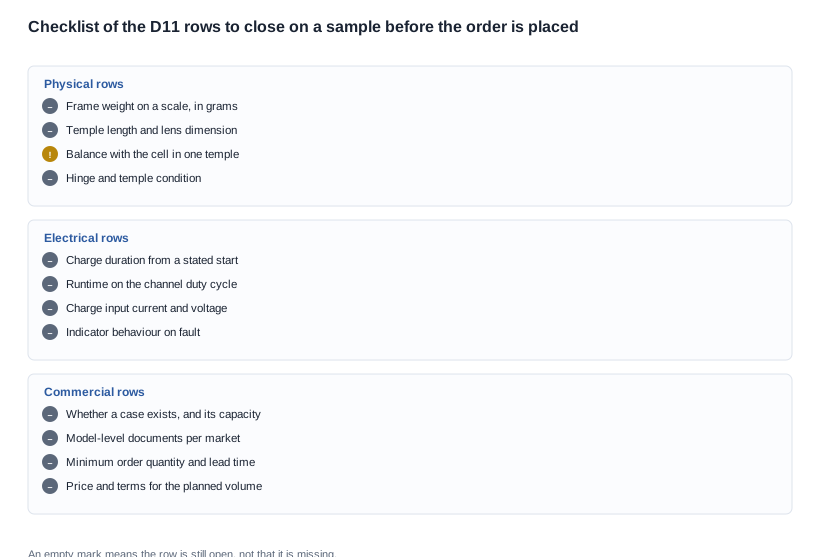
The physical group is the one that cannot be answered later. A weight, a temple length and a balance on one side are properties of the sample in the box, and a channel that ships before measuring them has no way to answer a return reason later. The electrical group behaves the same way: a charge duration and a runtime figure measured on the unit that ships are worth more than a catalogue figure, because they carry their conditions.
The commercial group does not need a sample at all, but it needs a written answer before the order rather than a verbal one after it, because a minimum order quantity or a lead time given in a conversation is not a commitment. A register of what is confirmed, what is open and who is chasing it is the cheapest document in the whole process.
One unit is enough for the physical rows and not enough for anything else. A sample settles the questions about the object in the box, and it cannot settle the questions about the batch behind it: consistency between units, the capacity behind a delivery date, or the certification position for a destination market. Those need documents, and they need them before the shipment rather than after it, which is the difference between a request and a delay.
Where CYNRIN stands on the D11 questions
The D11 is a clean, single-platform product with one real differentiator, and a buyer who understands the surround-sound claim and the missing weight figure can stock it with confidence. What we will not do is turn a published word into a published number, or present a company-level certification position as a model-level document.
Give us the channel, the volume and the destination market and we will send back what we can confirm about the D11 and what we cannot. The category this model sits in is on the Bluetooth audio glasses range page.
Related reading
- How this model sits against a mechanically different platform — D11 against the G07
- The commercial case for this model — D11 value for money
- The trade-offs an open-ear frame carries — open-ear audio
Send the channel, the volume and the destination market, and we will answer with published rows and named gaps.


