

The D11 smart glasses value for money question does not have the answer most buyers arrive looking for, and it is worth being direct about why. Our catalogue publishes no price for the D11, no minimum order quantity, no delivery schedule, no warranty term and no production capacity figure. We will not substitute a typical industry number for any of those, because a buyer who builds a launch plan around an invented figure has no way to audit it later, and the cost of a wrong assumption here is paid in cash rather than in goodwill. What the D11 does publish is a short, specific set of rows: Bluetooth V5.4, a 100 mAh cell, a charge time of two hours or less, a rated runtime of about seven hours, Type-C charging, and a surround-sound feature row. Value is a relationship between a price and a set of capabilities, so the useful question is not whether the D11 is cheap but which commercial questions the published rows can answer on their own, and which ones have to be closed in writing before an order is placed. This page sets out that separation, in the order a procurement team will meet it.
D11 value for money: the question we cannot answer with a catalogue
The rows the D11 publishes, and the rows it does not
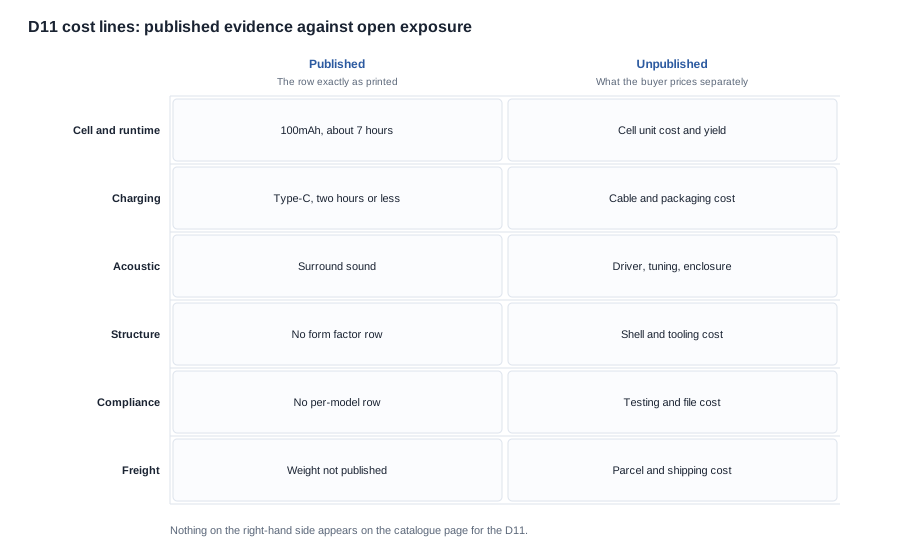
The published D11 rows are short enough to read in a minute. The radio is Bluetooth V5.4. The frame carries a single 100 mAh cell. The charge time is two hours or less, and we treat that as a ceiling rather than a typical value, because the catalogue states a limit and not a measurement condition. The rated runtime is about seven hours. The charging interface is Type-C. Alongside the standard rows, the D11 page carries a surround-sound feature line and a long-battery-life feature line. That is the whole of the published specification.
Everything else is open. There is no driver size, no frequency response, no microphone pickup distance, no frame weight, no ingress rating, no camera, no charging case row, no battery cycle life, no acoustic measurement condition, and no per-model certification row. Our catalogue carries an export certification page that belongs to the company, and the content on it is images rather than text; the catalogue wording leaves CE, FCC and RoHS unnamed, and not one per-model certification row appears anywhere.
Why an unpriceable product can still be assessed
A buyer who wants a verdict cannot get one from us, and a buyer who wants a method can. The method is simple: separate the quotation into the lines that a published D11 row already supports, and the lines that are currently a promise. A quotation that says "cell: 100 mAh" and a quotation that says "cell: 100 mAh, 5-year cycle life at 80% retention, tested at 0.2C" are not comparable, even though the first figure in both cases is the number we publish. The second quotation is more useful, but only if the test behind the second figure can be produced and repeated.
That separation is the entire subject of this page. It is also the reason we do not divide the range into price tiers. Structural grouping is a legitimate tool: you can group the D11 with the models that share its single-cell Type-C architecture, and you can group the models that use paired cells with magnetic charging. What you cannot do is call one group entry, another mid and another premium without publishing the prices that define the boundaries, and the boundaries would change with volume, configuration and payment terms anyway.
What a D11 assessment has to end with
A finished D11 assessment is not a judgement about value. It is a list of the questions that have been closed, the questions that remain open, and the commercial terms that the buyer will accept once the open ones are answered. The rows below are the checklist that produces that list.

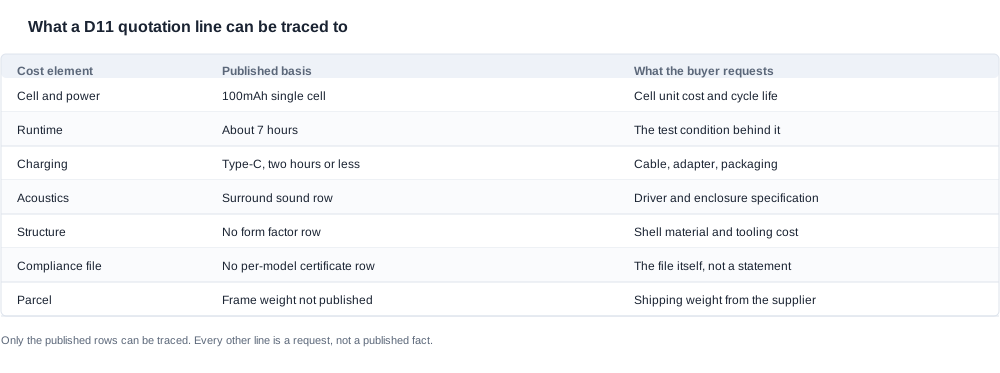
Tracing a D11 quotation back to the rows that support it
The seven lines a D11 quotation should itemise
A D11 quotation is useful when it is broken into lines that can each be checked against a published row or against a document the supplier can produce. Seven lines are worth insisting on:
- The frame cell. The published D11 row is 100 mAh, single cell. Anything else in the quotation is a different product.
- The runtime basis. The published figure is about seven hours. The question is what workload produced it.
- The charging interface. Type-C is published, so the connector type is settled and the in-box cable question is a real question with a real answer.
- The charge time condition. The published figure is two hours or less. The condition attached to it is not published.
- The acoustic configuration. A surround-sound row exists. The driver and enclosure behind it are not published.
- The accessory and packaging content. No charging case row exists for the D11, so what ships in the box is a quotation item, not a specification.
- The documentation pack. Which file, covering which model designation, is supplied with the shipment.
Where two D11 quotations usually separate
The separation almost never happens on the rows we publish, because those rows are the same for every buyer. It happens on the five items that follow them: the actual unit cost of the cell and the enclosure, the acoustic configuration, the accessory content, the freight weight, and the compliance documentation.

A useful discipline for procurement teams is to write the check down before the quotations arrive, in a single sheet that has one row per question and a column for the answer, the document behind the answer, and the date it was received. When two suppliers are compared, the sheet is the comparison. Comparing two totals on a summary line is how accessory and freight differences end up discovered after the first shipment.
A worked example of two D11 quotations
Take two quotations for the same D11 configuration at the same quantity. The first lists a single line for the unit, mentions the 100 mAh cell and the Type-C interface, and states a total. The second lists the unit, the cell, the acoustic configuration, the box contents, the documentation pack, the packed weight, the inspection terms and the delivery schedule as separate lines, and states a total at the bottom.
The second quotation is longer, and the temptation is to treat the first as the better commercial offer because it is easier to read. In practice the second is the only one a buyer can act on, because the first leaves the five variables that determine the shipment cost unpriced. Once the second quotation is completed, the line items that usually move are the acoustic configuration, the accessory content and the packed weight, and each of them moves for a reason that is visible in the line itself. A buyer who arrives at a second quotation has no idea whether an increase in the acoustic line came from a different driver, a different enclosure or a different supplier, and therefore cannot decide whether to accept it, negotiate it, or scope it out.
The pattern repeats on the commercial side. A quotation that separates the unit price from the tooling, the packaging and the documentation lets a buyer move a cost between categories, and a quotation that does not makes that impossible. Total cost analysis only works when the total is decomposed, and the decomposition is what a buyer should demand before asking anyone to reduce a number.
Failure modes worth naming
Three failure modes account for most of the trouble buyers report in this range, and all three are visible in advance.
The first is a claim built on a feature row. A surround-sound line becomes a sound quality claim, a Bluetooth version becomes a performance claim, and the listing page then promises something the catalogue never published. The remedy is procedural: every claim in the copy is traced to a row, and the rows that are features are described as features.
The second is a cost line that appears only after the order. The frame weight was never asked for, so the freight calculation changed at the shipping stage, and the price that had been agreed turned out to exclude it. The remedy is the same request list used above, sent before the order, with freight weight and packed weight treated as mandatory answers.
The third is a comparison between two suppliers that were never asked the same questions. One supplier answered a runtime question with a number and the other with a description, and the buyer compared the two responses as if they were the same kind of object. The remedy is a single request form sent to both, with the same wording and the same number of questions, and an explicit instruction that a refusal to answer is a valid answer that goes into the comparison as such.
The cost drivers behind a D11, and the evidence each one needs
Cell, runtime and the power path
The D11 publishes a 100 mAh cell, which places it at the top of the capacity range among the audio models we list, and it publishes about seven hours of rated use. That combination matters commercially in a way that a bare capacity figure does not: a single larger cell usually means fewer cells to assemble, balance and protect, and a simpler pack. It also means the runtime figure is not simply a function of capacity. Elsewhere in the same range, paired 55 mAh cells publish runtimes from about six to about eight hours, which tells you that cell capacity and cell count are not what set the outcome. The remaining drivers are amplifier efficiency, firmware power management and the test conditions, none of which are published for any model.
So what can a buyer legitimately do with the D11 row? A buyer can state that the D11 carries a 100 mAh cell. A buyer can state that the catalogue rates it at about seven hours. A buyer cannot state that the D11 outlasts a model with a smaller total, cannot convert seven hours into a working day, and cannot use the figure to plan a multi-shift pattern without asking for the workload that produced it. The battery comparison across the range sets out why the runtime rows resist the comparison buyers want to make.
Audio, structure and the accessory chain
The D11 publishes a surround-sound row and no acoustic figures. That is a feature line, not a measurement, and the difference matters to a channel that intends to put a sound claim in its listing copy. Without driver size, frequency response, leakage figures or a test method, a buyer can honestly write "surround sound" and attribute it to the catalogue, but cannot write "clearer calls", "bass you can feel" or anything comparative. For a brand owner, the request to the supplier is straightforward: ask for the acoustic configuration and the measurement method behind it, and if the answer is that no measurement exists, the listing copy has to stay inside the feature row.
The structural side is thinner still. The D11 publishes no form factor row, no weight, and no material information. That means the shell, the temple, the hinge and the frame weight are all commercial variables that only appear once a supplier prices them, and it means the parcel cost cannot be estimated from anything in the catalogue. The customisation options available in this range are the other side of the same coin: what a brand owner can change about a D11 is a question for the supplier, not a line in our catalogue.
Compliance, freight and the paperwork behind them
Two commercial lines are almost always underestimated in an audio glasses quotation. The first is the documentation. Our catalogue publishes no per-model certification row, and the text contains no reference to CE, FCC or RoHS, so a buyer who needs a compliance file for a market has to request it and inspect it. The relevant European radio requirement sits under the Radio Equipment Directive, framework reference 2014/53/EU, and it attaches to a specific configuration; a restricted-substance file is separate work. Whether the certificate names the D11 under its exact designation is the row that stops orders more often than any specification question, and the way to close it is to ask for the document rather than for a statement. The certification status across the range explains the difference between a company-level page and a model-level file.
The second is freight. No weight is published for the D11, and no charging case row exists, so both the parcel volume and the shipping weight are unknown until the supplier answers. In a channel where the parcel is the product for the first thirty seconds, that is a real cost line, and it is a request rather than a published fact.

Turning an open D11 row into a written answer
Eight open rows for the D11, sent once rather than pieced together
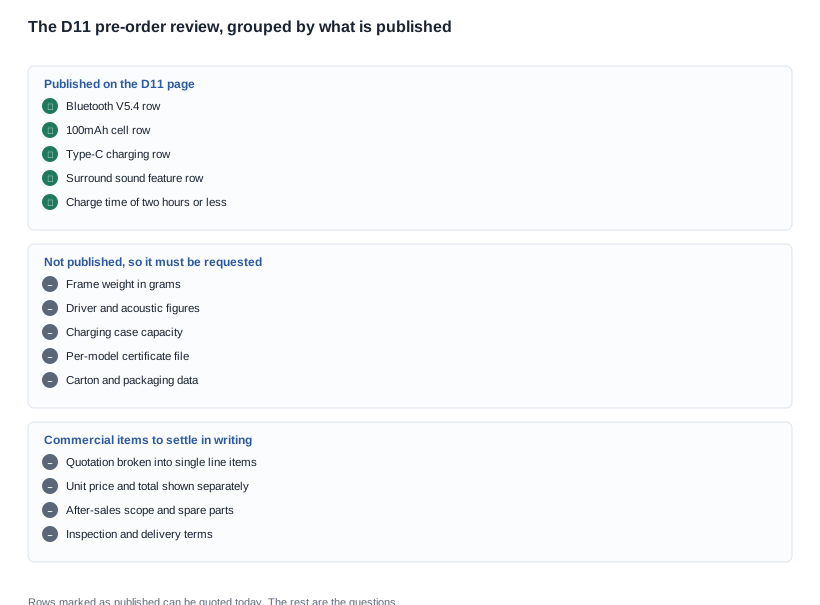
An open row becomes closable when a supplier has answered it in writing, with a document or a stated method attached. The request list for the D11 is short, and it is better sent once than pieced together over weeks:
- The acoustic configuration behind the surround-sound row, with the measurement method if one exists.
- The runtime workload, volume level and pairing state that produce about seven hours.
- The charge time under a stated start state, and the definition of the end point.
- The measured frame weight, and the packed weight including any accessory.
- The exact box contents, including whether a cable is supplied and whether any case is offered.
- The certification file that names the D11 under its exact model designation.
- The cell specification and its cycle life, if a file exists.
- The material and hinge description, in enough detail to write a listing page.
The acceptance rule for an answer
Not every answer is a closure. The acceptance rule we suggest is deliberately strict: an answer is accepted when a second buyer could repeat the same question, get the same answer, and reach the same conclusion. A figure without a method fails, because the next shipment may differ. A method without a figure fails, because it cannot be published. A statement that a document exists fails, because documents expire, get reissued and get superseded.
Where an answer cannot be obtained, the correct commercial response is to narrow the claim rather than to keep the question open indefinitely. A channel that cannot get a weight can still sell a D11, it simply cannot promise lightness, and it can say so internally without saying it in public. A channel that cannot get a workload figure can still use the catalogue runtime, provided the listing copy attributes the figure to the catalogue rather than presenting it as a measured result.

A hypothetical D11 order, worked through
The following is a constructed buying situation, not a customer project, and it is included because the reasoning generalises better than any conclusion would.
A channel that already sells connected audio accessories is considering adding the D11 to a range that ships to three markets. The commercial situation is straightforward: the D11 fits the product category, the Type-C interface matches the cable the channel already puts in every parcel, and the surround-sound row gives the listing copy something specific to say. Nothing about the acoustic quality is known, and nothing about the weight is known.
The first step is to write down what the channel actually needs, before any quotation arrives. Two requirements are hard: the parcel must not grow, because the channel's freight cost per unit is already fixed against a given box size, and the listing copy must not contain a claim the channel cannot evidence. One requirement is soft: the customer should be able to use the product for a typical working day without planning around a charger.
Applying the published rows to those requirements produces three different kinds of answer. The parcel requirement is a real risk, because the D11 publishes no charging case row and no packed weight, so the box content is unknown and could go either way. The copy requirement is comfortable, because a feature line can be used in the listing if it is attributed rather than embellished. The endurance requirement is unanswerable from the catalogue, because about seven hours is a rated figure with no attached workload, and the only way to settle it is to run the workload the channel's customers actually generate.
The second step is to send one request covering the open rows, in a single form, to whichever suppliers are being considered. The form asks for the acoustic configuration, the runtime workload, the charge time under a stated start state, the frame and packed weight, the exact box contents, the certification file naming the exact model designation, the cell specification, and the material and hinge description. Eight questions, one form, one date for the answers.
The third step is where most buyers stop too early. The answers arrive and they are uneven: one supplier answers the weight and the acoustic configuration clearly, and gives a runtime figure with a method; another answers the weight but declines the acoustic question; a third answers the acoustic question and leaves the certification file question open. The correct response is not to rank the three suppliers on how complete their answers look, but to map the answers onto the requirements. A complete answer to a requirement that is not binding is worth less than a partial answer to the requirement that decides the shipment.
The fourth step is a written record. Every answer is filed against the requirement it serves, with the document attached and the date of receipt noted. Where an answer is missing, the requirement is either narrowed in the listing copy or removed from the brief. In this constructed case, the outcome is a channel that can order the D11 for a use case that does not depend on the missing answers, with two specific claims removed from the copy, and a written list of the questions that remain open for the next quotation round.
That outcome is not a verdict on value, and it is not a recommendation. It is the normal state of a D11 sourcing process: the published rows narrow the field, the written answers price it, and the two together are what the buyer can commit against.
What we can and cannot say about the D11
The boundary this page draws
We publish the electrical rows and the feature rows for every model in the catalogue, and we publish nothing else. For the D11 that means Bluetooth V5.4, a 100 mAh cell, a charge time of two hours or less, about seven hours of rated use, Type-C charging, a surround-sound line and a long-battery-life line. We do not publish a price, so we cannot tell a buyer whether the D11 represents good value in the marketplace, and we will not describe it as the best value in the range, because that claim would require exactly the figures we do not publish. We also do not publish a weight, so we cannot describe the D11 as light or comfortable, and we do not publish a frame weight for any model except one in the camera range, where the catalogue states it explicitly.
This is a limitation we accept rather than a stance we defend. A catalogue that published every number would be more useful on a web page and less useful in a negotiation, because the buyer would still have to verify the numbers that drive cost. The buying guide for this range sets out the same principle for the category as a whole.
Which D11 requirements are specifications and which are questions
If you are evaluating the D11, send us the model, the quantity you have in mind and the target market, and we will tell you which configurations exist, which rows are published for them, and which of your requirements are currently questions rather than specifications. We will also tell you which questions we cannot answer ourselves, so that your supplier request list starts from the real gaps rather than from a generic checklist. On our side, we will not return a price without a written line-item breakdown, because a number without its line items cannot be compared against another supplier's number. That is the whole of the D11 smart glasses value for money question: the published rows tell you what the product is, the written answers tell you what the shipment will be, and the two together are what a buyer can actually buy against.


