

A form factor comparison between the D11 and the G07 has an unusual shape, and it is worth stating the shape before the details, because most of the useful content on this page is about what cannot be compared. The G07 publishes a form description: an ultra-slim temple that detaches. The D11 publishes no form description at all, only its electrical rows and its feature lines. Neither model publishes a frame weight, and no model in our range publishes a weight except one camera model, where the catalogue states it explicitly. So the comparison has exactly one positive form fact on one side, a complete absence of weight on both sides, and a different charging architecture on each side, because the D11 charges over Type-C and the G07 charges magnetically. That is a smaller amount of published form information than a buyer usually expects between two models in the same family, and the honest way to write about it is to work with the shape rather than around it.
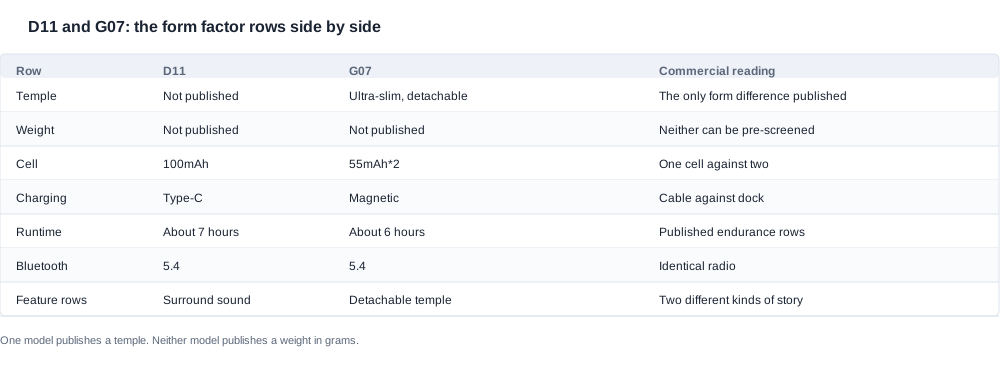
D11 and G07: one publishes a temple, neither publishes a weight
The published rows, read strictly
The D11 publishes Bluetooth V5.4, a single a charge time of two hours or less, 100 mAh cell, a rated runtime of about seven hours and Type-C charging, and it carries two feature lines: a surround-sound line and a long-battery-life line. The G07 publishes Bluetooth V5.4, 55mAh*2, a charge time of two hours or less, a rated runtime of about six hours and magnetic charging, and it carries one feature line describing an ultra-slim, detachable temple. That is the complete published specification of both models.
Everything a buyer would use to answer a form question is absent from both pages. There is no frame weight for either model. There is no temple length, no bridge measurement, no lens dimension, no material, no hinge type, no colour, no lens tint, no ingress rating, no camera and no charging case row for either. The catalogue publishes no touch row for any model in the range, so the interaction method on both is also unstated, as are the microphone specifications and the acoustic figures that would tell a buyer how the two sound against each other.
The G07 temple is the only published form difference in the audio range
The G07's detachable temple is worth more attention than it first appears, because it is nearly unique in the catalogue. Across the whole range, only three models publish a detachable component: the V06 and the S7 publish a detachable inner frame, and the G07 publishes a detachable temple. Everything else in the catalogue publishes a fixed structure.
That has two commercial consequences, and a buyer should hold both at once. The first is favourable: a detachable temple is a genuine product story for a channel, a point of difference in listing copy, and a structure that suits a brand owner who wants a configurable frame. The second is less comfortable: a detachable part is a spare-part commitment, and it is a design with a fatigue and failure mode that a fixed temple does not have. The catalogue publishes neither the number of cycles the joint survives, nor whether spare temples are supplied, nor how a replacement is obtained, nor what a replacement costs.
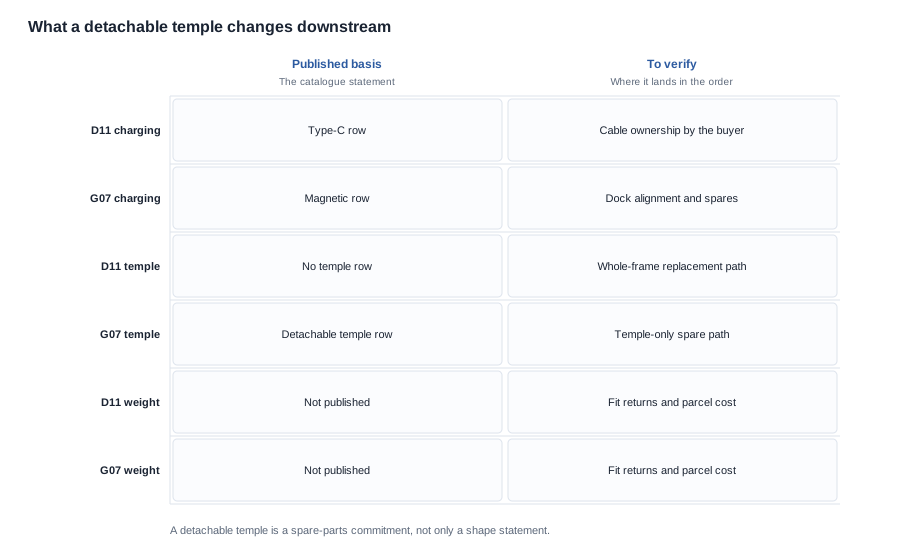
What the D11's silence means commercially
The D11's silence on form is not a defect in the comparison, it is the comparison. A model with no published form description cannot be pre-screened against a model with one, and any buyer who has seen a G07 sample and is now looking at a D11 sample is doing the work the catalogue declined to do. In practice that means two things happen on the sample bench that never happen on a specification sheet: the shape is judged against the channel's own customer base rather than against numbers, and the replacement question gets asked for the first time.
The buyer-side consequence is a budget question. Any comparison of these two models that is not settled by the specification has to be settled on samples, and samples cost money, time and a round trip. A buyer who has not budgeted for that will end up making the decision on the specification, which is where the two models are least distinguishable, because the specification is nearly identical on the radio and differs only on cell architecture, endurance and charging method.

What a detachable temple changes downstream of the catalogue
From a shape line to a spare-parts line
A detachable temple is a structural commitment, and it propagates in three directions that a fixed temple does not.
First, the accessory chain. A fixed frame is replaced as a frame. A temple that detaches can be replaced on its own, which means the channel has a spare-parts decision to make: which temple lengths to stock, in what quantity, and whether they are sold as an accessory or as a warranty replacement. The catalogue publishes nothing about this, so the buyer either requests a spare-parts list or accepts a support cost that will appear later in the form of a replacement request per unit sold.
Second, the service path. A detachable joint is a joint, and a joint is where a design either holds or fails. The catalogue publishes no cycle rating, so the only way to know is to cycle it: remove and refit the temple a number of times on a sample and watch for play, noise or difficulty. A buyer who has never handled a detachable temple will over-estimate the difficulty of the operation, and a buyer who has handled one badly will under-estimate it, and both of them will be wrong about the customer experience.
Third, the packaging. A detachable temple can be shipped disassembled, which reduces the parcel volume, or assembled, which does not. Nothing in the catalogue says which, and the difference is a freight line and a customer-experience line at the same time.
The two charging architectures and what each obliges
The D11 charges over Type-C. The G07 charges magnetically. This is the other published difference between them, and it is not a form difference at all, which is exactly why it is useful to mention in a form comparison: it changes the physical relationship between the product and its environment.
A Type-C device is charged by plugging a cable into a socket on the frame, which means the charging moment is a visible, deliberate act that happens at a desk, at a car, or wherever a socket happens to be. A magnetically charged device is charged by seating it on a dock, which means the charging moment is a placement act, and placement acts go wrong when the alignment is not obvious. Magnetic charging also implies a dock in the parcel or a dock on the accessory list, and neither model publishes a case row, so the dock question is open for the G07 in the same way the case question is open for the D11.
Where the two models sit in the same range
Structurally, the D11 and the G07 belong to different parts of the audio range. The D11 shares its single-cell Type-C architecture with the D12, which publishes the same rows plus no feature line at all. The G07 shares its paired-cell magnetic architecture with the LC-105-1 and the LC-105-2, which publish 55mAh*2 and about eight hours, and with the YK12, which publishes the same cell and the same six hours with a surround-sound and slim-temple feature line. The practical point for a buyer is that the form difference between the two models is also a difference in how the two products are supplied: one needs a cable, the other needs a dock.
Settling form factor on a sample, because the pages cannot
The measurement protocol we would use
Since no weight is published for either model, the first thing a sample bench has to establish is a measured weight, using one scale and one method, for both. Comparing a published figure for one model against a measured figure for the other is the standard error, and it produces a decision that cannot be repeated. If both are measured on the same scale, in the same state, with the same accessories in the box, the result is at least internally consistent, and it can be repeated when the next shipment arrives.
The second thing to establish is temple geometry, on both models, including the G07 with its temple detached. If the temple detaches, the frame has to be held in some way while the temple is fitted, and that is a step a customer performs. The bench should record how long it takes, whether the action needs both hands, and whether the frame can be charged while the temple is off. That last question is not published for either model and is directly relevant, because a detached temple on a magnetically charged frame may or may not seat on the dock.
The third thing is the charging behaviour. On the D11, the connector has to be found and plugged in, on a frame whose form the buyer has not seen before. On the G07, the dock alignment has to be discovered. Both are one-time learning tasks for the customer, and both belong in the quick-start material, which is a packaging cost rather than a product cost.

What a sample can settle that a page cannot
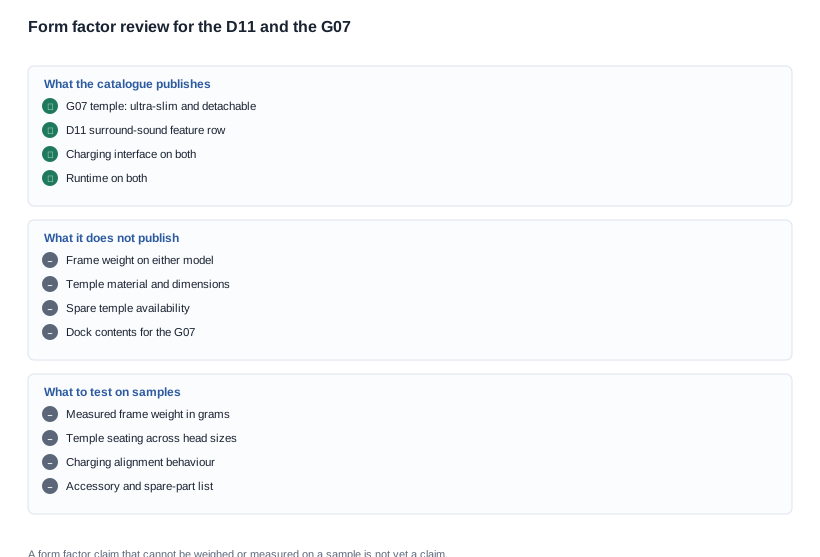
A sample settles the questions the catalogue leaves open, and it is worth being specific about which ones, because the list is finite and short.
- The measured frame weight, and the packed weight with the box contents in place.
- The size of the frame and temple relative to the channel's existing range, which is a comparison the buyer can make and the catalogue cannot.
- The sound of both models in the same room, which is a subjective judgement but a real one, and which no published acoustic figure replaces.
- The behaviour of the G07 temple through repeated refitting.
- The charging behaviour of both interfaces, including the time a customer actually needs for a full charge under ordinary conditions.
- The parcel: what is in the box, how large it is, and what the customer has to find to make the product work.
Freight, documents and model match: the part a sample leaves open
A sample settles experience, not cost, and it does not settle compliance. It does not tell a buyer what the shipment will cost, what documentation will travel with it, or whether the model designation on the certificate file matches the model in the box. Those remain written-answer questions, and they are the ones that stop an order. The buyer review approach in this range sets out how the two kinds of question are usually sequenced in practice.

Questions to put to a supplier about the G07 temple
The spare-parts question
The single most useful question about the G07 is not about the temple itself, but about the temple after the first hundred units. A buyer should ask what spare temples exist, in which lengths, at what quantity, whether they are sold separately, and how a customer obtains one. A supplier that answers with a parts list and a mechanism has closed the row. A supplier that answers with a statement that the temple is durable has not, and the difference between those two answers is the difference between a serviceable product and a service cost.
The documentation question
The catalogue publishes no per-model certification row, and the text contains no reference to CE, FCC or RoHS, so nothing about market access can be concluded from the G07 or the D11 pages. The question to ask is which file covers the exact model designation, and to ask for the file rather than a statement about it. The same file question applies to any private-label version, because a configuration change can change the answer. The certification position for this model family sets out the distinction between a company-level page and a model-level document.
The questions that only a supplier can answer
- Which temples are available as spares, in which lengths and at what quantity.
- How the joint is retained, and what the design does to prevent a detached temple from being lost.
- Whether the frame charges with the temple removed, on both models.
- The measured frame weight for each model, and the packed weight.
- The temple material and the hinge construction.
- Whether the G07 dock is supplied with the product, sold separately, or optional.
- The acoustic configuration behind the D11 surround-sound line, and whether the G07 has an equivalent.
- The file that covers each model designation for the target market.
A selection path for the D11 and the G07, without a price list
The four questions that decide the pair
When two models publish one form difference and no weight, how to choose between them comes down to four questions, and the order matters because each one can end the process.
Question one: does the channel need a form story at all? If the channel sells on audio, sound and call quality, the G07's detachable temple is a merchandising asset with a cost attached, and the D11's surround-sound row is a different asset. If the channel sells on durability, on a product that gets handled roughly, the detachable joint is a question rather than an asset, because the catalogue publishes no cycle rating and no spare-parts list. This is the first question because it decides whether the form difference is relevant at all.
Question two: what does the customer carry, and what must be in the box? A Type-C device needs a cable, which most customers already own, and the D11 therefore implies a smaller parcel. A magnetically charged device implies a dock, and the G07's dock is not published in any list, so the parcel question is open. For a channel working on freight cost per unit, this question usually decides more than the form question does.
Question three: how long is the working period, and is the endurance row the binding constraint? The D11 rates about seven hours and the G07 about six, and neither figure carries a published workload, so the two are not strictly comparable. The buyer should ask what workload produced each figure, and if the supplier gives the same workload and the same conditions for both, the difference becomes usable. If the figures cannot be tied to a common workload, the endurance row should be dropped from the comparison and treated as a claim each model carries separately.
Question four: what can the sample bench actually settle? Weight, geometry, temple behaviour, charging behaviour, parcel contents and sound. That is the list from the previous section, and a buyer who cannot fund it should not make the decision on the specification, because the specification is where these two models are least distinguishable.
Criteria that cannot be traded, and criteria that can
A shortlist built from a pair like this needs a split between the criteria that are requirements and the criteria that are preferences, because the whole point of the exercise is to avoid negotiating on the wrong things.
The criteria that cannot be traded for a D11 and a G07 are the ones that make the product unusable if they fail: the charging interface the channel has already committed to, the certification file for the target market, the accessory content the parcel plan assumes, and the endurance the customer's working period requires. The criteria that can be traded are the ones that make the product better: the form story, the spare-parts convenience, the size of the temple, and the acoustic description.
The trade-offs worth writing down are short. A detachable temple costs a spare-parts obligation. A Type-C interface costs a box-content saving and a visible charging moment. A longer rated endurance costs an extra cell and a different charging method. A surround-sound line costs a claim that has to stay inside the feature row. None of these are costs in the price sense, and each one is real.
What to ask before you order
Before any order is placed, the D11 and the G07 comparison needs a written record on six items: measured frame weight for each model, temple and material description, the charging interface and dock content for each, the runtime workload behind each endurance figure, the acoustic configuration behind the D11 feature line, and the certification file for each exact model designation. A supplier that answers all six produces a document a buyer can order against and a support team can quote. A supplier that answers two produces a quotation, and a quotation is not the same thing as a specification.
The same request should go to every supplier in the shortlist, in the same form, because a comparison between suppliers is only meaningful when the questions were identical. Where a supplier declines a question, that refusal is itself an answer and belongs in the comparison.
Where the comparison ends and the quotation begins
The D11 and the G07 are not a form comparison in the sense a buyer might want, and it is better to say so than to construct one. The published record gives one model a temple, gives both models the same radio, gives them different cell architectures, different endurance figures and different charging methods, and gives neither model a weight. A buyer who needs more than that has to buy a sample, and the sample has to be measured properly or the comparison will be made on impressions.
We publish the rows we have and nothing else, so on this pair that means Bluetooth V5.4 on both, a 100 mAh single cell on the D11 against 55mAh*2 on the G07, about seven hours against about six, a charge time of two hours or less on both, Type-C against magnetic, a surround-sound line on the D11 and a detachable ultra-slim temple on the G07. We publish no weight, no dimensions, no material, no per-model certification row, no price and no delivery schedule, so none of those appear here.
What we will do is tell you which of the two architectures a given requirement actually depends on. Send us the channel, the customer profile, the target market and the quantity you are working with, and we will map your requirements onto the published rows, tell you which of them can be settled from the catalogue and which have to be closed with the supplier, and flag where the G07's detachable temple is a genuine advantage for a channel and where it becomes a spare-parts obligation. The sizing considerations in this range cover the customer-side questions that a detachable temple makes more visible, and the charging options across the audio family cover the accessory consequences of the two different interfaces.


