
The published row for this model is Bluetooth V5.4, a single 100 mAh cell, Type-C charging with a charge time of two hours or less, a rated runtime of approximately seven hours, a surround-sound feature line and a long-battery-life feature line. Seven items, and every one of them is a real published row rather than an inference.
That makes the D11 an unusually clean specification to read, and it also means there is exactly one row on the sheet that a customer can perceive — the surround-sound line. Everything else describes how the device behaves electrically. A buyer who reads the sheet as a list of seven specifications will have a wrong impression of how much marketing room the product has, and a buyer who reads it as a list of seven things to interrogate will find that five of them are already closed.
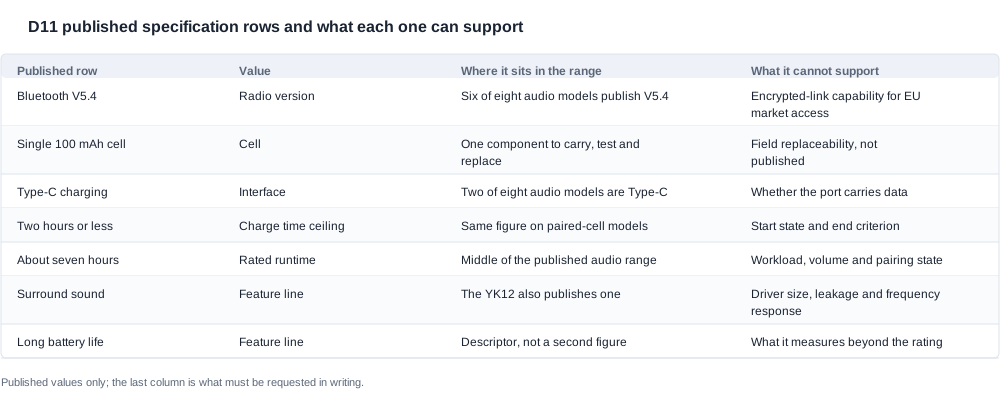
D11 specifications: five electrical rows and two feature lines
The electrical rows, in the catalogue's own terms
The charging interface is Type-C. The frame carries one 100 mAh cell. The charge time is two hours or less. The rated runtime is approximately seven hours. The radio is Bluetooth V5.4. Five rows, each of them a single value with no second value attached.
Two of the five carry a qualification that is part of the row rather than a comment on it. The charge time is a ceiling: the catalogue states how long the charge may take, not how long a particular charge took, and there is no starting state and no end criterion, so "two hours from empty" and "two hours from a partial charge" are different statements and the documentation does not say which one it means. The runtime is a rating: approximately seven hours is published with no workload, no volume level and no pairing state, so the figure describes a duty cycle and a test method rather than a cell. Our battery specification guidance sets out the questions to ask before either figure goes into a comparison sheet.
The two feature lines
The D11's product page carries a surround-sound line and a long-battery-life line. That is the entire feature content of the page. There is no driver size, no frequency response, no leakage figure, no microphone count, no pickup distance, no form-factor line, no material line and no weight line.
Within the eight-model audio range, only three models publish a feature row at all. The D11 publishes a surround-sound line and a long-battery-life line. The YK12 publishes a surround-sound line and a slim-temple line. The G07 publishes an ultra-thin detachable-temple line. The K01 and the LC-105-2, the D12 and the K02, and the LC-105-1 publish no feature row whatsoever.
That distribution is the single most useful thing to know about the feature content of this range. It means a feature row is not the norm, it is the exception, and choosing a model because it publishes one is a real decision with a real cost attached: the feature is a marketing hook that has to be defended, and it has to be defended with a description rather than with a number.
What the sheet does not contain
The following are absent for the D11, and their absence is a different kind of fact from the qualifications above. There is no charging-case row. There is no frame weight, temple length, lens dimension or head-size range. There is no ingress rating. There is no charge-indicator row and no charging-input row. There is no runtime test condition. There is no field-replaceability row for the cell. There is no per-model certification row. There is no price, no minimum order quantity, no lead time, no warranty term and no production capacity figure.
Some of those rows exist for other models and not for this one, which is the interesting case, and the section on the difference between an absent row and an unconditioned row deals with it directly.
Reading each published row against the range
The radio version, and how small the difference is
Bluetooth V5.4 is the current published version and the D11 is on it. In the audio range, six of the eight models publish V5.4 — the LC-105-1 and the YK12, the D11 and the LC-105-2, and the D12 and the G07 — while the K01 and the K02 publish V5.3. The D11 is therefore one of six models on the newer version and is not one of the two on the earlier one.
What the version buys in practice is connection stability and power-management behaviour, and it is the version that maps onto the encrypted-link capability that European market-access discussions tend to raise. Our Bluetooth connectivity guidance covers what the version differences actually change for a channel.
What is worth saying plainly is that the radio version is a weak differentiator in this range, because most of the range is already on it. A buyer who selects on radio version is selecting against two models, and a buyer who selects on a feature row is selecting against five.
The cell, and why one is the interesting part
The D11 carries a single 100 mAh cell. Six of the eight audio models carry two cells: the K01 and the K02 publish 90 mAh × 2, and the G07 and the LC-105-1, and the YK12 and the LC-105-2 publish 55 mAh × 2. The D12 shares the D11's single 100 mAh cell, and the D17, in the sport range, publishes a single 115 mAh cell.
Two consequences follow and one does not. One cell means one component to carry, one to test at incoming inspection and one to replace, and a different internal layout and balance from every paired-cell model. Whether the cell is field-replaceable is not published for any model in the range, so that one unknown decides whether a channel's spare-parts line is a cell or a whole temple assembly.
What does not follow is a different charge time. The published figure of two hours or less applies to single-cell and paired-cell models alike, so the cell count does not produce a different headline number and must not be read as if it did.
The interface, and the split across the whole catalogue
Type-C is published for the D11, and within the audio range it makes the D11 one of exactly two models on that interface, alongside the D12. The other six audio models publish magnetic charging.
Across the full twenty-eight model catalogue the split runs seven models on Type-C against seventeen on magnetic. The seven are the V03 Pro, the L2 Utral, the D11, the D12, the D17, the ZH12 and the bone-conduction model. The interface is therefore a family-level filter rather than a rare option, and it is a filter a buyer can apply before any specification comparison begins.
The runtime, and the two-hour spread on identical cells
Approximately seven hours places the D11 in the middle of the published audio range, with no test condition attached. The number that makes the range hard to compare is that it publishes a two-hour spread on identical cells: the LC-105-1 and the LC-105-2 publish approximately eight hours on 55 mAh × 2, while the G07 and the YK12 publish approximately six hours on exactly the same 55 mAh × 2 cell configuration.
Whatever separates those two pairs is not the battery, which means a runtime figure in this category is a statement about a duty cycle and a method rather than about a cell. A comparison chart that puts the LC-105 pair at the top of a runtime ranking is making a claim the published rows do not support.
The difference between an absent row and an unconditioned row
Three states, not two
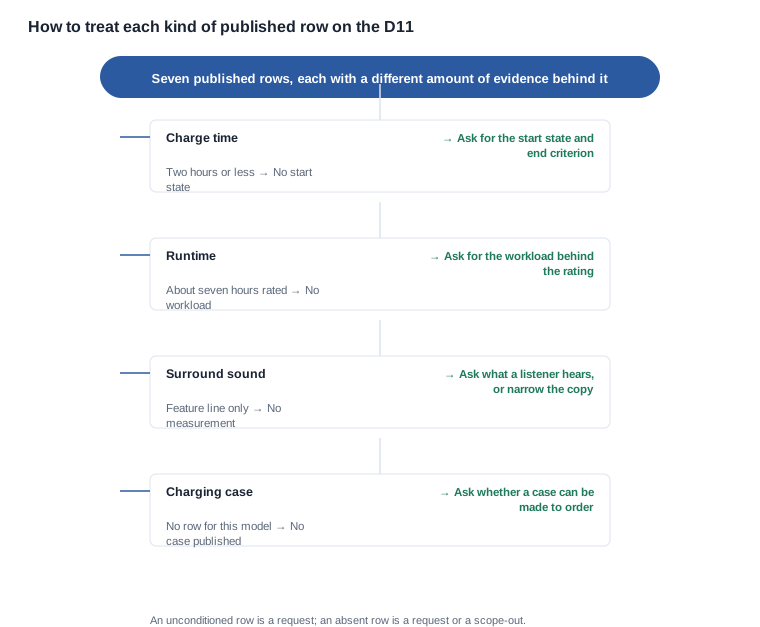
A buyer reading a catalogue tends to divide missing information into two piles: published and not published. That division is too coarse to work with, because it hides the difference between a row that exists but lacks a condition and a row that does not exist at all. Three states matter commercially.
Published and conditioned. The figure exists and the condition behind it is stated. This is the easiest state to work with and the rarest one in this catalogue.
Published and unconditioned. The figure exists and no condition is attached. The charge time of two hours or less is the clearest example: the number is real and it is a ceiling, but without a starting state and an end criterion it cannot be turned into an interruption time. The approximately seven-hour runtime is the second: the number is real, and without a workload it cannot be turned into a shift plan.
No row at all. The information is simply absent. The charging method is the instructive case. Four camera models — the CY03 and the MT6, and the CY05 and the L1 Pro — publish no charging-method row at all, and all four publish a charging-case capacity, so the absence of a method row is not the same as the absence of a case. Four camera models, the V03 Pro and the V03, and the S7 and the V06, publish no charging-case row, which is an absence rather than a statement that they have no case. The case question for those four is therefore a request, not a reading.
Why the distinction decides what happens next
Each state leads to a different action, and confusing them wastes the most valuable resource in a sourcing process, which is the supplier's willingness to answer.
An unconditioned row leads to a request for the condition. It is a short, answerable question: what start state and what end criterion for the charge time; what workload, volume and pairing state for the runtime. A supplier can usually answer both, and once answered the published figure becomes usable. These are the cheapest gaps to close in the whole range.
A row that does not exist leads to a request for the information, and sometimes to a decision. The question is longer: does the feature exist, does it apply to this configuration, and if it exists why is it not written down. That question has three possible answers, and the answer determines the action. If the feature does not exist, it is scoped out of the proposition in an afternoon. If it exists and is simply undocumented, it becomes a specification item with a sample to test. If it exists only on a different configuration, it becomes a different model on the shortlist.
Getting these two apart in advance is what separates a request list that gets answered from a request list that gets ignored.
The rows that belong to the camera range, and why a buyer should know them
Several rows a buyer will look for on the D11 are published on camera models, and the fact that they are published elsewhere is exactly what makes them worth asking about.
The charging-case capacity is the clearest case. Five camera models publish one: the L1 Pro, the CY05 and the CY03 — each at 1400 mAh, the L2 Utral with either a 900 mAh or a 1400 mAh option, and the MT6 with a folding 1200 mAh case. Two more, the KY06 and the MT5, have a case without a published capacity. No audio model publishes any case row, which means the mid-day top-up story lives in the camera range and not in this one.
The ingress rating is the second case. Only two models in the entire catalogue carry one: the V06 and the S7, both camera models, both marked IP54. A D11 buyer who needs a wet-environment brief is not looking at a range where the answer is published elsewhere; the answer has to come from a supplier.
The weight is the third case, and it is the one most often misused. The only published weight anywhere in the catalogue is the MT6's 158 g, and that figure is the weight of the glasses body including its cell and camera, excluding its folding charging case. It belongs to a camera model and it must not be carried across into an audio listing as though it described the D11, or a frame, or a comparable product.

The feature lines, and what they license
The surround-sound line
The D11's page carries a surround-sound line and the YK12's page carries a surround-sound line too, in English, alongside a slim-temple line. Those are the two surround-sound rows in the audio range. The D12, the G07, the K01, the K02 and the LC-105 pair publish none.
What is published is the word. There is no leakage figure, no driver size, no frequency response, no microphone count and no pickup distance for this model or for any other in the range. The family-level technical description covers an open-ear acoustic structure, directional audio and intelligent noise reduction, which is a platform statement rather than a measurement of the unit in the carton.
So the claim has a shape and the shape is narrow. A listing may say that the D11 publishes a surround-sound row and attribute it to the catalogue. It may not say the model is louder than another, leaks less, has larger drivers or is better on calls, because each of those needs a number that does not exist and each is the kind of claim a retailer, a reviewer or a competitor will ask to see the basis for.
The long-battery-life line, and why it is not a second runtime
The D11's second feature line is a long-battery-life line, which is a marketing descriptor for the approximately seven-hour rating. It is not an additional figure, and it is not a measurement of anything the runtime row does not already cover. A listing that quotes seven hours and then also quotes long battery life as a separate specification is presenting one number twice.
The same discipline applies to the YK12's slim-temple line and the G07's ultra-thin detachable-temple line. Those are structural descriptors. The G07's detachable temple is the reason a broken arm is not necessarily a written-off product, which is a service and return-rate consequence rather than a comfort or style one, and it is the kind of feature a channel with a long returns loop can use commercially without any measurement behind it.
The open-ear consequence
An open-ear frame played loudly in a quiet space is audible to the people around it. That is a property of the acoustic structure and it applies across the range, but a model with a surround-sound claim invites the customer to play it louder in order to hear the difference, which makes the interaction more likely. Our open-ear audio guidance covers the trade-offs that the missing acoustic numbers would otherwise cover.
Turning the sheet into a written specification
What goes into the specification annex
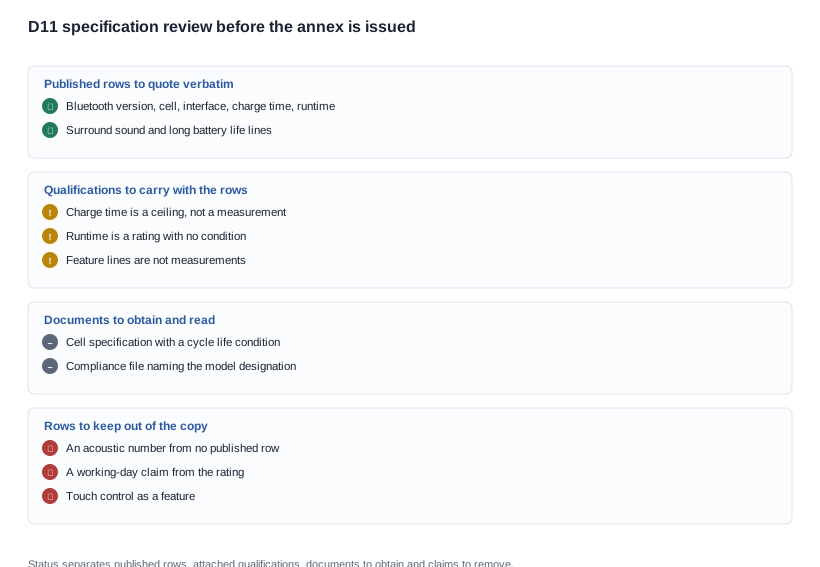
The published sheet is the starting point for a specification, not the specification itself. A specification annex that a buyer can hand to a supplier, a factory and an auditor should contain seven kinds of statement.
First, the published rows quoted verbatim, with the catalogue identified as the source, so that both sides are working from the same numbers and neither side can claim a different version of them. Second, the qualifications attached to those rows — the ceiling on the charge time and the absence of a condition on the runtime — written out rather than assumed. Third, the rows that are absent, listed explicitly as absent, so that a supplier is asked about them rather than left to guess whether the buyer cares. Fourth, the documents that will close those rows, named individually. Fifth, the claim set the listing copy will be allowed to use, with the permitted wording for each published figure. Sixth, the inspection method that will be used at incoming inspection. Seventh, the review point at which each still-open row is re-tested.
Which rows to request, in what order
Three questions close most of the value, and they are cheap. What workload, volume and pairing state produce the approximately seven-hour rating? What start state and what end criterion apply to the two-hour-or-less charge time? Is the cell field-replaceable, and how is a failed unit handled? Each one is a short answer, and each one converts a published-but-unusable figure into a specification a factory can build and an auditor can check.
Two documents close the rest of the material risk. The cell specification, with any cycle-life figure and the condition behind it, because a cycle number without a charge rate, a temperature and a retention threshold cannot be used. And the compliance file that names the D11 under its exact model designation, because the relevant European radio requirement sits under the Radio Equipment Directive, framework reference 2014/53/EU, and it attaches to a specific configuration. Our catalogue publishes no per-model certification row, and the catalogue text contains no reference to CE, FCC or RoHS, so the file has to be requested and read rather than assumed.
The acceptance rule for a row
The rule should be written before the answers arrive, and it should be strict on purpose: a row is closed when a second buyer could ask the same question, receive the same answer and reach the same conclusion. A figure without a method fails, because the next lot may differ. A method without a figure fails, because it cannot go into a specification. A statement that a document exists fails, because documents expire and get reissued, and a buyer holding a statement rather than a file has nothing to audit at the next supplier audit.
Where a row cannot be closed, the correct response is to narrow the claim rather than to hold the row open indefinitely. A channel that cannot establish a charging-input specification can still order the model, and it simply does not promise the customer that their own adapter will reach the published ceiling. A channel that cannot establish field-replaceability can still order the model, and it budgets a whole-unit replacement.

The limits of the published sheet
We publish the electrical rows and the feature rows for every model in the catalogue, and we publish nothing else. For the D11 that means Bluetooth V5.4, a single 100 mAh cell, a charge time of two hours or less, an approximately seven-hour rated runtime, Type-C charging, a surround-sound feature line and a long-battery-life feature line. We do not publish a price, a minimum order quantity, a delivery schedule, a warranty term, a production capacity figure, a frame weight, an acoustic figure, a charging input, an indicator behaviour, a cell cycle life, an ingress rating or a per-model certification row, and we will not substitute a typical value for any of them.
We will not add a number to the surround-sound claim, we will not present the approximately seven hours as a working day, and we will not fill the acoustic, ingress, control or certification rows with values from the industry — because the industry-typical value is how a product ends up failing its own specification sheet.
What we will do is tell you which rows exist, which ones do not, which of the missing ones we can close for you on request, and where this model sits against the rest of the family. The model-level fit is in D11 best for, the questions buyers ask about it are in D11 common questions, and the family is on our Bluetooth audio glasses range page.
The six open rows to close before you order
Five electrical rows and two feature lines are enough to describe the D11, and they are not enough to order it. The rows a buyer has to close before the purchase order is issued are the ones the catalogue deliberately leaves open: the acoustic specification, the frame weight, the charging input, the ingress position, the certification file for the destination market, and the commercial terms. Each has a different owner, and each changes the order in a different way, which is why a single generic request list produces a single generic answer.
The order in which the questions to ask are put is the order in which an unanswered row becomes expensive. Ask the acoustic question first, because a channel that intends to make a sound-quality claim cannot revise that claim later without revising the packaging. Ask the certification question second, because it has the longest lead time and it gates the market rather than the unit. Ask the weight question third, because it feeds the freight line. Ask the commercial terms last, because they are the only row that can be renegotiated after the product questions are closed.
That sequence is not a style preference. It is the order of consequence: the acoustic row becomes a claim on the listing, the certification row becomes a delay at the border, the weight row becomes a freight surprise, and the commercial row is the one that waits for everything else. A buyer who negotiates first and asks afterwards spends the negotiation on the wrong variable, and a buyer who treats all six rows as equally urgent reaches the purchase order with six open questions instead of with a specification.
Send us the channel, the volume, the target market and the claims you intend to make, and we will come back with the rows that support them and the ones that do not. That is the whole of the D11 smart glasses specifications and features question: five electrical rows and two feature lines tell you what the model is, the written answers tell you what the shipment will be, and the two together are what a buyer can commit against.
Related reading
- Where this model fits against the family — D11 best for
- The questions buyers ask about it — D11 common questions
- What an open-ear frame actually gives up — open-ear audio
Tell us the channel, the volume and the target market, and we will come back with what is available.


