

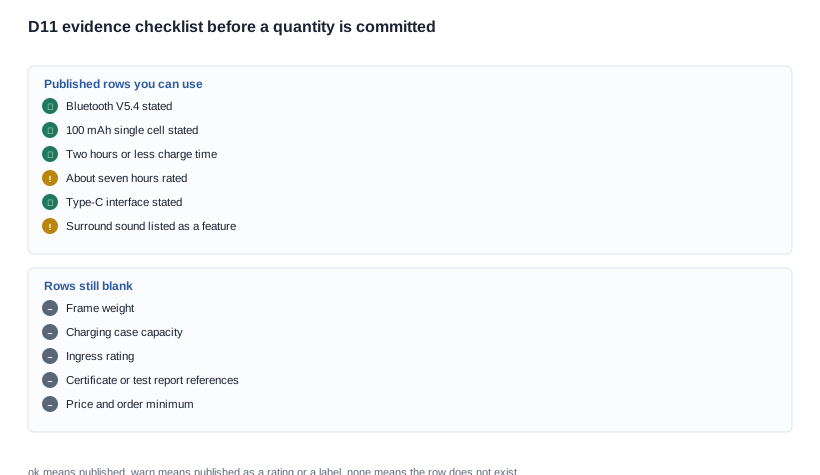
The D11 publishes Bluetooth V5.4, a 100 mAh cell, a charge time of two hours or less, an endurance rating of about seven hours, Type-C charging and a surround-sound listing. Those six rows are the entire published specification of this model, and for a buyer whose channel is already standardised on Type-C they are unusually load-bearing.
This is a screening method, not a recommendation. The catalogue publishes no price, no minimum order quantity, no lead time and no weight for this model, so nothing here can tell you whether it is good value for your business — and any article that claims to is guessing. What it can do is set out which published row decides the outcome once your interface standard is fixed, which rows are blank and will stay blank, and what to put to the supplier before a quantity enters a quotation. The short version: this model fits a channel that has already committed to one cable and one charging routine, and it fits poorly into a channel whose proposition rests on measured acoustic performance, because no acoustic measurement is published for it or for anything else in the range.
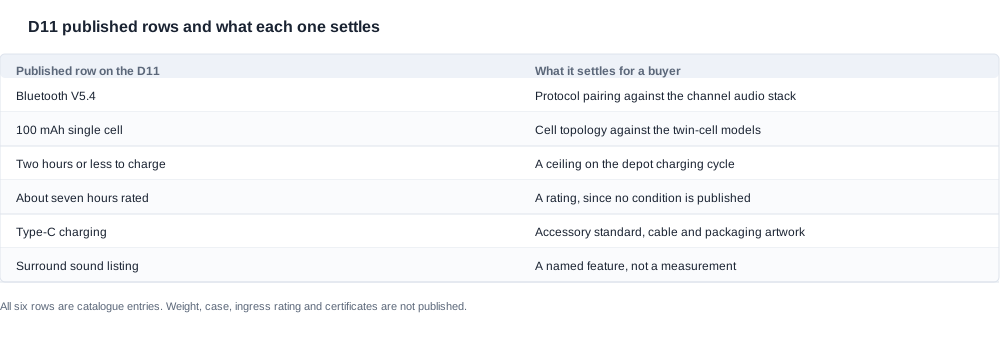
| Published row on the D11 | What it settles for a buyer |
|---|---|
| Bluetooth V5.4 | The protocol pairing profile against the channel's existing audio stack |
| 100 mAh single cell | Cell topology, and whether the alternative is one cell or two |
| Two hours or less to charge | A ceiling on the depot charging cycle, not a measured cycle |
| About seven hours rated | A rated figure, because no test condition is published |
| Type-C charging | The accessory standard, the cable and the packaging artwork |
| Surround sound listing | A named feature, not an acoustic measurement |
Every cell in that table is a catalogue row. Every row the catalogue does not contain is a question to ask rather than an assumption to make, and the largest cluster of them sits on the physical and compliance side: no frame weight, no charging-case row, no ingress rating, no certificate reference and no test report naming this model.
D11 smart glasses best for a Type-C standardised channel
The interface row does more work than any other row here
In a catalogue where most rows are absences, a stated interface is unusually valuable. The D11 states Type-C. So do the ZH12 and the D17, the V03 Pro and the L2 Utral, and the D12 and the bone-conduction model — seven of the twenty-eight published models. The remaining twenty-one split into seventeen that state magnetic charging and four that publish no charging method at all: the CY03, the CY05 and the MT6, and the L1 Pro.
That distribution matters when you are building a channel. A stated interface is a fact you can put in artwork, in a packing list and in a compliance file. An unstated interface is an open question you have to close with the supplier before any of those three documents can be finalised. For a channel that has already standardised on USB-C at the counter, in the depot and in the support workflow, the D11's interface row removes a variable rather than adding a specification — and in a category where most comparison tables are made of blanks, removing a variable is worth more than adding one.
The cost of that statement is that it does very little else. It says the product charges over a standard connector. It says nothing about how much current the device accepts, whether the port carries data, whether it supports a wired audio mode alongside Bluetooth, or how the charge indicator behaves. Those four items are all unpublished for this model, and each one is a support contact waiting to happen if your customer charges from their own adapter instead of the one in the box.
The second row is a named feature, and nothing more
The D11's catalogue page carries two feature rows: surround sound and long battery life. The D12's page carries none at all. The LC-105-2 and the LC-105-1, and the K02 and the K01 also carry none. That makes the D11 one of only five models in the whole catalogue with any acoustic descriptor — the YK12, the YKC02 and the D17 publish surround sound in their own words, and the ZH12 publishes a stereo surround line in Chinese.
If your channel needs a feature to name on a listing, this model has one. Understand what that supports. A listed feature is not a measured result: no driver size, no frequency response, no leakage figure, no microphone count and no pickup distance are published for any audio model in this range. The row is a name on a page. It can support a category position and a product title. It cannot support a comparison against another brand, because the other brand's figure is not available either, and it cannot support a superlative, because there is no baseline to be superior to.
The long battery life row deserves the same treatment. About seven hours is already published as a number on the same page, and the feature row is a restatement of it in marketing form rather than an additional fact. Treat the two as one line of evidence, not two.
Who this model is not for
If your proposition leads on endurance, the D11 is mid-range in its own family. The K01, the K02 and the LC-105 pair publish about eight hours, and the D17 and the ZH12 publish a charge time of about one hour — the only two models in the catalogue that do. The 55 mAh twin-cell models are the opposite trade: the G07 and the YK12 publish about six hours on the same paired cells the LC-105 pair rates at eight, which is the clearest published evidence in the catalogue that these endurance figures were not taken under one protocol.
If your proposition leads on repairability, the D11 has no published answer at all, while the G07 publishes an ultra-thin detachable temple and the YK12 a slim temple. A detachable arm changes the economics of a returns loop. A model with no published replacement strategy does not.
If your proposition leads on acoustic performance, this model cannot carry it, and neither can anything else in the catalogue. The distinction is that some models at least publish a feature label you can name.
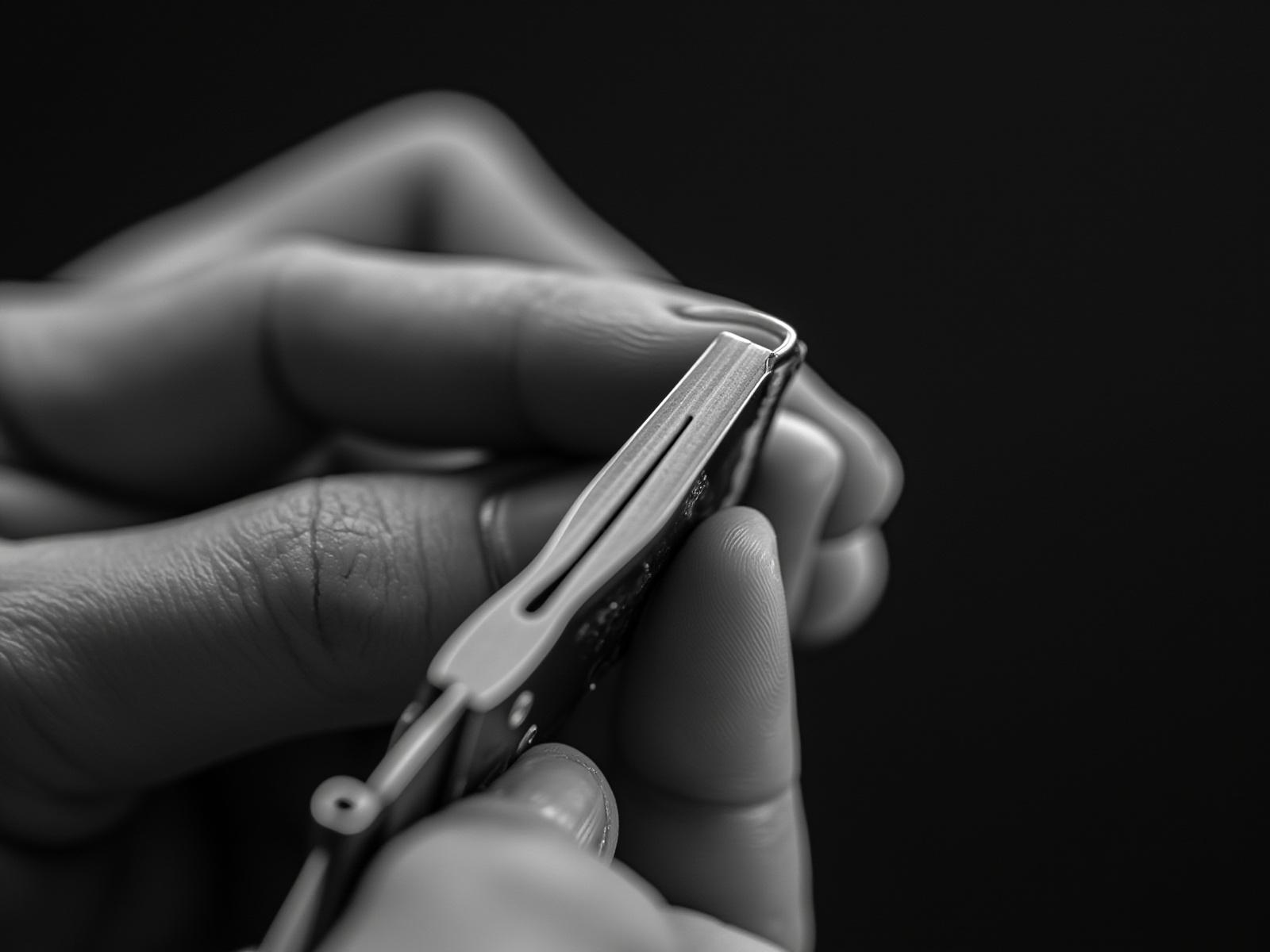
D11 screening criteria once the interface is fixed
Once the interface question is settled, the remaining screening runs on three gates, each of which can end the evaluation on its own. The sequence below is the order we would run them in, because two of them can close the evaluation before the third is reached.

Gate one: is the interface actually stated on the model page
The test is simple and it is worth applying to every model on a shortlist, not just this one. Find the model's own page in the catalogue and read the charging row on that page, rather than reading it from a comparison table, a trade show listing or a previous quotation. Four of the twenty-eight models have no charging row on their page at all, which is an absence rather than a statement of either method, and the difference between "charges magnetically" and "nothing published" decides whether you can put an icon on the carton.
For this model the answer is Type-C, which is a statement. That closes the gate.
Gate two: one cell or two
The D11 publishes a single 100 mAh cell. Across the eight audio models the alternatives are paired: the K01 and the K02 publish 90 mAh × 2, the LC-105-1, the LC-105-2, the G07 and the YK12 publish 55 mAh × 2. Read as cell values multiplied by cell count, the D11 is the only single-cell model in the audio family, and the derived totals are 100, 180 and 110 mAh respectively — derived figures, not catalogue numbers, and worth labelling as such in any internal model you build.
The commercial consequence is not the number. It is what happens at the end of a charge cycle. A single-cell model has no second cell to fall back on: when it is flat, it is flat. A twin-cell model can in principle keep the other temple working. For a channel whose product is used away from a charger, that tolerance is a real product property, and it is not published as such for any model — it follows from the cell topology and has to be confirmed with the supplier.
The counter-argument is on the packaging side. One cell means one battery document in the transport file rather than a paired pack, and one charge point rather than a case with its own interface.
Gate three: can the endurance rating be quoted at all
About seven hours is published. The condition it was measured under is not. A rating without a condition is usable for internal planning and dangerous for a product page.
Three questions separate the two uses. Was continuous playback running, or was the device mostly idle? Was the Bluetooth link active and paired throughout? Was the figure taken on one unit or averaged across a batch, on new cells or cycled ones? A supplier who answers all three clearly has given you a figure you can build a page around. A supplier who cannot has given you a number to set expectations below.
The published charge time needs the same discipline. Two hours or less is a ceiling. It is not a claim that the product charges in under two hours, because the difference between a ceiling and a measurement is the difference between "at most two hours" and "always less than two hours" — and only the first one is what the catalogue states. It is also a ceiling without a stated starting state: no catalogue entry says what percentage of charge the device is at when the two-hour window begins, and none says what counts as a full charge.
The rows that stay blank whatever the answer
Four rows are blank for this model and cannot be closed by any amount of reading:
- Frame weight. Not published for any audio model in the catalogue. The only published weight in the whole document belongs to the MT6 camera model, at 158 g for the glasses body including its 265 mAh cell and camera, excluding its foldable charging case. That figure cannot be transferred to an audio model.
- Charging case. No charging-case row is published for the D11. That is an absence, not a statement that no case exists — a distinction that matters commercially, because a case can be added later and would then change the parcel, the accessory line and the battery transport file.
- Ingress rating. Not published. IP 54 appears on only two models in the catalogue, the V06 and the S7.
- Certification. The catalogue carries a company-level export certification page whose content is images rather than text — ten patent certificates, eight appearance-design patents and two utility-model patents — and the catalogue text contains no reference to CE, FCC or RoHS anywhere. There is no per-model certification row for the D11 or for anything else.
The absence of a touch row deserves its own line, because it is the item buyers in this category ask about most often and it is not there for any model. The catalogue publishes no touch row for any of the twenty-eight models, and the only control-surface line anywhere in the document belongs to the AR glasses model, which publishes an indicator light and button control. Whether the temple of this model carries a touch surface, and how it is configured, is a question for the supplier.
D11 against the models on the same shortlist
The D12, and the two rows that separate them
The D12 publishes the same five standard rows as this model: Bluetooth V5.4, a 100 mAh single cell, a charge time of two hours or less, about seven hours and Type-C charging. Its catalogue page carries no feature rows at all. So on published evidence the two models are identical on every electrical and interface line, and this one adds two feature rows the other does not: surround sound and long battery life.
A buyer with both on a shortlist therefore has a decision that is about range architecture and packaging rather than about specifications, because the specifications are the same. If you need two SKUs, the honest basis for splitting them has to be something the catalogue can evidence; if it cannot, one SKU is the defensible answer. The D11 and D12 price positioning analysis works through what the possible answers mean for the range.
The magnetically charging alternatives
The eight audio models divide cleanly once you put the interface in front of you: two charge over Type-C and six charge magnetically. The magnetically charging group covers the K01 and the K02 at 90 mAh × 2 and about eight hours, the LC-105 pair at 55 mAh × 2 and about eight hours, and the G07 and the YK12 at 55 mAh × 2 and about six hours.
If your channel's accessory standard is magnetic, this model is out of scope and the comparison that matters is between those six, which the D11 how it compares article sets out in full.
The models that charge faster
The D17 and the ZH12 publish a charge time of about one hour and are the only two models in the catalogue that do; every other one, including this one, publishes two hours or less. Both also charge over Type-C. The D17 publishes 115 mAh and about seven hours; the ZH12 publishes 100 mAh and about eight hours. If a fast cycle is a commercial requirement of your channel — a single-shift product in a high-turnover retail environment, for instance — those two rows are the ones to compare against this model's, and they are the only published rows in the catalogue that can support that argument.
The twin inside the camera family
One more shortlist risk is worth naming, because it is not visible from an audio range at all. The catalogue contains a separate family of eleven camera models, and four of them — the L1 Pro, the MT6 and the CY03, and the CY05 — publish no charging method, while the catalogue's camera models otherwise split across magnetic and Type-C. A channel that may migrate from audio to camera products later should establish its interface standard once, because four models in the camera family will not tell you which they use.
D11 risks that only appear after the first shipment
The endurance-to-expectation gap
The published rating is about seven hours. A customer who uses the product continuously on a desk for a working day will exhaust it, and will describe that as a product that dies by lunchtime. The gap between a rated figure and a customer experience is exactly where returns come from, and it is closed by one thing: a stated test condition, published on your own page, alongside the number.
This risk is amplified by the interface choice. A Type-C product is easy to charge and therefore likely to be charged opportunistically; a magnetically charging product with a case is more likely to be topped up. Neither is wrong, but the expectation you set in the listing has to match how the product is actually recharged in your channel.
The case you did not budget for
No charging-case row is published for this model, and for no audio model in the catalogue. Every one of the eleven camera models is different: five publish a case capacity, two publish a case without quantifying it, and four publish no case row at all. Those three states are different from each other and only two of them are declarations; the third is a silence that a buyer has to close with the supplier before the accessory plan is written.
For an audio product this means your packaging decision has no catalogue row to lean on. If a case is planned, its capacity, its own charging interface, its charge time and its weight all become open items, and a case charged by a separate cable is a different accessory from one charged by the same cable as the frame.
Freight and the missing weight
With no published weight, the freight calculation is a guess. This matters more for a single-cell model than a twin-cell one, because the whole battery sits in one temple and the other side carries only electronics — but the asymmetry itself is unpublished too. If you are building a unit-economics model for this model, the weight has to come from a weighed sample, because nothing in the catalogue substitutes for it. The shipping weight analysis covers how to establish the figure and what to do while it is missing.
The documentation gap at customs
Because the catalogue carries no per-model certification row, the conformity file for this model is a document request, not a lookup. The items a distributor will ask for are the same ones for every model: test reports that name this model, certificate or grant references with issuing body and expiry date, the Bluetooth listing and declaration identifiers, and the cell test summary that supports the transport packing instruction. The certification status for this model sets out the full list and who resolves each item.
D11 supplier questions to settle before quoting
Eight questions, in writing, before a quantity is committed. The framing matters: ask for documents that name the model rather than for assurances, because both answers are useful.
- Which conformity documents name the D11 specifically, and from which laboratory?
- What are the certificate or grant references, the issuing body and the expiry date for each?
- What are the Bluetooth SIG listing and declaration identifiers?
- Under what test condition was the seven-hour figure measured — playback, idle or a defined mix — and was the link active?
- Is the figure from a single unit or a batch average, on new cells or cycled ones?
- Which cell is fitted, what is its declared watt-hour rating, and where is its test summary?
- Is there a charging case for this model, and if so what are its capacity, interface, charge time and weight?
- What is the frame weight in grams, and is the port on one temple only?
Two of those questions have a useful second half. A supplier who assembles the file in a few days has a documentation problem. A supplier who confirms in writing that no test report names this model has told you that this product was never separately tested — which is a product decision, not a paperwork delay, and it is yours to accept or reject.
What we will and will not claim about the D11
This model suits a channel whose logistics are already settled and whose listings are functional, and we would rather it were sold on the interface it states than on an acoustic claim that no published figure supports. We will not present surround sound as a measured sound field. We will not present about seven hours as a working day, and we will not convert a ceiling of two hours or less into a promise of a faster charge. We will not quote a weight, a case capacity or a certificate number that the documentation does not contain, and we will not describe a touch control that no catalogue page records.
What we will do is tell you exactly which rows you can build a listing on, which rows you have to close yourself, and which questions to send in writing before you commit a quantity. The published D11 specification list is the honest baseline, the D11 battery life article covers the endurance question in detail, and the D11 buyer review checklist covers the sample-stage work.
Related reading
- The audio range this model belongs to — Bluetooth audio glasses
- Why runtime figures do not compare — D11 smart glasses battery life
- The range comparison in full — D11 smart glasses how it compares
- The sample-stage evidence list — D11 smart glasses buyer review checklist
Give us the target market, the quantity and the required configuration, and we will reply with what is available and what is not.


