

Two models that publish the same radio, the same single 100 mAh cell, the same charge time of two hours or less, the same rated runtime of about seven hours and the same Type-C interface will normally be two commercial positions, and a buyer comparing them will want to know where each one sits. Our catalogue publishes no price for the D11 or the D12, so it cannot answer that, and this page will not manufacture a position out of a feature line and a guess. What the catalogue does publish is one difference between them, and that difference is worth more attention than it first appears: the D11 carries a surround-sound feature row, and the D12 publishes no feature row at all, making it the only one of the eight audio models in our range with nothing on that line. Everything else — cell, radio, charge time, endurance, interface — is identical on the page. A price position built on identical specifications is a position built on nothing, so the useful work is to separate what the two published rows can carry from what a buyer has to obtain in writing before either model can be positioned commercially.
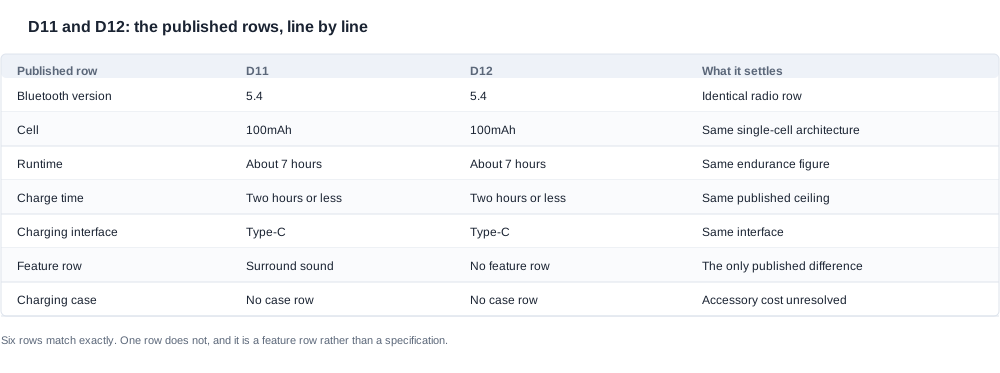
D11 versus D12: one published row separates them
The matching rows, and why matching is not the same as equal
Six rows match exactly between the two models: Bluetooth V5.4, a single a rated runtime of about seven hours, Type-C charging, 100 mAh cell, a charge time of two hours or less, and the absence of a charging case row. On a specification table, two models that match on six rows and differ on one can look like an oversight on our part, and in commercial terms they are the harder case rather than the easy one. When two models differ a lot, a buyer can write a positioning sentence from the difference alone. When they match, the positioning sentence has to come from somewhere else, and if it cannot, the range ends up with two names for the same product and a sourcing team that cannot explain why.
That is the real question behind the D11 against D12 comparison. It is not which of the two is better. It is what a range does with two models whose published specifications are the same.
The one row that is not the same
The D11's page carries two feature lines: a surround-sound line and a long-battery-life line. The D12's page carries none. It publishes the five standard rows and stops. That absence is a published fact, and it is the only published fact that separates the two models.
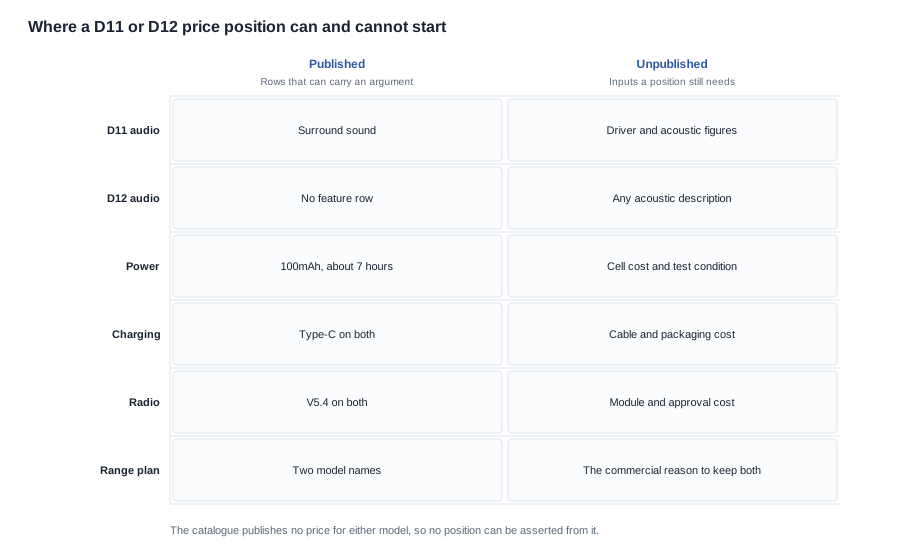
Note what this does and does not tell a buyer. It tells a buyer that the D12 is not documented with a surround-sound configuration, so a listing that needs a named audio feature has a row to work with on the D11 and nothing on the D12. It does not tell a buyer that the D12 has no surround-sound capability. The catalogue publishes no acoustic descriptor for the D12; whether the underlying hardware differs, whether the tuning differs or whether the row is simply absent from the page is not something the text answers, and the honest commercial response is to request the acoustic configuration of the D12 in writing rather than to infer either answer.
What both models do not publish
For completeness, and because it shapes the quotation: neither model publishes a driver size, a frequency response, a microphone pickup distance, a frame weight, an ingress rating, a battery cycle life, a charging case capacity, a per-model certification row or any price. The catalogue holds a company-level export certification page, the content on it being images rather than text, and the catalogue text makes no mention of CE, FCC or RoHS. There is no per-model certification row anywhere in the range. So the specification gap between the two models is narrow, and the commercial gap is wide, because the commercial gap is made of exactly the things the catalogue does not print.
Why a price position cannot be read off a specification sheet
Price positioning is a claim about a market, and the market is not in the catalogue
A price position is a statement about where a product sits relative to competing offers and relative to the expectations of the channel selling it. Two ingredients are needed: a specification that the position can stand on, and a price. We have the first for both models and not the second, so the position cannot be asserted from our catalogue at all.
This is not a gap in the comparison; it is the shape of the question. It also means that any comparison of the D11 and the D12 that ranks them by price is comparing two things we have not published. Where a buyer sees a ranking, it came from somewhere else: a sample order, a distributor conversation, an old catalogue, or an assumption. Each of those is a legitimate input to a commercial decision, and each needs to be recorded as an input rather than treated as a specification.
The four inputs a position actually rests on
A position for either model has to be built from four inputs, and it is worth being explicit about which of them a catalogue can supply.
- The specification. Published for both models, and identical except for the feature row.
- The cost structure. Cell, acoustic configuration, enclosure, packaging, accessory content, freight weight and documentation. None of it is published for either model.
- The commercial terms. Minimum quantity, unit price, tooling, packaging, delivery schedule, payment milestones, after-sales scope. All of it comes from a quotation and none of it comes from a catalogue.
- The demand assumption. What the channel believes it can sell, at what price, in which market. A buyer's own estimate, and the only input on this list that the supplier cannot supply.
A position that is missing input two or three is a guess with a number attached. A position that is missing input four is an internal decision. Only inputs one and four are stable across a buying cycle, which is why a durable position rests on the published rows and on the buyer's own demand estimate, and treats the quotation as a variable to be negotiated rather than a fact to be published.
Where the identical rows create commercial exposure
The identical rows are not neutral. They create a specific exposure that a range with different specifications does not have. When two models publish the same radio, the same cell and the same interface, a buyer who receives two quotations will find that the specification sheets are interchangeable, and any visible difference in the quotations has to come from the lines that are not published. That means the buyer will negotiate against a specification advantage that does not exist, and the supplier will correctly point out that the two products are the same on every published row.
The commercial consequence is a narrow negotiation: the D11 and the D12 can only be separated on the feature row and on whatever the supplier is willing to disclose about the acoustic configuration of each. If that disclosure does not arrive, the range has one product with two names, and the honest response is to consolidate the SKU rather than to invent a distinction in the listing copy. The range-level buying guide covers the same consolidation logic across the whole audio family.
Structural groups, not price tiers
The groups that the published rows genuinely support
The catalogue supports structural grouping because the rows are structural. In the eight audio models, the published architecture splits into a small number of configurations, and the D11 and the D12 sit together inside one of them.
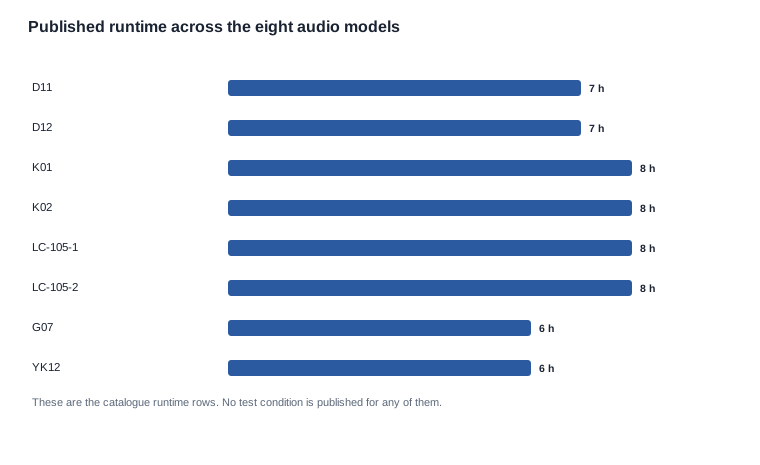
- Single cell, Type-C, about seven hours. The D11 and the D12, both publishing a 100 mAh cell, a Type-C interface and a rated runtime of about seven hours. Within this group the only difference is the D11 feature row.
- Single cell, magnetic, about eight hours. The AR glasses entry, publishing 100 mAh, magnetic charging and about eight hours.
- Paired cells, magnetic, about eight hours. The K01 and the K02, publishing 90mAh*2, magnetic charging, about eight hours and Bluetooth V5.3.
- Paired cells, magnetic, about eight hours, newer radio. The LC-105-1 and the LC-105-2, publishing 55mAh*2, magnetic charging, about eight hours and Bluetooth V5.4.
- Paired cells, magnetic, about six hours. The G07 and the YK12, publishing 55mAh*2, magnetic charging and about six hours.
These are structural groups, and we want to be exact about what they are not. They are not entry, mid and premium tiers. We publish no price, so no boundary can be drawn between groups on cost, and a tier label without a published price is a marketing invention rather than a catalogue structure. The bluetooth audio glasses buying guide uses the same discipline for the range as a whole.
What the grouping tells a buyer
Grouping is useful because it tells a buyer which questions are already answered and which are not. Inside the D11 and D12 group, the radio, the cell, the runtime, the charge time and the interface are all answered by published rows, and the charge-time row is a ceiling of two hours or less rather than a measurement. So a buyer working inside this group can skip five questions and spend the request budget on the acoustic configuration, the weight, the box contents and the compliance file.
Grouping is also useful because it exposes duplication. Two models inside one group, with one feature row between them, is a range design question rather than a sourcing question. A brand owner with a fixed number of listings has to answer it with channel economics; a reseller carrying one model per group has a simpler answer. Neither answer comes from the catalogue, which is why we present the grouping and stop there.
What grouping cannot tell a buyer
Grouping cannot tell a buyer which model in a group a given customer will accept, because no customer-facing attribute is published for either model. It cannot tell a buyer which model has a lower cost, because no cost is published. And it cannot tell a buyer which model a market will pay more for, because there is no price and no demand data in the catalogue. Any of those three questions needs a quotation, a sample, or a channel estimate, and each of them should be recorded as an input with a source attached.

The acoustic row is the only commercial difference you can document
Why a feature line is worth more than it looks
A feature line is unusual in a catalogue full of measurements, because it is the one thing on the page that describes a configuration rather than a quantity. On the D11, the surround-sound line can support a listing sentence in a way the Bluetooth version cannot. The radio row supports a compatibility statement, and a compatibility statement is a technical fact with a narrow commercial meaning. The surround-sound line supports a description of what the product is configured to do, and a description can be differentiated in copy, in naming, in packaging and in the way a channel merchandises the range.
The limitation is equally clear. A feature line is not a measurement, so it cannot be turned into a comparative claim, an acoustic performance claim or a quality claim. The D11 and the D12 are a good illustration of the whole distance between the two: the D11 can be described as a surround-sound configured model and no more, while the D12 cannot be described that way at all, and can only be described by what it does not publish.
Turning the difference into a request
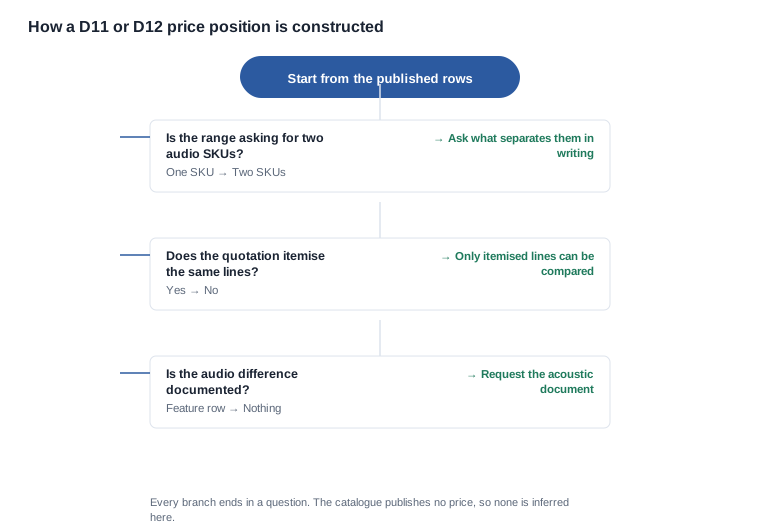
The request that follows from this is short. Ask each supplier for the acoustic configuration behind the D11 feature line, and ask for the acoustic configuration of the D12, in the same form. Three questions do the work: what is the configuration, is it documented, and does the documentation state a measurement method.
If both suppliers answer that the two models are acoustically identical, then the range has one product with two names, and the correct action is to consolidate the SKU and keep the stronger listing, not to write copy that implies a difference the evidence does not support. If the D12 is documented differently, then the D12 has a feature the D11 does not, and the copy should say so. If neither supplier can answer, then the feature difference is unverified, and the D12 has to be positioned on the published rows that it does share with the D11, which is a legitimate position provided nobody claims otherwise.
The commercial weight of an undocumented feature
There is a fourth possibility that buyers often forget, which is that an undocumented feature can carry commercial risk rather than commercial value. If a listing page states a surround-sound configuration for the D11 and the supplier's own documentation does not support it, the claim is exposed in exactly the situation where it is most visible, which is a market inspection or a customer complaint that reaches the supplier. This is a reason to request the documentation even when the answer is expected to be positive, and it is a reason to keep copy inside the feature row rather than around it.

What to ask for before a D11 or D12 quotation is accepted
The quotation request
A single request, sent to every supplier being considered, covering the rows the catalogue does not publish for either model:
- Acoustic configuration for the D11 and for the D12, with the documentation behind it.
- The runtime workload, volume level and pairing state behind about seven hours.
- The charge time under a stated start state, and the definition of the end point.
- The measured frame weight and the packed weight.
- The exact box contents, and whether a cable is included.
- The certification file naming the exact model designation of each model supplied.
- The cell specification and cycle life, if a document exists.
- Material and hinge description, in enough detail to write a listing page.
- Unit price and total cost shown as separate line items, with the minimum quantity, the tooling and packaging charges, the delivery schedule and the payment milestones stated in writing.
Whether a second buyer would reach the same conclusion
An answer is accepted when a second buyer could ask the same question, receive the same answer and reach the same conclusion. A figure without a method fails. A method without a figure fails. A statement that a document exists fails, because a file is what closes the row, not a description of one.
Sequencing matters as much as wording. The acoustic question and the runtime question should go out first, because they determine whether the two models are the same product for commercial purposes, and every later negotiation step depends on that answer. The weight, the box contents and the certification file can follow, because they cost the buyer money but do not change the range structure. Asking everything at once tends to produce a partial answer to a long form, and a partial answer to a long form is harder to use than a complete answer to a short one.
The three failure modes specific to two near-identical models
The first failure mode is copying a distinction that only one of the two models actually has. It is easy to write listing copy for a pair of models from a single template, and the template almost always contains the more interesting feature, which here belongs to the D11 only.
The second is comparing quotations on a summary line. When the published rows are identical, the summary line is the only place the two products can appear different, and the difference is usually packaging or documentation rather than the product.
The third is running two models through the same channel and letting the customer decide. A range with two SKUs and one audible product is a support cost, not a choice, and the returns data will show it. The charging options across the range covers the accessory side of the same consolidation question.
Where our own position stops
We publish the electrical rows and the feature rows for every model we list, and for the D11 and the D12 those are Bluetooth V5.4, a 100 mAh cell, a charge time of two hours or less, about seven hours of rated use, Type-C charging, and — for the D11 only — a surround-sound line and a long-battery-life line. The D12 publishes the five standard rows and no feature line. We publish no price, no minimum quantity, no delivery schedule, no warranty term and no production capacity figure, so we cannot tell a buyer where either model sits in the market, and we will not describe one as the better value, because that claim would need exactly the figures we do not publish.
We also do not publish a frame weight for either model, so no comfort or fit claim is available from this page, and we do not publish a per-model certification row, so any market access plan has to start with a document request rather than with a catalogue reference. The certification status for this range explains the difference between a company-level page and a model-level file.
What we will do is answer the practical version of the question. If you send us the models, the quantities and the target markets you are working on, we will tell you which configurations exist, which rows are published for each, which of your requirements are currently questions rather than specifications, and where two near-identical models should probably be consolidated into one. That is a more useful answer than a position we are not in a position to take, and it is the same answer we give for every model in the range.


