
The published battery figures in this range cannot be compared with each other, and the reason is visible in the data rather than hidden in it. The eight-hour rating appears on frames with 180 mAh of cell and on frames with 110 mAh. The six-hour rating appears on frames with the same 110 mAh. Same cell configuration, two-hour difference, no stated conditions. That is the finding of this comparison, and it is more useful to a buyer than a ranking would have been, because it tells you exactly which question to ask before you trust any of these numbers in a quotation.
The eight audio models publish four rows between them: Bluetooth version, cell capacity and count, charge time, and rated endurance. Everything else you would want — start state, end criterion, volume level, test protocol, frame weight — is absent. This article takes the four published rows, shows what they separate and what they cannot separate, and turns each gap into a question that produces a usable answer.
What the published battery rows on bluetooth audio glasses can and cannot settle
The range divides cleanly on cell architecture before it divides on anything else, and that division is the one piece of structure the catalogue gives a buyer for free.
Four published rows, and only one of them is a measurement. Cell capacity and count are a build fact. Charge time is a ceiling — every audio model in the range publishes a charge time of two hours or less. Endurance is a rating with no published protocol. Bluetooth version is a specification claim that a buyer can verify from a unit in seconds. Only the last of those four can be checked on the sample, and even that only checks the version number, not the radio behaviour.
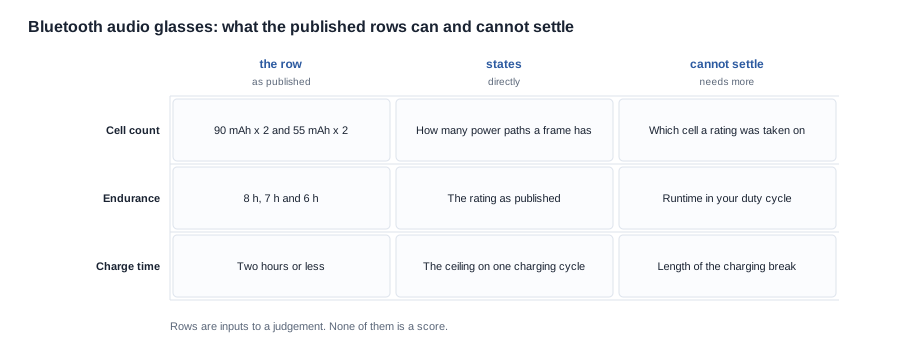
What the rows settle. They tell you how many power paths a frame has. A single-cell frame has one path and one point of failure in the charging circuit; a dual-cell frame has two and a correspondingly more complex enclosure. They tell you whether the charging pad or the cable travels in the carton, which is a parcel and packaging decision. They tell you the published rating you will have to defend to a customer who complains that the unit did not last as long as the listing claimed.
What the rows cannot settle. They cannot tell you how long a unit runs in a duty cycle, because no start state and no end criterion are published. They cannot tell you which cell configuration a rating was taken on where two configurations share a rating. They cannot tell you whether the charge time was measured from empty, from the state the unit ships in, or from a defined threshold. And they cannot tell you what the unit weighs, what leaks, or what the microphone specification is, because none of that is published for any model in the range.
That distinction is the whole basis of a comparison that survives contact with a supplier. A buyer who asks for the four published rows will get a fast answer and will learn almost nothing about whether the product meets the duty cycle they are buying it for. A buyer who asks for the protocol behind the rating will get a slower answer and will be able to compare two suppliers at all.

Bluetooth audio glasses cell configurations compared without inventing totals
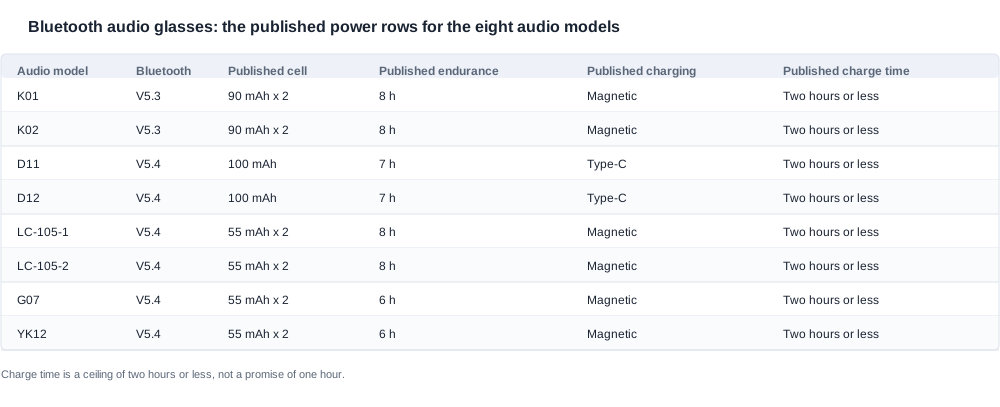
The catalogue publishes cell capacity and cell count. It does not publish a total. This matters more than it sounds, because the temptation to add them up is exactly where a comparison turns into a fabricated figure.
The 90 mAh pair. The K01 and the K02 each publish 90 mAh x 2, magnetic charging, a charge time of two hours or less and a rated endurance of about eight hours. Two cells per frame, so two power paths and two charging contacts.
The 100 mAh single cell. The D11 and the D12 each publish 100 mAh, Type-C charging, a charge time of two hours or less and a rated endurance of about seven hours. One cell, one port, one cable in the box.
The 55 mAh pair. Four models publish 55 mAh x 2. The LC-105-1 and the LC-105-2 publish a rated endurance of about eight hours. The G07 and the YK12 publish a rated endurance of about six hours. All four are magnetic charging with a charge time of two hours or less.
| Audio model | Published cell | Published endurance | Published charging | Published charge time | Bluetooth |
|---|---|---|---|---|---|
| K01 | 90mAh*2 | About 8 h | Magnetic | Two hours or less | V5.3 |
| K02 | 90mAh*2 | About 8 h | Magnetic | Two hours or less | V5.3 |
| D11 | 100mAh | About 7 h | Type-C | Two hours or less | V5.4 |
| D12 | 100mAh | About 7 h | Type-C | Two hours or less | V5.4 |
| LC-105-1 | 55mAh*2 | About 8 h | Magnetic | Two hours or less | V5.4 |
| LC-105-2 | 55mAh*2 | About 8 h | Magnetic | Two hours or less | V5.4 |
| G07 | 55mAh*2 | About 6 h | Magnetic | Two hours or less | V5.4 |
| YK12 | 55mAh*2 | About 6 h | Magnetic | Two hours or less | V5.4 |
The cell column is written in the catalogue's own notation, which publishes the cell value and the cell count rather than a total. No total appears anywhere in that table, because a total is a derived value and a table is read as though it were published.
If you add the two cells in each configuration yourself, you get 180 mAh for the K01 and the K02, 100 mAh for the D11 and the D12, and 110 mAh for the four 55 mAh models. Those three totals are derived values, not catalogue figures, and they should be labelled as derived in anything you write or send. A buyer who quotes 180 mAh as a catalogue figure is quoting a number the catalogue does not contain, and that is precisely the kind of small overstatement that becomes a dispute later.
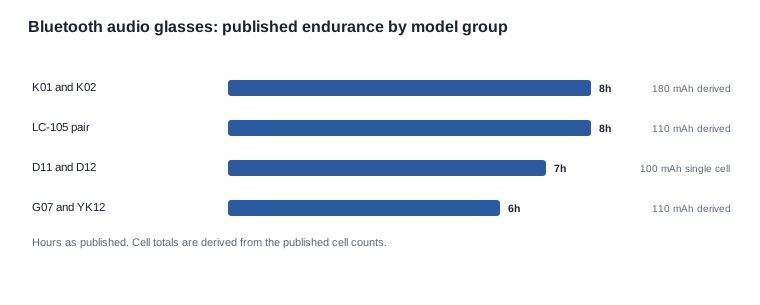
Once the totals are derived, the comparison stops being a capacity ranking and becomes something more interesting. The 110 mAh derived total appears against both an eight-hour rating and a six-hour rating, within the same four-model group, on the same charging method and the same charge-time ceiling. The only published differences between the LC-105 pair and the G07 and YK12 pair are form-factor notes: the G07 publishes an ultra-slim, detachable temple, and the YK12 publishes a surround-sound, slim-temple note. If the thinner temple is what costs the two hours, that is a design trade-off a buyer should be able to see stated. If it is not, then the two ratings were taken under different protocols and neither can be used as a specification.
The 70 mAh x 2 configuration is not in this range, and that is worth saying explicitly. The YKC02 publishes 70 mAh x 2 with a rated endurance of about eight hours and magnetic charging. Its catalogue name is a sport model, so it belongs with the other sport models rather than with the eight audio models, and any comparison that quietly folds it into an audio enumeration has changed the group it is measuring. The same caution applies to the D17 and the ZH12, which publish 115 mAh and 100 mAh with a charge time of about an hour. They are the only models in the whole catalogue with a charge time stated as about an hour rather than as a ceiling of two hours or less, which means the charge-time comparison across the catalogue is not a comparison within one range. If your shortlist mixes an audio model with a sport model, you are comparing a ceiling against a point estimate, and the supplier questionnaire has to say which basis each figure uses before the two can sit in the same table.
The same discipline applies to the camera models, which carry eleven published power configurations of their own across a different set of rows. The ai camera glasses battery comparison sets those out separately, and the reason for keeping them apart is the same one: a cell configuration only means something inside a range whose charging method, case content and test convention are the same.
Bluetooth audio glasses endurance figures and the test conditions behind them
Every audio model in the range publishes an endurance figure. None of them publishes the conditions under which that figure was obtained, and the difference between those two facts is the difference between a specification and a claim.
What a rating without a protocol is worth. A rating is a number produced under some load, at some volume, from some starting state, over some interval, ending at some threshold. Remove all five and the number describes the test bench rather than the product. Two suppliers quoting the same eight-hour rating may be describing completely different things, and the buyer has no way to tell from the quotation alone.
The three conditions that change the number most. The first is the start state — a unit charged to full and a unit at a moderate state of charge do not produce the same runtime, and an endurance figure quoted without its start state cannot be used to plan a duty cycle. The second is the end criterion: runtime measured to the point where audio stops and runtime measured to the point where the unit switches off are different numbers, and the gap between them is exactly the part of a shift a buyer cares about. The third is the audio load: the codec, the volume level and whether the microphones are active during playback all change the current draw, and a rating taken in a quiet room with playback only is not a rating for a unit used for calls.
Why the catalogue cannot settle it and why that is the buyer's job. The catalogue is a product document, not a test report, and it does not purport to be one. Every model in the range publishes a charge time of two hours or less — the same ceiling across eight models — which tells you the charging side is not where the differences live. The differences live in the endurance row, and the endurance row is the row the buyer has to interrogate.
What this means for comparing two suppliers rather than two models. The useful comparison is not "which of these two units lasts longer". It is "which of these two suppliers will tell me under what conditions the number was measured, in writing, before I place the order". A supplier that answers the protocol question produces a comparable figure. A supplier that does not produces a figure that can only be compared against another non-answer. The how to compare battery life method covers that request in more detail, and the bluetooth audio glasses buying guide covers the other rows a shortlist has to run through.

Bluetooth audio glasses battery questions that produce a comparable answer
The value of a published figure is entirely in what it lets you do next. Here is the set of questions that turns the eight published rows into something you can put in front of a customer, a compliance reviewer or a second supplier.
-
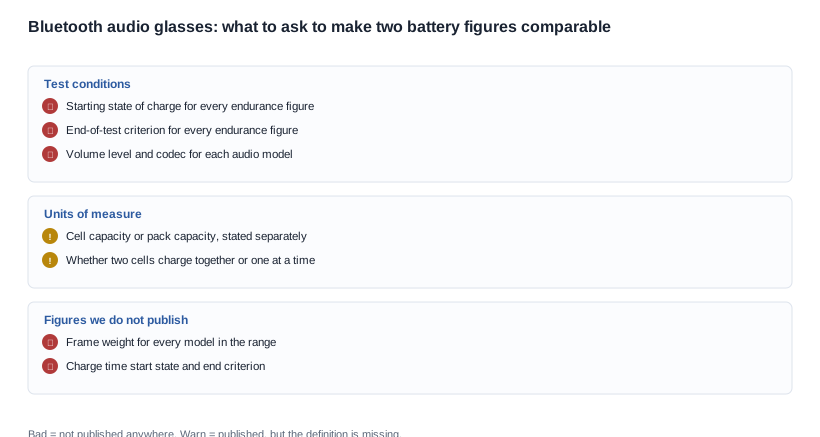
For every candidate: what is the starting state of charge for the published endurance figure, and what is the end-of-test criterion? Without both, the figure cannot be used to size a duty cycle.
-
For every candidate: what volume level, codec and microphone state were used during the endurance test? A rating taken with the microphones active is a different product claim from one taken with playback only.
-
For the K01 and the K02: do the two 90 mAh cells charge together or independently, and does the published eight-hour rating assume a particular charge state on each cell?
-
For the LC-105-1 and the LC-105-2 against the G07 and the YK12: on what basis does an eight-hour rating and a six-hour rating sit on the same published cell configuration? Is the difference the temple profile, the audio load, or the measurement protocol?
-
For the D11 and the D12: what does the published capacity describe — one cell, or the pack including any protection circuit? The two are different numbers and only one of them is the catalogue figure.
-
For every candidate: what is the total shipped weight of the unit with its packaging, and what is the frame weight on its own? Neither is published for any model in the range, and the first decides the freight class while the second decides the acceptance criterion in a sample test.
-
For every candidate: what is the charge time measured from, and at what state does the charging circuit consider the unit charged? The published figure is a ceiling of two hours or less; a buyer needs to know what the actual interval is under the duty cycle being planned.
-
For every candidate: what is the cell part number and the cell manufacturer behind the published capacity, so that a subsequent order can be held to the same cell rather than to an equivalent one?
-
For every candidate: what is the warranty period on the cell, and what is the returns procedure for a unit that fails inside it? Neither is published, and both affect the cost of a defective batch far more than the unit price does.
-
For a supplier comparison: will you confirm all of the above in writing against the model designation that appears on the unit and the carton? A protocol attached to a model family rather than to a model designation cannot be audited later.

Bluetooth audio glasses battery failures a buyer finds only in the channel
Most battery problems are not visible on the sample bench, and the ones that damage a programme tend to appear in the first weeks after the units reach customers.
The rating is repeated as a guarantee. A published eight-hour figure reaches the retail listing as "up to eight hours", and the customer's expectation is set by the listing rather than by the datasheet. When the unit returns after four hours in a loud environment, the returns desk receives a complaint about a number that was never a promise. The fix is not technical: it is to make the conditions part of the listing, and to make the supplier confirm in writing that the conditions hold.
A single-cell frame is compared against a dual-cell frame. The D11 and the D12 publish 100 mAh and a seven-hour rating; the LC-105 pair publishes a larger derived total and an eight-hour rating. A buyer who builds the marketing on capacity alone will lead with the number that looks better and will be challenged on the number that matters. Which of the two numbers leads is a channel decision, and it should be made from the duty cycle rather than from the specification.
Two cells, one charging path. Dual-cell frames are published with two cells, but the catalogue publishes nothing about how the second cell is managed when one of them fails, or how a unit behaves if the two cells are at different states of charge. A sample test that charges both cells from a known state and then runs them to exhaustion will expose an imbalance that a single-cell frame cannot produce.
The charge time ceiling is treated as the charge time. The published figure across the whole audio range is a ceiling of two hours or less. A buyer who plans a shift break on the basis of "two hours" is planning against the worst case, which is defensible, but a supplier who quotes a shorter figure without a protocol has not demonstrated it. The planning question is what the ceiling means for the interruption length the operation can actually absorb.
The weight question is answered by inference. Because no frame weight is published, buyers reach for the nearest thing they can find, and they often reach for a weight from a different model or a different category entirely. The bluetooth audio glasses weight comparison covers that trap, and the bluetooth audio glasses shipping weight covers the parcel consequence once a wrong assumption has been made.
The unit is never tested at the volume the channel sells it at. The sample test is usually quiet. The customer is not. This is the failure that ends up in the returns data and the review scores, and it is the one that a protocol question would have caught before the first container landed.
Two suppliers quote the same rating and neither is comparable. This is the most common form the problem takes in a sourcing exercise, because each supplier is quoting a real figure from a real test and neither is wrong. The buyer sees eight hours from one side and eight hours from the other, treats the comparison as settled, and discovers the conditions only when a customer returns a unit. The defence is cheap and mechanical: ask both suppliers the same four questions in the same order, in writing, and treat a non-answer as a difference in itself. A supplier who cannot state a start state and an end criterion has told you something about the depth of its testing, and that is information worth having even when the ratings match.
The comparison is made on the retail listing rather than on the datasheet. Once a unit is on sale, the rating becomes marketing copy, and the copy outlives the quotation. A buyer who wants the channel to be able to defend the claim needs the conditions written into the listing, the packaging insert and the support script at the same time, and needs the supplier to confirm that those conditions are the ones under which the figure was taken. Otherwise the channel carries the gap between the datasheet and the listing, and the returns desk carries the consequence.
Where our battery figures stop and the supplier's file begins
The published rows are published because they are build facts, and everything else on this page is a question for the supplier rather than an answer we can supply. We publish cell capacity and count, charge time, rated endurance and Bluetooth version for the eight audio models. We do not publish frame weights, leakage figures, microphone specifications, test protocols, start states, end criteria, prices, minimum order quantities, lead times or capacity figures, because we do not have verified versions of any of them.
That boundary is useful rather than disappointing, and it works in both directions. For the buyer, it means the four published rows are a reliable basis for a structural shortlist: the dual-cell versus single-cell division, the magnetic versus Type-C division, the 5.3 versus 5.4 Bluetooth division and the rating groupings are all facts a supplier cannot contradict without contradicting their own catalogue. And for the supplier, it means the unanswered rows are precisely where a serious buyer differentiates two quotations — a supplier who answers the protocol question has told you something about how the business runs that a price comparison never would.
Three habits follow. The first is to write the duty cycle down before reading any rating, so that you know which of the published endurance figures is even relevant. The second is to label every derived value as derived, so that a buyer reading your comparison cannot mistake an addition for a catalogue figure. The third is to treat the missing rows as the actual shortlist criteria, because a comparison built only on published rows cannot distinguish two suppliers at all — it can only distinguish two products, and even then only partially.
The bluetooth audio glasses charging options article takes the charging half of this range and follows it into the parcel and the interruption, and the bluetooth audio glasses common questions article answers the shorter version of the questions raised here.


