
Form factor is not a styling preference, and this comparison treats it as an engineering and commercial decision rather than an aesthetic one. The D12 and the G07 differ in exactly two published rows that have anything to do with shape and construction: the G07 carries a slim-temple, detachable-temple description that the D12 does not, and the two charge differently. Everything else that separates them — the cell configuration, the runtime, the radio version — is electrical, and electrical differences are the easy ones to evaluate.
Here is what the form factor difference actually does, in the order a buyer discovers it.
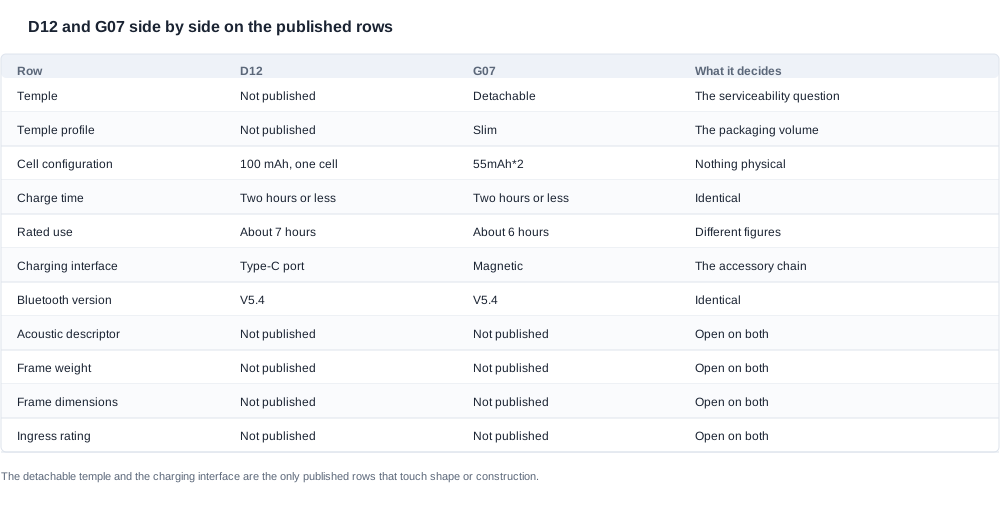
D12 versus G07 form factor: the two published rows that touch shape
The G07's catalogue entry names two things about its physical construction: a slim temple and a detachable temple. The D12's entry names nothing at all about its temples — no profile, no detachability, no adjustment range, no temple description of any kind.
Everything else that differs is electrical. The D12 publishes a single 100 mAh cell, about seven hours of rated use, a two-hour-or-less charge ceiling and Type-C charging. The G07 publishes a 55mAh*2 configuration, about six hours of rated use, the same charge ceiling and magnetic charging. Both publish Bluetooth V5.4.
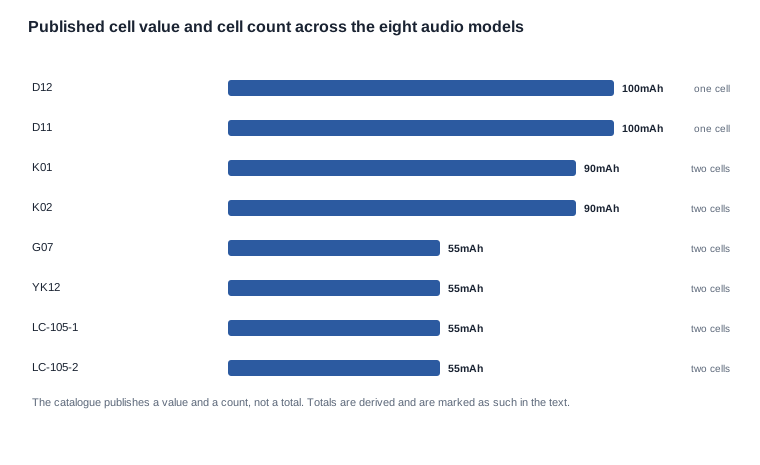
One clarification that matters for any comparison of these two rows. The catalogue publishes a cell value together with a cell count, and for the two models in this pair it publishes them in different forms: a single value for the D12, and a value with a multiplier for the G07. That means the count is published for both of them, and any total you see quoted for the G07 is a derived figure rather than a catalogue row. If you put the two into a cost model, mark the derived total as derived; if you put them into a published table, keep the catalogue's own form.
And the runtime figures do not line up with the cell configurations. The D12 publishes about seven hours from a single cell, the G07 publishes about six hours from two smaller ones. That is a sign the ratings were taken under different duty cycles, and it is the reason the method for comparing battery life insists on the test condition before it allows a comparison of the two numbers.
The detachable temple question, and why it decides the business model
A detachable temple is a serviceability decision before it is a design decision. If the temple is user-replaceable, the product acquires a second spare-parts family — replacement temples in one or more lengths — and a distributor can serve a wider range of face shapes without holding complete units. That is a genuine commercial asset in a market where eyewear is fitted rather than bought over the counter.
If the temple detaches only at the factory, the feature is a manufacturing convenience and none of that value exists.
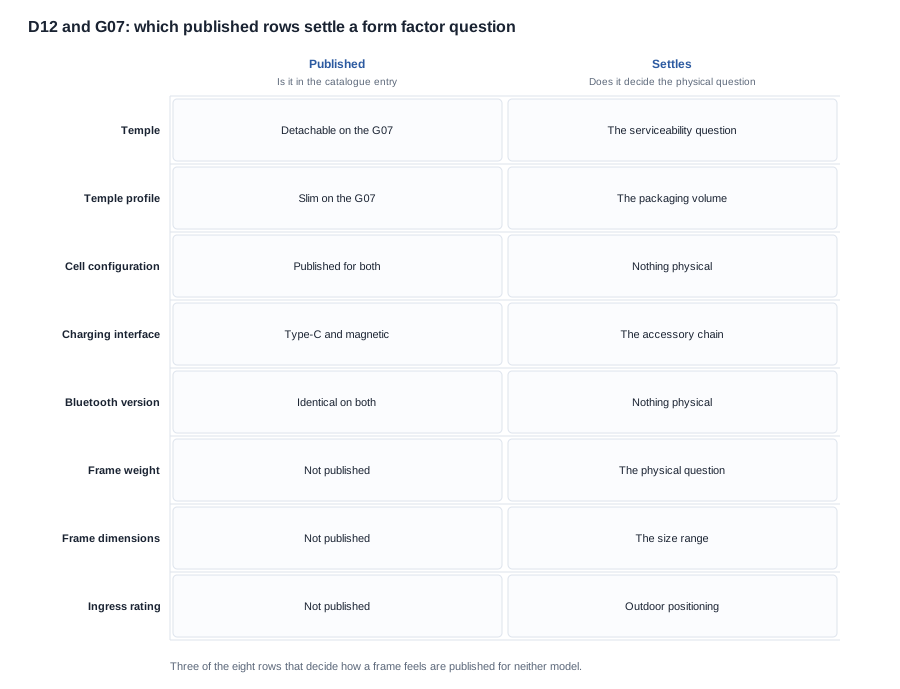
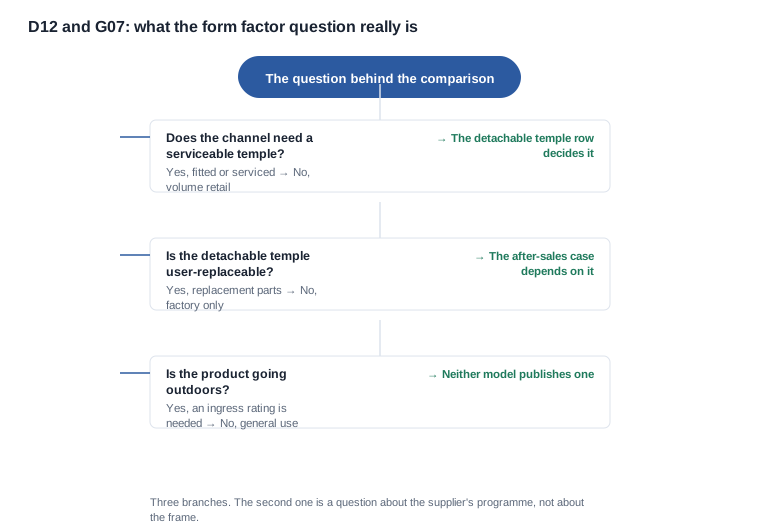
The catalogue does not say which of the two applies to the G07, and this is the single most important question in the comparison. "Detachable temple" on a specification sheet is genuinely ambiguous, and the two readings differ by an entire after-sales programme: one of them creates a spare-parts line, a fitting tool, a replacement price list and a service flow; the other creates nothing at all.
Ask it in the first supplier message, not in the third round. The answer changes the model of the business rather than the shape of the product, and everything downstream — the accessory list, the packaging, the warranty exposure, the spare-parts stocking policy, the distributor conversation — depends on which answer comes back.
And ask the follow-up in the same message. If the temples are user-replaceable, you need to know in what lengths they are supplied, whether a customer can buy one directly, at what quantity a distributor can stock them, and what happens to a warranty claim where a temple has been swapped. Those four answers are what turn a published feature row into an after-sales programme, and they are what a channel partner will ask about.
How to close the temple question properly
The temple question is unusual because the published row is real and the ambiguity is about what sits behind it. Two or three questions close it, and it is worth asking them in a form that forces a specific answer rather than a description.
Ask whether a replacement temple can be supplied separately from a complete frame, and in what lengths. A yes with a length list turns the row into a programme; a yes without lengths turns it into a partial answer, because a single length does not solve the sizing problem the feature exists to solve. Push for the length range rather than accepting "various lengths".
Ask who may buy them. If only the factory may, the feature serves production flexibility rather than the channel. If a distributor may, at what minimum quantity, the feature becomes a stock item and the after-sales case is real. The answer is usually a number rather than a yes or a no, and the number is what belongs in a range plan.
Ask what a replaced temple does to the warranty. This is the question that gets skipped and it is the one a distributor will ask first. A temple swap on a frame that carries a fitted acoustic pair, an antenna or a charging contact is a service operation, and the terms around it — whether the frame is swapped as well, whether the swap voids anything, whether the spare has to come from the same batch — decide whether the after-sales programme is an asset or a liability.
And ask the packaging question at the same time. If a replacement temple is a stocked part, it needs a package of its own, a barcode, a packing list line and a place in the carton artwork. That is a small commercial item, but it is one that is expensive to add after the artwork is printed and it is the kind of thing that stops a distributor ordering replacement parts at all.
What to write into the range plan. Not "detachable temple" but a sentence that says who may buy a replacement, in which lengths, at what minimum, and with what warranty terms. That sentence is what makes the G07's published row usable in a fitted channel, and it is what a competitor quoting the same row will not have.
What the cell configurations do and do not tell you
The direction here is useful and the conclusion is not. The G07 carries a slimmer temple profile, and the D12 publishes a larger single cell, and a slimmer temple profile leaves less room for a larger cell — so the two published configurations are consistent with the two published physical descriptions.
What that does not settle is the question a form factor comparison is actually about, which is how the products feel in use. The parameter that would settle it is frame weight, and frame weight is not published for either model. Our catalogue publishes exactly one frame weight anywhere, and it belongs to the MT6 — the glasses body including its battery and camera, excluding its folding charging case — which is a camera model on a different platform and cannot stand in for an audio frame.
Without a weight, you cannot tell whether the slimmer frame is genuinely lighter or simply smaller, and that distinction matters commercially: a smaller frame that weighs the same occupies less packaging volume but carries the same freight weight, while a lighter frame changes both.
So the trade is real but it is not yet quantified. You are choosing between a frame that publishes a slimmer, detachable temple and a two-cell configuration, and a frame that publishes a single larger cell and a standard cable. Which of those suits a channel is a decision about the channel; what each one weighs is a decision about a scale, and it should be settled with three sample units before the packaging is designed.
How to measure the pair on the same script
Comparing two frames physically is only useful if the procedure is identical on both, so the script is the deliverable rather than the result.
Weigh both frames on the same scale, with the cells fitted and any case excluded, and record the unit of the same convention as the one published weight in our catalogue. Repeat on three units of each model so the spread is visible rather than assumed. A single unit tells a buyer nothing about a production batch, and the spread is what decides whether a size claim can be made at all.
Measure the same five dimensions on both: overall frame width, lens width, lens height, bridge and temple length. Add the temple's adjustment range if the temple adjusts on either model. A frame comparison built on two different dimension lists is not a comparison, and the G07's slim-temple description makes the adjustment question a live one rather than a formality.
Record the mass distribution as an observation. Where the cell sits and how the frame balances are not published for either model, and a single-cell arrangement can be distributed or concentrated. Hold the frame, note where the weight falls, and record that as an observation on the sample record rather than as a specification claim. It is the kind of thing a reviewer will notice in the hand, and it is exactly the thing a catalogue row cannot tell you.
And weigh the packed box, not just the frame. The accessory difference between the two models is real and it is where the parcel cost sits. Weigh the complete package as it would ship, on both models, and the difference between them is a number you can put in a cost model rather than an assumption.
One script, two units, one record. That is the whole method, and it closes five of the open rows — weight, dimensions, adjustment range, mass distribution and packed weight — in a single session with the samples you have already ordered.

The box: charging architecture and what it costs the parcel
The G07 charges magnetically and the D12 charges over Type-C. That is the second published row that touches construction, and it is the one that shows up in the parcel and the accessory chain.
Magnetic charging on an open-ear frame implies a dock or a cradle with a mating connector. That is an additional moulded part, an additional charging circuit, and a different unboxing. Whether a case is actually supplied with the G07 is not published, so the accessory list is an open item rather than a known one.
A Type-C product ships with something the buyer already owns. No dock, no cradle, no proprietary accessory to lose, and no second lithium cell in the parcel unless a case is added.
For a channel buyer this is a margin decision rather than a feature decision. A cradle raises perceived value in the product photograph and raises the landed cost in the parcel; a standard cable keeps the carton light and the customer can replace what is missing. Neither is wrong, and they are different businesses with different cost models and different after-sales exposures. The charging options analysis covers the accessory economics in the range, and the shipping weight analysis covers how the parcel number is established.

The rows that are missing for both, and the channels they rule out
Ingress protection is not published for either model. For outdoor, sport or industrial channels that is disqualifying on its own: a fitness proposition for sweat and rain cannot be written from a specification sheet that does not address it. Our sport smart glasses range is where that information is at least addressed — and even there the position is a catalogue marking rather than a test report.
Weight, temple length and lens dimensions are not published for either. Without temple dimensions a size range cannot be built, and a frame that does not suit the customer comes back. Ask for them in millimetres, and ask for the weight in grams with the cells fitted.
The acoustic position differs in a way that has to be handled carefully. The D12 publishes no acoustic descriptor. The G07's published rows also carry no acoustic descriptor, so on the published evidence the two are the same on sound. The difference between them is the temple, not the sound — which is worth knowing, because it means a sound-quality argument cannot be used to separate them either.
And the certification position is unpublished for both. Our catalogue's text contains no reference to CE, FCC or RoHS anywhere; there is a company-level export certification page whose content is images rather than text, and no per-model certification row for the D12 or the G07. A document that names one model does not automatically cover the other, so a two-model range can require two sets of evidence where a one-model range requires one.
The published row that makes each model eligible for a channel
Rather than a recommendation, the honest form of this is the published row that makes a model eligible for a given brief.
If the channel is fitted or serviced — an optician relationship, a distributor stocking replacement parts, a market where eyewear is sized rather than one-size — the published row that makes the G07 eligible is its detachable temple, and only if that temple turns out to be user-replaceable.
If the channel is volume retail, shipping direct, or a market where USB-C is already the default cable — the published row that makes the D12 eligible is its Type-C interface and its single-cell configuration, which together mean the simplest carton and the simplest accessory list in the range.
If the product is going outdoors, neither model has a published ingress rating, and for that brief the absence of the number is the decision. The channel moves to a model where the marking exists.
Where our D12 and G07 position on form factor sits
We do not publish frame weights, temple dimensions or ingress ratings for these two models, and we will not fill them with figures typical of the category. A form factor comparison that hides those three numbers is a marketing sheet, and form factor is exactly where the fit complaints come from.
We will also not read an engineering conclusion into the cell configurations. That the G07 publishes a slimmer temple and a two-cell arrangement, and the D12 a single larger cell, is what the catalogue holds; where the mass sits in either frame is not published, and we would rather ask for the measurement than publish an inference a reviewer can disprove in a minute.
And we will not claim either model holds a certification our documentation does not mention, nor carry a feature across from a neighbouring model to fill a gap.
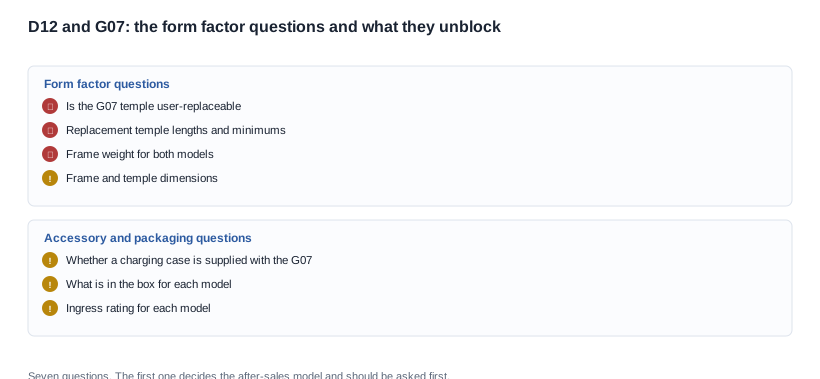
Seven questions to settle before you order
- Is the G07's temple user-replaceable or factory-only? Replacement availability, in what lengths, at what minimum quantity.
- What is the frame weight of each model, measured with the cells fitted?
- What are the frame and temple dimensions of each model, in millimetres?
- Is a charging case supplied with the G07, and is it quoted as a line item or bundled?
- What is the test condition behind the six-hour and seven-hour ratings — volume, codec, distance from the source?
- Does the certification evidence cover both designations, in each destination market?
- What is the parcel weight of each configuration, once the accessory question is answered?
How to judge the answers. Each must be tied to a model designation, must state the configuration it applies to, and must say what it excludes. The red flags are a weight given without the cells fitted, a dimension given without the temple length, a case answer that describes what it does rather than what it holds, and a certification answer naming a sibling model.
A shortlist criterion, and how to use it
How to choose between these two models comes down to one published row each, and the shortlist is quick to build once the row is identified.
If the brief needs a serviceable or fitted channel, the criterion is the detachable temple, and the published row that makes the G07 eligible is that temple — conditional on the answer to the replaceability question. If the answer is factory-only, the criterion fails and the G07 leaves the shortlist on this ground alone, whatever else it has.
If the brief needs the simplest parcel and the simplest accessory chain, the criterion is the Type-C interface combined with the single-cell configuration, and the published row that makes the D12 eligible is that pair of entries. If the brief needs an all-day reserve and a dock-led routine, the D12's rows do not serve it and the magnetically charging models in the range do.
If the brief is outdoor or industrial, neither model clears the criterion, because no ingress rating is published for either, and the shortlist moves to a model where the marking exists.
What to ask the supplier, in one message. Seven questions: the temple replaceability and its length range and minimums, the frame weight of each model with the cells fitted, the frame and temple dimensions of each model, the box contents for each model, the endurance test condition, the certification scope per market, and the commercial terms.
The trade-offs to hold in view. The G07's published advantages are a detachable temple and a slim profile; its published disadvantages are a lower rated runtime and a magnetic interface that implies a dock. The D12's published advantages are a standard cable, a single cell and a higher rated runtime; its published disadvantages are an empty feature set and an unpublished temple description. Neither set of advantages is free, and neither is visible in the published rows on its own.
The red flags before you order. A temple answer that describes the mechanism without saying who may buy a replacement. A weight given without the cells fitted. A dimension list without the temple length. A box contents answer that does not say whether a case is quoted separately. An endurance answer that restates the rating instead of the condition. And a certification answer that names a sibling model.
How the seven questions divide, and what each route costs
The seven open questions do not all close the same way, and putting them in three groups is what keeps a selection programme on schedule.
Three are programme questions and should be started first. The temple replaceability question, the certification position and the commercial terms. All three have timelines that belong to somebody else — a factory's parts programme, a testing body's calendar, a commercial negotiation — and none of them can be accelerated by a more urgent request. They also have the longest lead times, which is why starting them in the first week matters more than anything else on the list.
Two close with a measurement on samples. The frame weight and the frame dimensions, in one session as described above. These are the cheapest items on the list and the ones most often deferred until the packaging is already designed.
Two close with a written reply. Whether a charging case is supplied with the G07 and whether it is quoted as a line item, and the test condition behind the six-hour and seven-hour ratings. Both are records the factory holds, and both belong in the same message as the first group.
And one is the pair's structural question. Whether the D12 publishes an acoustic descriptor and the G07 publishes one — it does not, either of them — and therefore whether the sound argument can be used to separate them. On the published evidence it cannot, and a range plan that relies on it is relying on something the documentation does not support.
What the sequence looks like end to end. Send the programme questions, order one sample of each model, run the measurement script, then close the two written items. The two programme questions keep moving while the samples are in the building, which is the only way the certification and parts timelines stay off the critical path.

Send us the market, the channel and the price you need to land at, and we will tell you which of the two is buildable there — and tell you plainly if the answer is that neither is the right frame for your channel.
Related reading
- Both models sit in this range — Bluetooth audio glasses
- Frame fit and returns, in detail — sample evaluation
- Outdoor-rated alternatives — sport smart glasses
Send the market, the channel and the target retail price, and we will tell you which frame fits.


