

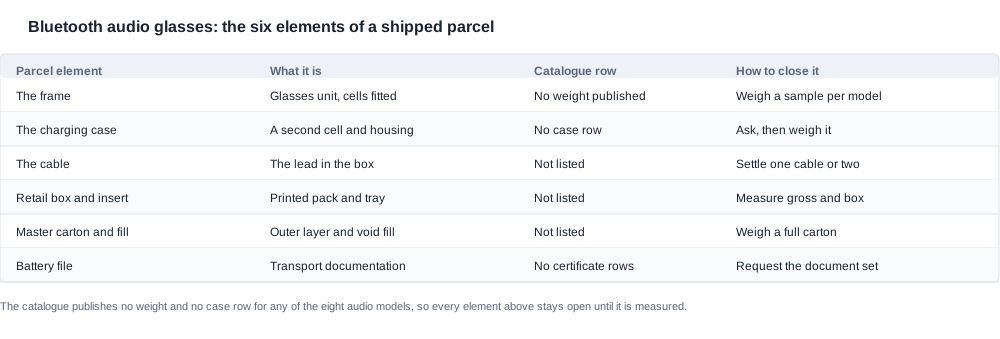
Not one model in this range publishes a frame weight, and the case capacity is not published for any of them either. That means the shipped weight of every product in this category is currently unknown, and a landed cost built on an estimated weight is a landed cost built on a guess. This is the shortest route to a real number, because none of the six elements below requires anything except a sample and a scale.
Bluetooth audio glasses shipping weight: the parcel is not the product
Three different numbers, and the confusion between them
A buyer who asks for "the shipping weight" is usually asking for one of three figures, and the three are not interchangeable.
The first is the gross weight of the retail unit — the frame, the case if one exists, the cable, the insert, the printed material and the box, measured as a packed parcel ready to hand to a courier. The second is the production carton weight divided by the units in that carton, which is the figure that reflects how the goods will actually be stacked on a pallet. The third is the billable weight, which is what the carrier charges, and which is normally the greater of the actual weight and the volumetric weight of the consignment.
Most freight disputes in this category are not disputes about a number being wrong. They are disputes about which of the three numbers was being discussed. A forwarder quoting per-kilogram rates against a carton figure, and a buyer comparing that quote against a unit figure, will reach a conclusion that neither of them can defend. Write the definition into the request, not the word "shipping weight".
Why the catalogue cannot answer it, and what the one published weight is for
The eight models in the Bluetooth audio glasses family — the LC-105-2 and the K02, the G07 and the K01, the D11 and the YK12, and the D12 and the LC-105-1 — publish a cell capacity, a Bluetooth version, a charge time, a rated runtime and a charging method. None of them publishes a frame weight, a packed unit weight, a carton weight, a case weight or a case capacity. There is no box contents list, no carton dimension and no accessory schedule.
Exactly one frame weight exists anywhere in our catalogue, and it belongs to a different family: the MT6 AI camera glasses unit is published at 158 g, explicitly stated as the glasses unit including its battery and camera and excluding its foldable charging case, whose capacity is published separately at 1200 mAh. That figure is useful to a buyer because it anchors the scale of a wearable of this class, and it is useless as a proxy for an audio frame, because the MT6 is a different product with a camera, a different battery and a case.
The honest position is therefore short: the shipped weight of every model in the audio family is unknown, and it can only be established by measurement.
What the published rows still tell you about the parcel
Three of the five published rows are worth carrying into the freight conversation, because they structure the parcel even though they do not weigh it.
The charging interface splits the range into two groups: the YK12 and the LC-105-2, the LC-105-1 and the K01, and the K02 and the G07 charge magnetically, and the D11 and the D12 charge over Type-C. A magnetic interface implies a dock, and a dock implies a second cell in the box; a Type-C interface implies a cable, and a cable implies a port in the temple. That is a statement about the accessory chain, not a measurement.
The cell architecture splits the range again: the LC-105 pair, the G07 and the YK12 publish 55mAh2, the K01 and the K02 publish 90mAh2, and the D11 and the D12 publish a single 100mAh cell. A two-cell frame places its mass in both temples and balances; a single-cell frame concentrates it. Which of those designs is heavier is a question for a scale, not for arithmetic on the catalogue.
The charge time of two hours or less tells you the cell is small. It is a ceiling rather than a typical figure, and it comes without a starting state or a termination criterion, but it is enough to establish that a compact cell is what is being shipped.

Why a light device ships in a heavy box, and what that does to a landed cost
The ratio problem, which is specific to this product type
An open-ear audio frame is a light object, and that is the whole commercial difficulty in one sentence. The electronics inside it — the cell, the radio, the amplifier, the drivers, the microphones — are a small fraction of the value of the parcel they travel in. The packaging, the accessory, the documentation and the freight are a large fraction of it.
That ratio does something specific to the category. In a heavier product, a packaging error is absorbed by the product weight. Here, a packaging decision is the freight bill. A frame that ships in a generous retail box with a moulded insert, a printed manual, a dock and a cable is a parcel whose weight is mostly not the product, and a change to that packaging specification changes the freight cost per unit directly and immediately.
It also means the choice of model has an outsized effect on the freight rate, and the effect runs through the accessory chain rather than through the device. Two models from this range can differ more in shipped weight than a heavy product and a light product would, purely because one of them ships a dock with a second cell in it.
The two freight metrics, and the divisor you do not control
Carriers do not bill purely on actual weight. They bill on the greater of the actual weight and the volumetric weight, which is derived from the dimensions of the consignment and a divisor that the carrier applies for that mode and that lane. The divisor is the carrier's, not yours, and it differs between air, road and sea, and sometimes between lanes within a mode. The rule is worth knowing because the arithmetic is simple once you have the three inputs: the three dimensions of the carton, the number of units in it, and the divisor your forwarder applies.
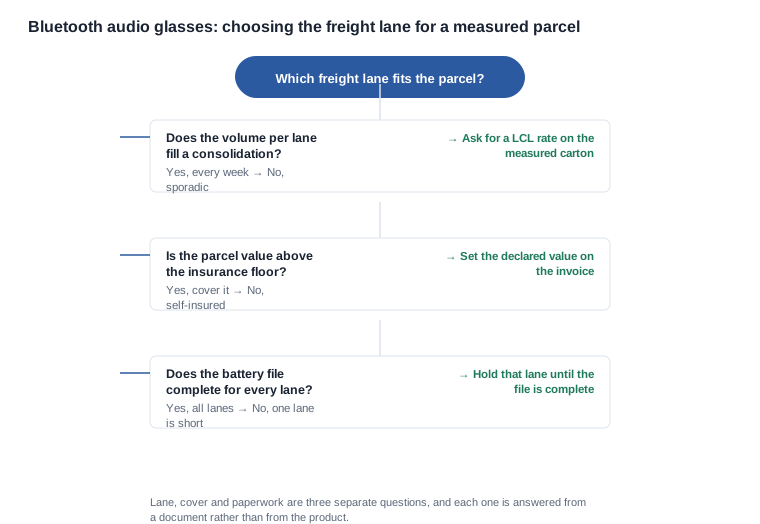
Two practical consequences follow. A small product in a large carton is charged as though it were the carton, which is why the carton specification is a freight decision and not only a packaging decision. And a carton with fewer units in it raises the per-unit volumetric figure, because the outer layer and the void fill are being spread over fewer units — so a carton count that is too low costs more per unit in freight than the packaging saves.
The shipping weight analysis for the camera family covers the same problem on the other side of the catalogue, where a foldable charging case changes the parcel by a much larger factor.
The trade-offs inside a freight line: four factors, three of them packaging
At the level of a purchase order, the freight line is the product of four things: the per-unit packed weight, the carton count, the volumetric divisor and the rate for the lane. Three of those four are packaging or logistics decisions, and only one is a product decision. That is why the conversation about freight in a light-goods category is mostly a conversation about cartons.
At the level of a channel business, it is worse, because a channel buyer is comparing a landed cost per unit against a competitor's landed cost per unit, and the comparison is usually made at the same retail price. If one of you ships a bare frame in a slim mailer and the other ships a boxed set with a dock and a printed set, the freight line decides the price comparison before anybody looks at the product. That is a legitimate reason to compare parcels rather than frames, and the Bluetooth audio glasses bulk ordering piece covers where that measurement belongs in a pricing sequence.
The two questions to ask before the packaging is designed
The first is whether a dock or a case is in the box at all. The catalogue publishes no charging-case row for any of the eight audio models, which is a gap rather than an answer: it means the case question has to be asked for every model, including the six magnetically charging ones where a dock is the most plausible configuration. The charging options analysis covers the accessory chains in this family.
The second is how many units the master carton is designed to hold, and whether the same carton is shared with other products. A shared carton amortises the outer layer across more units and is a normal request to make at the point where the packaging is specified, rather than after the first shipment.
Together these two answers are how to choose between configurations once the parcel has been measured, and they are worth more to the landed cost than any unit price difference that is under negotiation at the same time.
The six elements of a shipped audio frame, and how each one gets closed

One: the frame
The base weight, and the element nobody has published. Weigh a sample across the batch for every model you intend to sell, with the cells fitted, and record the figure against the model name together with the spread across the sample. The spread matters as much as the mean: a frame whose mass varies across a batch is a balance question, and balance problems show up in the field as a complaint rather than as a defect.
The weight comparison across the audio range sets out why the one weight published in the catalogue, on a camera model, cannot be used as a proxy for any of the eight.
Two: the charging case
A second lithium cell in every unit for a magnetically charging configuration, and it is often the heaviest single item in the box. The catalogue publishes no case capacity for any of the eight audio models, so there is nothing to quote and nothing to compare. The three questions that close it are short: does a case or dock ship with this model, what does it hold, and how much does it weigh. The K-series charging options and the D12 configuration piece both set out how the interface choice propagates into the accessory chain.
Three: the cable
Small, but it appears in every unit and it is a line on the packing instruction. Settle whether one cable serves both the frame and the case, whether the case even has a charging input, and whether the cable is in the box or optional. For a Type-C model the cable specification has a second job: it is the accessory a customer is most likely to try with a substitute, which is the subject of a separate quality discussion.
Four: the retail box and the insert
The insert does two jobs — it holds the product and it carries the printed material — and it sets the internal volume of the box. Volume matters because the billable weight is the greater of actual and volumetric, and a small product in a large box is a shipping bill that has nothing to do with the product. Measure the assembled box on all three dimensions, and measure it assembled rather than flat-packed, because the fold is part of the volume.
Five: the master carton and the void fill
The outer layer, and the part most often estimated rather than measured. A full carton on a pallet tells you the volumetric weight per unit directly, and it is the only figure that reflects how the units will actually be stacked. The void fill is the variable that moves most between a sample carton and a production carton, because the insert is designed for the product and the filler is designed for the void that the product leaves.
Six: the battery documentation
Paper, and a small weight — but it decides whether the consignment moves at all. A shipment with an incomplete battery file is held, and the cost of that is far larger than its weight. The battery transport compliance notes set out the chain, and the export documentation checklist covers the rest of the file.

Measuring a parcel so the number survives contact with a forwarder
Weigh the unit, then the pack, then the carton
The sequence matters because each stage is a different deliverable to a different person. The frame weight goes to the product team, who need it for handling and for the carton design. The packed retail unit weight and its three dimensions go to the packaging designer and to the forwarder, and they are the pair that produces the volumetric figure. The full carton weight, divided by the units in that carton, goes into the landed cost model, because that is the figure the freight rate is calculated against and it is the one that includes the outer layer and the void fill.
Do all three for every model and every case configuration you intend to ship. A magnetically charging configuration and a Type-C configuration are not the same parcel, and two models that publish the same electrical rows are not necessarily the same parcel either, because the accessory and the packaging decisions sit outside the published rows.
Record the spread, not only the mean
A single reading on a single unit is a sample of a sample. Five or ten units spread across the batch, weighed with the cells fitted, gives a mean and a range, and the range is the number that tells you whether the frame is well controlled. If the spread is wide, the carton design and the freight model should both assume the high end of it, because the high end is what the last carton weighs.
Re-measure after the first production run
A sample is a sample. Tooling, inserts, cable specifications and packaging all move between a sample unit and a production unit, and the difference is usually small and always real. The Bluetooth audio glasses buying guide covers what to request before the first order, and the re-measurement belongs in the acceptance list for the first production lot rather than in a later review.

Where freight estimates go wrong, and the terms that decide the bill
Five estimation errors, in the order they occur
These five are the red flags in any freight quote that arrives without a measured carton, and they are listed in the order a buyer usually meets them.
The frame weight was estimated and the packaging was never measured. The symptom is a landed cost model that is close on the device and wrong on the parcel. The root cause is that the device weight was the only number anyone had, so the packaging was assumed to be proportional. The prevention is to treat the packaging as an unmeasured cost until a box has been weighed.
The box was measured flat rather than assembled. The symptom is a volumetric figure that is optimistic by a factor that nobody can reproduce. The root cause is that the measurement was taken on the die-cut sheet. The prevention is to assemble the box, close it, and measure the three dimensions of the closed box.
The volumetric divisor was assumed. The symptom is a quote from a forwarder that does not match the buyer's own arithmetic. The root cause is that the divisor was taken from a different mode or a different lane. The prevention is to ask the forwarder for the divisor it applies to the specific mode and lane, in writing, as part of the rate request.
The carton count came from a sample carton. The symptom is a per-unit figure that is right in the first shipment and wrong in the second. The root cause is that the sample was packed by hand. The prevention is to measure the carton as the factory packs it.
The battery file was assumed to exist. The symptom is a consignment held at the border or at the carrier, with a delivery date that moves. The root cause is that the documentation was treated as a formality because the device is small. The prevention is to request the file before the first shipment, because a small lithium cell is a regulated item regardless of how light the parcel is.
The terms that decide the bill, and the terms that do not
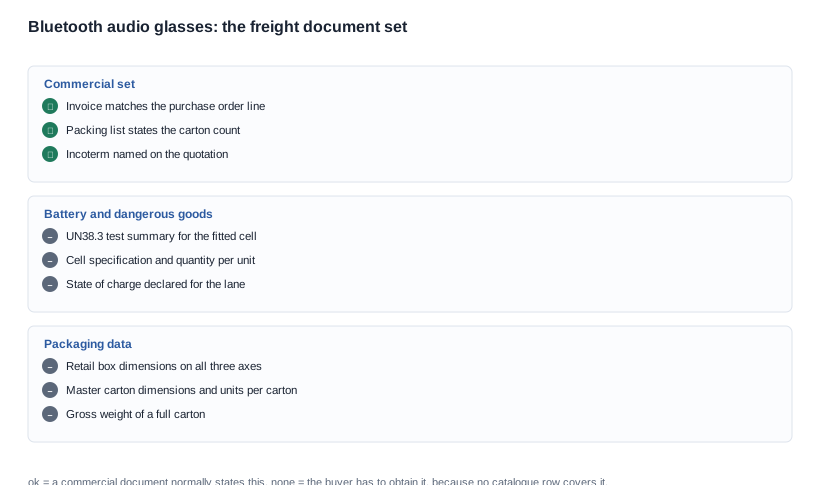
The negotiable items are the packaging specification and the units per carton; whether the master carton is dedicated or shared with other products; the accessory set and its own minimum quantities; delivery splitting against a confirmed carton count; the insurance basis and the declared value; the freight terms named on the quotation rather than agreed afterwards; and the preparation of the battery documentation file.
The items that do not move are worth naming so that a negotiation is not spent on them. The carrier's tariff and the volumetric divisor it applies are not a commercial variable. The dangerous-goods rules and the documentation they require follow the transport mode and the cell, not the negotiation. The cost of a re-palletisation, a refused delivery or a held consignment is a consequence of the lane and the paperwork rather than of the relationship. And the rate itself moves with fuel and with lane capacity, which is why a freight quote should carry a validity date.
The freight document checklist to request alongside the rate is short: the retail box dimensions on all three axes, the master carton dimensions with the units per carton, the gross weight of a full carton, the gross weight of a packed retail unit, the accessory list, and the battery file for the cell that is fitted. The total cost of moving a light good is decided by this list, and the list is short enough to request in one message.
A hypothetical lane comparison, and the numbers we will not invent
A hypothetical comparison, worked through
This is a worked case rather than a client project. It intends to show the choices.
Assume a channel buyer placing a first order covering two models from the audio family into a single destination market, with the shipping cost as the deciding factor between them.
The first step is to ask the right question of the supplier. Not "what is the shipping weight" but four separate questions: the gross weight of a packed retail unit, the three dimensions of the retail box, the gross weight of a full master carton and the number of units in that carton. Asking for the four together avoids a second round of clarification, which is how most freight disputes begin.
The second step is to establish the accessory position per model, because it is the one input that determines whether the two parcels are comparable at all. If one model ships a dock and the other does not, the weights will not be comparable, and the comparison has to be made on the packaged unit of each rather than on the device.
The third step is to get the forwarder's own divisor and rate for the lane, and to rebuild the landed cost on the measured carton rather than on the unit. This is the step that usually reverses a conclusion, because a light product with a generous retail box is often cheaper to move as a bare retail unit than as a boxed set, and the decision is a packaging decision.
The fourth step is to re-run the comparison after the first production run, using the factory-packed carton rather than the hand-packed sample, and to hold the quotation open against the measured result.
The outcome of that walk-through is not a cheaper product; it is a landed cost model that survives a conversation with a forwarder.
What we publish, and what we will not estimate
No weight in this range can be calculated from our documentation, and any landed cost built on an estimate is a number that will move. We will not publish a frame weight, a case weight, a packed unit weight or a carton weight for any of the eight audio models, because none of them exists in the source, and we will not estimate one. What we can do is set out the six elements, tell you which route closes each one, and point at the two published facts that structure the parcel: the charging interface that splits the family into a magnetic group and a Type-C group, and the cell configuration that splits it into a 55mAh2 group, a 90mAh2 group and a single 100 mAh group.
The one weight our catalogue publishes is 158 g for the MT6 glasses unit, excluding its foldable charging case, and it belongs to the camera family rather than this one.
Six items to establish, in order
- The frame weight per model, with the cells fitted, and the spread across a sample.
- The case or dock, if one exists: its capacity, its weight and its charging input.
- The cable, and whether one serves both the frame and the case.
- The packed retail unit: gross weight and the three box dimensions.
- A full master carton, weighed, and divided by the units it holds.
- The battery file, so the consignment actually moves.
Related reading
- The accessory decision — Bluetooth audio glasses charging options
- The one-cable model — D12 smart glasses best for
- Where the measurement belongs — Bluetooth audio glasses bulk ordering
Send us the models, the volumes and the destination country, and we will tell you which model's parcel is the cheapest to move and which is the heaviest.


