
These two models do not compete for the same programme, and the battery rows are where that becomes obvious. The D17 is a sport model with a 115 mAh cell, a charge time of about one hour, roughly seven hours of rated use, Type-C charging and a remote photo trigger. The V06 is a camera model with a 260 mAh cell, a 5 to 8 hour rated range, a charge time of two hours or less, magnetic charging, an 8 MP camera, a removable inner frame and an IP54 marking.
So this is a comparison of two different products that happen to answer the same question about power. That is still worth doing properly, because the four power figures can be read, compared and turned into acceptance questions — as long as nobody converts a ceiling into a duration or a cell figure into a runtime.
D17 smart glasses vs V06 battery and charging, read as published
The two power rows, side by side
The D17: a 115 mAh cell, a charge time of about one hour, roughly seven hours of rated use, Type-C charging.
The V06: a 260 mAh cell, a charge time of two hours or less, a 5 to 8 hour rated range, magnetic charging.
The first thing to notice is that the V06 is a camera model. It publishes an 8 MP camera class, a removable inner frame, an IP54 marking and an ergonomic design note, and it publishes a 超长续航 long-battery-life feature line. The D17 publishes no camera row and no feature line about endurance; its two feature lines are Remote Control Photo and Surround Sound.
That difference decides how far the power comparison can be taken. A larger cell in a camera platform is doing a different job from a smaller cell in an audio frame with a trigger, and the numbers are not two readings of the same quantity. They are the power budgets of two products, and a buyer who treats them as a ranking of the same attribute is comparing the wrong things.
The cell figure, and what it is not
The D17 publishes 115 mAh. The V06 publishes 260 mAh. Both are single published figures, and both are legitimate catalogue values.
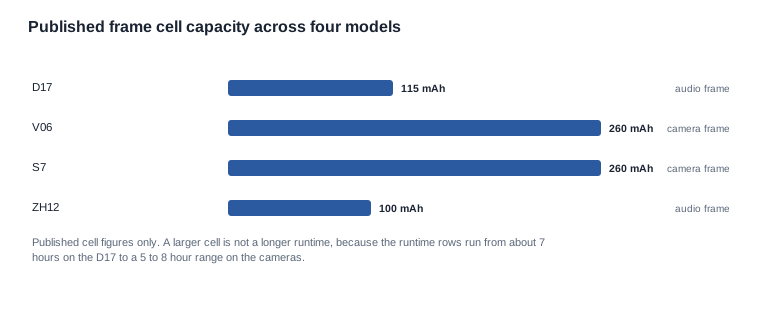
A cell figure is a component value, not a runtime. The clearest proof is inside the catalogue itself: the D11 and the D12 publish 100 mAh with roughly seven hours of rated use, while the ZH12 publishes 100 mAh with roughly eight hours. The same cell figure appears with two different runtime figures, which means a runtime cannot be derived from a cell.
A cell figure is also not a total. Other models in the catalogue publish a two-cell form, 70mAh2 on the YKC02, 90mAh2 on the K01 and the K02, 55mAh*2 on the LC-105 pair, the G07 and the YK12. When a cell figure is written into a table or a chart, it should keep the catalogue's own notation, because a total is a derived number and a derived number in a specification column reads as a published one.
The runtime figures, and the two different kinds of number
The D17 publishes roughly seven hours. The V06 publishes a 5 to 8 hour range.
A point figure and a bracket are different claims and they behave differently in a listing. A point can be quoted as "about seven hours" with the catalogue as its source. A bracket is more useful in practice, because it says where the figure moves, but it also says that the figure is not a fixed duration.
The camera models on the pillar mostly publish brackets, and the D17 and the ZH12 publish points. The V06 and the S7 publish 5 to 8 hours, the KY06 publishes 6 to 8 hours, the MT5 publishes 6 to 8 hours, and the CY03, the L2 Utral and the MT6, the CY05 and the L1 Pro publish about seven hours.
What neither figure publishes is the profile behind it. Volume, connection state, codec, whether the camera is running, whether the screen is on. A runtime figure without a profile is a number with a footnote, and a programme that needs a shift claim has to obtain the profile before it can write one.

Four published figures and the caution attached to each
Reading the four rows against each other
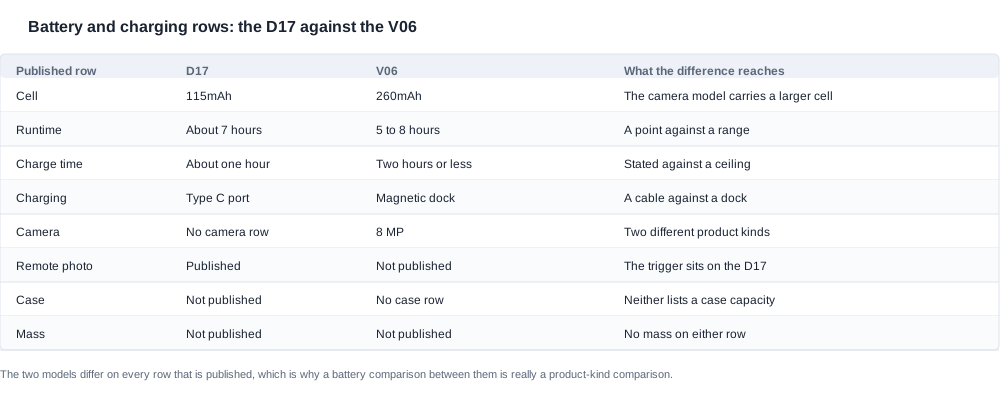
Cell. 115 mAh against 260 mAh. The camera model carries more than twice the published cell figure. The caution attached to this row is that the two products are not the same object, and that a cell figure is not a runtime.
Runtime. About seven hours against a 5 to 8 hour range. A point against a bracket. The caution is that neither figure states a measurement profile, and that the bracket cannot be collapsed to its upper or lower bound for a listing.
Charge time. About one hour against two hours or less. A stated figure against a ceiling. The caution is that the two are not the same kind of claim, and the difference is set out in the next section.
Charging method. Type-C against magnetic. A cable against a dock. The caution is that the published line is an interface, and the commercial consequences sit in the accessory, the packaging and the aftermarket supply.
The three rows that carry no published condition at all
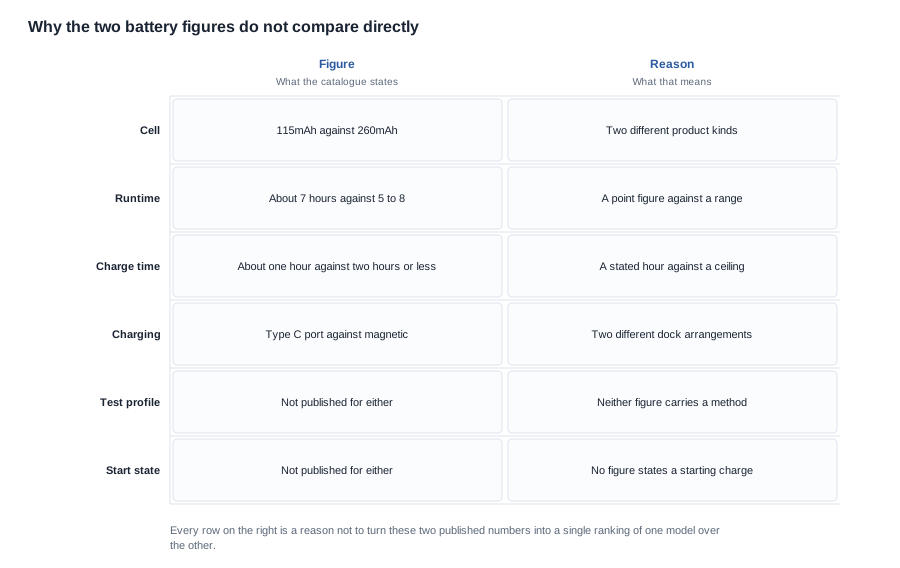
Underneath the four figures there are three absences, and they are the same for both models.
No start state. Neither model publishes the state of charge at which the charge-time figure begins, so the figure cannot be turned into a promise about a turnaround between shifts.
No end point. Neither model publishes what counts as a complete charge, or how the device signals one, so the charge cycle cannot be planned to the minute from the catalogue.
No test method. Neither model publishes the profile behind the runtime figure, so the two runtimes cannot be compared without knowing what was being measured.
These three absences are why a battery comparison in this category usually has to end in a sample. A supplier answer can name a start state and an end point; a measurement can produce a profile. Nothing else can.

Why the charge-time comparison stops at the published wording
A stated hour and a ceiling are different claims
The D17 publishes a charge time of about one hour, and it is one of only two models in the catalogue that publish a charge time in that form. The other is the ZH12, also about one hour. The remaining twenty-six models publish a charge time of two hours or less.
The distinction is not pedantry. A ceiling of two hours or less permits a cycle that takes exactly two hours. A statement of about one hour is a figure the catalogue offers as a description of the cycle. Those are two different claims, and a programme that merges them produces a specification that is wrong in one direction or the other — either a cycle that takes longer than promised, or a claim that the catalogue cannot support.
So the comparison stops here. The D17 publishes a stated one-hour figure and the V06 publishes a two-hour ceiling. That is what the catalogue says, and the honest way to write it in a specification sheet is to reproduce both wordings exactly.
The feature line that has to be checked against the row
The V06 publishes a 超长续航 long-battery-life line, which is a marketing statement on the model page, and it publishes a 5 to 8 hour runtime row.
A feature line and a runtime row have to be read together, and here they are of different kinds. The row is a range; the feature line is a claim. The claim is not a second measurement, and it does not extend the range.
This is a general point about feature lines, and the D17's two feature lines work the same way. Remote Control Photo and Surround Sound are statements of capability, and the D17's about-seven-hour runtime row is a separate publication. A feature line never converts into a number, and a number never converts into a claim. The specification breakdown works through the D17's lines in detail.
The operational consequence, which is the one that matters
The charge-time difference matters where a programme is turning devices over between people, and it does not matter where a programme charges overnight. A warehouse operation that issues a device at the start of a shift and recovers it at the end of one has a turnaround problem, and the published rows give the D17 an advantage there. A programme that returns devices to a charging point overnight has no turnaround problem at all, and the difference between the two published charge-time wordings is then a line in a data sheet rather than a decision.
A magnetic dock is also a turnaround difference in disguise. A cable can be plugged into a charging cabinet with no fixed position. A dock has to be physically located, has to be plugged in, and occupies space that a cable does not. Where a programme turns devices over in a field rather than a room, that is a service design question and it is not visible in either published row.

The charge-cycle questions to put in writing

Six questions, asked once, against both models
- What state of charge does the published charge time start from? A percentage, a description, or an explicit statement that the figure assumes a full discharge.
- What end point does the cycle stop at, and how does the device signal it? A current threshold, a voltage, a status indicator, or a full charge to the point of disconnection.
- What does the runtime figure assume? Volume, connection state, codec, whether the camera is running on the V06, and whether the screen is on.
- Is the magnetic dock quoted separately or included in the box, and what does the accessory set contain?
- What cable and adapter does the Type-C port on the D17 need in the field kit, and what length?
- How many charge cycles is the cell rated for, and what is the capacity retention figure at the end of that life?
Ask them against both models in one message. The questions are identical, the answers are not, and a single round of correspondence is cheaper than two.
Recording the answer against the published row
Record the answer against the published row, in a separate column, with the date. A supplier that answers with a start state of "from a depleted state" against a published figure of about one hour has told you something the catalogue did not, and it may be the difference between a cycle that fits inside a break and one that does not.
A sample measures what a document cannot. A cycle timed from a stated state to the device's own completion signal, and a runtime run to the end of the published figure under a stated duty cycle, produce two numbers with a method attached. Those are the numbers to use in a shift plan, and the catalogue figure stays in the file as the published claim.
The warehousing consequence, stated in procurement terms
Charging has a capacity requirement, and a capacity requirement is a supplier question. A programme that recovers a fleet of devices on a schedule needs to know how many charging points it needs, and that number depends on the charge time, the turnaround window and the fleet size — none of which the catalogue answers on its own.
Ask the supplier for the recommended charging arrangement against the fleet size the programme actually has, and ask whether the dock or the cable is the arrangement they would use in that scenario. The answer is more useful than the published charge time, because it is the answer to the question the programme is actually asking.
What a power comparison means for the procurement file
The power rows are not only a technical matter, and a buyer who files them under engineering will find that the commercial file has nothing to attach them to.
The four places the power rows land in a procurement file. First, the specification sheet, where the cell, the runtime and the charge time have to be quoted in the catalogue's own wording. Second, the acceptance plan, where the start state, the end point and the profile become the criteria against which a sample is measured. Third, the commercial request, where the charging arrangement, the accessory set and the packing determine what a supplier is actually quoting. Fourth, the quality control plan, where a cell that does not hold its published runtime is a defect and the defect definition needs the same profile as the acceptance measurement.
The questions to ask, in the language the supplier answers fastest. What is the charge time from a depleted state, and what is it from a partially charged state? What end point does the cycle reach? What does the runtime figure assume? What is the recommended charging arrangement for a fleet of a given size? What is the cell's rated cycle life and its retention at the end of that life? Which of these answers hold for the exported configuration as well as the domestic one?
How to choose the order in which they are asked. The start state, the end point and the profile come first, because the acceptance criteria depend on them and the sample cannot be measured without them. The commercial questions come second, because a quotation for a configuration whose acceptance criteria are still open tends to be revised later. And when to ask is a scheduling decision: the one question with the longest lead time is the conformity set, and it goes out on day one even though it is answered last in the planning sense.
The shortlist rule. If both models are on the shortlist, they get the same six questions in the same message, and their answers go into the same two columns. A shortlist where one model has been asked and the other has not is not a comparison.
And the commercial questions that sit on top of them. Ask for the unit price of each configuration against the same quantity band, the same packing and the same destination, so that the comparison is made on a common basis. Ask whether the dock or the cable is in the box. Ask for the payment milestones and what the deposit covers. Ask for the warranty period on the cell, because a cell is the component most likely to fail first and a warranty that excludes it is a warranty that excludes the most likely failure.
None of these questions is answered by the catalogue, and all of them are answered by a supplier. That is the practical statement of what a power comparison in this category produces: not a verdict, but a short list of questions that convert two published rows into a decision that can be signed.
When the power rows are enough on their own
There is one case where a buyer does not need the supplier round, and it is worth recognising because it saves a week of schedule.
If the programme's requirement is already written in the catalogue's own words — a device that must show a published runtime of about seven hours and charge in about one hour over a Type-C port, and nothing more — then the D17's row satisfies it as published, and the open rows do not need to be closed before the order. The sample measurement then becomes a quality control check rather than a gate.
The trap is recognising this too early. A requirement written in catalogue words is a requirement that has not been thought about, and the conditions behind the figure are exactly what the programme is usually relying on without noticing. A checklist for the buyer is short: is the requirement about a published figure, or about a duty cycle? A published figure is satisfied by the catalogue; a duty cycle needs the sample, and no amount of reading will close it.
What the catalogue supports about battery claims
What the catalogue supports. A cell figure, a rated runtime, a charge time and a charging method, for both models, quoted as published. For the D17 that means 115 mAh, about seven hours, about one hour to charge and Type-C. For the V06 that means 260 mAh, a 5 to 8 hour range, a charge time of two hours or less and magnetic charging.
What it does not support. It does not support a statement that one model lasts longer than the other, because one figure is a point and the other is a bracket with no profile attached. It does not support a statement that one charges faster, because the two published wordings are different kinds of claim. It does not support a battery life figure for the trigger use case, because the catalogue does not publish what the trigger does to the power budget, and a remote shutter that draws a radio link is a different load from an idle frame.
We do not publish a price for either model, a warranty period, a cycle life figure or a cell specification beyond the published capacity, and we will not fill those gaps with typical values. The D17 limitation list sets out the full open-row set for the D17, and the spec comparison against the V06 puts these power rows in the context of every other row the two models publish.
Our position is that a power comparison is worth doing on published rows alone, as long as the wording is reproduced exactly and the absences are named. Send us the two models, the fleet size, the turnaround window and the destination market, and we will tell you which published figures can be carried into your specification sheet as they are, and which have to wait for a supplier answer or a sample measurement.


