
The D17 and the V06 are separated by every published row that divides them, and by kind rather than by degree. One is a sport model with a remote trigger and a surround-sound line; the other is a camera model with an 8 MP class, a removable inner frame and an IP54 marking. A buyer who puts them on one product page is asking a customer to choose between a shutter and a lens.
The useful work in a comparison like this is not the ranking, it is the line-by-line read — reading every row as written, marking what each one licenses a product page to say, and separating the rows that are published from the rows that are only half published. This article does that, and it uses the S7 as a control: a third model whose published rows are identical to the V06's on everything except the camera class.
D17 smart glasses vs V06 spec comparison, line by line
The published lines, in full
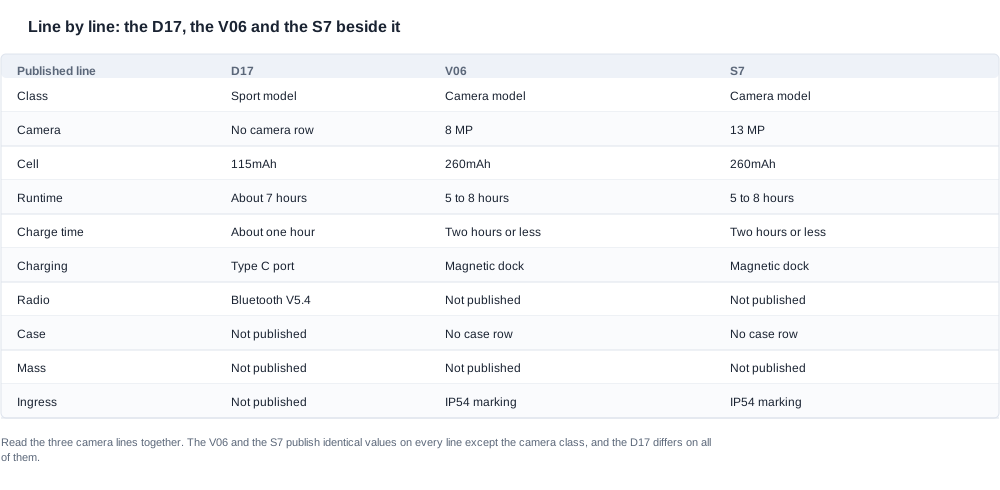
The D17: Bluetooth version V5.4, a 115 mAh cell, roughly seven hours of rated use, a charge time of about one hour, Type-C charging, Remote Control Photo, Surround Sound. No camera row, no case line, no mass, no ingress marking.
The V06: an 8 MP camera class, a 260 mAh cell, a 5 to 8 hour rated range, a charge time of two hours or less, magnetic charging, an ergonomic design note, a 超长续航 long-battery-life line, a removable inner frame, an IP54 marking, and a colour line with four options. No radio version, no case line, no mass.
The reading order, and why it starts with the camera
Read the camera class first, in every comparison, before anything else is weighed. It decides what kind of product is on the table, and it is the line that cannot be moved later by any other row.
The D17 publishes no camera row, and that absence is a fact rather than a gap in our knowledge: the page exists and it carries no camera line. The V06 publishes an 8 MP class, and the catalogue publishes a resolution class and nothing further about the camera behind it.
Everything else follows from that split. A 115 mAh cell in an audio frame with a trigger and a 260 mAh cell in a camera platform are two different power budgets, and comparing them as two readings of one attribute is where a spec comparison starts producing false conclusions.
The rows that are the same, and the row that is not
Only one published line differs between the D17 and the V06, and it is not a measure of quality. The camera class. A radio version is published on one and not the other. The charge method, the runtime shape, the case position and the mass position are all different too — but the two models sit on opposite sides of the class line rather than at different points along a scale.
So a spec comparison between them has to be written as a statement about product kinds. The alternative — a table with the D17 on one side and the V06 on the other and a conclusion at the bottom — is a table that invites a reader to treat the D17's smaller cell as a weakness rather than as a description of a different product.
The two camera models differ on one published line only
Including the S7 in this comparison is not padding. It is a control, and it shows what the camera platform actually looks like when two of its models are placed side by side.
The V06 and the S7 publish identical values on every standard row: a 260 mAh cell, a 5 to 8 hour runtime, magnetic charging, a charge time of two hours or less, no radio version, no case line, no mass. They both publish an ergonomic design note, a removable inner frame and an IP54 marking. The published differences are the camera class — 8 MP on the V06 against 13 MP on the S7 — and a colour line published for the V06 alone.
What that control tells a buyer
Two models that are identical on every row except one are one platform at two camera classes. A buyer weighing the V06 against the S7 is therefore not choosing between two designs. They are choosing a camera class, and the question behind that choice is what the class changes in the finished product: the storage and video format question, the sensor and field of view question, and the cost of the extra processing.
The camera classes in the catalogue, for scale. Eight models publish an 8 MP class, and three publish 13 MP. The 8 MP group covers the MT5, the CY03 and the V03, the MT6, the V03 Pro and the V06, the KY06 and the CY05. The 13 MP group covers the L1 Pro and the S7, and the L2 Utral. The two classes are the only camera differentiations the catalogue publishes.
The one published difference, read carefully
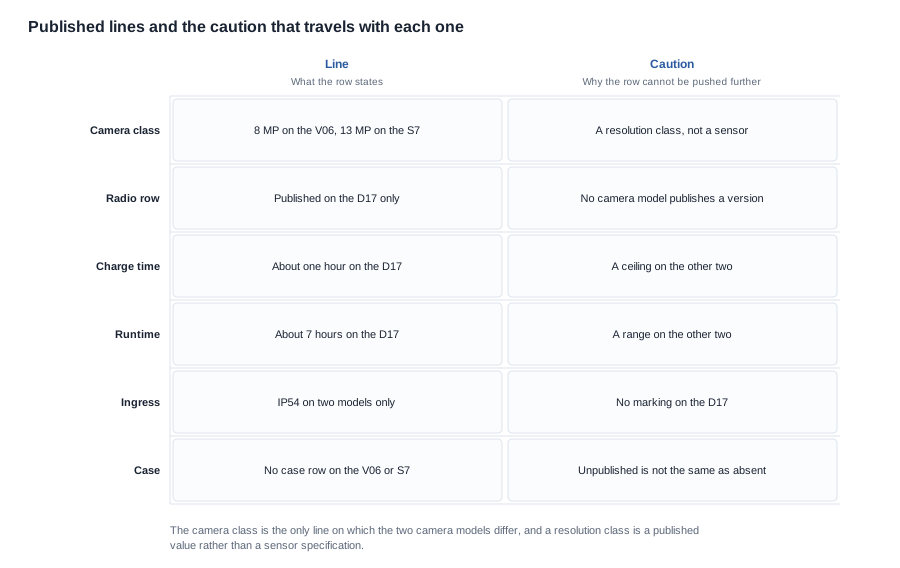
The camera class is a class. It tells a buyer the resolution tier of the camera and it supports a product-page line of the form "8 MP camera" or "13 MP camera". It does not tell a buyer the sensor, the field of view, the frame rate, the video format, the storage capacity, the stabilisation behaviour or the low-light performance, because none of that is published for either model.
A resolution class also does not support a comparison of image quality between the V06 and the S7. The catalogue does not publish a test image, a lens specification or a sensor generation for either, and the difference between 8 MP and 13 MP on paper is a difference in class rather than a documented difference in output. A programme that needs to know what the picture looks like has to evaluate a sample, and that evaluation is the only evidence available.
What a line-by-line read leaves for the commercial file
A spec comparison is usually written for a technical audience, and a procurement file is usually built from a quotation. The line-by-line read is the bridge between them, and it is worth converting explicitly.
The closed rows go into the specification sheet as published values. For the D17 that is the radio version, the cell figure, the runtime, the charge time, the charging method and the two feature lines. For the V06 that is the camera class, the cell figure, the runtime bracket, the charge ceiling, the charging method, the ergonomic note, the long-battery line, the removable inner frame, the ingress marking and the colour line. Those values do not need a supplier to be quoted, and a programme that sends a request for them is buying a day of correspondence for nothing.
The open rows go into the request, with a name and a date against each. They are the radio version, the case position, the mass, the dimensions, the ingress position on the D17, and the conformity documents for the destination market. A request that arrives without those six names attached gets a general answer, and a general answer closes nothing.
And the comparison basis goes into the request too, so that the two quotations describe the same object. Same quantity band, same packing, same destination, same accessory set, same payment milestones, and the same conformity scope. The supplier who answers all of that in one message has given a buyer a comparison that can be signed; the supplier who answers a model name and a number has given a catalogue entry.
The cost of a comparison done this way is one round of correspondence and one sample session. That is the cheapest way to reach a decision in this category, and it is available because the published rows are few enough to read and the open rows are few enough to name.
Why the D17 is not in that platform
The D17 cannot be placed on the camera platform's scale, because it is not on it. It has no camera row, a different radio position, a different charging method, a different cell figure and a different runtime shape, and its only published feature lines point at a remote trigger and a spatial audio claim.
The honest way to write the D17 and the V06 on one page is as two products with two different briefs, and to send the reader to the questions that decide between them rather than to a total. The form factor comparison and the battery comparison each take one of those dimensions and read it in full.
Rows that must not be read further than they are written
Several rows in this catalogue are published in a form that invites a reader to add something. These are the ones that cause trouble.
The radio row, which exists on one side only
The D17 publishes Bluetooth version V5.4. The V06 publishes no radio version, and neither does the S7. That is a general property of the eleven camera models, not a gap on one page, so a programme cannot reason from the audio and sport models to the camera models on this row.
A published version is a documentation asset, not a performance figure. It lets a compatibility statement, a connection procedure and a support script be written today. It says nothing about range, codec, multipoint or the number of simultaneous connections, and a copywriter who turns a version into "advanced connectivity" has written something the row does not support.
The charge time, which is a ceiling on one side
The D17 publishes about one hour. The V06 publishes two hours or less. The two are not the same kind of claim, and the point is not pedantry: a ceiling of two hours or less permits a cycle that takes exactly two hours, which is not the same assertion as a cycle that finishes inside two hours. A programme that merges the two wordings produces a specification that is wrong in one direction or the other.
The runtime, which is a bracket on one side
The D17 publishes roughly seven hours. The V06 publishes 5 to 8 hours. A point and a bracket carry different weight in a listing, and neither states the profile behind it — volume, connection state, codec, whether the camera is running on the V06.
The ingress marking, which exists on two models in the catalogue
The V06 publishes an IP54 marking, and so does the S7. Those are the only two models in the whole catalogue with an ingress marking. The D17, the ZH12, the YKC02 and every other model publish nothing of the kind.
Two cautions travel with that row. The marking carries no third-party test report number in the catalogue, so it should be handled as a supplier claim to be verified rather than as a proven rating. And it must not be carried sideways to the D17, which is a habit worth naming because the two models sit on the same pillar page.
The charging case, where absence and silence are different
The catalogue publishes no charging-case row for the V03, the V06 or the S7. That is an unpublished row, not a published statement that those models ship without a case.
The distinction matters because the catalogue is explicit elsewhere: seven camera models ship with a case, and one model, the V03 Pro, has no charging-case row. Five camera models publish a case capacity, and two more publish the fact of a case without a figure. A buyer who reads "no case row" as "no case" will raise a packaging question that does not exist, and a buyer who reads it as "a case is included" will be wrong at the carton.
The resolution class, once more
Eight models publish an 8 MP class and three publish 13 MP. Both figures are structural facts about the catalogue, and both are useful for framing. Neither supports a claim about image quality, a comparison between individual models, or any statement about a sensor that the catalogue does not name.
The rows that are closed on both sides, and why that matters
Four rows are settled for both models, and they are the ones a specification sheet can be built from. The cell figure, the runtime, the charge time and the charging method are published on the D17 and on the V06, each in its own wording, each reproducible from the catalogue.
The value of a row that is closed on both sides is that it removes a class of dispute. A buyer does not have to argue with the supplier about what the published charge time is, does not have to chase a specification for a cell figure, and does not have to reconcile two documents that describe the same device differently. What is left to discuss is the small set of rows where the catalogue is silent, and a short dispute is a discussion about a sample and a document rather than about a number.
There is one more closed row on the D17 alone, and it is the most valuable one in this comparison. The radio version is published on the D17 and on the ZH12, the D11, the D12, the LC-105 pair, the G07, the YKC02 and the audio models, and it is published on none of the camera models. A programme that has to publish a compatibility statement, a connection procedure and a support script can write all three from the D17's page today, and has to wait for a written answer before it can write any of them for the V06.
That is the comparison, when the class question has already been answered. The two products differ in kind, and the D17 carries the documentation burden that a camera platform in this catalogue does not.
The verification sequence that closes the gaps
The order, and why it is this order
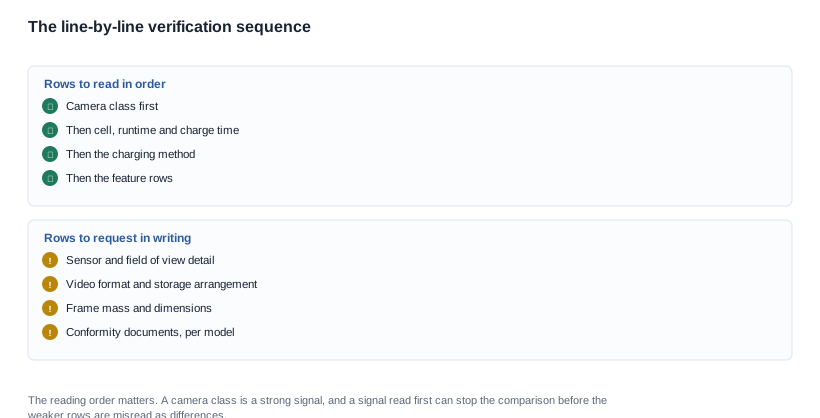
Read the published rows first, in the order they are listed above, and mark each one as a closed row or an open row. The camera class, the cell, the runtime, the charge time and the charging method are published on at least one side and are quotable today. The radio row, the case, the mass, the ingress position and the conformity set are open on at least one side.
Then close the open rows, longest lead time first. The conformity documents for the destination market go out on day one, because a laboratory relationship and a document review cannot be compressed. The case position and the radio position go out next, because they are commercial questions with short answers. The measurements — mass, dimensions, the charge cycle, the runtime profile — wait for the sample, because they cannot be answered without one.
Then, and only then, price the configurations. A quotation for a configuration whose acceptance criteria are still open will be revised, and a programme that has already committed to a launch date will pay for the revision.
The questions that close the rows, in one request
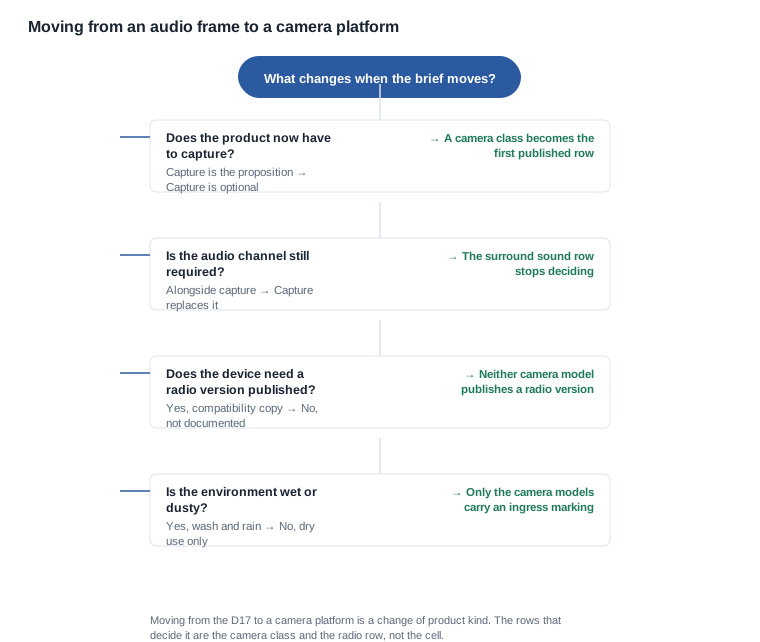
The criteria for closing a row are the same in both directions. A row is closed when the answer names the model, carries a unit or a boundary, and arrives in writing with a date. A description of a characteristic leaves the row open, however accurate it is.
- Which radio version is fitted to production units of the V06, and against which devices has the connection been verified?
- Which conformity documents cover the V06 and the D17 in the destination market, issued against which model numbers?
- What is the ingress position for the D17, and which laboratory and report support the IP54 marking on the V06?
- What mass and what dimensions does each model ship at, with the cell fitted?
- From what state of charge does the published charge time start, and what end point does the cycle reach?
- Does a charging case ship with either model, and what does the accessory set contain?
Ask them once, against both models, and record the answers in a column that is not mixed with the catalogue rows. A file where a supplier answer sits beside a published figure is a file where the two will be confused later by somebody who was not in the correspondence.
What to ask is settled; when to ask is a scheduling decision. The conformity set goes out first because it has the longest lead time, the commercial questions go out with it because they are short, and the measurements wait for the sample. The question that should be settled before you order is whether the programme needs a decision at all, or whether the requirement can be met by a model whose rows are already published — the D17's are, in full.
The sample programme, and what it has to measure
A sample unit measures what a document cannot. For this pair, that is the charge cycle from a stated state, the runtime under a stated duty cycle, the mass, the dimensions, the remote trigger on the D17, and the picture the V06 actually produces. A sample programme with a written method, a named unit and a recorded result is what turns a spec comparison into a decision.
And the sample has to be the export configuration. A measurement on a domestic unit is evidence about a different product, and the difference between the two is exactly where a market access problem appears late.

What this comparison settles and what it does not
What it settles. It settles that the D17 and the V06 are different products rather than different versions of one product, that the D17's radio version and the V06's camera class are the two rows that do the most work, that the V06 and the S7 are one platform at two camera classes, and that the open rows on both sides are short, known and closable.
What it does not settle. It does not settle which product a programme should buy, because that depends on a brief rather than on a table. It does not settle what the D17 weighs, what either camera produces, whether either model conforms in any market, or what either configuration costs, because none of those is published. It does not settle whether the S7's 13 MP is better in the field than the V06's 8 MP, because the catalogue publishes a class rather than an output.
We do not publish a price for any model, a mass, a dimension, a sensor specification or a per-model conformity row, and we will not rank the two. What we will do is read the rows with you, mark the closed ones and the open ones, and say which requests have to go out before the comparison can be signed.
Send us the two models, the brief, the destination market and the channel, and we will tell you which of the published rows the comparison actually turns on, which requests close the rest, and what the sample programme should measure. The D17 specification breakdown sets out the D17's own row in detail, and the selection path against the S7 covers the routing that this comparison feeds.


