
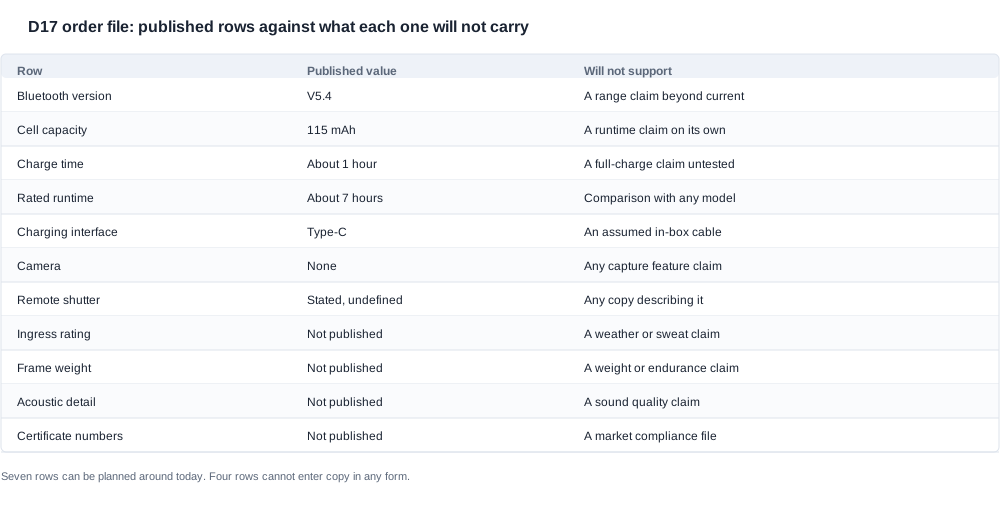
The D17 publishes Bluetooth V5.4, a 115 mAh cell, a charge time of roughly one hour, a rated runtime of roughly seven hours, Type-C charging, remote shutter control and stereo surround sound. It publishes no camera. That combination produces a single question that has to be answered before any other row on the list, because everything else on the list can be written around and this one cannot: what does the shutter trigger? The D17 sits in the sport-positioned range rather than the general audio range, which raises the stakes on that row. Sport buyers test the physical controls first, and reviewers test them in a single sentence.
This is the method for turning the D17's published rows into an order file that survives pre-shipment inspection, for handling the four rows where we hold no figure at all, and for deciding which claims your channel can make without a source behind them. It is written for the buyer who signs the purchase order rather than for the buyer who reads the listing, because the listing is where the problems arrive rather than where they originate. Where a row is marked unavailable below, it means we hold no value for it — not that the feature is absent, and not that it is present but undocumented. Those are three different statements, and only one of them is a fact.
D17 shutter control: the one row that can invalidate a listing
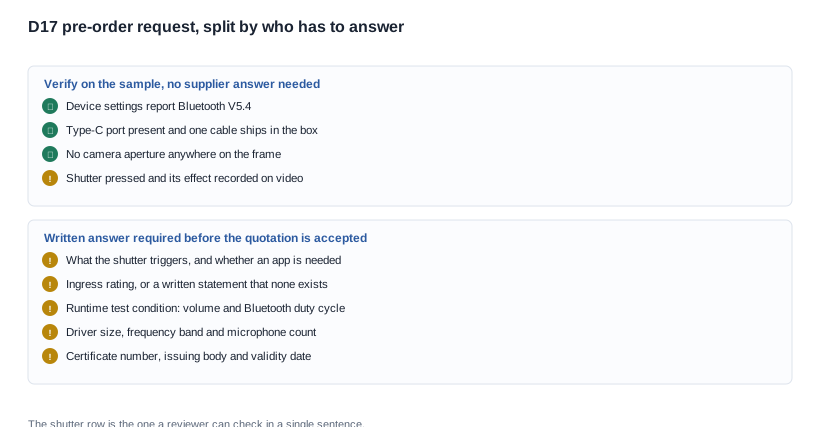
Remote shutter control is published for the D17. A camera is not. The same pair of rows appears on the ZH12, which also publishes no camera. That combination has at least three explanations: it triggers something on a paired phone, it controls a separate unit that is not part of this package, or it is inherited from a shared design and its behaviour was never defined for this configuration. All three are speculation, and we will not present any of them as fact, because a supplier who guesses alongside you will guess differently the next time you ask, and because a guess repeated twice becomes a specification in somebody's spreadsheet.
The commercial consequence is more concrete than the technical one. A shutter control on a product that cannot record is a detail that a reviewer, a channel quality team or a competitor will notice, and by the time they notice it, it is already written into your listing. The cost is not the return. The cost is that the return reason is public, specific and attached to your store rather than to the model, which is the version of the problem that does not go away when the customer is refunded.
So ask three separate questions rather than one general question, because a general question reliably produces a vague answer. What does the control trigger when pressed with no companion device present? Does it require an application, and if so, who publishes that application, which phone systems does it support and where is any data held? Is the control present on every production unit, or is it a variant that is only assembled on some runs? Each question can be answered in a sentence, and all three belong in the same written request as the rows below rather than in a follow-up exchange three weeks later.
If the answer does not arrive, the correct commercial decision is neither to guess nor to omit it silently. Omit it explicitly: describe the D17 by its published rows and leave the control out of the feature list until somebody can explain it. A listing that says less is defensible in a quality questionnaire and in a dispute. A listing that says something nobody can evidence is not defensible in either, and it is the second one that generates the emails you have to answer yourself. Buyers who have handled this situation before generally treat an absent feature as a normal product decision and treat an unsupported feature as a supplier failure.
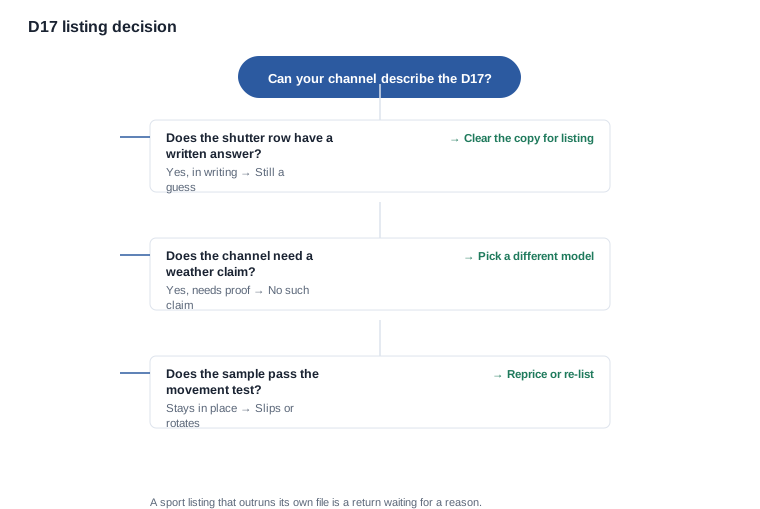
There is a second-order reason to settle the row early. If the control is confirmed as functional, it changes the product's category in your channel's eyes, and category drives which competitors you are compared against and which questions a buyer asks. If it is confirmed as inert, the D12 and the ZH12 comparison becomes the relevant one instead, and the whole shortlist may deserve a second pass. That is why this question belongs in supplier evaluation rather than in the copy stage.
Five published rows and what each one will not carry
The rest of the D17 file is straightforward, provided each row is used for the one thing it can actually support.
Bluetooth V5.4. A current generation version, and a compatibility statement rather than a performance one. Verify it in device settings on the sample rather than trusting the carton, since the packaging is printed before the product is assembled and the two drift apart more often than anyone expects.
115 mAh cell. This is the largest single cell in the sport audio group, against the ZH12's 100 mAh and the YKC02's paired 70 mAh cells. That is a genuine differentiator and it is worth putting in front of a buyer who cares about cell capacity. It is still not a runtime claim: cell capacity and usable runtime are two different measurements, and only one of them is published here. A buyer who asks how long the D17 runs is asking the second question, and answering it with the cell figure is an answer they will notice you changed.
Charge time of roughly one hour. The fastest published figure in the audio range, and the model's strongest commercial argument. Time it yourself from a stated low state rather than accepting the number, because a fast-charge claim that turns out to describe a partial fill is a support-contact generator rather than a selling point. Record the ambient condition and the cable you used, because the answer you get will otherwise be a number with no method attached to it.
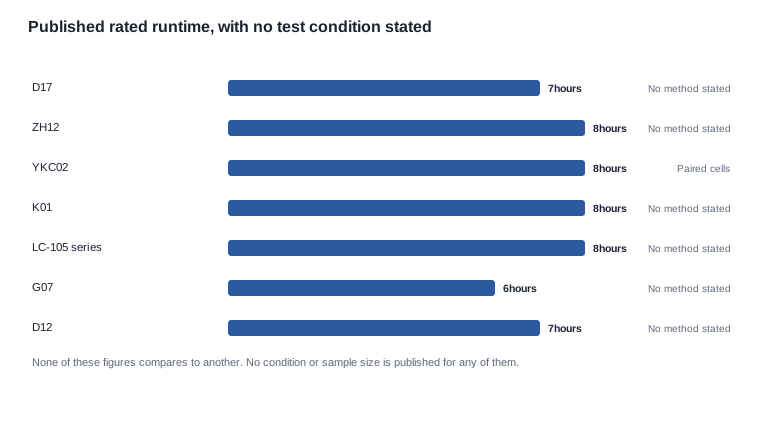
Rated runtime of roughly seven hours. Mid-range. The ZH12, the YKC02, the K01 and the LC-105 series all publish eight; the G07 publishes six. No test condition accompanies any of those figures, so none of them compares to another, and a comparison chart built on them will not survive a technically literate customer. If your channel wants a runtime comparison, the honest version of that chart carries a footnote that no condition is published for any figure on it.
Type-C charging. This settles your packaging and means a cable is required in the box. Confirm what actually ships in the retail box rather than what is described in the quotation, because a missing cable on a Type-C product is one of the few entirely avoidable return drivers in this category, and it is also the one most often assumed rather than checked. Put the cable in the purchase order as an explicit line item with a quantity.
Stereo surround sound. Published as a descriptor, with no driver size, no frequency response and no leakage figure behind it. Use it as a category label if your channel's data feed requires one. Do not turn it into a comparative claim about sound quality, because there is nothing behind the words to defend, and a competitor comparing two products on leakage will find an empty field on your side rather than a losing number.
The sport positioning gap, and how to sell into it without a durability claim
Four of the five models in the sport category are positioned for activity in weather and sweat. None of them publishes an ingress report number. The D17 carries no IP marking at all, where some models in the same group carry an IP54 marking without an accompanying report number. That is the largest single gap in this category, and it is a gap in the positioning as much as in the product — which means it will not be closed by the factory deciding to test harder. It has to be closed by you deciding what your listing says.
The commercial reason to settle it is the retailer questionnaire. Buyers in sport and outdoor channels increasingly answer a durability questionnaire before they answer a price question, and a blank field there is treated as a red flag rather than as an omission. That single field can move a model up or down a shortlist before anyone has heard the quotation, which is why it is worth answering even when the answer is negative. Three answers are available and each one is defensible: request the report and claim nothing until it arrives; describe the product as sport-positioned with no durability claim at all, which is a weaker proposition but an honest one; or shortlist a model in the same category that carries a published marking and accept the longer lead time to obtain it.
What to request, specifically: the ingress rating itself if one exists, the test standard used, the report number, the issuing laboratory and the date. If the answer is that no rating exists for this model, record that sentence in your order file rather than in a message thread — because it is the sentence your channel will need when a buyer asks the same question six months later, and nobody should have to reconstruct it from a support email.
There is a related discipline here that costs nothing: do not let sport positioning generate claims nobody asked for. A category label is fine. A statement about surviving rain, a statement about sweat resistance, a statement about surviving being dropped onto a hard surface — each of those is a claim, and each needs evidence of some kind. Where the evidence does not exist, the honest positioning is usually stronger commercially than the invented one, because the invented one produces exactly the kind of public, specific complaint described at the top of this section, and that cost lands on the channel partner who recommended the model.
The same reasoning applies to the absence of a camera. Do not describe the D17 as camera-free in a way that invites a buyer to ask what replaced it, and do not imply a capture function through the shutter row. State what it does, list what it does not do, and let the buyer decide. Buyers who work in this category already know that the two categories are separate, and the ones who do not are not the buyers you want anyway.

Sample protocol for a product positioned around movement
Because the D17 is positioned for activity, the sample order earns its cost differently from a desk-bound audio frame. Order one unit per colourway plus two spares, keep a signed test sheet with both party names on it, and record the date, the lot code and the measuring person against every result.
- Stability under movement. Set the unit in place and move through the motions your channel actually describes: walking pace, a cycle of head movement, a faster turn. Record whether the frame stays in position, and record what happens at the temple and at the bridge when it moves. Treat this as an observation rather than a pass or fail, and write it down as an observation, because a number you invented here will be quoted back at you later.
- Call test outdoors. Reproduce the environment you sell into rather than the one you happen to be standing in. Fixed source, fixed distance, fixed position, and record the setup before you record the result. Note whether speech at the far end is separable from wind and traffic noise, in words rather than on a scale.
- Charge timing. Time a full charge from a stated low state with the supplied cable, and note the ambient condition. Compare against the published one-hour figure and record the difference rather than rounding it away.
- Port, cable and packaging. Confirm the cable in every retail box, the port undamaged, and the carton intact after the handling it will see in distribution. This is the least glamorous test on the list and the one that most reliably predicts a preventable return.
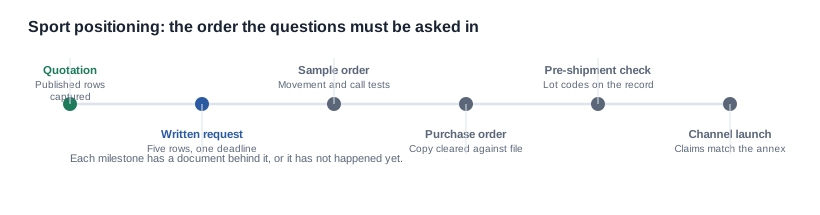
Keep the sample units after the test rather than returning them. When the production lot arrives, the same four tests run on the same equipment turn the sample into a baseline rather than an anecdote, and that comparison is the evidence you want in a quality claim conversation rather than a dispute about whether anything was ever wrong. Record the same four fields on both sheets so the two can be compared side by side.
Score the sample against the claim table rather than against an impression. A unit that passes the mechanical checks and contradicts a claim you planned to make is a better outcome than a unit that passes everything and quietly sets a standard you cannot sustain across the run. Where the sample contradicts the file, the correct action before you commit is to change the file, not the claim, because the file is the thing that travels with the goods and the claim is the thing that changes with your marketing cycle. Record the disagreement, send it back as a written question with a deadline, and treat the answer as part of due diligence on the supplier rather than as a defect notice.
Writing sport claims your channel can defend
The practical output of all of this is a claim table: one row per claim your channel intends to make, the evidence it rests on, and its current status. It is a small document and it settles arguments early, which is cheaper than settling them during a listing review.
| Claim you might make | Evidence it needs | Status on the D17 |
|---|---|---|
| Current Bluetooth generation | Version stated and verified on unit | Supported |
| Fast charging | Timed charge from a stated low state | Verify on sample |
| Sport positioned | Category designation only | Supported |
| Sweat or water resistant | Ingress rating and report number | Not available |
| Long runtime | Stated test condition and sample size | Not available |
| Clear call quality | Microphone pickup condition | Not available |
Put that table in the specification annex of the purchase order, so the copy your channel writes and the file your contract holds are the same document. When marketing and purchasing disagree later — and they will, usually over a single adjective — this table settles which of them moved, and it does so in minutes rather than in a meeting.
The commercial rows are equally unpublishable and equally necessary. Minimum order quantity, lead time and price are not published, and they belong in a quotation where they can be committed to rather than in a catalogue where they cannot. Ask which clock starts the lead time — deposit, artwork approval or confirmed purchase order — and ask whether it holds at your volume and at your colour count. Ask the warranty period and the claim route in the same sentence, because a duration without a route leaves your channel partner carrying the dispute at their cost rather than passing it back.
Two clauses are worth negotiating explicitly. Tie the balance payment to a passed pre-shipment inspection rather than to a shipping date, so the money and the evidence move together. Write the defect allowance and its remedy side by side, because an allowance without a remedy is a negotiation that starts once the container has sailed. Where a supplier resists both, record the resistance against the supplier rather than against the model — it tells you something useful about how a dispute will be handled six months from now.
Which buyer the D17 serves, and which should pick a different model
Name the cases honestly, because a shortlist that contains only the model you can supply is not a shortlist. If your channel leads with call quality, the D17 has no published microphone pickup figure and you will lose the comparison against a model that publishes a method. If your channel needs a durability claim, no ingress rating means the D17 cannot be positioned there at any price, and a model in the same category carrying a published marking is the better anchor even at a longer lead time. If your channel runs long shifts, the roughly seven-hour runtime with no stated condition is a claim you cannot defend, and an eight-hour figure on the same platform is easier to sell even without a method behind it.
For general retail, promotional volume and staff use in an active environment, the D17 is a reasonable pick. The charge time is genuinely strong, the cell is the largest in its group, the interface is current, and the absences are absences of documentation rather than evidence of a problem. That is a workable basis for an order, provided the four unavailable rows are recorded as unavailable in the file that travels with it.
The D17 is well specified on charge time and cell capacity and undocumented on everything else, and the shutter row should not reach a listing until it is explained in writing. Send us your market, channel and whether the sport positioning is central to your proposition, and we will tell you what this model can carry and which rows we cannot support.
Related reading
- Where this model sits against the alternatives — which Bluetooth audio glasses model to pick
- The document set to request before you commit — Bluetooth SIG certification checklist
- Reading competing runtime figures honestly — battery comparison for Bluetooth audio glasses
- Packaging decisions that affect freight tier — packaging options
Send us the target market, the quantity and the required configuration, and we will come back with what is available and what is not.


