
A development process is usually described as a sequence: specification, sample, production, delivery. That description is accurate and almost useless, because a sequence tells you what happens next and not what has to be in your hands before it can happen. This review takes one programme end to end and looks at the four stages where the outcome is actually decided — and at the single question each stage is supposed to close.
One thing should be said at the outset. The programme walked through here is a composite: it is assembled from our own published range, our internal product table and the process documentation that governs how a custom order moves. It is not a named client, and it carries no client data. That is deliberate, because the interesting part of a programme is not the client's name or the volume on the order — it is the sequence of decisions, and the sequence is what a buyer can carry into their own supplier conversation.
What follows is written for brand owners and channel buyers who are about to run a custom smart glasses programme and want to know which gates matter, what each one should leave behind, and what a rejection actually tells you. The four stages are the same four that any development process has, whatever it is called inside a particular factory: the baseline, the first sample, the compliance file, and the production batch.
A development process case review: the four stages that decide the outcome
Most programmes do not fail dramatically. They fail quietly at a handover, because a stage ended without producing the artefact the next stage assumes exists. That is the whole reason this review is organised around stages rather than around documents: a stage is not a document, it is a point at which a set of questions gets closed, and the output of the stage is the record that the following stage is entitled to rely on.
It is worth being explicit about what this walkthrough covers and what it leaves out, because a review that claims to cover everything usually covers nothing in particular. It covers the four stage gates, the artefact each one should leave, and the failure mode each one carries. It does not cover commercial terms, because a quotation is written for one configuration and not for the whole range. It does not cover tooling schedules, because those depend on the factory's own route. And it does not cover the two failures that never reach a stage at all: a requirement that was never written down, and a requirement that was written down and then changed by somebody who assumed everybody knew. Programmes fail at those two points more often than they fail at a gate, and no review substitutes for the discipline of writing the scope down and circulating it.
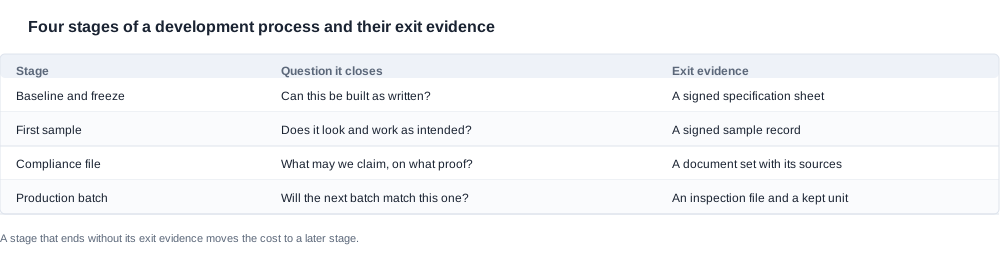
The four stages in the table are ordered by what each one settles. The baseline closes the feasibility question: is every requirement in scope buildable as written, and what exactly is being promised. The first sample closes the appearance and function question: does the thing look and behave the way it was supposed to. The compliance file closes the defensibility question: what may be said publicly, and on what evidence. The production batch closes the repeatability question: will the next batch match the one that was approved.
Read the table as a set of entry conditions rather than a timetable. Each stage has an entry condition, and if the entry condition is not satisfied the stage cannot really be run — it can only be performed, and the difference is where the cost goes. A sample built before the specification is signed is not a sample, it is a prototype that will be paid for twice. A production batch inspected against a specification that changed after approval is not a quality problem, it is an arithmetic problem: somebody is going to inspect units against a document that no longer describes them.
What decides the outcome is not the effort spent at each stage but the number of questions left open when the programme reaches its last one. A programme that leaves two questions open at the production stage has two options: it stops and resolves them, which costs schedule, or it ships and resolves them later, which costs a more expensive kind of attention — the kind that arrives through a complaint, a chargeback, or a market listing that has to be corrected.
There is one more structural point, and it applies to the development process as a whole rather than to any one stage. Each stage should get harder to start as the programme advances, not easier. By the compliance file, the scope should be closed enough that the only open questions are evidential. By the production batch, the only open questions should be the ones that a physical inspection can answer. When a programme reaches the production stage still carrying a scope question, it has skipped a stage rather than passed through it, and the skipped stage will bill later.

The baseline and the first sample, and what a rejection proves
The baseline is the least glamorous part of a programme and the one that decides everything that follows. It is the point at which the buyer and the supplier agree, in writing, what is being built: which model, which options are in scope, which are explicitly out, what each published specification is, and which questions remain unanswered. Without that agreement, every later stage is working from a memory.

Our published range shows why this stage carries weight, and why a baseline has to be written rather than copied. A colour line exists for two entries, V03 Pro with three and V06 with four. A weight appears against MT6 alone, at 158 g. A protection rating appears against V06 and S7. Beyond those few lines the sheet is electrical rather than physical: it describes what a device does, and says very little about what it is made from or how it will wear.
That catalogue is specific enough to be a baseline and incomplete enough to require one to be built. The open items belong inside the baseline rather than beside it, and they are worth carrying in a form somebody can work through:
- A05 and A06 print the same parameters, with the differing field still unidentified.
- The name L2 Utral reads as a misspelling of Ultra, and Pro Max has no agreed meaning.
- MT5 sits on an odd page reference and its category is still disputed.
- V06 and S7 carry the same kind of page-reference anomaly.
- The AR, electrochromic and bone-conduction entries hold no formal SKU.
- No entry in the range has a real photograph, a video or a test report attached.
The first sample then tests what the baseline claimed. It cannot test repeatability, certification, packaging, cost or timing, and anyone who tells you a sample proves those things is telling you the sample programme has been compressed into a demonstration. What a first sample can do is answer whether the option set looks and behaves as intended, whether the finish and the fit are acceptable, and whether the specification sheet describes an object that exists.
Now, the rejection, which is the part buyers most often handle badly. A rejected sample is not a verdict on the supplier and not a verdict on the product. It is one of four things, and each has a different next step. The option may never have been production-stable, in which case it comes out of scope and the programme continues on what was proven. The reference may have been wrong, in which case the specification is corrected and the sample is rebuilt against a better baseline. The route may have changed between the quotation and the build, in which case the conversation is about what the route now is. Or the criterion may have been vague, in which case the real problem is that nobody agreed what passing meant, and the honest remedy is to write the criterion before rebuilding rather than after.
The practical value of classifying a rejection this way is that it converts an emotional event into a decision with an owner. "We rejected it" becomes "we removed two options from scope and the programme continues", or "we rejected the sample because the reference was wrong, and the reference has been corrected and re-issued". The first is a scope change with a schedule effect. The second is a correction that should not have cost anything. Confusing the two is how a development process turns a rejected sample into a rejected supplier.

The compliance file and the production batch
The compliance file is where a programme decides what it is permitted to say. It is assembled rather than written in one sitting, and it gathers everything that will be relied on later: the certification position, the test evidence, the instructions and inserts, the claims used in listings and packaging, and the documents behind them.
Certification has to be recorded as a position rather than as a yes or a no, and the position we can state is a narrow one. The wording appears nowhere in the body of the catalogue PDF or anywhere else in our published material, and we publish no certificate number and no list of covered models, so what has to be recorded is the framework that a named model will eventually be documented against. The export certification page of that PDF is an image, and what it shows is ten patent certificates — eight of them design and two utility model — rather than a set of test reports. The sports line adds its own IP54 mark in the catalogue with no third-party report number beside it. For the children's line, no certification information at all has been provided.
The same discipline applies to every claim the programme intends to make. A parameter advantage is only defensible when the comparison is made against competitor units physically in hand, rather than against a sheet of figures. There is no third-party measurement report behind our acoustic performance. A protection rating stays unpublished until its report exists. Where the electrochromic entry is concerned, no performance figures are published at all, so nothing about it can be presented as a difference. The 35dB figure on the bone-conduction entry raises the most serious compliance question of the range, and the children's line is where safety and health claims carry the greatest exposure. A file that records these limits honestly is worth more than one that hides them, because the hidden version fails later and in public.
The production batch is where the compliance file stops being a document and becomes a set of units. What the buyer should receive with the first batch is not just the goods but the file that describes them: the inspection record, the approved reference unit retained from the sample, the specification sheet the batch was built to, and the tolerance that was applied against the reference.
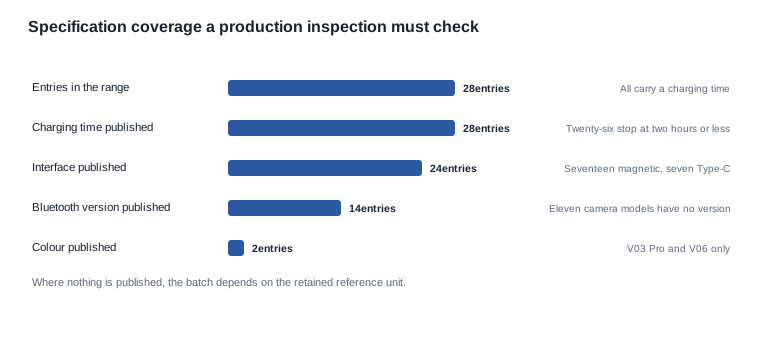
The bars above show the coverage a production inspection inherits from the published catalogue, and they are the reason the inspection file has to be more than a count. Twenty-eight entries have to be checked against a charging time; twenty-four have an interface figure to verify; fourteen have a Bluetooth version to confirm; and only two have a published colour to compare against. Two further lines shape what an inspector can actually compare in practice. On the charging case, the inspection inherits three different situations: a capacity figure on five camera models, a case named but not quantified on the KY06 and the MT5, and four entries — the V06 and the V03 Pro, and the V03 and the S7 — where the catalogue prints no case row, so nothing about them can be checked and the question has to go back to the supplier. On resolution, eight entries sit at 8MP and three at 13MP, namely S7 and L1 Pro, and L2 Utral, so a camera batch can be checked against a published figure while an audio batch may have nothing comparable to check. Where the catalogue publishes nothing, the inspection has no baseline at all, and the batch's quality depends entirely on the reference unit and the internal check that the factory has agreed to run. That is the single most important handover in the whole programme, and it is the one most often skipped, because the units have already arrived and everyone assumes the paperwork was completed.
Handover itself is a stage rather than a moment, and it has the same structure as the others: an entry condition, an artefact, and a question that is closed by the artefact. The artefact is the batch file. The question it closes is whether this batch can be released to customers without anyone needing to go back and ask what it was supposed to be.

The four questions this walkthrough is actually answering
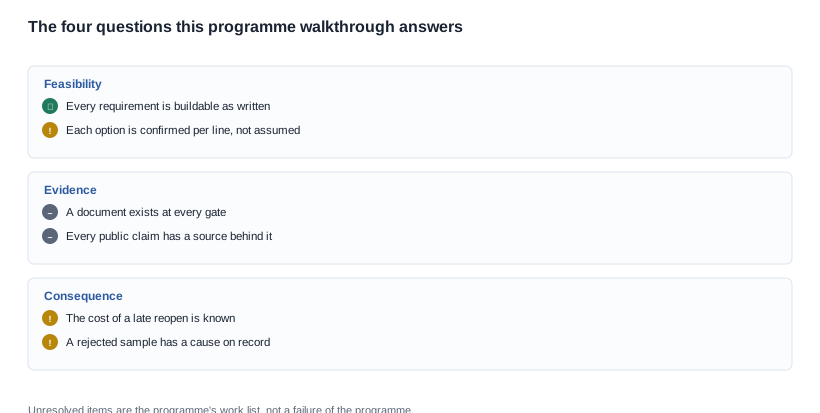
Walking a programme through four stages is only worth doing if the walk produces decisions. Here are the four questions the review answers, each of which has to be answered with a document rather than with an assurance.
-
Is every requirement in scope buildable as written, and on what evidence? A requirement that has never been produced before is a development item, not a specification item, and it should be labelled as one before the programme starts. The test is whether the supplier can name a process, a part and a precedent for it, or whether the answer is a general assurance that it can be done. Our internal table records how many customisation axes each line carries. The AI camera line has seven recorded axes, the Bluetooth audio line and the sports line five each, the children's line has two, and the electrochromic entry has three — with the bone-conduction entry carrying no customisation disclosure of any kind, and the AR entry left undescribed. The three families are not subsets of each other, and for the children's line, the application and firmware capability is flagged for verification. A count is not a capability, which is why the answer to this question has to be per line and per option.
-
What evidence will exist at each gate? This is where most programmes are vaguer than they believe. The gates are the baseline sheet, the sample record, the compliance file and the batch inspection. For each one, the question is whether a document will exist that a third party could read in six months and understand what was decided. Where the answer is "the factory will confirm it", the gate has no exit evidence and should be treated as a risk in the schedule rather than as a step.
-
What does a failure at each stage cost in time and in money? The four stages fail differently. A baseline failure is cheap, because nothing has been built. A sample failure costs the sample plus a rebuild cycle and, more importantly, the momentum of the programme. A compliance file failure costs the launch date, because it happens after the goods exist and before they can be sold. A batch failure costs the whole batch. A buyer who has ranked these four costs knows where to put their attention, and a supplier who has ranked them knows where to put theirs.
-
Which decisions are still open, and who owns each one? This is the question the walkthrough exists to produce, and the answer should be a short list with a name against every line. Open decisions at the end of a development process are the programme's real inventory of risk, and an unnamed open decision is the most expensive kind there is, because it will be discovered by whichever party is holding it at the worst moment.
The checklist groups the four questions by the kind of answer they need. Items marked as unresolved are not failures of the programme; they are the programme's work list, and the review is worth running precisely because it produces that list in a form somebody can act on.
How to use this review on your own programme
Running this review on your own programme takes one working session per stage and one artefact per stage, and the artefacts are cheaper to produce than the rework they prevent. Start by assembling what you already have: the model you intend to base the programme on, the published specifications you are relying on, the option list with the open items still visible, and the claims you intend to make to customers. Most buyers find that this alone produces three or four open decisions that nobody had assigned, which is a good return for an afternoon.
Then, for each of the four stages, write down three things: what has to be true before the stage starts, what document closes it, and who signs it. Anything that does not fit that pattern is a stage you have not defined yet. In practice the most common finding is that the sample stage is well defined and the baseline stage is not — most programmes have a clear idea of what an approved sample looks like and no clear idea of what the approved specification is, which is why samples so often get approved against a shared understanding rather than against a document.
There are trade-offs in all of this, and they are worth stating rather than implying. A tight review slows the start of the programme, and in a launch-driven market a slow start can cost more than a loose one. The counter-argument is that the loose version of this work is paid for later and is not optional: a specification that was never written gets written under pressure during the first production batch, when the people who could have written it are busy. The total cost of a programme is therefore mostly decided by which stage the work happens in, and the review moves that work earlier, where it is cheaper.
There is one more thing worth adding, because it is what buyers ask about most and what is least often written down: where the four stages diverge, and how that shows up. In a healthy programme the divergence appears at the baseline, because a specification sheet is where two readings of the same requirement are forced into a single sentence. In a weaker programme the first divergence appears at the sample, where it is still cheap but has already cost a build. In the weakest, it appears at the production batch, where the parties are arguing about what was agreed, and at that point the argument is usually about memory rather than about intent.
Two red flags are worth naming. The first is a supplier who produces exit evidence for every stage except the baseline, because a baseline document commits them to numbers and a process. The second is a programme where the compliance file is assembled after the packaging artwork is printed, which means somebody has already made public claims that the file cannot support.
The artefacts of a development process are the deliverable as much as the units are. We will not publish a certification statement we cannot evidence, and we would rather tell a buyer that a claim is open than let it travel into a listing and become a problem in a market we cannot see. If you want the same review applied to your own programme, the development process line on this site is where the stage structure is set out, and the questions above are the ones to bring into the first supplier meeting.
Related reading
- Recurring causes of delay — the patterns behind programmes that slip, and what usually precedes them.
- Handover, packaging and after-sales terms — what happens to the batch file once the goods are in your warehouse.
- Communication routines that avoid rework — the reporting habits that keep a stage from being reopened.
- Cost drivers inside the programme — where the money sits while the four stages are running.


