

A quotation for a custom smart glasses order is a number with a great many assumptions attached, and most of those assumptions are invisible on the page. A buyer who wants to understand what is really driving the cost needs to know which assumptions the development process has already fixed, which are still open, and which belong to the supplier and can only be disclosed by them.
That distinction is the whole subject of this article, because the most expensive mistake in custom buying is not paying too much. It is paying a number that belongs to a different order — a different configuration, a different evidence level, a different inspection scope — and only discovering the difference when the goods arrive and cannot be used.
This guide is written for brand owners and channel buyers who are running a development process and have a supplier's number to interpret. It deliberately contains no prices, no price bands and no commercial commitments, because those belong to a quotation for a specific configuration. What it does contain is the input list: which factors make two quotations for the same product incomparable, which of them you control, and what to ask a supplier before the quotation arrives so that the number can be read rather than simply accepted.
Development process cost drivers: the five a buyer controls
Five inputs to a custom cost are, in practice, under the buyer's control. None of them is a price. All of them change the price, and all of them are decided before the quotation is issued rather than after it.
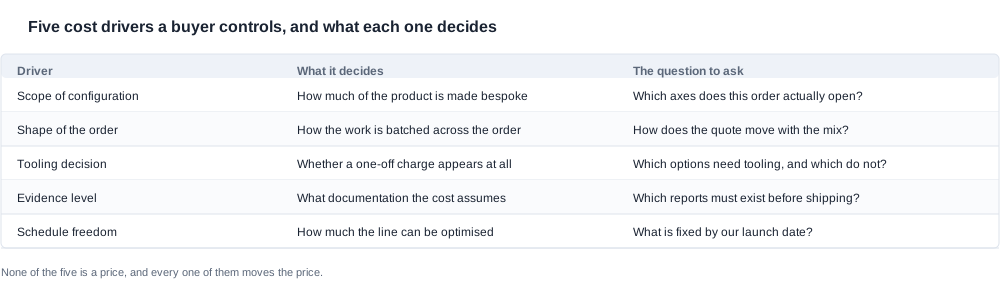
The first is the scope of the configuration. Every option opened is work that has to be quoted, and the count of options is the count of questions. Our internal product table lists how many customisation axes each line carries, and the counts are not the same from one line to the next: the AI camera line carries seven, the Bluetooth audio line five, the sports line five, the children's line two and the electrochromic entry three — while the bone-conduction entry is silent on customisation and the AR entry is not described. Those counts are a prompt rather than a menu, and the useful question is not how many axes a line has but how many of them this particular order actually opens. An order that opens one axis and an order that opens five are different projects that happen to share a product name, and a quotation that does not distinguish them is not a quotation a buyer can compare.
The second is the shape of the order. A single configuration across one volume, several configurations split across the same volume, and several configurations each with their own volume are three different production problems. Splitting configurations usually helps the unit economics of a line and usually costs in setup, because each configuration is set up, checked and closed separately. The trade-off runs the other way when a configuration is barely different from an existing one: opening it creates setup work for no benefit.
The third is the tooling decision, and it is the one buyers most often delegate without realising it. Some options can be applied to a part that already exists; others require a new tool or a new process route, and the second kind carries a one-off cost that appears nowhere in a unit price. The question to ask is which options in the scope need tooling and which do not, and whether the tool is dedicated to this order or is part of a line that already exists. A dedicated tool is an asset that survives the order; a route change is a cost that does not.
The fourth is the evidence level. Documentation is work, and specifying more of it costs more. If the order requires a report to exist before the goods ship, that report is part of the cost. If it requires evidence that only the supplier can obtain, the schedule inherits the supplier's dependencies. Our own documentation position illustrates the range: our catalogue publishes no CE, FCC or RoHS text and no per-model certification row, while the covering models and any certificate numbers still await confirmation by the enterprise, and no entry in the twenty-eight is published with a photograph, a video or a test report attached. A buyer who needs those things must ask for them and must accept that they are a cost.
The fifth is schedule freedom, and it is the driver most often given away. The more freedom a factory has over sequence, batch size and material call-off, the more it can optimise; the more a buyer fixes — a fixed ship date, a fixed batch split, a fixed delivery window — the less of that optimisation reaches the cost. This is not a trade the buyer should refuse to make, but it should be made knowingly.

The cost drivers a buyer does not control
Below the five, there is a second layer of drivers that belong to the supplier and to the world outside the order. A buyer cannot set them, and cannot usually see them, but they arrive inside the price and inside the schedule regardless.
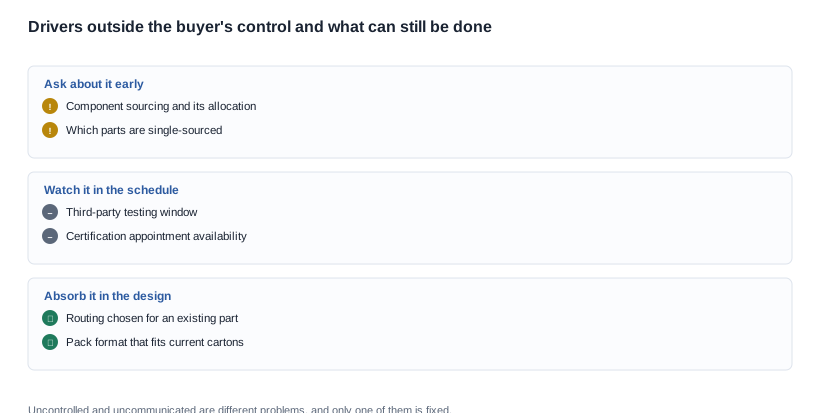
The largest of these is component sourcing. A part that is single-sourced, or that sits on a long allocation list, or that changes between the quotation and the build, moves the cost and the date in ways nobody planned. The second is third-party testing: the window for an external laboratory or certification appointment is outside both parties' control, and a programme that depends on one inherits its pace. The third is the routing the factory chooses for the parts it does not customise — a decision that is entirely the factory's, and one that a buyer can only influence by asking what it is and why.
There is also a layer that is often mistaken for bad luck and is in fact a reporting failure: the difference between a driver that is uncontrolled and one that is merely uncommunicated. A factory that has not told you that a component moved from a dual source to a single source has not protected you from anything; it has simply not told you. The practical response is not to demand control over the factory's sourcing, which nobody has, but to require that the things which move the cost are surfaced early enough to be planned around — and that "early" is defined before the order rather than after the first surprise.
The last group in this layer is the one buyers can influence without controlling: choosing configurations that fit what the factory already runs. A packaging format that matches existing cartons, a colour that sits inside what the line already offers, an option that a nearby variant already uses — each of these is a design decision that reduces the amount of new work in the order. The checklist groups these three responses, because the practical question is rarely whether you can eliminate an uncontrollable driver, but whether you have stopped paying for avoidable work inside it.
The practical consequence of all this is a set of planning assumptions rather than a set of instructions, and the difference is worth being explicit about. A buyer cannot instruct a factory to source a part differently, but a buyer can decide not to promise a date that depends on it, and can decide to ask for the substitution rules in advance. The same holds for the third-party windows: the appointment is not the buyer's to make, but the consequence of a missed appointment is, and the difference is usually worth a contingency that the buyer's own plan absorbs rather than one that the buyer's customers discover.
That suggests three questions worth asking before any of these drivers are allowed into a plan. What could change here, and how would we know. What happens to the order if it does. And who inside our own organisation is told when it does. The third is the one that gets skipped, and it is the one that turns a supplier problem into a customer-facing problem, because the people who decide whether to absorb the change, re-sequence the launch or revise the claim are almost never the people who watch the order every week.

The five questions to ask a supplier about cost structure
Before a number arrives, five questions determine whether it can be read. They are about structure rather than amount, which is why they can be asked before any figure is on the page and why they are worth keeping as a standing template for every quote you receive.

- What exactly is being quoted? Ask for the configuration to be written out line by line, with the option list closed and the published specifications attached. A quotation without a configuration is not comparable to anything.
- Which elements are included, which are separate, and which are conditional? A quotation that shows one figure and then a paragraph of exceptions has not told you where the cost sits. The included elements, the separately charged ones and the ones that depend on a third party should be visible as three groups.
- What changes when the order changes shape? Ask what happens to the quote when the configuration is reduced, when the volume changes, when two configurations are split instead of merged, and when a delivery window is tightened. The direction of the answer matters more than the size of it.
- What is charged when a change is requested after approval? The answer distinguishes a supplier who prices a change against a list from one who prices it against the work it causes, and it is the difference between a predictable programme and one where every change is a fresh negotiation.
- What is excluded from this quote on the grounds that it is somebody else's job? This is the question that surfaces the boundaries — a certification appointment, a test report, a translation, an artwork approval, a shipping document. Each of those exclusions is a piece of work that still has to be done by somebody, and if the quotation does not name them, your plan does not either.
Read the structure of the answer, not just the answer. A quotation whose elements are grouped by inclusion is a document built by somebody who understands the order; one that presents a single figure with conditions attached is a document built to close a conversation. Neither is dishonest, but they support very different planning, and the difference is visible long before the goods arrive.
The way the questions are put matters more than people expect. Asking for them in writing, before any figure has been discussed, is what turns a commercial conversation into a structural one; asking afterwards, in the middle of comparing two numbers, turns it back into a negotiation. There is also a signal in the answer that is easy to miss. A supplier who answers the second question honestly — showing which elements are included, which are separate and which are conditional — is telling you that their internal structure matches the structure of the question. A supplier who cannot answer it is not necessarily concealing anything, but it does mean the cost basis will have to be established later, during production, when there is no leverage left.
Two habits make the difference in practice. Write the five questions into the request so that they are answered in the same order every time, which makes answers comparable across suppliers rather than across moods. And require the answers back in writing, because a structural answer given in a call and a structural answer given in a document age very differently, and the first one will be remembered differently by each party.
What to settle before the programme is quoted
Everything in the previous section is a precondition for a comparable quotation rather than a substitute for one. There are five things worth settling first, and settling them is what turns a quotation into something you can act on rather than something you have to interpret.
The first is the configuration sheet: every option in, every option out, and the published specification lines that apply. The second is the evidence list: what must exist before the goods ship, what may follow them, and what is simply not available. The third is the inspection and documentation scope, which is where a surprising amount of cost hides — the difference between a check on a sample and a check on every unit is a cost difference, and the difference between an inspection report and a full batch file is another. The fourth is the change policy: what a change costs in time and money, who may authorise one, and how it is recorded. The fifth is the comparison basis, which is the one most often skipped.
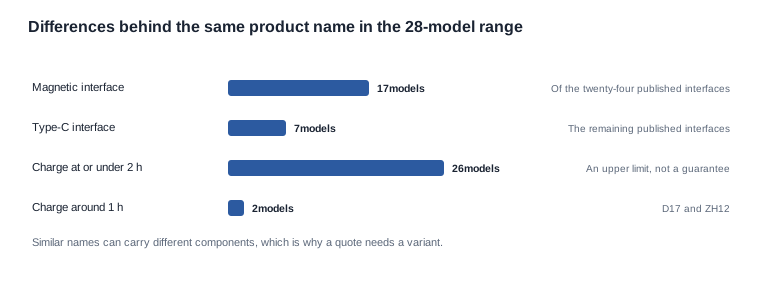
The chart shows why the comparison basis matters more than it first appears. In our own published range, the same product family is not internally uniform: seventeen of the twenty-four published charging interfaces are magnetic and seven are Type-C, and charging time is given as two hours or less on twenty-six entries with D17 and ZH12 nearer one hour. Each of those is a different component sitting behind a similar name, and each one is a legitimate reason for two quotations of "the same" model to differ. A buyer comparing quotations without establishing that both were quoted against the same variant is comparing two different things and will conclude that one of the suppliers is wrong.
Six kinds of line have to appear separately on a quotation if it is to be compared with another one, and it is worth naming them, because a quotation that merges them is not wrong — it is simply not comparable.
The first is the configuration itself: every option in and every option out, written as lines rather than as a reference to a catalogue. The second is the specification, and it should be split into the lines that carry a published figure and the lines that do not, because the two behave differently. A published figure can be quoted against and checked; a blank is an open field that has to be filled before the quote means anything, and if the supplier has filled it internally and you have not asked, the quote you are comparing is not the quote you are receiving. The third is the evidence: which reports, which declarations and which test documents are required, and which of them the supplier already holds rather than has to obtain. The fourth is the inspection scope, because a check on a sample and a check on every unit are different products. The fifth is documentation — instructions, inserts, artwork approvals, packaging — which is often folded into a single line and is one of the easiest places for scope to hide. The sixth is the exclusions, which belong on the quotation rather than in a note underneath it.
On the specification lines there is a practical test. Write down which lines in the published range carry a figure and which do not: a charging time is given for every entry, an interface for twenty-four, a colour for two and a weight for one. A quotation resting on the entries that have figures has a firmer basis than one resting on the entries that do not, and the difference should appear as a visible line on the quotation rather than as a feeling of confidence.
Even at the same configuration, two quotations can differ for three structural reasons, and it is worth knowing which one is operating before reading the numbers. The first is the batch assumption behind the quote. One supplier may be pricing the configuration as if it were part of a continuous run and another as if each batch were set up from nothing. Both positions are reasonable, they produce different quotes for identical goods, and the difference shows up only in the second order. The second is the rule about what travels with a batch. Some documentation is a property of the product and goes out with every order, while other documentation is tied to a model, a test result or a certification record and may be held on file and issued on request. A quotation that assumes the first kind where the second is required is not cheaper; it is simply incomplete, and the cost appears at the moment somebody needs the document. The third is the boundary of the word included. One supplier includes a basic check on every unit and another includes a documented check on a sample of every batch, and the two quotations may be identical in every other respect.
None of the three is a trick, and each of them is closed by a question rather than by a dispute. Ask how the batch is assumed to be run, ask which documents travel with the goods and which are held on file, and ask what an included check covers in unit terms. The three answers put two quotations on a common footing, and the comparison that follows is worth having.
To compare two quotations properly, put them into the same basis before you put them side by side: same configuration, same evidence requirement, same inspection scope, same documentation, same delivery terms, and the same exclusions. Where they still differ after that, the difference is a real difference and is worth asking about. Where they differ before it, the difference is an artefact of the comparison and is worth nothing. The discipline is cheap and it is the single change that most reliably converts a purchasing decision from a negotiation into a choice.
Where our own position sits on cost drivers
We will not publish a price, a price band or a discount structure, and we will not quote an order without a configuration in front of us, because a number without a configuration is not a quotation and only invites a dispute later. Our position on cost drivers is that the interesting work happens before the quotation, when the configuration is written down and the evidence list is agreed, and that the sooner a buyer engages with us on those two things, the narrower the gap between two suppliers' numbers becomes.
What our published documentation does give you is a factual basis to ask sharper questions. It states a charging time for every entry and an interface for twenty-four, it publishes a colour for two models and a weight for one, it records how many customisation axes each line carries, and it separates what is claimed from what is confirmed. Six items in our range remain open, and each one of them is a line a quotation should carry rather than a subject a buyer should guess at: the A05 and A06 parameter sheets are a duplication error rather than a genuine match; the label L2 Utral is a slip for Ultra and Pro Max has no settled meaning; MT5 sits on an odd page reference and its category is unsettled; the notes beside V06 and S7 are annotated without explanation; the AR, electrochromic and bone-conduction entries have no model number of their own; and no photographic or test evidence accompanies any of the twenty-eight. Those are not commercial obstacles; they are the questions a supplier should expect to be asked, and a supplier who answers them clearly is telling you something about the rest of their paperwork.
We do not state an acoustic performance figure, a protection rating or a specification advantage as though it were established, because none of them is currently supported by a third-party report, and the 35dB figure on the bone-conduction entry is the item we flag most often. Nothing about the electrochromic entry can be presented as a difference either, since no performance figures are published for it. A cost conversation that rests on claims nobody can evidence is not a cost conversation; it is a marketing conversation with a number attached.
The practical invitation is simple. Bring us a configuration and an evidence list rather than a number, and we will tell you which parts of it are settled, which parts are open, and which parts can only be answered once the first build has happened. That conversation is worth more than a quotation obtained first and interrogated afterwards, because everything said in it survives contact with the production batch.
If you want the range assessed against a configuration and an evidence list rather than against a headline, the development process line on this site is where to start, and the questions set out above are the ones we would put to any supplier.
Related reading
- Cost factors on the customization side — the other half of the cost picture, on the options themselves.
- How lead time interacts with cost — what happens to the total when the schedule is constrained.
- Minimum order quantity trade-offs — how order size changes the structure of the cost.
- Programme timing, delays and their causes — where the time side of the same question shows up.


