

Delivery terms are usually agreed at the moment when there is nothing left to negotiate. By then the tooling is committed, the artwork is printed and the shipment date is already in a forecast that finance has built a plan around. The agreement still happens; it just happens without leverage, one email at a time, with the supplier quoting from their side of the ledger. It also decides who is allowed to change them once the first unit has shipped. The argument of this article is narrow: delivery and support are terms of the development process itself, and every one of them should be settled before release rather than negotiated afterwards under pressure. This is not an argument for a longer contract. It is an argument for six terms being written down at the moment the team still has the freedom to choose what they say, and for a buyer knowing in advance which question belongs to which term, so that the conversation with a supplier starts at the decision instead of at the background.
The terms a development process must settle before release
Six terms cover almost every dispute that shows up after the first delivery. The first is delivery scope: what actually travels with each unit. The second is carton and labelling: which artwork version ships, on which carton, with which labels, in what packing quantity. The third is documentation handover: which records you receive with the goods, in what format, and at what point. The fourth is defect handling and returns: what counts as a defect, where a report goes, who answers it, and who pays the freight. The fifth is warranty scope: what is covered, what is excluded, and which party administers the claim. The sixth is the support window: for how long the supplier supports the programme, how escalation works, and what happens when that window closes.
Each of the six belongs to a different owner, and that is why they are usually settled in the wrong order. Commercial owners think about price and lead time, quality engineers think about inspection, packaging buyers think about the carton, and nobody thinks about the support window until the programme is nearly over. The order that works is the one that follows the physical flow of the goods: first the scope, then the carton, then the paperwork that arrives with the shipment, then what happens when something is wrong, then what happens when something is wrong twice, and finally what happens when the programme ends. A term that is settled out of that order tends to be settled in a conversation that belongs to a different term, which is why the same question keeps coming back and nobody can close it.
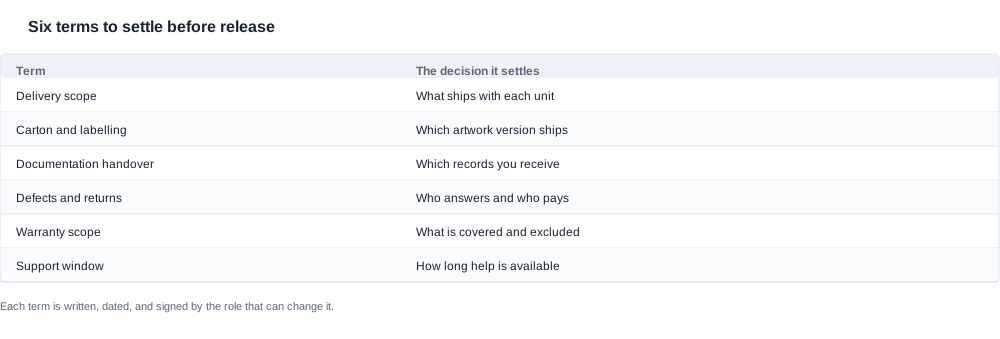
Figure 1 — The six terms, each with the single decision it exists to settle.
A term is settled when three things are true, and buyers should test for all three rather than assuming a signed order form covers them. The term is written, with the specific values inside it rather than a reference to a future document. The term is dated, so that everyone knows which version governs the shipment they are discussing. The term names the role that signed it, so that a later question goes to the person who can change the term and not to the person who can only describe it. If any of the three is missing, the term is still open, and it will be negotiated later at a moment when the buyer has far less freedom.
The other discipline that keeps these six from drifting is a single change route. If a carton is reissued, a component is substituted or a support commitment is extended, it happens as a written variation against the term, with the previous version retained. A term that is changed by email keeps its old meaning in somebody's memory, and the mismatch between two memory versions is what turns a routine deviation into a dispute.

What each term has to state
Delivery scope has to state what is in the box for each SKU, because a scope that is written once for a product line fails as soon as the line contains a variant with a different case. It should name the device, the accessories, the printed material, and the packaging layers, and it should say explicitly what is not included. The evidence to keep is a signed packing list per SKU, reconciled against what actually arrives. The failure mode to ask about is the accessory set: a case included for one SKU and not for a sibling is a normal manufacturing decision, but it is a packaging decision if the carton artwork says otherwise.
Carton and labelling has to state the artwork version that ships and the packing quantity per carton, plus the labelling rules that apply at the receiving end. That means which stickers are applied by the factory and which are applied at your warehouse, and what happens to a carton that arrives with a legible serial mark on it that your system cannot accept. The evidence to keep is the approved artwork file and the artwork version that was released to production, because those two are frequently different documents and the difference is only visible in the artwork.
Documentation handover has to state the list, not the intention. Which documents you receive with the shipment, in which format, whether they are provided as part of the delivery or on request, and who holds the master copy. For a camera glasses programme that list typically includes the frozen specification for the SKU, the per-SKU component table, the string register, the test records for the batch, and whatever compliance material exists for that market. The evidence to keep is the handover itself, checked off against the list. The failure mode here is subtle: a document that is promised as available on request is a document that will be requested during an audit, at the worst possible time.
Defect handling and returns has to state the definition of a defect, the reporting channel, the information the report must contain, the routing to the party that can decide, the freight responsibility in each direction, and the step that follows every report. Photos, batch identifiers and a serial reference are the usual minimum. The evidence to keep is a claim record per report, including the reports that were rejected, because the rejected ones are how you test whether the definition of a defect is being applied consistently or case by case. A supplier who has never rejected a report in writing should make you ask how the criteria are applied.
Warranty scope has to state what is covered, what is excluded, which party administers it, and what the buyer must do to make a claim. Consumables, physical damage, and unauthorised modifications are the usual exclusions, and they need to be written rather than implied. The evidence to keep is the warranty text as issued, together with the channel through which claims are submitted, so that a claim is not routed through a salesperson who was not in the room when the scope was agreed. What a supplier will not publish in a catalogue, a buyer must have in the warranty text.
The support window has to state how long support is available, what it covers, what escalation looks like, and what happens at the end: notice, last-time-buy, spare parts, or end of life. It also has to state what the supplier owes you in the final months, because that is the period in which your own customers are still asking questions. The evidence to keep is the escalation log, which shows whether the promised escalation path was ever actually usable.
There are two wording habits that make a term unusable later, and both are cheap to avoid. The first is stating a category where a value belongs: a term that says the goods ship with a standard accessory set cannot be applied to a SKU whose accessory set was decided differently, and the dispute that follows is about the term rather than about the goods. The second is writing a term that can change without changing: if a clause can be satisfied by a decision taken in a different meeting by a different person, it is not a term. A workable term names the value, names the party, and leaves one route for altering it. Buyers who ask for this level of precision are sometimes told it is unworkable in practice, and the honest test of that claim is whether the supplier can produce, on request, the document a value came from.
The third habit is the most expensive of the three, and it hides in the schedule. A term drafted late is drafted by whoever is left rather than by whoever knows, and the person who knows has already moved on to the next programme. The buyer then inherits a term written in a hurry by someone with no authority to compromise, which is the worst of both worlds: precise enough to bind the buyer and vague enough to be useless. This is a scheduling decision as much as a commercial one, and it is the one part of this article a buyer can act on without waiting for anybody else to agree to anything.
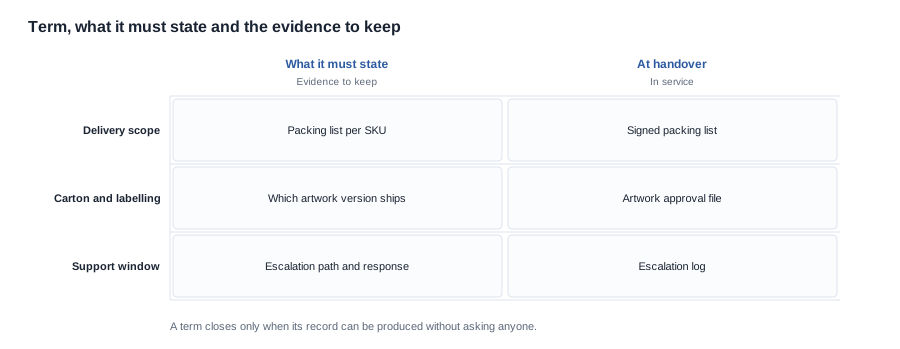
Figure 2 — Three of the six terms, the content each one must carry, and the record that proves it.
Why these belong at release rather than later
The first reason is simple arithmetic about leverage. Before release, a change to a term costs a revision to a document. After release, the same change costs a revision to a document, a communication to the channel, a decision about stock already in the pipeline, and often a goodwill discount. Nothing about the goods improves because the term was settled late; only the cost of changing it goes up. Buyers who compare suppliers on price are usually comparing the wrong column, because a low unit price does not offset the cost of a carton that has to be reprinted.
The second reason is memory. A supplier team that staffed a programme at launch is not the team that answers at warranty, and a buyer team that signed a term at launch is not the team that inherits it. Terms that live only in an inbox degrade quietly, and the first symptom is usually an internal argument about what was agreed rather than a disagreement with the supplier. Writing the terms down protects the buyer's own organisation more than it protects the supplier, which is a good reason to insist on it even when the relationship is warm.
The third reason is that delivery and support terms are consumed by people the programme team does not meet. Channel buyers and distributors plan on the terms they were given, and they plan around the packaging, the case, the documentation and the replacement route. A programme whose terms are still informal leaves its downstream partners to guess, and a guess made by a distributor becomes a commitment made by your brand. If your buyers are channel partners rather than direct users, settling the six terms at release is how you stop somebody else making your commercial commitments for you.
The fourth reason is the warranty clock itself. Whatever the agreed period turns out to be, it runs from a defined event, and that event has to be defined. Is it the date on the purchase order, the date the unit left the factory, the date it cleared customs, or the date your customer received it? A term that does not answer this question produces a warranty that starts in four different places depending on who is asked. Settling it before release costs one sentence. Settling it during a claim costs the claim.
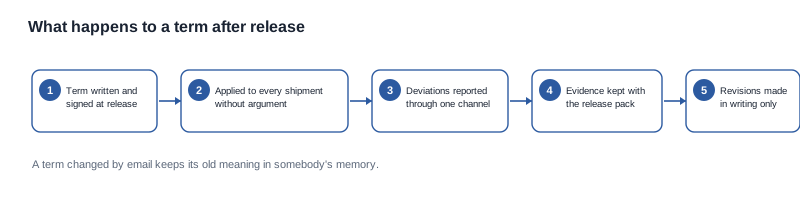
Figure 3 — The life of a settled term, from signature to the point where it is revised.
There is also a procurement reason that is easy to overlook. When terms are settled at release, a buyer can compare two suppliers on the same basis, because both are quoting against the same set of six questions. When they are not settled, every comparison mixes a product difference with a term difference, and the cheapest-looking option is often the one whose terms are least complete. Decide the six terms first, then compare, and the comparison becomes a comparison you can defend to the person who signs. The reverse order does not work. Comparing first means comparing products whose terms are still being invented, so every line of that comparison is provisional in a way nobody has written down, and the buyer ends up choosing a supplier on a price and a specification, then discovering the delivery scope, the documentation list and the defect route afterwards. Each discovery is a separate negotiation, and none of them was priced into the original comparison.

Where our own documentation constrains this
Our own catalogue is a useful constraint, because it shows exactly what happens when a specification is published in part. We publish 28 camera glasses models. Every one of them states a charging time, and 26 of those 28 cap that figure at two hours or less, with two models near one hour. That is a complete statement, and it is worth reading carefully: two hours or less is an upper bound, not a promise of two hours, and a delivery term that says under two hours would be a term our own catalogue does not support. The charging interface is stated for 24 models, split between magnetic and Type-C, and four rows leave the interface unstated. The wireless version is stated for 14 models, with two on an earlier revision and the rest on the current one, while 11 camera models say nothing about it.
The packaging side of the catalogue is thinner in a way that buyers should notice. A charging-case capacity is published for five camera models, two more entries name a case without giving a figure for it, and four entries carry no charging-case row at all: the V06 and the V03 Pro, and the V03 and the S7, so the case position of those four has to be confirmed before a delivery scope is written for them. Colour information appears on two models only, one listing three colours and one listing four. Ingress protection is stated for two models. Pixel counts are grouped, with eight models at one level and three at another, and the higher group spans three different model families. This is normal for a catalogue and it is the reason delivery scope has to be written per SKU rather than per family: a family-level statement about a case or a colour will be right for some models and wrong for others.
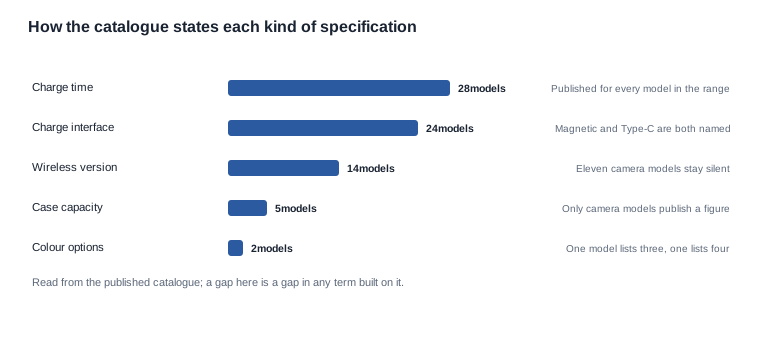
Figure 4 — How many of the 28 models state each kind of specification, which is the completeness a delivery term should assume.
Two further gaps in our documentation shape how we write terms. Our export certification material is presented as image pages of certificates rather than as a text list of standards, so it cannot be quoted as a specification line the way a charging time can; a term that promises a compliance document therefore has to promise a specific document, not a general assurance. And the catalogue contains no touch-control row and no translation row at all, which means any delivery term, packaging copy or manual that implies either of those features is a term the catalogue cannot support.
The practical consequence is a rule we apply to our own terms as well: state the value, name the source, and never rely on inference from a sibling model. Where we do not publish a value, the buyer should ask for it in writing, and we will put it in the term rather than in a conversation. That is also why the six terms in this article carry no lead time, no minimum order quantity and no warranty period: our catalogue does not publish them, and a term we state without a source would be the exact error we are asking suppliers to avoid.
Where CYNRIN stands on delivery and support
Delivery and support terms are part of the product, not paperwork that follows it, and the right moment to write them is before the first unit is released. We will put the six terms in writing against a specific SKU, with values and sources, and we will revise them only as a written variation with the previous version retained. We do not publish lead times, minimum order quantities or warranty periods in the catalogue, which means we will state them in the commercial terms of a quotation, where they can be dated and signed, rather than leaving them to a quotation message that will be quoted back at us in a different form.
What we ask from a buyer in return is the same discipline we apply to our own documents: decide the scope, carton version, documentation list, defect definition, warranty scope and support window in writing, and keep the version history. A buyer who arrives with a decided position on each of the six gets a faster answer and a more accurate one, because we are not guessing which version of the request is live. A buyer who is still deciding which option to fund gets the same attention, but the answer comes back as a set of options with the trade-offs named, and somebody has to choose before it can be written into a term.
On the part buyers most often defer, we are equally direct. A support window that nobody has planned for is a promise the supplier will make and nobody will staff, and a warranty scope written as a sentence of goodwill will be interpreted differently by every party that touches the claim. Both need a value, an owner and a channel, and both are cheaper to agree while the programme team is still in one room. The comparison to make between two candidate suppliers is not which one quotes faster, but which one can evidence all six terms against a document, and that comparison is available before any tooling is committed.
Before any of this is signed, ask for one document that answers all six questions at once: a delivery and support term sheet tied to a specific SKU and carrying a date. If the supplier will not produce that sheet, the answers still exist somewhere, and a buyer who has seen the six answers together can decide which of them are negotiable and which are simply facts. That document is also the artefact to show a channel partner, an auditor or a successor when the same question is asked again six months later.
- The five upstream delays that create most of these arguments are described in the delays that appear before release.
- The stage checklist for settling them in order is in the OEM programme stage checklist.
- Structural packaging choices, as opposed to print-only ones, are separated out in structural versus cosmetic packaging choices.
- The returns path in more detail is covered by the returns and replacement handling note.
- How a warranty scope is normally worded is in the warranty scope note.
- The wider support checklist, including the items this article does not cover, is the after-sales support checklist.
- The compliance material to request before ordering is summarised in the certification evidence checklist.
- The overall route these terms sit inside is described on the OEM and ODM programme page.


