

A hardware programme rarely fails because an engineer cannot build what was asked. It fails because nobody decided which version of the request was true. Across camera glasses programmes the same interruptions repeat while the plan still shows only drawings, tooling and sample rounds. The lost weeks go into clarifying a claim that was never frozen, classifying a change request that arrived without a category, and settling component and model-string details that nobody owned. Each one looks small on the day it arrives and stays small until it is too late to absorb. The development process itself is rarely the problem; the missing decision is. This article breaks the five delays that buyers most often meet, shows the signal that reveals each one, and gives the order in which they should be closed. Where a supplier has published part of a specification and left the rest open, the catalogue we publish shows the same pattern, and that is useful: a claim can be present, partial or absent, and only the first of those three can be signed.
The five delays that appear in a development process
Delay one: the claim that was never frozen. Delay two: the request nobody classified. Delay three: a component that was agreed in principle and never written down. Delay four: the model string, which was still about right when the carton went to print. Delay five: tooling, where ownership is disputed and nobody feels responsible. None of these is an engineering problem. Each one is a decision that was left open, and each one comes back at the moment when closing it is most expensive, because by then other work has already been built on the assumption that it was settled.
The five are listed in the order they typically return, not the order they occur. That order matters, because the cost of leaving each one open grows as the programme moves downstream. A claim left open at the drawing stage only delays the drawing. The same claim left open after the carton artwork is approved forces a reprint decision, and that decision is made under time pressure with fewer options left. When you compare two candidate answers to an open question, the comparison that matters is how many artefacts each answer touches: a specification row, a carton, a manual insert, a label, a test plan. An answer that touches fewer artefacts is normally the cheaper one to execute, even when it looks more complicated on paper.
It also helps to know which of the five is open right now in your own programme, because that determines what to ask first. The sequence below is a screening method rather than a schedule. You can run it against any stage, and you can run it with the supplier present or without them.
- Is a written, dated specification in place, or is the specification still a conversation? If there is no document, treat the claim as open.
- Does every change request carry a class, or are all of them being handled as urgent? If they do not, classify before estimating.
- Can you point to the component value for each SKU rather than for the family? If the sheet has an empty cell, that cell is the delay.
- Is one string register feeding the carton, the manual, the label and the listing? If somebody re-types the model string by hand, the delay is already active.
- Does the tooling schedule name an owner, a location and a release condition? If it does not, settle that before the first tool is cut.
The table below records the signal that reveals each delay. Read it as a checklist against your own documentation, then use it to decide which conversation to have next and which artefact to produce.
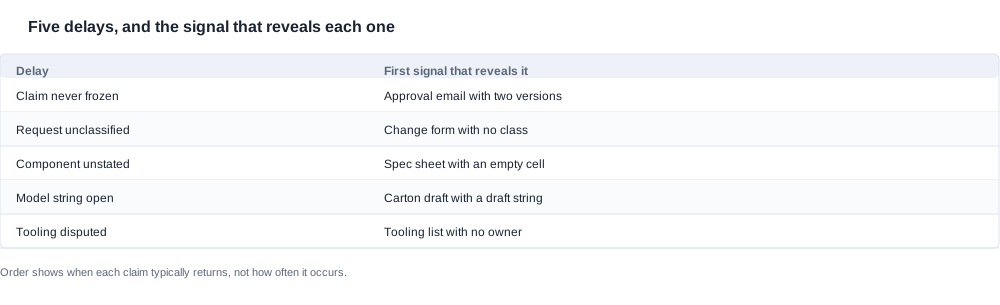
Figure 1 — The five delays, with the first signal that shows each one is already active.

Delay one: the claim that was never frozen
A frozen claim is not a locked document. It is a decision that says which value is true for this programme, at this version, for this market, and it is written down where both sides can point at it. In practice a frozen claim has to cover more than the specification row people assume. It has to name the product variant, the firmware branch, the carton artwork version, the manual insert version and the market the units ship into. When any one of those is left open, the supplier is not guessing; they are choosing, and they will choose differently for different batches, which is how a programme ends up with three versions of the same product and no record of which one is the correct one.
The cost of an unfrozen claim appears in the artefacts rather than in the meeting. A carton prints before the label is finalised, so the carton carries a string that the label corrects. A firmware branch is shipped with a menu that names a variant the packaging does not mention. A specification row is written from a catalogue line that summarised a family rather than a single SKU. None of these is visible on the purchase order, and each one has to be reconciled later by somebody who now has to find the original intent.
Our own catalogue makes the point without intending to. It lists 28 models, and every one of them states a charging time. Twenty-six of those twenty-eight cap the figure at two hours or less, and only two sit near one hour. Charging time, in other words, is the one specification we publish for all 28 products. The charging interface is published for 24 of them, split between magnetic and Type-C, while four rows leave the interface unstated altogether. Wireless version is published for 14 models, with two of them on an earlier revision and the rest on the current one, and eleven camera models say nothing about it. The export certification page in the catalogue is an image page rather than a text listing. These are not errors. They are the honest shape of a specification that is complete on one axis and open on another, and any buyer comparing two suppliers should score the completeness of each row rather than assume that a blank cell is a small gap.
The decision to freeze is a governance choice, not a technical one, so the evidence should be equally plain. Freeze at a named gate rather than at a date, because a date gets moved. Put the version string on every artefact, keep the revision history rather than the last version only, and record who signed. When you ask a supplier to confirm a claim, ask which document is the contractual one and how you would prove, three months later, that the row you signed is the row they built. A supplier who answers that question with a document reference has already closed this delay. A supplier who answers it with a person is still inside it.
- Name the gate at which the specification is frozen, and state what stops moving after that gate.
- Give every artefact its own version string so that a carton revision is distinguishable from a firmware revision.
- Record the market and the firmware branch inside the same frozen claim, not in an email thread.
- Keep the revision history in the release pack, because the history is the evidence that the change was decided rather than drifted.
Delay two: the request nobody classified
Change requests are not the problem. Unclassified change requests are. A request that arrives by chat at four in the afternoon carries no class, no owner and no decision rule, so the only safe response is to treat it as urgent, and treating everything as urgent is the same as treating nothing as urgent. The programme then spends its capacity re-planning instead of building, and the buyer loses the ability to compare options because nobody ever produced a comparison.
Classification is cheap once you have written the rule. A request is structural when it changes a tool, a housing dimension, a component that is soldered rather than plugged, or the scope of a test. It is cosmetic when it changes print, colour, finish, artwork or wording. It is functional when it changes behaviour, firmware, or the meaning of a control. Anything else is a question, and a question is answered, not estimated. The rule does not need to be clever. It needs to be agreed before the first request arrives, because the value of the rule comes from applying it under pressure when the request arrives from someone senior.
The evidence that closes this delay is a change log, and the log is only useful if it has the same fields every time: the request in one line, the class, the requester, the date received, the artefacts affected, the decision taken and who took it. With that log, a buyer can ask the only question worth asking about scope, which is how many changes were decided and what each one did to the plan. Without it, the answer is a story, and stories cannot be compared between suppliers.
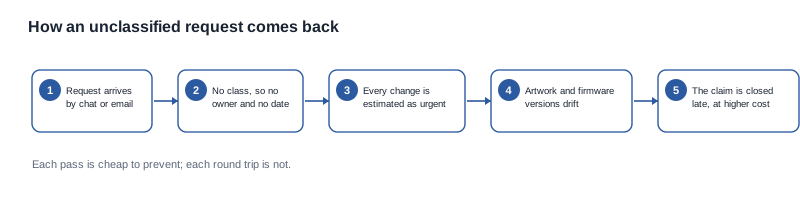
Figure 2 — The path of a request that arrives without a class, and the point at which it becomes expensive.
Two rules keep a log usable. First, an unclassified request gets a hold date rather than an immediate refusal, because refusing a request without classifying it simply moves the delay to a channel with no record. Second, the class is decided by the role that owns the affected artefact, not by the role that receives the request, which means the requester never has to guess how serious their own change is.
The comparison you should make with a supplier is not about how many changes they accept. It is about what happens to a change they decline. A supplier who declines a request in writing, with the reason attached, is cheaper to work with than one who accepts everything and absorbs the cost silently in build schedules. That difference will not appear in a quote, and it will not appear in a sample, and it will show up only in the fifth month of a programme, which is exactly why the log is worth keeping.

Delay three and four: the component and the model string
Components and model strings are often treated as one item because both arrive late, but they fail differently and they are closed with different evidence. A component claim is closed by a value in a specification for a specific SKU. A model string claim is closed by a register that every artefact reads from. Confusing the two is how a programme ends up with correct hardware and wrong packaging.
Component claims go open when the discussion moves from a family to a variant. A family can agree that the charging interface is magnetic and that the case is included. The variant then changes one of those without anyone rewriting the sheet, and the ambiguity lands on the carton, the manual and the test plan at once. Our catalogue shows the shape of this. Five camera models publish a charging case capacity, and two more name a case without publishing a figure for it. Four models — the V03 and the S7, and the V06 and the V03 Pro — print no charging-case row at all, which is the same question left open rather than answered. Three different answers to the same buyer question, each of them correct for a different product. A buyer who asks for the case specification of a whole family will get a wrong answer, and the wrong answer will travel into artwork.
The model string is the second half of the same trap. Names in this category are not uniform by design: some models carry a letter and a number, some carry a letter with a suffix, some carry a number and a letter, and one or two use a word instead of a number. That is fine, as long as one string is authoritative. The failure mode is manual retyping. A carton artist types the string from an email, a listing editor types it from a spreadsheet, and a firmware engineer types it a third time from a PDF. Now three artefacts disagree by one character, and a buyer has to decide which is correct before the units ship. A model string register with a single owner removes the decision entirely, because no one types it twice.
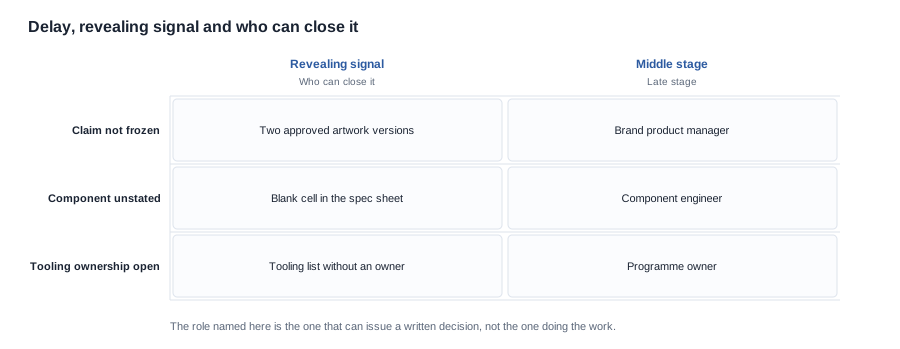
Figure 3 — Three of the five delays, the signal that exposes each, and the role able to close it.
The component rule that keeps this short is simple: a component value is either stated for the SKU or it is not, and a blank cell is an open claim rather than an implied one. Where the catalogue leaves a field unstated, ask the supplier to state it in writing rather than inferring it from a sibling model. Where a value is stated, ask which document it came from, and whether it applies to the sample you received or only to the catalogue row. These two questions are the difference between a specification you can sign and one you can only hope about, and they take one message to ask.

Delay five: tooling, which is nobody's fault
Tooling delays are rare in number and expensive in effect, and they arrive with a peculiar property: every participant is sincere. The brand owns the drawing, the manufacturer owns the execution, and a sub-supplier often owns the material purchase, and the mould is the one artefact where all three meet. Nobody was asked to own it, so nobody was accountable for it. It sits in a list with no location, or in a warehouse, or in a supplier's facility, and the programme assumes that someone is looking after it.
The decisions that close a tooling delay are commercial rather than technical, which is why they are so often postponed. Who owns the tool? Who pays for maintenance and repair? Where is it stored, and who can move it? Under what conditions is it released to production, and what happens to it if the programme stops? Who holds the samples cut from it? None of these can be answered by an engineer, and each unanswered question becomes a cost later, usually in the form of a change that cannot be made cheaply because the tool is no longer where anybody thought it was.
Tooling also multiplies quietly when appearance decisions are deferred. A colour or finish request that lands after a tool is released is not a paint change; it may be a different material, a different texture, or a different part of the tool entirely. Our catalogue publishes colour rows for only two models, one with three colours and one with four, which shows how few products carry a colour range at all. Every additional colour in a range is another question about tooling ownership, because each one needs a decision about whether it shares a tool or needs its own. Deciding colour scope before tooling release is one of the cheapest decisions in the whole programme, and it is routinely made far too late.
The artefact that closes this delay is a tooling schedule, and it should contain the following.
- A list of every tool, identified by the part it produces and by the programme it belongs to.
- An ownership line for each tool, naming the legal owner and the party holding it.
- The storage location, the maintenance responsibility and the person who may authorise a move.
- The release condition, the number of retained samples, and what happens when the programme ends.
What closes a development process delay early
Every delay in this article closes the same way. It closes with an artefact, not with a conversation. A conversation records that two people agreed; an artefact proves what was agreed, when, and to which version. The difference matters because a delay is not an opinion that is wrong, it is a record that is missing. Nothing in a programme closes by goodwill, and the moment a decision is written down, the number of people who can reopen it drops to one.
Closing order is worth deciding once and applying everywhere. Close the claim first, because every other closure depends on it: the classification of a change request is meaningless if the baseline it modifies is still open. Close the classification second, because an unclassified request will reopen the baseline. Close the component value third, and the model string fourth, because those two feed the artefacts that are about to be printed. Close tooling last, because the tool is the one artefact that should not be moved until every value above it has stopped moving. If you cannot close everything, close in that order, and record what is still open in the release pack so that the next supplier inherits a list rather than a surprise.
The evidence worth keeping before release is short and specific: the frozen specification with its version and revision history, the approved artwork file, a per-SKU component table with no blank cells, an export of the string register, the tooling schedule, and the retained samples with their test photographs. This is the pack a buyer should be able to reconstruct the programme from without asking anyone a question.
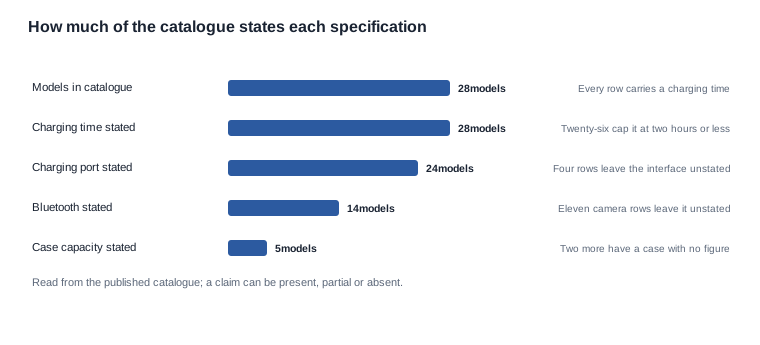
Figure 4 — How many of the 28 catalogue models state each specification, as a yardstick for what a complete claim looks like.
The chart is deliberately boring, and that is the point. A claim is complete when it is stated for the SKU in front of you, and it is partial when the row is inherited from a family or a sibling model. Counting how complete a specification is, row by row, is a better way to compare two suppliers than asking how many products they have, because the count stays honest when the catalogue grows. Our position is that we would rather have a supplier answer with a document reference than with a number of models.
Before any of this is approved, run one comparison, and run it on options rather than on suppliers. Take the two answers still open for a claim and compare them on four criteria you can verify without a phone call: how many artefacts each answer touches, which role has to sign it, what evidence the supplier can produce today, and what it costs to reverse the decision later. The answer with the smaller artefact footprint is usually the one to choose, and the answer whose evidence already exists is usually the one to fund first. Where the two answers are otherwise equal, choose the one that can be closed with a document, because a document is what protects the decision when the programme is reviewed by someone who was not in the room when it was taken.
Budget is the last criterion you should apply, not the first. The cheap option that lands two stages downstream can carry more cost than the expensive option that closes the claim immediately, because every stage it crosses is a stage where the decision can be reopened. That is why we tell buyers to decide early and revise later: a written decision that is revised is a revision, while a decision that was never written down is an argument. Ask each candidate supplier which of the two they can evidence today, and let the answer set your order of work.
Where a supplier asks you to decide something, the right answer is not always the detailed one, and a buyer who decides early pays less. A buyer who decides on the evidence available at the time and writes it down can reopen the decision cheaply, because reopening a written decision is a revision. A buyer who waits for certainty is not avoiding cost; they are moving the cost to the point where the answer cannot be changed at all.
We will not quote a lead time, a minimum order quantity or a warranty period in this article, because our catalogue does not publish them and we hold our own documents to the same rule we ask suppliers to follow. What we do publish is the structure of the decision: what has to be settled, in what order, and what evidence has to exist on the day you need to prove it.
- The release terms worth settling before you sign are covered in the delivery and support terms note.
- The packaging and design options that change structure, not just print, are listed separately.
- A stage-by-stage version of the same sequence is in the development process checklist.
- If you want to see how these points were handled on a finished programme, read the case review.
- The communication rules that keep change requests classified are described in the communication norms note.
- The cost drivers that make an open claim expensive are set out in the cost drivers note.
- The overall OEM and ODM route these decisions sit inside is described on the OEM and ODM process page.
- If you want to see a physical sample before you close any of these claims, start with what to request when ordering samples.


