

Most smart glasses programmes do not fail because somebody made a bad decision. They fail because a decision was made in a meeting, understood differently by the two sides, and then quietly built on. By the time the disagreement surfaces, it has usually surfaced as a specification dispute rather than as a communication one, which means it is argued at the most expensive point in the schedule instead of the cheapest.
That is the problem communication norms exist to solve. A norm is not a polite convention. It is an agreement about who owns a decision, when it has to be in writing, and what happens when it changes — agreed while the parties are still on good terms, so that nobody has to invent a rule in the middle of a dispute. The rest of this article is about what those agreements should actually say, written for brand owners and channel buyers who are setting up a development process with a supplier rather than reacting to one that has already gone wrong.
The argument throughout is practical. Communication does not fail because people are careless; it fails because the default behaviour in a busy programme is to let the loudest recent thread set the priority. A norm replaces that default with something decided in advance.
Development process communication norms: the routines that prevent rework
Four routines carry most of the weight, and they are worth naming precisely because each one has a shape that can be written down, assigned, and checked. None of them requires a project-management system. All of them require that somebody owns the output and that the output exists in a form another party can act on without asking a question.
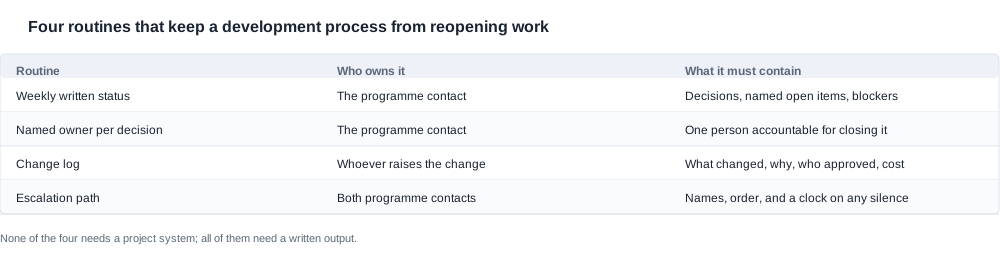
The weekly written status is the least glamorous and the most effective. It is a short, dated document that states what was decided in the period, what is outstanding, and what is blocked. Its value is not the update; it is that it forces the outstanding list to be written down while the people who know the answers are still in the room. A programme that meets weekly but keeps no written list will discover its open items at the moment they become expensive, because that is the only moment at which a list becomes visible.
The single named owner per decision is the second routine. It sounds trivial and it is not. In most programmes every question has an owner in the sense that somebody is nominally responsible, and no question has an owner in the sense that one named person is accountable for closing it. The difference shows up on a decision that crosses a boundary — a colour that depends on a finish route, a packaging change that depends on a die line, a claim that depends on a certificate — where the boundary itself is the problem. A named owner does not prevent disagreement. It makes disagreement visible early, which is the whole point.
The change log is the third, and it is the one that protects the buyer. Every change after the baseline is recorded with four things: what changed, why, who authorised it, and what it costs in schedule and money. A change that is not in the log has, in effect, not been made, and saying so politely at the start of a programme is far easier than saying so at the end.
The escalation path is the fourth. It names the people, the order, and the time limit at which an unanswered question is escalated rather than left to circulate. Most programmes have an implicit escalation path, and it is usually the same for everything: someone senior gets involved, which either resolves the question or turns it into a priority for somebody whose actual job is elsewhere.
It is worth saying why these are written as routines rather than as principles, because a programme that adopts principles tends to fail in a predictable way. A principle such as communicate early or keep the buyer informed leaves every interesting decision to the moment it is taken, and at that moment the cheapest interpretation is usually the one that requires no extra work. A routine moves the decision to a fixed point in the calendar, where it can be made once and then applied to everything that follows. The weekly status is the clearest case: it does not ask anybody to communicate more, it asks for a list to exist on a particular day, and a list that exists can be read by people who were not in the room that produced it.

The two failures worth naming because they recur
Almost every communication failure in a custom programme is one of two shapes, and they are worth naming precisely so that they can be recognised early.

The first is the silent scope change. Somebody decides something — a slightly different colour, a different cable, a simpler insert, a reduced option — inside a conversation that nobody thought was a decision meeting, and the decision enters the programme without entering the record. It is invisible from the outside precisely because the conversation was friendly and nobody was hiding anything. What it produces, weeks later, is a disagreement about what was agreed, in which both parties are entirely sincere. The remedy is not to insist on formal meetings; it is to insist that any decision touching scope, cost or timing is confirmed in writing by the end of the working day in which it was taken, and that a decision nobody can recall agreeing to is treated as not yet taken.
The second is the unowned question. An open item exists, everybody knows it exists, and it has no name against it. It sits in a chat thread, or in somebody's notebook, or in the awareness of a single person who raised it once and then got pulled into something else. Unowned questions are more expensive than owned ones that are late, because an owned question has a date attached to it and an unowned one has only a vague sense of urgency that decays. The routine that defeats this is simple and slightly unpopular: the outstanding list has a name against every line, and the meeting starts by reading that list rather than by asking what is new.
There is a third pattern worth mentioning because it is so common it is usually invisible: the asymmetry between what is asked and what is answered. A buyer asks about certification and receives a confident yes, and the conversation moves on. A buyer asks which models the claim covers and receives a list. The difference matters because a yes protects nobody, whereas a list is something that can be checked, and checking is the entire purpose of the exchange. A good norm requires answers to be specific enough to be wrong. "Yes, we are certified" fails that test, and so does a paragraph that leaves the gaps out. The version that passes says what is claimed, what is marked without a report behind it, and what has not been supplied at all: our catalogue publishes no CE, FCC or RoHS text and no per-model certification row, with the covering models plus any certificate numbers yet to be confirmed by the enterprise, the sports line carries an IP54 mark with no third-party report number beside it, and for the children's line no certification information has been provided.
There is a third shape that is not a failure of communication so much as a failure to agree where communication lives. The upstream party puts something in a document; the downstream party expects it in an email; the document is filed, the email is answered, and the two halves of the programme continue on the mutual assumption that the other one is holding it. Nothing surfaces until the point where the missing item is actually needed, and at that point the conversation is no longer about the item but about who was supposed to have sent it.
The remedy is unglamorous and it is cheap. Agree one place where the programme's truth lives — a single specification document that both sides treat as authoritative — and make every other channel a notification of something that has already been entered there. A message that changes a requirement is not a message; it is an edit to the specification, and the person who makes it owns the consequence of making it. This sounds rigid, and in a small programme it can feel like ceremony, but the alternative is a programme where the same question is answered twice in two registers and the second answer wins because it is the most recent.
The same mechanism explains why a verbal undertaking is the most expensive kind of commitment in a development process. Nobody objects to a sentence said in a meeting, and nobody afterwards remembers it the same way. One side heard a feasibility comment, the other heard an intention, and two weeks later both are acting on their own version. Norms exist partly because the alternative is that memory becomes the specification, and memory in a busy programme is not a neutral instrument: it is biased towards whatever was said last and by whoever had the most authority in the room.

What a factory owes a buyer, in writing
A communication norm is only as good as the documents it obliges somebody to produce. For a custom smart glasses order, there are four written deliverables that a buyer should be able to expect, and they should be named in the order rather than requested afterwards.
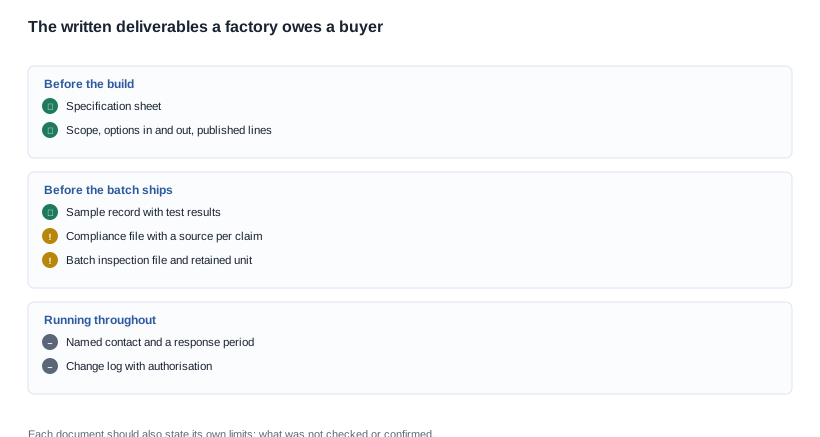
The first is the specification sheet: what is being built, which options are in scope, which are excluded, and what each published line is. This is where a buyer learns something the catalogue cannot tell them, because the catalogue publishes a charging time against every entry and a weight against one model only, publishes an interface line on twenty-four entries and none on CY03 and CY05, and L1 Pro or MT6, and publishes a colour line on V03 Pro and V06 alone. Every one of those blanks has to be filled by the order, because an unstated line is a line nobody has committed to.
The second is the sample record: what was tested, against what criterion, with which deviations, and who approved it. The third is the compliance file: the certification position, the evidence behind it, the claims that may be made publicly, and the source for each of them. The fourth is the batch inspection file: what was checked, against which reference unit, and with what result.
Two rules make those documents usable rather than decorative. The first is that each one should state its own limits — what was not checked, what could not be confirmed, and what remains open. A document that claims completeness is less useful than one that is honest about its edges, because the buyer's next question depends on knowing where the uncertainty is. The second is that each one should be issued with a version and a date, so that a later reader can tell whether they are looking at the current state or a superseded one.
There is a fifth deliverable that is less common and worth asking for: a named contact on the factory side for each function, with the hours during which that person is reachable and the period in which a reply is expected. Programmes run across time zones and across calendars, and a large share of the delay in a custom order is not production time at all — it is the time a question sits unanswered in an inbox between two people who are both waiting for an answer to the same question.
The written deliverables also settle a question that otherwise gets answered by whoever happens to be nearest the problem. When a request is outstanding, two reasonable positions are available: the supplier assumes the buyer does not need it, and the buyer assumes the supplier is working on it. Neither is unreasonable, and both can last for weeks. A document with a named owner and a date on it removes the position entirely, because the request stops being a matter of expectation and becomes a matter of record. That is why these four documents matter more than they look. They are not an administrative layer over the work; they are the mechanism by which two organisations avoid silently disagreeing about what is outstanding.
The order of the questions to ask matters more than the list itself, and the obvious order is the wrong one. Ask which documents the factory will issue, then ask what each one does and does not cover, then ask how versions and dates are handled, and only at the end ask about timeframes. Run the other way round, this produces a document that looks complete and states no boundary, and the boundary is exactly what makes a document usable at the next handover.
Two red flags belong in the same discussion. An acceptance record that lists only what was checked, without saying what was not, cannot later prove the scope of the check when a batch is disputed. And a contract that fixes every deliverable in detail sounds thorough while quietly creating familiar trade-offs: each later change then needs the whole set re-signed, and the pace of the programme slows to the pace of its own paperwork. Which deliverables are fixed, which move on a change note, and which are settled by a call and recorded afterwards is a decision the buyer should take before you commit to the order.

The one distinction that changes how a contract is read
The single most useful distinction in a development process contract is between an obligation that can be compelled and an outcome that cannot. It changes how every clause in the document should be read, and it is the difference most often blurred.
An obligation to build a unit to a written specification can be compelled, because the buyer holds the specification and the goods. An obligation to supply a certificate from a third-party body cannot, because the certificate depends on a schedule the buyer does not control. An obligation to make a product succeed in a market cannot be compelled at all. When these three are written in the same grammatical form — "the supplier shall deliver CE certification and market-ready units by Q3" — the contract reads as if all three were equally enforceable, and the first dispute over a missed date becomes a dispute over interpretation rather than over performance.
The practical consequence is that each obligation should name its mechanism. Where the obligation is a document, the contract should say who prepares it, from what source, and by when. Where it depends on a third party, it should say what the supplier is responsible for — supplying the sample, the application, the technical file — and should not convert the third party's timetable into the supplier's obligation. Where it is an outcome, it should be removed from the contract entirely and, if it matters, tracked as a programme objective instead.
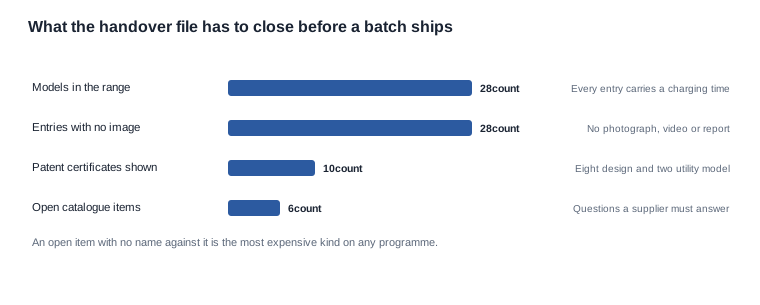
The same distinction applies to the catalogue itself, and this is where a buyer can protect themselves cheaply. A published line is a statement of fact about a model; an unpublished line is not a commitment, a defect or a hidden feature. Six items in our own published range are still open, and a communication norm has to say how each one gets answered rather than assume the catalogue will close it: whether the parameters printed for A05 and A06 are meant to be identical or are a duplication error, what the name L2 Utral was meant to read and what Pro Max denotes, which page and category MT5 belongs to, why the references against V06 and S7 are annotated as they are, which model numbers the AR, electrochromic and bone-conduction entries should carry, and that no photograph, video or test report is attached to any of the twenty-eight entries, so the source of that evidence has to be established rather than assumed. None of those questions is a complaint. Each of them is a line in a status document with a name against it.
The distinction is equally useful when a clause is being drafted rather than interpreted. The test for any clause in a custom order is whether it names something the supplier can do, something a third party can do, or something that depends on a market. A clause that names the first is enforceable and should be dated. A clause that names the second should allocate the preparation work and leave the third party's own timetable alone. A clause that names the third is not a clause at all, and the honest response to a buyer who asks for one is to offer a programme objective instead of a contractual promise.
How to set up communication norms at kickoff
Communication norms are cheapest to set at the beginning, when nobody is annoyed yet, and the natural moment is the kickoff meeting. The agenda is short, and it can be handled in the same session in which the scope is discussed.
- Write down the four routines — the weekly written status, the named owner per decision, the change log, and the escalation path — and attach them to the order as an annex.
- Name a contact on each side for each function, with the hours and the response period that apply to that person.
- Agree the classification of changes before the first change happens, so that nobody has to argue about what counts as a change while a change is in dispute.
- Agree the documents the programme will produce, who issues them, and what each one must contain.
- Set the escalation clock: how long an unanswered question waits before it moves up a level.
- Agree how decisions will be confirmed — by email, by a shared document, by whatever channel both sides will still be able to search in eighteen months.
- Review the norms at the end of the first stage rather than at the end of the programme, because a norm that is never reviewed is a norm that has quietly stopped being followed.
The classification in point three is the part worth thinking about before the kickoff, because it is the one that will be used under pressure. A useful classification separates a clarification, which does not change the scope or the cost and can be recorded in the next status note, from a change, which touches scope, cost or timing and needs authorisation and a log entry, and from an escalation, which is a change whose effect cannot be priced or scheduled without further work. Buyers often want two categories and get a third one they had not planned for, because a change whose cost is unknown is not the same thing as a change whose cost is large.
The final discipline is measurement, and it should be modest. Count the open items that are older than one reporting period, and count the decisions that were made and then re-opened. Both numbers are small in a healthy programme and both are visible to everyone involved, which is what makes them useful. A programme that never re-opens a decision and never leaves an item unanswered is not necessarily well-run, but a programme that re-opens decisions constantly is paying for its communication failures in the most expensive currency it has.
Three things distort a programme more than anything else, and each of them feels like a reasonable economy at the time. The first is the threshold in the change classification. A norm that says report every change gets ignored, because most changes are trivial and reporting them all costs more than it saves. A norm that says report every change to scope, cost or timing is workable, and the discipline is to define those three words once, in writing, at the start rather than every time the question arises. The second is the escalation clock. A clause saying that an unanswered question will be escalated gives the clause no shape, so nobody escalates and the question simply ages. A clause saying that an unanswered question will be raised at the next scheduled meeting, and at the meeting after that if it is still open, turns escalation into a routine instead of a confrontation. The third is the response period. A period measured in business days and stated per contact is respected in a way that the word promptly never is.
All three have the same characteristic, which is why they are worth settling early: they are cheap to set and expensive to introduce later. A programme that adopts them in the first fortnight of a development process will never notice them, because a norm that was always there is invisible. A programme that introduces them in the third month will be read as distrust — and it will be — and the trust the norms were meant to protect will take longer to rebuild than the norms would have saved. That is the practical argument for writing these things down at kickoff rather than after the first escalation, and it is the same argument the four routines make, applied to the programme's own habits rather than to its outputs.
We would rather answer a question late with a document than answer it early with an assurance. The claims we can evidence are published; the ones we cannot are described as claimed, with the gap stated, and we will not close that gap by describing it in a different way in a quotation. For a programme that needs the same discipline applied to the stage structure itself, the development process line on this site sets out how the gates are arranged, and the routines above are the communication layer over them.
Related reading
- A stage-by-stage programme checklist — the gates these communication routines sit between.
- Where programmes typically lose time — the delays that usually turn out to be unanswered questions.
- A worked programme walkthrough — the same four stages seen end to end.
- What drives the cost of a build — why the cost consequences in a change log have to be written down.


