
Yes. Every seal in every product degrades, and an ingress rating describes the product as it left the factory rather than as it will be in a year. That is not a criticism of the standard. No ingress rating was ever intended as a lifetime guarantee, and treating one as one is what produces the customer in month fourteen who is frustrated that a product was supposed to be water resistant.
The honest answer has two parts, and buyers need both. The first is mechanical: a rating is a statement about a specific enclosure on a specific day, and the materials doing the sealing change in service. The second is procedural: because the rating does not age with the product, the thing that protects the rating is not a stronger seal, it is a care instruction, a warranty position that separates wear from defect, and a listing that describes the rating as what it is.
Our published position is narrower than the question might imply. This catalogue carries an ingress marking on exactly two models — the V06 and the S7, both in the camera range, both marked IP54. No other model carries an IP marking, which includes the whole sport range of YKC02, D17 and ZH12. No third-party test report number is published for either marking. No case in the range carries an ingress marking. And we hold no ageing data, so we will not estimate a service life for a seal in this product.
What follows is what actually attacks a seal, where it fails first on this product class, how to test and document the question in your own programme, what the ageing question is worth commercially, and the care and warranty positions that keep the rating meaningful. Our IP ratings and durability page sets out what the digits cover, and IP rating problems and fixes covers the day-to-day handling consequences.
There is a commercial framing behind all of this that is worth stating at the top, because it changes how the question should be negotiated. The seal rating is a marketing asset at the moment of sale and a returns liability a year later, and the cost of the second thing falls on whichever party agreed the warranty. A brand that publishes IP54 without a care instruction, a wear-item policy and a defined diagnostic procedure is buying a returns rate at the price of a marketing claim. A brand that publishes IP54 with all three is buying a defensible position. Which model to shortlist, and which supplier to place the order with, should therefore be decided on the second calculation rather than on the first.
Does ip degrade over time: what actually attacks a seal
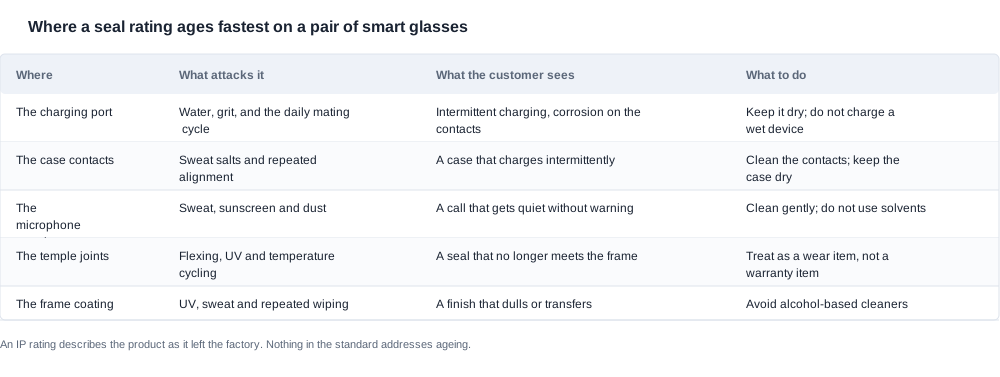
Five exposures do most of the work, and they are not equal in severity. A buyer who knows the order of them can predict where a returned unit will have failed.
Salt and sweat. Sweat carries salt, and salt is hygroscopic: it holds moisture against a surface after the liquid has evaporated, so the conductive path survives after the water is gone. This is why seawater and pool water are more corrosive to electronics than fresh water despite both being water, and why a fresh-water rinse after salt exposure is standard practice rather than folklore. For a wearable worn against the head, sweat is the most common chemical exposure a seal ever sees, and it is the one that arrives every single day.
Ultraviolet light. The frame and any coating on it are exposed to daylight continuously, and ultraviolet degrades both rubber and coating compounds. This means the same product ages at different rates in different markets, and nothing on a specification sheet reflects it. A programme selling into a high-ultraviolet region should treat the care instruction as a stronger requirement, not an optional extra.
The mating cycle. Every time a charging interface connects, the sealing surface is disturbed. A port that mates once a day has been cycled hundreds of times over a couple of years, and a magnetic contact pair is aligned and separated at least as often. The wear is concentrated at the interface rather than spread across the frame, which is why the interface is where a design either succeeds or fails.
Mechanical movement. The temple flexes every time the frame is put on and taken off, and the joints move with it. A seal that depends on the compression of a rigid part against a fixed surface is more durable than one that depends on a compressed seal inside a moving joint, because compression is restored every time the joint closes. This is a design decision, made years before the product ships.
Temperature cycling. A device that moves from a parked car in winter to a hot day expands and contracts its materials at different rates, and the seal is where the difference in rate shows up first. Cycling is also what turns a marginal seal into a failed one, which is why a single hot-and-cold exposure in a test is weak evidence.

Why the answer to does ip degrade over time is a care instruction, not a rating
It helps to be precise about what a marking covers before deciding how much weight it can carry. IP54 describes one enclosure. The first digit, a 5, describes protection against dust ingress; the second, a 4, describes protection against water splashing in any direction. Neither digit describes immersion, a shower, a hose, a jet, or a product that has been in the sea for an afternoon, and neither digit describes how the enclosure behaves after a year of sweat and ultraviolet. The full standard background is in our IP rating industry standards page, and the two-digit reading matters commercially because "IP54" in marketing copy is very often heard as "waterproof", which it does not mean.
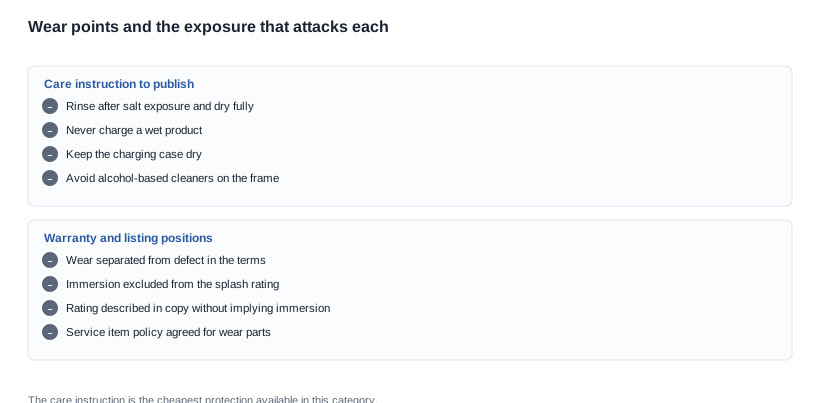
Given that, the practical answer to ageing is a document rather than a component. A care instruction is cheap, it is under your control, and it addresses the exposures listed above rather than the rating:
- Rinse the product with fresh water after salt or pool exposure, and dry it completely before charging.
- Do not charge a wet product. This is the single most damaging avoidable action, because water trapped in an interface is exactly the path the seal exists to close.
- Keep the charging case dry, and do not leave a wet product docked in it overnight.
- Avoid alcohol-based cleaners on the frame and on any coating, because they attack the surface material the seals depend on.
- Store the product away from prolonged direct sun if the packaging allows it, and do not leave it on a car dashboard in summer.
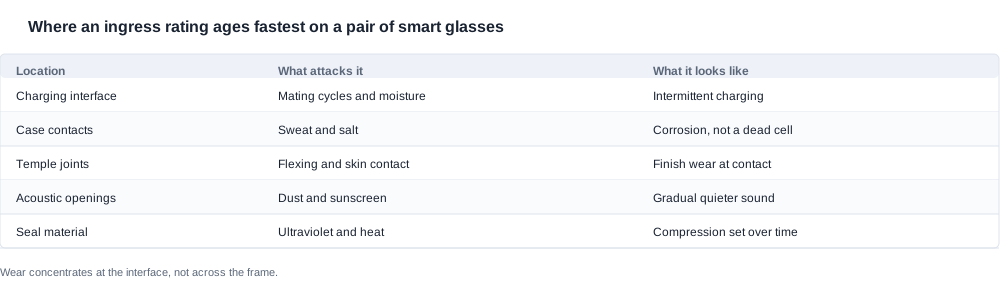
The second half of the answer is the warranty position, and this is where the money is. A unit that has been immersed is outside a splash rating, and a unit whose contacts have corroded after a year of daily use is a wear item. If the warranty does not distinguish them, the disputes get handled by whoever is more persistent, and in practice that means your customer service team absorbing a cost you had budgeted as a defect rate. Separating the two categories in the warranty terms — and giving your team the diagnostic detail to tell them apart — is what turns a returns problem into a predictable cost.
The third half is the listing. "IP54" on a product page describes the product in the box. The same characters in a two-year-old customer's hands describe something else, and the listing should not imply otherwise. A sentence that says the product carries an IP54 rating for protection against dust ingress and splashing water is accurate and does not create a promise that the hardware cannot keep.
Where does ip degrade over time show up first on a pair of smart glasses
Four locations do most of the failing, and they are worth naming in the order a buyer should worry about them.
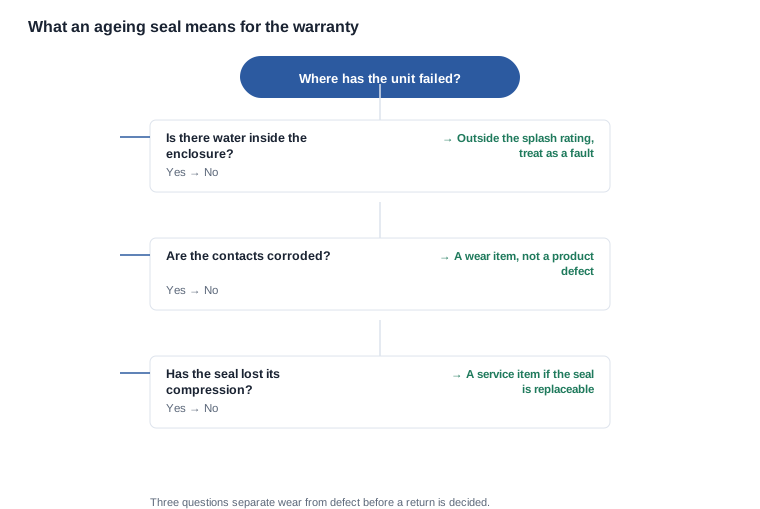
The charging interface. On a Type-C model the port is a deliberate opening in the frame, and it is the part with the most exposure and the most cycles. This catalogue publishes Type-C charging for seven models and magnetic charging for seventeen, and does not publish the charging method at all for MT6 and L1 Pro, and CY05 and CY03 — which means for those four, the interface question is open and the wear-item analysis cannot be completed from published data. That is a real due diligence item, not a formality.
The case contacts. A case with a cell has a contact pair that has to align and conduct every time the product is docked, and those contacts are exposed to the same sweat and salt as the frame. A case that charges intermittently is very often a case with corroded contacts rather than a dead cell, and the two need different diagnoses and different remedies. The published case capacities in this range are 900 mAh, 1200 mAh and 1400 mAh, and no case carries an ingress marking, so the case is also the part of the package with the least published protection.
The temple joints and the skin contact area. These flex, and they are exposed to sweat at exactly the point where a wearer rests them. The finish at the contact area is generally the first visible change, and the wear pattern is a useful diagnostic in a returns assessment.
The acoustic openings. Any opening a design requires for sound is a path into the enclosure, and it accumulates dust and sunscreen over time. The symptom is usually gradual and unnoticed — a call that becomes quieter, a microphone that sounds further away — which is exactly why it goes unreported until it is severe.
One model-specific point that belongs in front of any buyer asking this question: within this catalogue, the only products with a published ingress marking are the V06 and the S7, which are camera models. The sport range of YKC02, D17 and ZH12 carries no marking at all, so a buyer entering the sport channel on the strength of a water-resistance claim is building on nothing published here. Our sport smart glasses page sets out that range as it stands.

How to test and document does ip degrade over time in your own programme
Nobody publishes ageing data for this category, and that is why the question has to be answered by the programme rather than found on a datasheet. The method is not complicated, and the documentation is what makes it defensible.
- Define the environment before you define the test. Name the exposures your market actually produces — salt, ultraviolet, sweat, temperature range, dust, and the number of daily charges. A test that does not match the environment proves nothing about it.
- Define the duty cycle. How many charge cycles per week, how many hours worn, how often the case is docked, how often the product is rinsed. The ageing rate follows the duty cycle, not the calendar.
- Define the pass criterion before you start. Which observable outcome counts as a failure: water inside the enclosure, a visible water line, a change in charging behaviour, corrosion on the contacts, a change in acoustic performance. Write it down, because a criterion invented after the results arrive will always be the convenient one.
- Run a sample, not a unit. At least three units per configuration, each labelled, each inspected at intervals, each with its own record. Single-unit results in this field are noise.
- Inspect at intervals rather than only at the end. A leak that appears at cycle forty and then dries out is invisible at cycle one hundred and forty, and the interval inspection is what catches it.
- Record everything with the result. Unit number, cycle count, environment, temperature, the observation, and the date. The record is what lets you tell a buyer that the product is good for a season of hard use, and it is what protects you in a warranty dispute.

For a buyer evaluating a supplier, five questions get you most of the way, and they are the ones worth putting in a shortlist comparison:
- Do you hold ageing data for this model, and if so under what conditions? A supplier with no data and a supplier with data under a different duty cycle are both useful answers; an evasive one is not.
- Which parts are designated wear items, and are they replaceable? A replaceable seal turns a warranty event into a service event, and the cost of that difference is substantial over a product lifetime.
- What is the seal material, and what does it degrade into? Rubber, foam and elastomer lip seals age differently, and a supplier who knows the answer has designed for it.
- What does the warranty distinguish between wear and defect? This is a policy question with a direct commercial value.
- Is the ingress rating on the same document as the CE conformity assessment, and does the model list on it name your configuration? A rating that covers a family rather than a model is not a rating for your SKU.
Our IP rating case study template is the right starting point for the last question, because it is the document-level check that most often goes wrong.
A shortlist built on the marking itself will produce the wrong shortlist, because every credible supplier in this category can present an ingress rating, and the differences between them sit in the questions that are harder to ask. The criteria that actually separate suppliers are whether they will name the wear items, whether they hold data, whether the seal is replaceable, whether the rating document names your configuration rather than a family, and whether they will agree a warranty that separates wear from defect. Those five answers are worth more in a comparison than the rating itself, because they determine what the rating costs you over the life of the product rather than on the day it is sold. Ask them of every supplier in the shortlist in the same order, and record the answers in the same form, or the comparison will be a comparison of brochures.
The trade-off behind one of those answers is worth spelling out, because it is a real negotiation rather than a request. A sealed design that is not serviceable is cheaper to make and cheaper to certify, and it fails as a single unit when the seal goes. A serviceable design with a replaceable seal or a replaceable contact assembly costs more in tooling and quality control, and it turns a warranty event into a low-cost service event. For a programme selling a seasonal or outdoor product into a market with a hard winter, the second option is usually the better commercial answer even though it is the more expensive unit. Which one to take depends on the volume, the warranty period you are willing to carry and the average selling price of the product, and it is a decision that belongs in the quotation rather than after the first returns report.

What does ip degrade over time cost you in the commercial terms of the order
The ageing question has a price, and it appears in the order rather than in the lab. A handful of lines in the supply agreement determine whether the seal question costs you a rounding error or a percentage of your margin, and they are worth negotiating deliberately rather than accepting by default.
The warranty period and the response commitment. A warranty with a stated response time costs the supplier more than one without, and that difference is visible in the negotiation. A response time that is stated and staffed is worth more than a longer warranty period with no commitment behind it, because the cost of an unresolved failure is the customer, not the unit.
The wear-item definition. Put the categories in the agreement rather than leaving them to interpretation: immersion outside the rating, corrosion on contacts after sustained exposure, seal compression set, finish wear at skin contact. If the categories are not written down, each return becomes a fresh argument, and the argument is handled by whoever has the time that week.
The spares position. A serviceable seal or contact assembly has a minimum order quantity of its own, and a supplier who has not thought about spares will quote a single unit that cannot be bought. Ask whether spares exist, what the MOQ is, what the lead time is and whether they are covered by the same tooling as the main product. This is a small line that turns a warranty event into a costed operation.
The returns rate you are prepared to carry. For a product sold into an outdoor or seasonal channel, a returns allowance belongs in the unit economics before the order is placed. A few percent of units returned through a damp season has a predictable cost, and it is a far better argument to have with a supplier than an emotional one after the season has closed.
Sample, golden sample and audit. A golden sample that includes the case in its shipped state is worth more than a bare unit, because the case interface is one of the four places the seal fails. And a factory audit that looks at the sealing process, the seal material and the inspection method tells you more about ageing than any catalogue line, since the question is really about whether the process controls the variables.
On the freight and insurance side, one practical note: a product that is heavier because of a case has a different packed weight and a different packed volume, which changes the insurance value and, on a DDP or FOB basis, the per-unit freight. That is the same arithmetic as the charging-case weight question, and the two belong in one model rather than two.
What we publish about does ip degrade over time, and what we hold
Our published position, stated so it can be quoted in a buyer brief without qualification.
Published: the ingress marking IP54 for the V06 and the S7, and the absence of a marking for every other model in the range, including the whole sport range. The charging method where it is published, the charge times where they are published, and the case capacities where they are published.
Not published, for any model: a third-party test report number for either ingress marking, any ageing data, any seal material specification, any service life figure, any ingress marking for a charging case, and any warranty term.
We will not publish an ageing figure, because we hold no measured basis for one and an invented service life is a fabricated specification. What we can do is tell you which models carry a marking and which do not, explain precisely what the marking covers and what it does not, identify which parts of the product are the wear items in practice, and give you the care instruction that preserves most of the rating for most of the life of the product.
If you want this settled for a programme, send us the model, the environment your market produces, the channel, and whether the claim is going onto a listing or into a care instruction. We will tell you what is published for that model, which parts to treat as wear items, and where the answer to your question has to come from a test rather than from a catalogue.


