
The marking on a pair of glasses is defined by IEC 60529, and every other standard that touches durability in this category is a different document answering a different question. IP rating smart glasses industry standards is therefore a map rather than a code: which document answers which question, which parts of the standard never appear in the marking, and what the IP code does not cover about a wearable product at all.
Two models in our catalogue are marked IP54 — the V06 and the S7. We publish no third-party test report number behind them, and this article is about what the marking means rather than about how ours was established.
IP rating: the boundary IEC 60529 draws
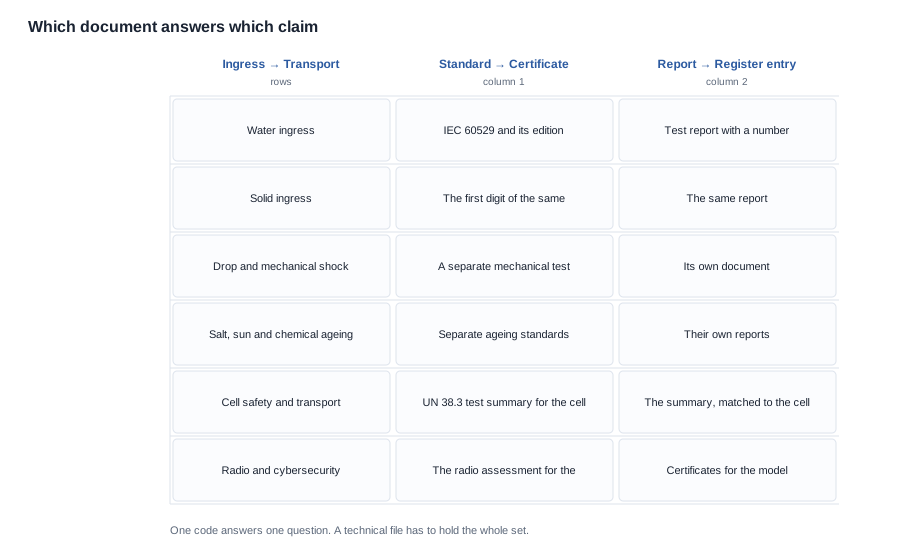
One code, one question, one document
IP rating smart glasses industry standards is decided by asking which question a buyer actually needs answered, because the IP code answers only one of them. Ingress is IEC 60529. The drop and mechanical shock behaviour is a different test entirely, salt spray and UV ageing are separate ageing standards, and chemical resistance is another document again. A buyer who specifies "IP54" and nothing else has specified one dimension of a durability envelope the product will be judged on.
The starting position for a technical file
A buyer working through the standards is usually building a technical file, or answering a compliance question from a customer or a marketplace, and holds a datasheet, a target market list and a set of samples. What they will not hold is the mapping from question to document, because it is not written on the datasheet and the datasheet is the only place most buyers look.
The mapping is short enough to hold in one page and important enough to be worth writing down, because a technical file that cites the right document for each claim is defensible and one that cites only the ingress code is not. A retailer or a marketplace reviewing the file will ask about the drop behaviour, the chemical exposure and the battery transport, and those are three other documents.
The four gaps a technical file usually has
A file that cites one document and implies coverage of everything. The IP code is the one everybody quotes, and it is the narrowest of the set.
A rating treated as a durability claim. The ingress code is silent about the frame that has been flexed, dropped twice and left in a parked car through a summer, and it is silent about the salt, the ultraviolet and the chemical exposure as well.
The charging interface being assumed covered. On a Type-C configuration the port is a deliberate opening in the frame. A splash rating is a statement about the frame's surfaces, and the port is a separate question that the marking does not answer on its own.
The chemical and UV exposure in a marine or a high-sun market. A product sold into those markets will meet requirements that no ingress rating addresses.
The parts of the code that never appear in the marking
A marking is two characters, and the standard behind it is considerably longer. The procedure specifies the volume of water, the angle and duration of the spray, the position of the sample, the state of the sample beforehand, and the acceptance criteria. Without them the same two characters can describe materially different tests, which is why a report number is worth more than a marking.
The first digit, read precisely. The first digit is solid foreign object protection and runs from 0 to 6. A 4 means protection against solid objects larger than 1.0 millimetre — the row that says a finger cannot reach the electronics. A 5 means dust protected: limited ingress of dust is permitted, but not enough to interfere with satisfactory operation or to impair safety. A 6 means dust tight, with no ingress of dust at all. The difference between 5 and 6 is the difference between a product that survives a season of dust and one that does not, and it is the difference a buyer in a dusty channel should insist on resolving.
The second digit, read precisely. The second digit is water protection and runs from 0 to 9. A 4 is protection against splashing water from any direction. A 5 is water jets. A 6 is powerful water jets. A 7 is temporary immersion, to a stated depth and duration. A 8 is continuous immersion, also to a stated depth and duration. A 9 is high-pressure and high-temperature water jets, which is the cleaning regime. A marking of IPX4 or IPX7 means the solid protection was not rated at all, and that is not a minor detail.
So IP54 reads as: dust protected with limited ingress permitted, and protected against splashing water from any direction. It is not dust tight, and it is not a water-jet or immersion rating. The digits are independent, which is why a device marked IPX4 is not less dust-proof than one marked IP54 — it is simply not rated for dust, which is a completely different statement.

The standards a retailer or marketplace will ask about besides ingress
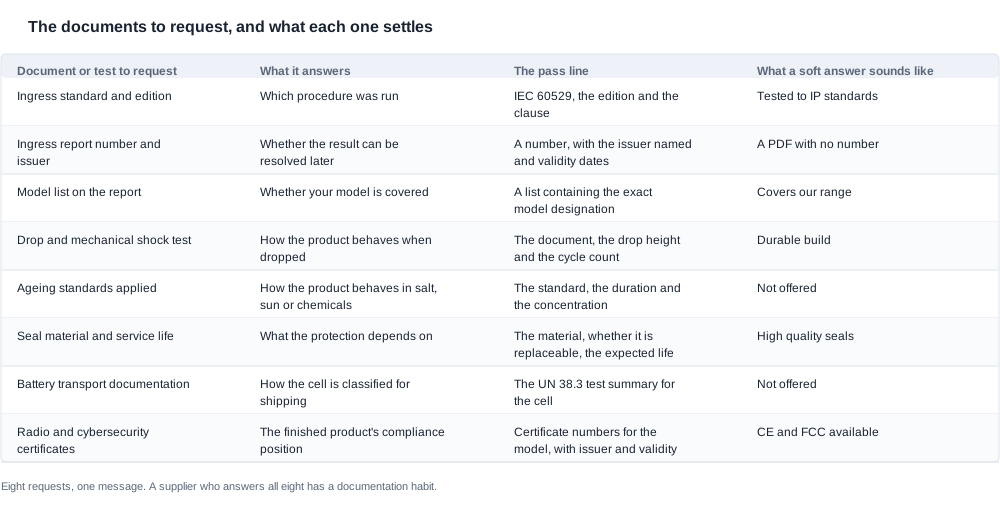
The request above goes to every supplier in the same form. The right-hand column separates a supplier with a technical file from one with a catalogue, and the eight rows together cover what a technical reviewer in this category normally asks for.
The mechanical behaviour. Drop and mechanical shock are covered by the IEC 60068 series — the free fall and shock parts for drop, the random vibration part for transport and handling. In a wearable category this matters more than the ingress document, because the failures are more often wear and drop than water, and because a retailer's technical team reads the drop document before the ingress one.
The environmental ageing. Salt spray, solar radiation and damp heat are separate parts of the same IEC 60068 series, and each carries conditions that matter: the concentration of the salt, the duration of the exposure, the radiation intensity, the humidity and the cycle profile. A product sold into a coastal or a high-sun market will meet requirements in these that no ingress rating addresses, and the buyer who asks for the ageing standards "with their conditions" is asking for the part that actually matters.
The frame and the product. Spectacle frames have their own general requirements and measurement-method standards under the ISO 12312 series, and the product's own safety standard — IEC 62368-1 for audio and video and information and communication technology equipment — covers the product as an electrical and electronic item rather than as a wearable.
The light source. Where the product has an illuminated element, photobiological safety under IEC 62471 is a separate assessment from ingress, and a camera that records continuously is a different optical situation from an indicator that blinks.
The materials. Restriction of hazardous substances and chemical substance obligations run as separate regimes from the durability standards, and a material change to reach an ingress rating is a change that reaches them.
What the point of the map is. It is not that a buyer needs every document on every SKU. It is that a buyer needs to know which claim each document supports, so that when a reviewer asks, the answer is a document rather than an assurance.
Building a claim-to-document map for your own technical file
The map is a working document, one line per claim on the product page, and it is the single most useful artefact in this category.
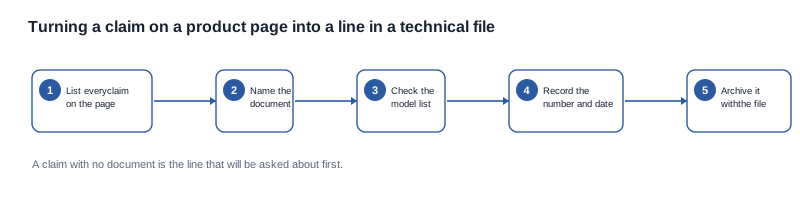
Five steps, in order. List every claim that appears on the product page, the packaging or the listing. Name the document that supports each one. Check that the model list on that document contains the exact model designation you ship. Record the number and the date, so the entry can be re-checked rather than re-found. Archive it with the file.
The lines with no document are the ones that will be asked about. That is the entire diagnostic value of the map, and it is why it takes an hour rather than a day. In our experience the lines without a document are almost always the adjectives rather than the numbers — the "waterproof", the "military grade", the "drop tested to survive" — and each of them is a claim the brand is making with no document behind it.
The column that turns the map into a control. Add a fourth column to the map: who owns the line, and when it was last verified. A map with owners and dates becomes a reviewable document; a map without them becomes an archive.
The questions to ask a supplier, in one message. These are the same for every supplier and every model.
- Which ingress standard and edition was the test made to, and which clause?
- What is the report number, with the issuing body and the validity dates?
- Which model list does the report name, and does it contain our designation?
- Which drop and mechanical shock document applies, and at what height and cycle count?
- Which ageing standards were applied, with their duration and concentration?
- What is the seal material and its expected service life?
- Which cell is fitted, and where is the UN 38.3 test summary for it?
- Which radio and cybersecurity certificate numbers cover this model?
How to score the answers. An answer naming a document, an edition or a date passes. An answer describing a quality does not. The scoring rule matters because it converts a qualitative judgement about a supplier into a countable fact, which is what makes it arguable in a sourcing meeting.
The one rule that prevents the map becoming a fiction. Every line in the map has to describe a document that exists and can be produced on request. If it cannot, it is a marketing claim, and the correct action is to delete it from the product page rather than to leave it in the file as an aspiration.
The sign-off checklist that closes the file
A file is not finished because the documents have been collected. It is finished when a reviewer can find what they need without asking anyone. This checklist is the test for that, and it is the question to ask before you tell a supplier the file is accepted.
- Does every claim on the product page, the packaging and the listing have a line in the map?
- Does every line in the map name a document that exists and can be produced on request?
- Does every named document cover the exact model designation that will ship?
- Is the model list on each document checked against the units received, rather than against the order?
- Has any claim in the map been superseded by a later change, and if so has the line been updated?
- Is the model list on the ingress document checked against the variants in the range, one by one?
- Does the file record the cell that is fitted, and is the cell's transport summary attached?
- Is there a named owner and a review date against each line?
- Has the packaging copy been read against the file, rather than the file read against the packaging copy?
- Are the exclusions printed next to the marking, in the same place the customer reads the marking?
The two checks that catch the most. Number four catches the substitution, because it compares the document against the physical unit rather than against the purchase order. Number nine catches the drift, because the file is the artefact that is written carefully and the packaging is the artefact that is edited quickly, and the gap between them is where the over-claim appears.
When the file gets refreshed. Before it is released with the first shipment, and again whenever the claim set changes. A file that is accurate on the day it is compiled and stale six months later is worse than no file, because it gives a reviewer the confidence to ask less.
The cost of an incomplete file. It does not arrive as a rejected shipment. It arrives as a technical query from a retailer's compliance team, a listing amendment, a delay in a marketplace approval, or a customer enquiry that nobody in the organisation can answer from a document. The cost is administrative rather than technical, which is why it is often underestimated and why the checklist is worth running once properly.

The standards that follow the cell rather than the product
Some documents in this category describe the cell rather than the finished product, and that distinction has a practical consequence: a cell substitution invalidates a document even when nothing visible on the product has changed.
The transport document. The test summary under the United Nations Manual 38.3 test standard is tied to a cell model, and it is what supports the shipping paperwork for the product. Change the cell and the summary no longer describes what is in the box, whatever else has been verified. This is why a cell change is a documentation event and not only a purchasing one.
The cell safety standard. IEC 62133-2 covers the safety requirements for secondary cells and batteries for portable applications, and it is a cell-level assessment. It is separate from the ingress rating, separate from the radio assessment and separate from the product-level safety standard, and it follows the cell through every product configuration the cell is used in.
The two-cell case. A charging case with a second cell is a second declaration and a second set of shipping paperwork, and it is the reason the case has to be treated as a separate object in a product file rather than as an accessory. We publish no ingress rating for any charging case in our range, and the same principle applies across the document set: the case has its own electronics, its own contacts and its own opening, so it carries its own file.
The runtime claim. Where a cell change moves the runtime, the number on the packaging moves with it, and the change is a claim change. It is easy to treat a runtime figure as a specification rather than as a claim, and the file should not.
The question to ask, and the trap in it. "What is the transport documentation for this product?" is a good question. "Is it compliant?" is a bad one, because it invites a yes and produces no document. The same applies to every other line in the file: ask for the number, the edition, the model and the date, and the answer will be checkable.
Why this matters commercially. A cell substitution is a normal procurement event — a supplier runs out, a second source is qualified, a price moves. It is also the event most likely to quietly invalidate a document set that nobody re-checked, because nothing visible on the product changed and nothing on the spec sheet changed. Putting cell and interface changes into the change-control procedure with a notice obligation is what prevents that.
Assembling a durability file for a marine and a high-sun channel
The exercise below works in the opposite direction to the usual one. It starts with the claims a product page makes and works back to the documents that could support them, which is the order a technical file has to be built in. It describes no client engagement.
A brand sells into a coastal retail channel and a high-sun outdoor channel, with one platform and a technical file that currently contains an ingress document and nothing else.
The claim list. The product page claims splash protection, a camera, a runtime and a rugged build. The packaging carries the ingress marking. The listing says "built for the outdoors". Four claims, one document.
The mapping. The splash protection claim maps to the ingress report. The runtime claim maps to a cell-level document and to the battery declaration. The camera claim maps to the product safety file and to the radio and cybersecurity certificates, because the update path and the recording function are part of the product's compliance position. The "built for the outdoors" claim maps to nothing at all — it is an adjective built on the other three, and it inherits whatever they do and do not support.
The gaps the map exposes. Nothing in the file speaks to salt, to ultraviolet radiation or to sustained high temperature, and the coastal channel produces all three. The brand adds the ageing standards from the IEC 60068 series as a separate request — salt spray, solar radiation, damp heat — each with its conditions recorded rather than summarised.
The outcome on the copy. The "built for the outdoors" line is replaced by two specific lines: the digit's own reading of the ingress position, and the ageing evidence with its conditions. The brand has lost a phrase and gained two claims it can defend. The retailer or marketplace reviewer, who would have asked about the missing documents, gets a file with a line for every claim.
The question the brand now asks every supplier. The eight-item request, sent in the same format, for every model in the range. The suppliers who answer with documents are shortlisted ahead of suppliers who answer with adjectives, regardless of price, because the second group's file will fail in someone else's technical review.
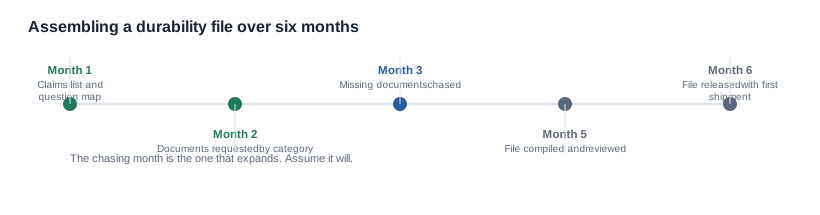
The schedule reality. The chasing month is the one that expands, and it expands because suppliers hold the documents for models that are no longer selling and because the ageing tests are not the same kind of evidence as an ingress report. A buyer who builds the file over six months with a named owner at each stage gets a defensible file; a buyer who attempts it in the week before the first shipment gets a partial one and a list of exceptions.
What our catalogue can answer, and what it leaves blank
The IP54 marking in our catalogue belongs to the two models that carry it — the V06 and the S7 — and we publish that no third-party test report number supports it, and we will not describe a splash-protected product as waterproof or present an ingress rating as though it were a durability claim. When the company confirms the test documentation for a model, we will publish the report number here rather than a restatement of the marking.
We will also not publish the standard, the test condition, the sample size or the laboratory behind our own marking, because the company has not confirmed them to us. We would rather show you an empty field than a plausible-looking one.
The file we can answer from today. Which of our models carry an ingress marking and which do not. What the digits in that marking mean, read out in words. Which document set a claim of each kind needs behind it, including the documents that are not ours to hold — the cell transport summary, the radio and cybersecurity certificates, the ageing reports. And which of our rows a buyer's own file can rely on today, which is a different and more useful question than which models are best.
What we leave blank, and why. No report numbers, no standard, no test condition, no sample size, no laboratory, no certificate numbers, no minimum order quantities, no capacities, no lead times. Every one of those is an empty field in our own documentation, and every one of them is a field a buyer should insist on being filled before the deposit rather than after.
Helping you build the claim-to-document mapping for your own file is something we do, and we can tell you which of the documents in the family your channel will actually ask about. The background is under IP ratings and durability, the wider compliance picture is under compliance, the reading of the code is in IP rating spec sheet explained, the document contents are in IP rating key specifications, and the range is sport smart glasses.
Where the standards map comes from
Give us the claims on your product page and we will tell you which document each one needs.


