

Ip rating smart glasses case study template is the document a buyer should ask for when a supplier quotes an ingress protection rating, because an IP rating without its conditions is a marketing string rather than a test result. The rating itself is well defined — under IEC 60529, the first digit is solid foreign object protection and the second is water — and our own catalogue marks exactly two models IP54: the V06 and the S7. We publish no test report number behind either of them.
This template is designed to be filled in by the supplier, so that a buyer can tell whether the number on the spec sheet describes the product in the box. It is nine fields on one page, and the reason it works is that a filled template can be judged. A free-text email cannot be judged, because its omissions and its assertions look identical.
IP rating: why a template beats a test report request
The reason to ask for a structured document rather than a set of emails is that emails create an ambiguity that nobody notices until it matters. "The unit is IP54" in an email could mean the factory tested the unit, could mean the factory saw a supplier's component rating, could mean a colleague typed it from a catalogue. All three are common, all three appear in writing, and none of them is distinguishable from the others at the time of reading.
A template forces the supplier to commit to a position on each field. The fields are deliberately narrow, and the field about the sample identity is the one that does the most work: it forces a statement about whether the result came from a production batch or from engineering units. A supplier who cannot fill that field has told you something important, and they have told it to you in a way you can put in front of a reviewer.
The second reason is procedural. The template is a thing that can be attached to a purchase order, indexed by model designation, and produced by a colleague who was not in the original conversation. Emails cannot be attached in a way that survives a change of personnel, and in most organisations the person who ran the original evaluation is not the person who maintains the file two years later.
One practical note on onboarding a supplier that has never seen the form. Send it as a form with the fields pre-labelled and the acceptance rule printed underneath each one, rather than as a blank page and a request. A supplier filling in a blank page decides what to leave out; a supplier filling in a field with its own acceptance rule printed beneath it either meets the rule or names the gap. The difference in the first response is usually the difference between a seven-field answer and a nine-field answer, and the nine-field answer is the one that can be filed.
What the template is for, and what it is not
The template is for establishing whether a marking describes the product the buyer is actually ordering. It is not a substitute for the report itself, and it is not a certification. The rating comes from a laboratory; the report is the evidence; the template is the form on which the supplier states which report, on which sample, in which configuration, produced the marking on the quotation.
That distinction is worth stating because a template can be mistaken for a document. The template is a summary of a document, and a summary can be wrong in a way the document cannot, because the summary is made by a person who may have understood the report differently from the person who wrote it. The template therefore has one non-negotiable field: the report number. If that field is blank, nothing else in the template has evidentiary weight.
The template is also not a performance specification. It does not say how long the product will last, how many cycles the seal will survive, or what happens after two years of use. It says what was tested, on what, and under which conditions — and that is enough for a buyer to decide what can be claimed, which is the decision the marking exists to support.

The nine fields, and the blank answer each one is hiding
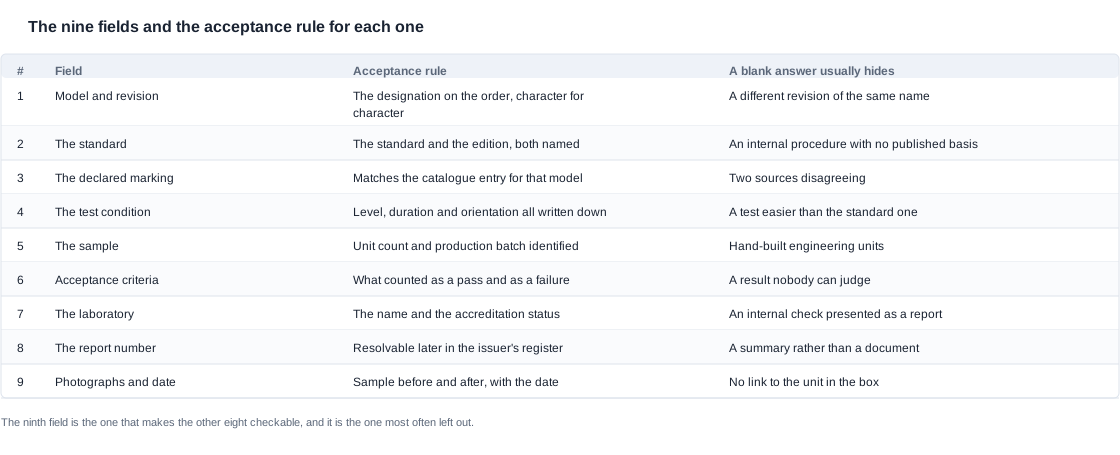
Each field below is paired with the failure it is designed to expose. A supplier who answers every field has told you what you need. A supplier who leaves one blank has told you something too, and the pairing tells you what.
Field one, model and revision. The exact model designation, the hardware revision and the firmware version. A rating attaches to a configuration rather than to a product name, and the most common reason a report cannot be used is that the report covers a different revision of the same model. A blank answer usually hides a revision that changed after the test.
Field two, the standard. IEC 60529, and which part of it was tested. A marking without a named standard is an assertion. A blank answer usually hides an internal procedure with no published basis, which may be a sound piece of work but cannot be compared with anything.
Field three, the marking as declared. The rating as the maker states it, so that there is a baseline to compare the report against. If the report and the catalogue disagree, that is the first thing to resolve and it is the cheapest of the nine to resolve. A blank answer usually hides two sources that were never reconciled.
Field four, the test condition. The dust level and the water level, the duration, and the orientation of the sample during the test. This is the field that most often reveals that two suppliers quoting the same marking have tested materially different things. A blank answer usually hides a test that was easier than the standard one.
Field five, the sample. How many units were tested and from which production batch. A rating established on three hand-built engineering units is a different proposition from one established on a production batch, and a buyer should know which one is in front of them. A blank answer usually hides a prototype.
Field six, the acceptance criteria. What counted as a pass and what counted as a failure. A test with no stated criteria produces a result nobody can judge, and the criteria are often the place where a supplier's test was easier than a standard one. A blank answer usually hides a pass condition that was decided after the result was known.
Field seven, the laboratory. The name and the accreditation status of the test house. An internal check by the factory's own staff is a useful quality practice, but it is not a test report and should not be presented as one. A blank answer usually hides an internal check described in third-party language.
Field eight, the report number. The identifier printed on the report itself. This is the only part of the whole document that can be independently checked later, by a customer, a broker or a marketplace, and a report without a number is not a document. A blank answer usually hides that the report does not exist, or that it exists in a form that cannot be resolved.
Field nine, the photographs and the date. Images of the sample before and after the test, and the date the test was run. The photographs matter because they are the only evidence that the sample in the report is physically the same object as the one in the box. A blank answer usually hides a gap between the tested unit and the shipped unit.
Acceptance rules that let a filled template be judged
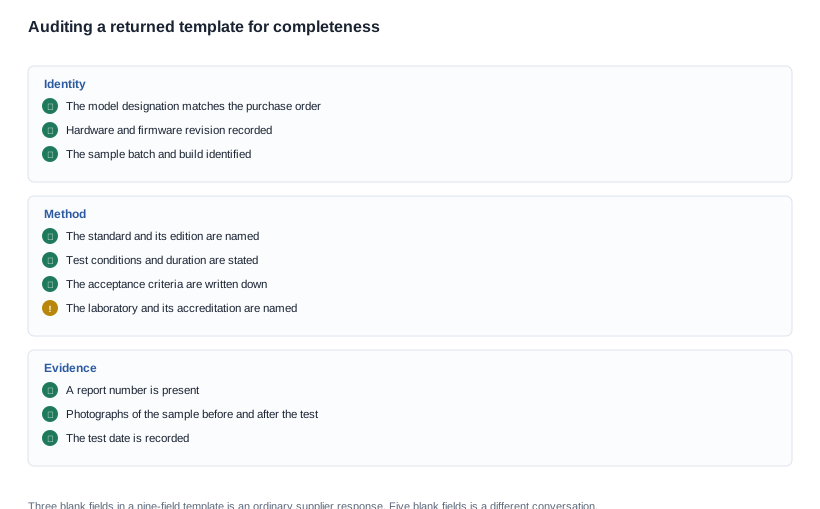
Judging a filled template is a mechanical process rather than a matter of judgement, which is what makes it usable by a second person. The rules are: the model designation on field one must match the designation on the purchase order character for character, with no abbreviation and no family name. The standard on field two must be named with its edition. The sample on field five must identify a production batch or state explicitly that it was an engineering build. The report number on field eight must resolve in the issuing body's own register, and the resolution must show the same model designation as field one.
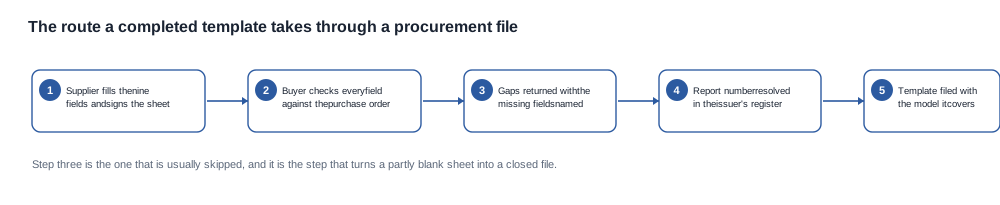
Applied as a checklist, a returned template goes through six checks in this order, and each one assumes the previous one passed.
- Compare the model designation on field one with the designation on the purchase order. Character for character, including any suffix. A mismatch is a stop condition rather than a query, because everything downstream is judged against the wrong product.
- Confirm the standard and its edition on field two. A standard without an edition is a loose fit, and the details of a procedure change between editions.
- Read the sample identity on field five and classify the build. Production batch, or engineering build. The classification changes what the marking is worth and it changes whether the result can be quoted in a listing.
- Resolve the report number on field eight in the issuing body's register. Check the model designation, the date and the validity on the register against field one.
- Compare the photographs on field nine with the unit in the box. Ports, contacts and interfaces, physically, on the unit rather than against a description of the unit.
- Record the outcome as accepted, accepted with an open item, or returned with named gaps. There is no fourth outcome, and a template that does not fit into one of the three is a template that has not been read properly.
The photographs on field nine are checked against the unit, not against the description of the unit. The sample is held up, the port and the contacts are compared with the configuration on field four, and the two are either the same or they are not. That single comparison is the most consequential check in the whole template, because it is the only one that can detect a build that changed after the test.
A template that passes all of these is a document the buyer can defend. A template that fails one of them is not a rejection — it is an open item with a named owner and a named question, and the difference between those two things is the difference between a supplier conversation and a dispute.

What to do when a template comes back partly blank
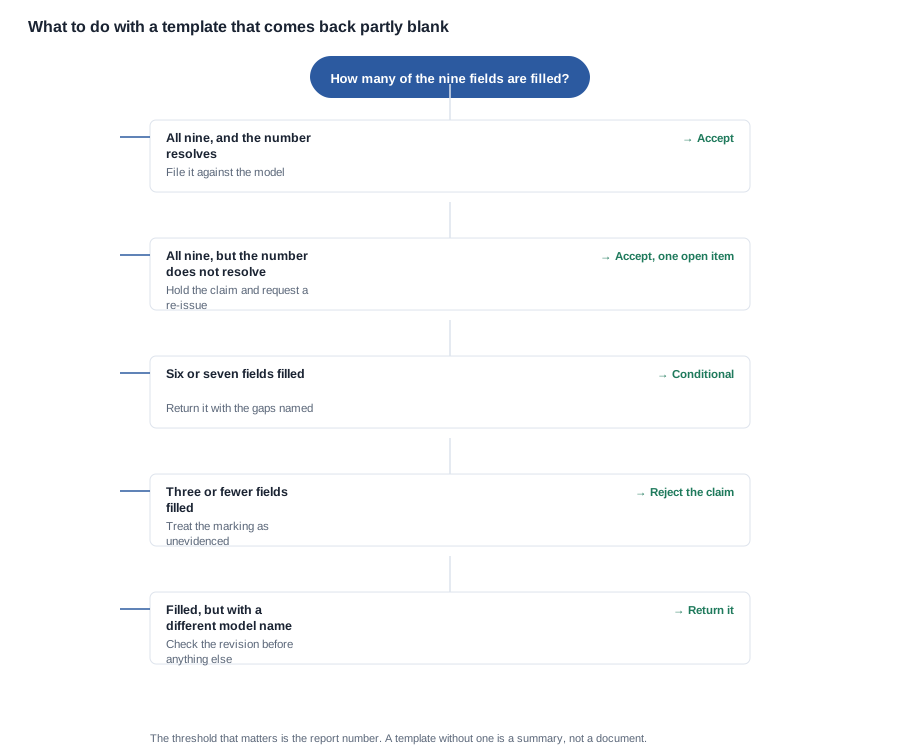
Suppliers respond to this template with a range of completeness, and the response itself tells you what kind of documentation culture you are dealing with. The handling rules below are ordered by how much of the template is filled.
All nine fields filled and the report number resolves. File the template against the model it covers, and cite the report number wherever the marking is published. Nothing further is needed from that supplier for this model, and the same template can be requested for a sibling model with a different designation.
All nine fields filled but the number does not resolve in the register. Accept the template into the file and hold the claim. The report may still be legitimate — a register is not always current, and a small laboratory may not appear in one — but until the number resolves, the marking is not evidence a third party can check. This is the state in which the buyer can publish the marking as a manufacturer statement and cannot publish it as a tested specification.
Six or seven fields filled. Return the template with the gaps named one by one, and give a response date. A template with two named gaps is a short piece of work for the supplier and a decision point for the buyer. The gap that matters most is field four, the test condition, because a template without it cannot be compared with any other template.
Three or fewer fields filled. Treat the marking as unevidenced and plan the programme on that basis. This is not a judgement about the supplier's honesty; it is a judgement about the documentation, and the documentation is what the buyer has to rely on when a customer asks.
Filled, but with a different model name. Check the revision before anything else. A template naming a different designation is either the wrong template or a different product, and both of those are resolvable within a day while a template naming the right designation with three blank fields may not be.
A hypothetical filled template for the V06, read line by line
This is a hypothetical scenario rather than a client project, and it is here to show how the template is read rather than to report an outcome.
Assume a brand sourcing the V06 for an outdoor channel, with a purchase order ready to be signed and a supplier who has returned the template with seven of the nine fields filled. Field one names the V06 with a hardware revision. Field two names IEC 60529 with the edition. Field three declares IP54, which matches the catalogue. Field four is blank. Field five identifies a production batch. Field six is filled with a pass condition. Field seven names the laboratory. Field eight is blank. Field nine has before and after photographs and a date.
Field four, the blank test condition. The buyer asks for the dust level, the water level, the duration and the sample orientation. The supplier's answer establishes that the sample was held at an angle the standard allows and that the water exposure was the splash procedure rather than a jet or an immersion. That single answer is what converts the marking from a two-character summary into something the buyer can describe to a customer in a sentence.
Field eight, the blank report number. This is the field that matters. The supplier's position is that the test was performed and that the paperwork is held at the laboratory. That may well be true, and it is still not a document the buyer can file, resolve or cite. The template is returned with the gap named, and the claim stays narrow in the meantime.
The consequence for the programme. Because the report number is outstanding, the buyer writes the listing with the code and the wording that the field four answer supports, prints the exclusion next to it, and does not describe the marking as a tested specification. Because field five identifies a production batch, the buyer knows the marking is not about a prototype, which materially strengthens the position even without the number. Because field nine carries photographs of the sample, the buyer can compare those photographs with the unit in the box — and here the comparison succeeds, because the port arrangement and the contact arrangement on the photographed sample match the shipped unit.
What would change the outcome. If the report number arrives, the claim can be described as tested and cited. If it does not, the buyer has a narrow claim that is still defensible, a documented test condition, and a photograph-based comparison between the tested sample and the shipped unit. Neither of those is as strong as a resolvable report, and both are far better than a claim written from a catalogue annotation.

What we publish, and the day we will publish a report number
Concretely, we publish the IP54 marking on the two models that carry it — the V06 and the S7, which are the only entries among the twenty-eight catalogue rows with an ingress marking — we publish that no third-party test report number supports either of them, and we will not describe a splash-protected product as waterproof.
We also publish what a template is for, so that a buyer can use one against any supplier, not only against us. When the company confirms the test documentation for a model, we will publish the report number here rather than a restatement of the marking, and that entry will be made in the same way an entry is made in the catalogue — with the number, the issuer and the date.
What we can do in the meantime is tell you exactly which models carry the marking, what the two digits mean, and which exclusions need writing into your own documentation. The technical background is under ip ratings and durability, the two marked models are on the sport smart glasses page, and the day-to-day handling consequences are in ip rating problems and fixes.
When a sample test is a legitimate substitute
If a supplier will not produce a completed template, a sample test is the substitute, and it is a partial one. Drying a wet unit with a defined method, immersing a unit in fresh water to a defined depth for a defined time, and putting a unit through a dust exposure are all procedures a buyer can run, and they establish whether the marking is credible. They do not establish an ingress rating, because an unaccredited test produces a result that cannot be used in a file.
Use a sample test to corroborate, never to replace, and record it as the buyer's own measurement rather than as a test result. The measurement route is described in how to measure an ip rating, the specifications behind the marking are in ip rating key specifications, and the question to put to a supplier first is in ip rating supplier verification.
Send us the completed template for a model and we will tell you whether the report covers the configuration you are buying.


