

A standard oem quality standard is only useful if somebody can check it. That sounds obvious and it is the single most common failure in this product class: quality documents are circulated, approved, filed and then relied on, and the thing they are checked against turns out to be a description rather than a measurement. A standard that nobody can evaluate is not a standard, it is a statement of intent, and a statement of intent produces no argument at the moment the argument is needed.
This page is organised around that one idea. It sets out the three tiers of checkability a quality requirement can occupy, separates the rows our catalogue publishes from the documents it does not, walks through the acceptance chain — who inspects, who signs, and what happens when a batch fails — and gives the question list that turns a quality file into something a procurement team can actually use at incoming inspection.
Nothing in this page claims a certification, a certificate number, a test result, a defect rate or a warranty period. Our published material contains no per-model certification row, no test report for any of the twenty-eight entries, and no photographic or video record of any entry. What it does contain are specification rows, and those rows are more useful than the missing documents, because a row can be checked against a unit in the buyer's own hands.
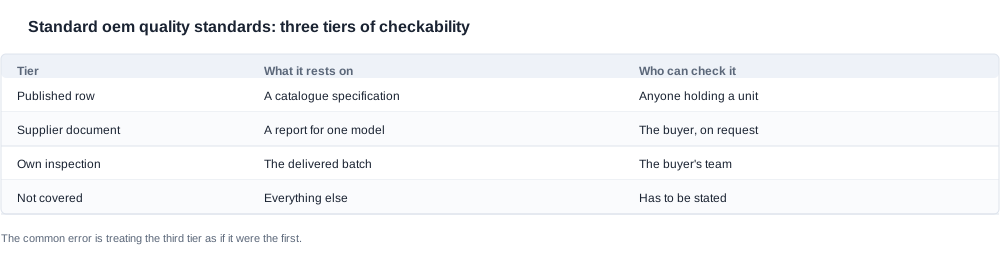
That table is the organising device for the whole page. A requirement that sits in the first tier is verifiable by anyone holding a unit and a measuring tool. A requirement in the second tier is verifiable only against a document the supplier holds and releases on request. A requirement in the third tier is verifiable only against the buyer's own inspection, and it is the only tier that speaks about the batch actually delivered.
What a quality standard can be checked against
The first tier is the published specification row. Every entry in our range carries four standard rows — the cell, the runtime, the charge time and the charging method — and the eleven camera models add a resolution class on top of those four. It publishes a Bluetooth version on the fourteen entries that carry one. It publishes a case capacity on five camera models, colour names on two entries, a removable part on three, an ingress marking on the V06 and the S7, a remote shutter on the D17 and the ZH12, and one weight in the entire range, belonging to the MT6 at 158 g for the glasses body excluding the folding case.
A requirement written against one of those rows is checkable in the strongest sense available: the buyer holds the unit and can compare. A cell that arrives with a different configuration from the published one is a defect that requires no interpretation.
Even this tier has a limit, and a quality file that ignores the limit is not usable. A published charge time is a ceiling of two hours or less for twenty-six of the twenty-eight entries and about one hour for the D17 and the ZH12, and no published row states the starting state of charge or the end point that counts as finished. A published runtime of about six hours on the G07 and the YK12, or a range of five to eight hours on the S7 and the V03, and the V06 and the V03 Pro, states a range without stating a test method. A published resolution class states a class, not a lens, a frame rate or a field of view. So a published row supports the check, but the method behind the check has to come from somewhere else, and that is precisely where the second tier starts.
The published rows are therefore not a quality standard on their own. They are the part of a standard that can be checked on a receiving bench, which makes them the most reliable section of any file and the cheapest to obtain. It also makes the rest of the file easier to judge, because a buyer can see precisely which items are already settled and which are still open — and an open item that has been listed is a task, while an open item that has been forgotten is a discovery waiting for the dock.
The second tier is the document the supplier holds. A test report covers one configuration. A conformity document covers one model designation. An inspection record covers one batch. None of these are published here, and none of them can be read off a catalogue page, but they are the only thing that supports a claim about a configuration the catalogue describes only in part. The correct request names the exact model designation, the exact configuration and the destination, because a report written for a different configuration does not cover this one.
The third tier is the buyer's own incoming inspection, and it is the only tier that speaks about the batch that actually arrives. This tier covers what neither the published row nor a supplier document can: whether the unit in the carton matches the reference unit, whether the accessories are the ones the order named, whether the labelling is right for the destination, whether the packaging is undamaged, and whether the batch as delivered is internally consistent.
The error that costs the most is treating the third tier as though it were the first. A specification that says "matches the approved sample" without a signed reference unit behind it moves a legal argument into an inspection queue, where it cannot be settled, because the people doing the inspection are not the people who approved the sample.

The published rows and the documents that are not published
The published set is small and it is worth knowing precisely, because the buyer who knows the boundary stops asking for evidence that cannot exist and starts asking for the evidence that can.
On the certification side, no model in the range carries a certification line of its own, and the catalogue text names none of CE, FCC or RoHS. What sits on that page is company artwork rather than a per-model record: ten certificate images, eight of them appearance-design patents and two of them utility-model patents, which is a statement about the company and not a conformity record for any model in the range.
The internal product record is more specific than the catalogue, and it records certification in exactly three states. For the camera group and the audio group, and for the photochromic entry, the record carries no published framework and no certificate number. For the sport group, the record carries the same absence and adds a note that the IP54 marking carries no third-party report number of any kind. For the children's group, certification information is not published at all. For the bone-conduction entry it is likewise not published. For the AR entry, which carries no model code, nothing is recorded either.
Three states, and no fourth: a claim whose numbers are pending confirmation, a claim carrying a note that no report is held, and no certification information at all. A quality file that says "certified" in the first case, or that treats the three states as interchangeable, is wrong in a way that will surface as a market-access problem rather than as a quality problem.
The same discipline applies to the two figures in the range that invite overstatement. The IP54 marking on the V06 and the S7 is annotated on the catalogue page; no report number is published against it, and it cannot be restated outside the factory without a report behind it. The 35 dB gain the bone-conduction entry publishes is a catalogue row with no acoustic performance report attached, and it supports no statement at all about hearing, about medical use, or about suitability for any population. Both are legitimate rows in the record and neither is a marketing permission.
What is missing across the board is broader than certification. For all twenty-eight entries, our published material carries no test report, no third-party measurement, no photograph and no video of the physical product. Every visual reference in this range is a rendering. That is not a criticism of the documentation; it is a statement about what a catalogue does, and it has a direct consequence for a quality file: the quality file has to be assembled from the specification rows and from documents requested in writing, because there is no image in existence that could substitute for either.

The flow above sets out the six document types that turn up in a quality file and what each of them is competent to prove. A market-access instrument establishes a legal baseline and says nothing about whether the product is good. A radio qualification addresses one component. A management-system certification says a process is documented and audited at a point in time. A factory audit establishes capability on a date and is a snapshot. A test report covers one configuration. And the buyer's own incoming check is the only one that speaks about the batch in the cartons — and it speaks only about the attributes the buyer chose to test.

Inspection, acceptance and who signs the batch
Acceptance is where a quality standard either works or does not, and it is the part of the arrangement that is usually left undocumented.
Three parties can be involved in inspecting a batch, and a programme should say which one is doing what. The supplier's own inspection covers the attributes the supplier checks before the goods leave. A pre-shipment inspection is an independent check at the factory, and its scope depends entirely on what was agreed in advance. The buyer's incoming inspection happens at the buyer's site, on the buyer's own sample of the delivered batch, and it is the only inspection that sees the goods as shipped rather than as presented. Most disputes arrive because these three were assumed to be doing the same job.
Four things have to be written down for an inspection to produce a usable result. What is inspected — the list of attributes, tied to the published rows and to the agreed tolerance. How much is inspected — the sample size, and whether it is a fixed count or a statistical scheme, because a scheme has an acceptance number that has to be written into the same document. How the result is recorded — the record has to identify the batch, the configuration and the date, or it cannot be used in a later argument. And who signs.
The signature question is the one that matters most and gets the least attention. A batch is accepted by a named party with a named authority. That authority can sit with the buyer's quality function, with a third-party inspector, with the brand owner, or with nobody at all, and the fourth case is the common one: the goods arrive, they are put away, and the batch is accepted by the act of receiving it. That is not acceptance, it is the absence of a rejection, and it is not the same thing. A programme that has written down who signs, and against what criteria, has already resolved the majority of the disputes that arise later.
The failure path needs writing too. When a batch does not meet the agreed criteria, what happens: rework at the factory, replacement units from the next run, credit, return, or rejection of the whole batch. These options have very different commercial consequences and they are not equivalent from the buyer's side, because a rework still carries the schedule risk while a rejection carries the inventory risk. Deciding which applies while the batch is at the supplier is a planning decision; deciding it afterwards is a negotiation with a delivery date already missed.
There is one more timing point that is worth stating. The acceptance criteria must be agreed before the production run, not after the batch arrives. A criterion written in the moment of disagreement is a criterion that has been negotiated with the evidence already in hand, and the supplier will recognise that. Criteria agreed in advance are defensible, and the programme's position when a failure occurs is much stronger.

Questions that make a quality file usable
A quality file is a set of documents arranged so that somebody can act. The questions below are the ones that turn a pile of records into something usable, and they are grouped by the part of the file they concern.
The first group establishes the baseline: which published rows the file will check against, and how each check is performed. Without the row and the method, a check produces a number with no meaning.
The second group asks what the supplier holds and will release: which test reports exist for the model and configuration in question, which conformity documents exist for the exact model designation and destination, and which inspection records exist for the batch once it is produced. These are requested in writing, because a verbal answer is not evidence and a document with no model designation on it is not evidence about this model.
The third group concerns the inspection itself: which attributes are covered, what the sample size is, how defects are classified, what the acceptance threshold is, and what happens to a batch that fails it.
The fourth group is the one most files omit. What the file does not cover. A quality file that does not state its exclusions invites the belief that everything outside the exclusions is covered, and the exclusions are usually larger than the coverage. The things no document in this range covers include the physical appearance of the unit, the acoustic performance of the audio models, the behaviour of the photochromic and electrochromic entries, and anything about long-term durability. Those are the buyer's own inspection items, and they should be written down as such rather than assumed to sit inside somebody else's file.
Two further exclusions are specific to this range and are likely to be assumed rather than noticed. No acoustic performance report is published for the audio models, so any statement about how they sound has to come from a measurement somebody commissioned or requested. No optical performance parameter is published for the photochromic or the electrochromic entry, so a requirement that touches the behaviour of either has to name who measured it, against what reference, and where the record is held. Otherwise the requirement is a wish with a document stapled to it.
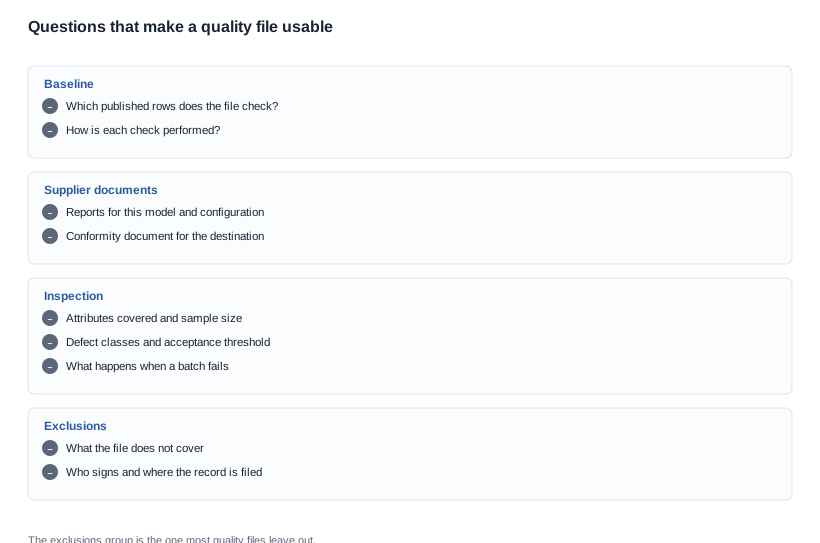
The fifth group is about the acceptance signature: who signs, against which criteria, and where the signed record is filed. A file without a signature trail has no closing evidence.
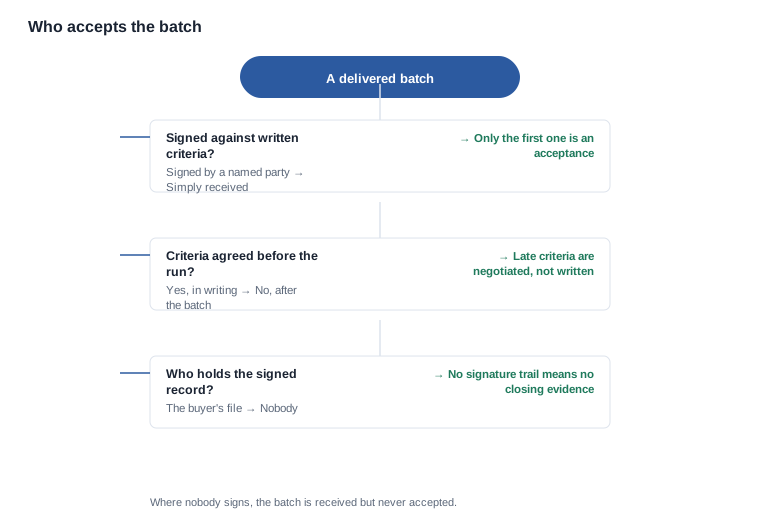
The decision diagram is the simplest statement of the point. A batch is either accepted by a named party against written criteria, or it is received without being accepted, and the second case is where the argument starts. Before you order, the question is cheap to answer and expensive to leave open.
Where CYNRIN stands on standard oem quality evidence
We publish specification rows and no evidence documents, and a buyer who knows the difference can build a workable file out of the two. The published rows can be checked by anyone holding a unit; the documents we hold can be released on request for a named model, configuration and destination; and the rest belongs to the buyer's own inspection, and we would rather say so plainly than let a gap be discovered at a receiving dock.
We will not state that a model is certified, because no certification line exists to state it from. We will describe the three states our internal record actually holds: a claim still awaiting company confirmation of its model and certificate numbers, a claim carrying a note that no report exists yet, and no certification information at all — and we will say which category a model sits in. We will not restate the IP54 marking on the V06 and the S7 as an external claim without a third-party report, and we will not extend the 35 dB figure published for the bone-conduction entry into any statement that touches hearing, medical use or suitability for a population of users.
We also publish no warranty period, no defect rate, no acceptance threshold, no sample size and no inspection cost, and those belong to the agreement and the quotation rather than to a catalogue. What we will do is state, for a named configuration, which published rows apply, which documents exist for it, what our own inspection covers, and what a batch has to be accepted against — and then let the buyer decide whether that set is sufficient for the destination it is shipping to.
For a procurement lead, the method is short. Establish the checkable baseline from the published rows, request the documents for the exact model designation, agree the inspection scope and the acceptance criteria before the run, and name the party who signs. A programme that does those four things can evaluate a supplier's quality claim, compare it with a second supplier's, and defend it at the point where the batch arrives — and the red flags are the ones that show up when any of the four is skipped.
Related reading
- a configuration and a quality file that depend on each other
- what a sample settles, and the reference unit behind it
- the catalogue rows a specification can be built from
- the printed claims on a carton that need evidence
- the tool line and the geometry a signed reference must match
A quality standard earns its place the moment somebody can check it — where that check sits, from the published row through the supplier's document to the buyer's own incoming inspection, is the structure worth getting right.


