

The factory versus trading company question is usually asked as a label question, and a label question produces a useless answer. Both sides can claim either. A trading company will say it sources and manages; a factory will say it manufactures. What a buyer actually needs to establish is narrower and more useful: who does the work, who can be made to own it, and what happens when it goes wrong. A review that answers those three things for every supplier in the shortlist is worth more than any number of factory tours.
This article sets out the structure of that review — the questions, the evidence to collect, the questions that waste time, a worked example of the same review run against two different kinds of supplier, the outputs it has to produce, and the questions it cannot settle. It is written for the buyer who has to make a decision rather than for the reader who wants to enjoy the topic.
One point of framing first, because it affects how the review is run. Being a trading company is not a defect. A well-run sourcing company can be better for a small brand than a large factory that treats a first order as a distraction, because it can move faster and it can absorb mistakes more cheaply. The cost of a trading company is not competence; it is indirection. You cannot get an answer about a tolerance, a build or a certification scope without going through someone who is also guessing. The review therefore is not about finding a bad supplier. It is about finding out how many layers sit between the question and the person who can answer it.
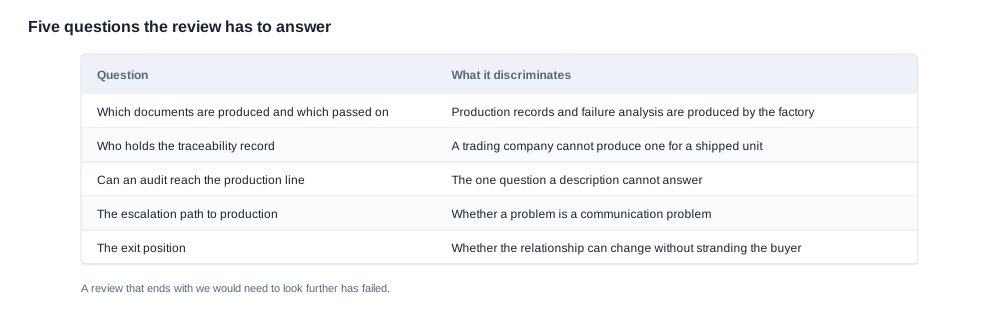
Factory vs trading company: the five questions a review has to answer
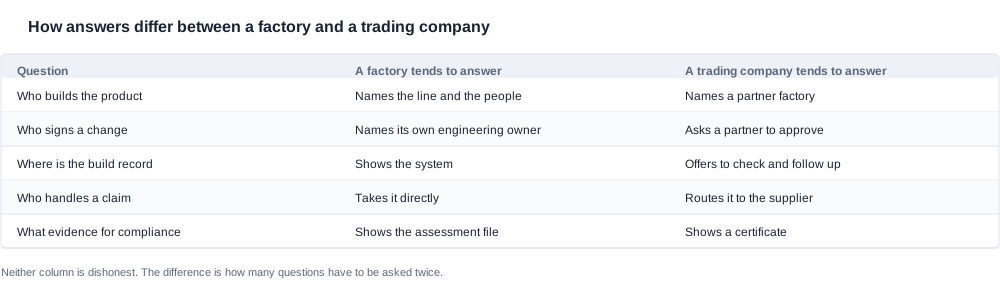
These five questions work for any product category and any order size. They are written so that the answer has to name a person, a document or a place, because an answer that names none of those has not answered the question.
- Who builds the product? Not who arranges for it to be built. The answer should identify the line, the site and the people who run it. A supplier who cannot say without checking has an answer, and it is not their own factory. For a smart-glasses programme this question has a specific test attached to it, because the production line questions are the ones worth asking carefully.
- Who signs the engineering change? When a specification changes, who approves it, who records it and who carries the consequence of it? A factory signs it directly. A trading company signs a change with its own partner, which means the buyer is negotiating with someone who is negotiating with someone else.
- Who holds the compliance evidence? Who can produce the assessment record for the specific revision that will ship, as opposed to a certificate for the model? We publish no per-model certification row in our own catalogue, and our export-certification page is a picture page showing ten patent certificates, eight design patents and two utility models — patents, which record what an applicant chose to protect, not regulatory test records. That is the position of a manufacturer that is being straightforward, and it is the standard a supplier should be measured against: the question is never "do you have certificates" but "can you produce the file for this revision".
- Who owns the field? When a unit fails in a customer's hand in the second year, who receives the claim, who diagnoses it, and who decides what is replaced? This is the question that separates a manufacturer from an intermediary more clearly than any other, because the field is where the answer gets expensive.
- Who owns the documentation? Who holds the artwork files, the manual, the build list, the golden sample register and the record of which version shipped to which order? The golden sample is the key artefact here, because it is the physical evidence of what "correct" means for a configuration, and the party that holds it holds the definition.
The five questions also have a useful property: they can be asked of the supplier in writing before any meeting, and the answers are comparable across a shortlist. That is what makes the review a review rather than a conversation.


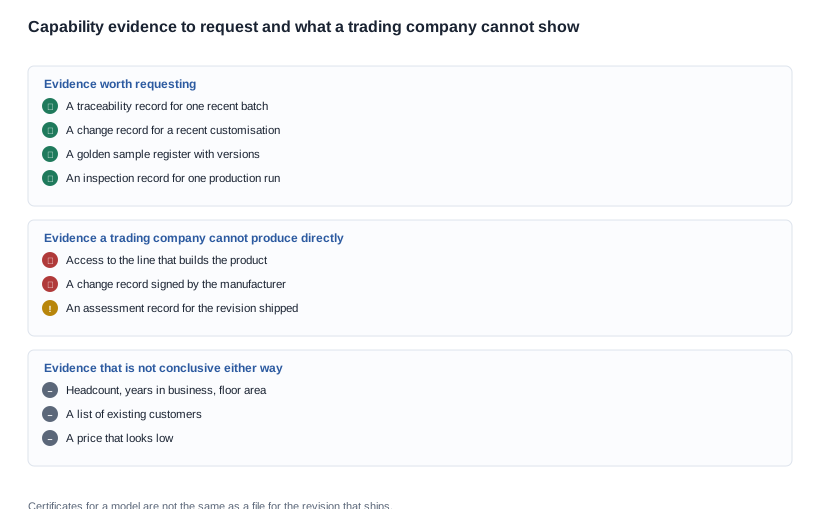
Factory vs trading company: the evidence to collect during the review
Answers tell you what a supplier believes about itself. Artefacts tell you what it actually does, and the difference between the two is the most valuable thing a review can find.
The evidence worth collecting, in descending order of usefulness, is as follows.
A change record for a real customisation. Not a description of their change process. An actual record from a recent programme: what changed, against which baseline, what it touched, who approved it. This single document reveals whether the supplier has a scope-management habit, and it separates a factory from a trading company more sharply than anything else, because a trading company rarely holds the change record of the factory that made the change.
A traceability record for one batch. A build list or a serial-to-batch mapping for a recent shipment, showing which build and which artwork version went into which order. Ask to see it rather than to hear about it. A factory produces it as a by-product of production; a trading company usually has to ask its partner.
A golden sample register. The list of approved samples, their versions, who approved them and when they were retired. If the register has versions and retirement dates, the supplier treats configuration as a controlled object. If it is a shelf with three units and no labels, the answer to the question is already known.
An inspection record for one production run. The evidence that somebody checked the units against something. In this category the most useful version is one that lists the checks that were applied to the customised elements specifically, not only the standard checks, because a customised unit passes the standard checks and can still be wrong.
A description of one recent programme, end to end. Not a reference visit — a walkthrough, on a call, from the requirement to the shipment, with the supplier explaining what happened at each stage. Where the supplier hesitates, and where they have to look something up, is the information.
The mechanics of collecting this evidence are worth stating, because they determine what a review can actually conclude. A supplier can produce a change record for a programme it ran two years ago, and that is a strong signal. A supplier asked for the record of a programme from three months ago, with the sample register and the build list open in front of them, produces a different kind of signal, because the retrieval is part of the test. The same applies to the site: a factory that owns its line can take a video call through assembly and answer questions about what is happening at each station, and a trading company can usually arrange the same tour at its partner's factory. The tour is therefore not the discriminator. The artefacts are.
One more piece of evidence is cheap and often skipped: a redacted version of the supplier's own quotation or order confirmation for a recent customisation programme. It shows how the supplier describes its own scope, whether it names the customisation elements individually, and whether it marks the commercial rows that are still open. A supplier whose documents are specific is a supplier whose internal documents are probably specific too.
Factory vs trading company: the questions a review should not ask
Four common questions consume time in supplier reviews and produce almost nothing. They are worth listing because the reason they fail is structural, not a matter of technique.
"Are you a factory or a trading company?" It asks for a label, and both parties have a commercial interest in the label. The answer tells you nothing about the capability and it puts the supplier in a position where the honest answer — "we source from our own partner factory" — sounds worse than the evasive one. Ask the five capability questions instead and let the structure of the answer reveal the answer.
"How many people do you have?" Headcount is self-reported, unauditable, and a poor proxy for engineering capability. A factory with forty people can have better engineering than one with four hundred, because a lot of large factories are largely assembly. The useful version of the question is about the specific capability: how many people work on firmware, how many on mechanical, who owns the quality function.
"How long have you been in business?" Trading companies are often younger than the factories they buy from, and established factories are sometimes older than their quality systems. Longevity is a weak signal and a poor filter, and treating it as one tends to exclude good new suppliers and admit old ones with weak processes.
"Can we speak to your biggest customer?" A supplier's largest customer is usually a distributor, a buyer of the distributor, or a supplier's own largest customer rather than the supplier's own. A reference call with someone who has never seen your programme tells you nothing about how your programme will be handled. A better reference request is narrower: a customer who ran a customisation, asked about the change record and the build record they received.
The trade-off behind all four is that these questions feel rigorous and produce a feeling of diligence. The evidence questions feel less conclusive and produce facts. Only one of those supports a purchase order.
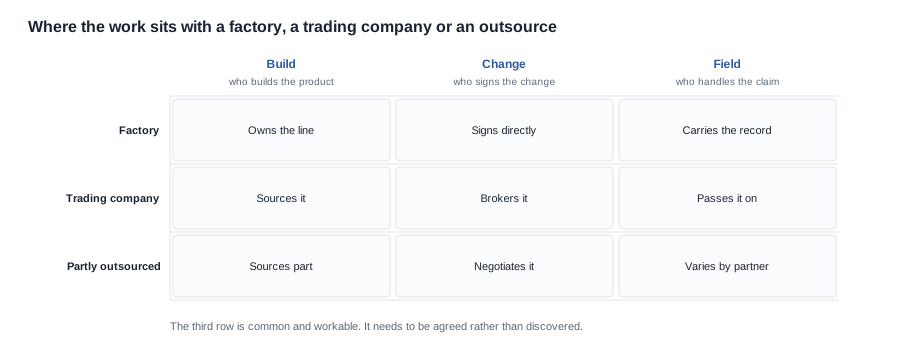
Factory vs trading company: a worked review of two shortlisted suppliers
The following is an illustration of how the same review produces different answers from two kinds of supplier. The two suppliers are composites of common arrangements in this category rather than named companies, and the point is not the verdict but the shape of the evidence.
A brand needs a camera model, private label, three markets, with a custom interface and a printed insert per market. Two suppliers are on the shortlist. Supplier One is a manufacturer with its own line; Supplier Two is a sourcing company with a partner factory.
Question one, who builds the product. Supplier One names the line, the shift structure and the team that assembles camera models, and offers to show it. Supplier Two names a partner factory in another province and explains the relationship, which is long-standing. The second answer is not a disqualification. It means the buyer is now in a three-party arrangement — brand, trading company, factory — and every subsequent question has to account for that.
Question two, who signs the engineering change. Supplier One produces a change record from a recent programme in which a camera model's setup flow was modified for a European customer, showing the baseline, the approval and the affected documentation. Supplier Two says the partner factory's engineering team signs, and offers to confirm the name. The consequence for the buyer is different in kind, not just in effort: with Supplier One the buyer can negotiate with the party that owns the consequence; with Supplier Two the buyer can only negotiate with a party that has to negotiate first.
Question three, who holds the compliance evidence. Supplier One walks through the assessment scope for the specific hardware revision and explains which change would trigger a re-assessment, including the radio-equipment cybersecurity requirements behind CE marking and the EN 18031 harmonised standards. Supplier Two provides a set of certificates for the model, which is what a trading company can normally do, and explains that the partner holds the underlying file. Again, not a disqualification — but it means the buyer cannot check the evidence directly and has to rely on someone who is also relying on someone.
Question four, who owns the field. Supplier One describes the claim route, the evidence it needs and how a replacement is decided, and offers to show a sample of a claim record. Supplier Two describes a route that passes to the partner factory and comes back through the trading company, with the trading company owning the customer relationship. This is a common and workable arrangement, and the buyer should price it accordingly: the claim path is longer, the response will be slower, and the buyer should agree that in writing rather than discover it.
Question five, who owns the documentation. Supplier One produces the artwork library, the manual and the golden sample register, all with versions. Supplier Two provides the artwork files it holds for the buyer and explains that the partner holds the master. The practical test here is whether the buyer can obtain the master files it needs for its own market and its own channels.
The outputs. On the evidence, Supplier One is a stronger fit for a programme with a custom interface and three markets, and the reason is not quality or honesty — it is the number of layers between the question and the answer. Supplier Two may well be the better choice for a smaller, simpler programme, or where the volume does not justify a direct relationship.
The general lesson from the worked review is that the differences between the two suppliers appeared in the artefacts, not in the descriptions. If the buyer had run a tour and a presentation, both suppliers would have looked similar, because both can present well.
A second lesson is about the negotiation that follows. With Supplier One, the buyer's leverage is the ordinary kind: volume, timing, the relationship over several programmes, and the specificity of the requirements. With Supplier Two, the leverage is thinner, because the buyer is negotiating with a party whose margin includes someone else's margin, and the party that does the work is not in the room. That does not make the negotiation impossible; it makes it a negotiation about terms rather than about capability, and it means the open items have to be closed contractually rather than conversationally. The specification, the evidence requirements and the claim route all need to be explicit, because there is no handshake at the far end of them.

Factory vs trading company: the four outputs a review must produce
A review that produces a feeling rather than a document will not survive contact with a purchase order. Four outputs are needed, and each has a different audience.
The determination. A short statement of what each supplier actually is, in operational terms: what it makes, what it sources, what it controls and what it does not. Not a label. The audience is the buyer's own decision-makers, including people who were not in the review.
The evidence list. What was actually seen or received, and what was promised but not produced. The second half is the more useful half, because a promise that is not evidenced is a dependency the buyer has to manage.
The open items. Every question the review could not close, with an owner and a date. This is the list that prevents the review from being repeated, and it is the list a buyer should attach to the purchase agreement.
The recommendation. Which supplier, on what basis, and what the buyer's negotiation priorities are with that supplier. A review that ends without a recommendation leaves the decision to be made again, usually under time pressure, on incomplete information.
Factory vs trading company: what the review cannot settle
It is worth being clear about the limits, because a review that is expected to settle everything will either over-reach or be quietly ignored.
A review cannot settle whether the supplier will treat the buyer well. That is a question of behaviour over time, and the best evidence is a short first programme with a manageable order rather than a large investigation.
A review cannot settle price. It can establish what is included and what is not, which is what makes two quotations comparable, but the number itself is a negotiation and depends on volume, terms and the programme.
A review cannot verify capacity. We publish no production capacity, and neither should anyone else without evidence, so capacity claims belong in the agreement as a representation rather than in a catalogue as a fact.
A review cannot settle the question of whether an outsourced line is good. A factory that outsources part of its production is not a trading company by definition, and the judgement has to be made on the specific part that is outsourced, the controls around it and the evidence that it is monitored.
A review cannot settle whether the documented specification is the one being built. That is a sample, a golden sample, and a change record, and it is exactly the question the quality documentation review and the documentation a customised programme needs are designed to answer.
We are a manufacturer in Shenzhen, and we will sit this review with any buyer who is running it on us. Bring the five questions and the four outputs, and we will show you the build records, the change record format and the documentation set for a recent programme, and we will mark the points where our own answer is a commitment rather than a fact. Where the difference between a factory and a trading company matters is not in the label but in how many questions have to be asked twice.
Related reading
- The structural difference and what it costs a buyer — factory versus trading company
- The questions that settle whether a supplier owns the line — production line questions
- The documents behind the answers — quality documentation
- What a customised programme needs on paper — OEM documentation needed


